
Introducing eLearning
Considerations for eLearning
eLearning Design & Development
eLearning Avatars
eLearning In Your Company
Considerations for eLearning
What is eLearning?
eLearning can be defined as learning facilitated by technology – for its design, development, delivery, administration, and evaluation. And its self-paced, anytime, anywhere accessibility is fast making it the most preferred mode of training.
Here are a few considerations for eLearning that will shape the approach, design, and treatment of your eLearning solutions.
1. Instructional Design
Learning Objectives
A Learning Objective is a statement, in specific and measurable terms, that describes what the learners will be able to do at the end of the course. Each learning objective has 3 components: Performance, Condition, and Criteria.
The importance of learning objectives lies in the fact that they form the basis for deciding the scope of the content, choice of instruction method, assessments, course duration, and cost.
Learning objectives should be SMART – specific, measurable, achievable, relevant, and time bound. Bloom’s Taxonomy is a very useful guide for framing learning objectives.
ID Strategies
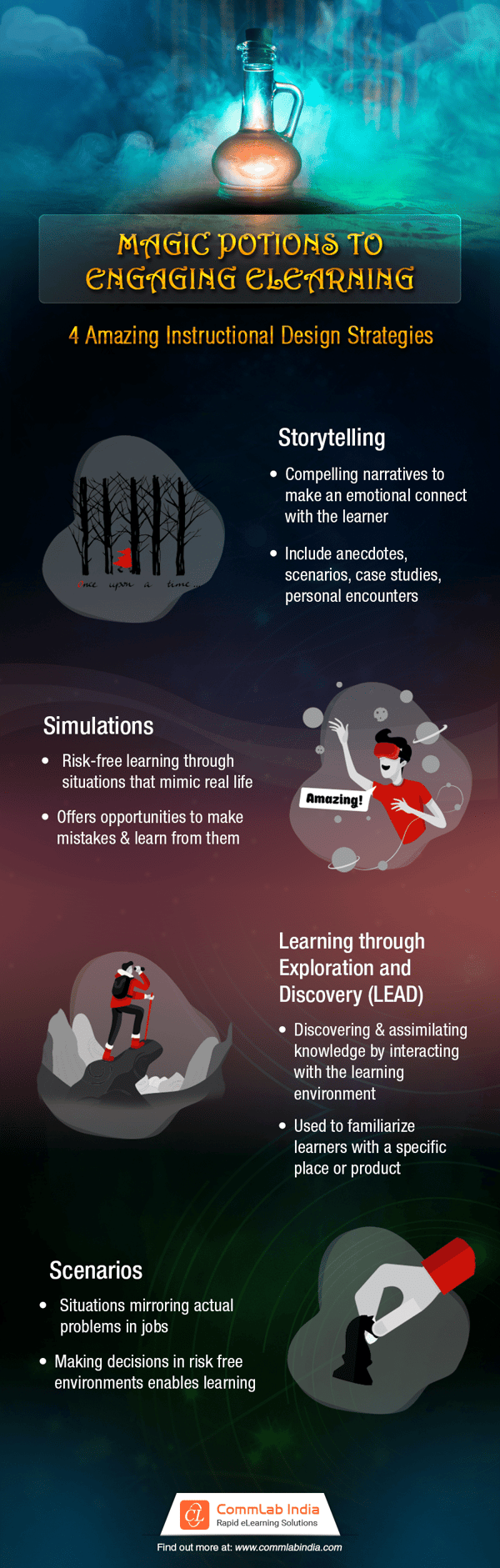
Simply put, an instructional design strategy is a high-level approach of how a topic must be taught to a particular audience. The right instructional design strategy works like a magic potion to engage learners in the learning experience, taking into consideration the:
- Content
- Learning objectives
- Visuals & Media elements
- Assessments
Here’s an infographic that highlights four creative instructional design strategies that can be used in your eLearning courses.
Other important eLearning strategies include guided learning and game-based learning.
eLearning Assessments
The most important thing about assessments is that they should be aligned with the learning objectives. Each E-learning assessments are of two types – formative and summative.
Formative Assessments reinforce learning, come after every enabling objective during the course, are diagnostic in nature, and always provide feedback.
Summative Assessments indicate the learner’s final achievement in the course, are evaluative, grade learners with “Pass or Fail”, and sometimes provide feedback.
2. Course Duration
The eLearning seat time determines the cost and time for course development. It is also an important factor that decides whether the learner remains engaged with the course or disengages from it. So, what exactly impacts the seat time of your eLearning course?
- Number of words of audio in the course – The general rule of thumb is 125 words/minute.
- Presentation of on-screen text – Bullets, infographics, etc. take less time than long paragraphs.
- Type of activities – Standard knowledge recall type of interactions take very little time, while those requiring critical thinking will demand more of the learner’s time.
- Familiarity with the medium – First time adopters of eLearning will take longer to go through the course than those comfortable with online learning.
When converting Instructor-Led Training (ILT) into eLearning:
- 8 hours of ILT will equal 2 to 2.5 hours of eLearning.
- A 20-slide PPT deck would be developed into 20-30 minutes of eLearning.
3. Level of Interactivities
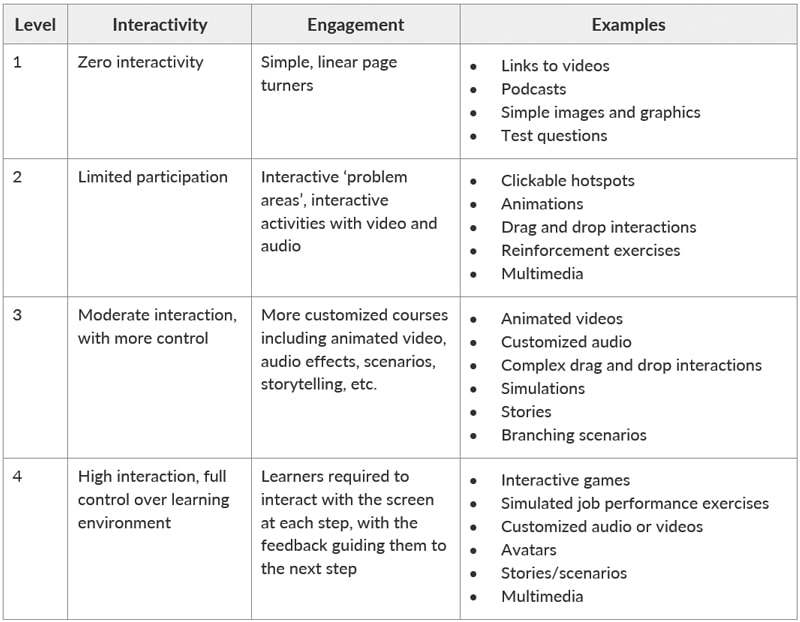
In the absence of an instructor, the engagement quotient of the course will depend on the interactivities in it. Interactivities are opportunities in the course for learners to engage with the content in terms of an action they need to take (such as selecting the right answer). They capture and engage learners’ attention, give them the opportunity to interact with the content, and help them participate actively in the learning process.
There are 4 levels of interactivities, depending on the type of content and degree of learner involvement.
eLearning Avatars
Technology and innovation have made eLearning a sustainable alternative to traditional learning and have also led to some very learner friendly avatars of eLearning.

Microlearning
Microlearning delivers short bites of learning, each addressing a single learning objective.It allows for easy absorption and retention, and helps quickly close skill and knowledge gaps, just-in-time. It can be used in a variety of ways to enhance individual and organizational performance. It helps:
- Beat the forgetting curve
- Prepare learners for the core training
- Create a learning culture
- Offer performance support and learning on-demand
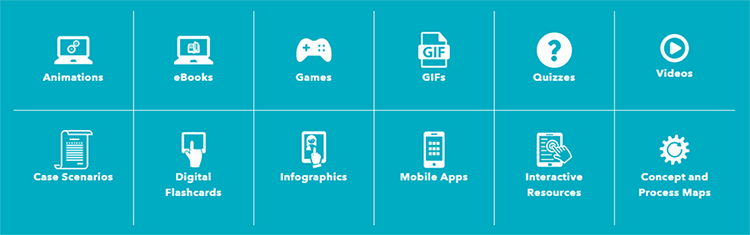
Microlearning assets can be configured in a variety of formats – whiteboard animations, digital flashcards, concept and process maps, quiz-based modules, etc., depending on their function.
Mobile Learning & Learning Apps
Mobile learning is learning that can be accessed by learners through mobile devices from any location. It makes the concept of ‘learn anything, anywhere, anytime’ a reality and can be an effective and accessible option for your organization to support employees (without taking them out of their workflow) and accelerate their time to proficiency.
Studies show that 74% employees use their mobile devices to access training resources, so it’s all the more important to harness the power of mobile devices for your employee training. Mobile learning is especially useful to train ‘always on the move’ employees – salespeople, field service technicians, remote workers, and others who use the mobile extensively in their work.
Mobile learning is also ‘microlearning’ because of its short duration. So, all the benefits of microlearning apply to mobile learning as well:
- Flexibility of access due to multi-device delivery
- Shorter duration leading to higher retention
- Just-in-time availability – serving both as teaching material and performance support.
Additionally, learning Apps:
- Enable easy push notifications
- Support offline content, in any format
eLearning In Your Company
Stages in the eLearning Journey
- Getting started – Start with a training that appeals to most employees
- Scaling up – Focus on standardization
- Centralizing training – Create an organization-wide learning community
- Advanced – Move toward becoming a learning organization
Organizations face many challenges when it comes to successful eLearning implementation, and that includes resistance from both the management and employees. Your biggest challenge will be the “It-may-be-good-but-it-will-not-work-in-our-company” syndrome. Different groups will have different concerns – about security, effectiveness, development, and infrastructure costs, and so on.
Here are some factors you need to check before implementing eLearning in your organization.
Where and How to Start
- Set Up an LMS. You can start with an open source yet robust LMS like Moodle at little or no expense.
- Start with Mandatory and High-Profile Courses Introduce eLearning to your learners through mandatory training programs.
- Identify ILT Material for Conversion Identify ILT materials best suited for eLearning and decide on how best to present them in an eLearning format with suitable interactive instructional design, media strategies, and engaging functionality.
- Decide on the Authoring Tool Choose the tool based on your training need, the expertise of your internal team with using the tool, and the state of eLearning adoption in the organization.
- Pilot Test the eLearning Pilot test the eLearning with an eclectic mix of learners to evaluate the course.
Challenges to eLearning Implementation
Organizations face many challenges when it comes to successful eLearning implementation. And there are different challenges at each stage.
Should you Develop the eLearning In-house or Outsource?
To develop your eLearning in-house or outsource to an eLearning vendor? That is the question!
If you have an internal team of instructional designers, it makes sense to outsource only that component where your inhouse lacks expertise, for instance:
- Flash to HTML5 conversion
- eLearning translation
- Rapid development from production-ready storyboards
- Development of videos and other media assets

But in case of huge projects or tight timelines, or if you are just starting eLearning in your organization, it might be better to outsource the entire project.
When you outsource eLearning design and development, you get access to experts in training, instructional design, authoring tools expertise, and more. Their pool of resources will make it easy to scale up development. And their strong project management and robust QA processes will ensure development proceeds smoothly, without any unexpected delays.
Selecting the Right eLearning Partner

With eLearning becoming increasingly popular as a cost-effective and efficient training method for businesses, and with hundreds of players in the market, it is becoming more and more difficult to find a good outsourcing vendor. But these questions will help you find the right one:
- Does the company specialize in eLearning or is eLearning just one of the services the company offers along with web designing, graphics art, software services, etc.? Always go for the specialist!
- Does the company have experience in corporate training?
- How long has the company been in business?
- How good is their portfolio of customers and testimonials?
- Is the company willing to submit a proof of concept or have samples to show you?
- Do they have robust Project Management and Design & Development processes in place?
eLearning In Your Company
Learning Objectives
A Learning Objective is a statement, in specific and measurable terms, that describes what the learners will be able to do at the end of the course. Each learning objective has 3 components: Performance, Condition, and Criteria.
The importance of learning objectives lies in the fact that they form the basis for deciding the scope of the content, choice of instruction method, assessments, course duration, and cost.
Learning objectives should be SMART – specific, measurable, achievable, relevant, and time bound. Bloom’s Taxonomy is a very useful guide for framing learning objectives.
ID Strategies
eLearning In Your Company
Learning Objectives
A Learning Objective is a statement, in specific and measurable terms, that describes what the learners will be able to do at the end of the course. Each learning objective has 3 components: Performance, Condition, and Criteria.
The importance of learning objectives lies in the fact that they form the basis for deciding the scope of the content, choice of instruction method, assessments, course duration, and cost.
Learning objectives should be SMART – specific, measurable, achievable, relevant, and time bound. Bloom’s Taxonomy is a very useful guide for framing learning objectives.
ID Strategies
eLearning In Your Company
Learning Objectives
A Learning Objective is a statement, in specific and measurable terms, that describes what the learners will be able to do at the end of the course. Each learning objective has 3 components: Performance, Condition, and Criteria.
The importance of learning objectives lies in the fact that they form the basis for deciding the scope of the content, choice of instruction method, assessments, course duration, and cost.
Learning objectives should be SMART – specific, measurable, achievable, relevant, and time bound. Bloom’s Taxonomy is a very useful guide for framing learning objectives.