How a Global Chemical Manufacturing Company Modernized Learning Content During a Platform Transition
CommLab India helped the enterprise classify legacy learning for retention, conversion, refresh, rebuild, or retirement, while providing flexible external execution capacity as the learning platform and authoring model evolved.
Rapid eLearning Solutions to Fast-Track Employee Learning
Train your learners anytime, anywhere, in any format, on any device!

Modernize Learning, Not Just the Platform
Use platform transition to improve the content portfolio, authoring model, and learning-production approach.
A New Learning Platform Changed the Content and Production Questions
A global chemical manufacturing enterprise with a mature internal learning ecosystem and established customer-training operations was moving toward a new enterprise learning platform. The transition would change how internal teams authored, maintained, and delivered learning, as well as how external learning partners supported future production needs.
A new platform was an opportunity to avoid carrying yesterday's learning problems into tomorrow's ecosystem.
The organization needed to decide what to do with legacy courses, which authoring practices should continue, how internal contributors would work in the new environment, and where external execution capacity would add the most value.
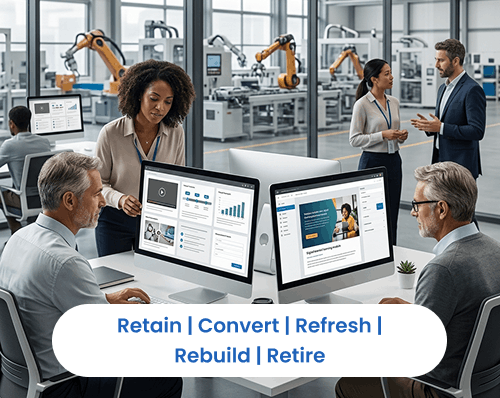
How Did the Enterprise Approach Learning Content During the Platform Transition?
It used a five-path content decision model: retain effective learning, convert technically suitable courses, refresh relevant content, rebuild learning that needed a new instructional approach, and retire outdated or low-value assets. External support was aligned to conversion, redesign, multimedia, QA, and project-based production needs.
The platform change became a content portfolio and operating-model decision, not simply a technical migration.
5
Content Paths Retain to retire
GLOBAL
Enterprise Mature learning ecosystem
PHASED
Transition Evolving over time
CONTENT
Modernization Beyond file migration
FLEXIBLE
Capacity Internal + external execution
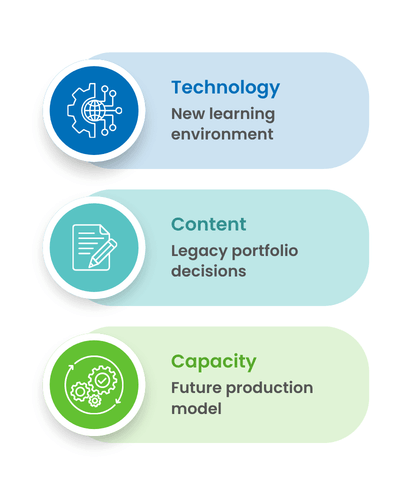
How Do You Avoid Rebuilding the Old Learning Ecosystem Inside a New Platform?
Technology migration raised questions about content quality, authoring, governance, ownership, and production capacity that could not be solved by moving files alone.
- Which courses still deserved to exist?
- Which content only required technical conversion?
- Which courses should be refreshed or redesigned?
- Which legacy assets should be retired?
- How should internal content authors work in the future model?
- Where should external development capacity complement new internal capabilities?
CommLab India Used a Retain, Convert, Refresh, Rebuild, or Retire Framework
The approach treated each learning asset according to its future value instead of applying one migration treatment to the entire portfolio.
- Retained effective and compatible learning where no change was needed
- Converted sound learning when the primary requirement was technical migration
- Refreshed relevant courses where design, interaction, or usability could improve
- Rebuilt learning when content, audience, or instructional strategy had materially changed
- Retired outdated or duplicative learning instead of carrying unnecessary content forward
- Used flexible external capacity for conversion, redesign, multimedia, QA, and project-based production
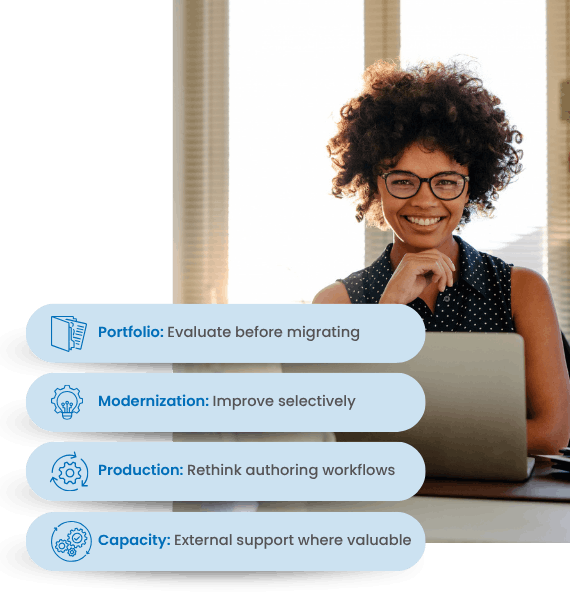
Modernize Learning, Not Just the Platform
Use platform transition to improve the content portfolio, authoring model, and learning-production approach.
The Platform Transition Became a Learning Portfolio Modernization Opportunity
The engagement helped the enterprise evolve its content and production model alongside the new learning environment.
- Legacy learning could be evaluated before migration rather than automatically moved
- Outdated or low-value content could be separated from learning worth preserving
- Modernization opportunities could be identified during the transition
- External production support could shift as internal platform capabilities changed
- Project-based execution provided flexibility for conversion, redesign, multimedia, and QA
- The enterprise could move toward a more sustainable future learning-production model
What changed for the client? The business payoff was not merely a cleaner migration. The learning team gained a clearer basis for deciding where to invest, where to simplify, and where external execution would continue to create value.
Questions Enterprise Buyers Ask
Concise answers to common questions related to this learning requirement.
Should every eLearning course be migrated to a new learning platform?
No. Each course should be evaluated for relevance, instructional quality, technical compatibility, usage, and future business value before deciding whether to retain, convert, refresh, rebuild, or retire it.
What is eLearning content modernization?
Content modernization improves existing learning rather than only changing its technical format. It can include instructional redesign, updated visuals, new interactions, accessibility improvements, mobile optimization, or restructuring.
What is the difference between eLearning conversion and course redesign?
Conversion primarily changes the technical format or authoring environment while preserving much of the existing learning. Redesign revisits the instructional approach, content structure, practice, and learner experience.
Why should organizations audit content before a platform migration?
An audit helps prevent time and budget from being spent migrating obsolete, redundant, low-use, or ineffective content into the new learning ecosystem.
Explore the Solutions Behind This Case Study
Custom eLearning
Refresh or rebuild learning when business and learner needs have changed.
Rapid eLearning
Convert and modernize learning efficiently at enterprise scale.
Authoring Tools Guide
Evaluate authoring approaches for changing learning ecosystems.
Moving to a New Learning Platform?
CommLab India can help evaluate, convert, refresh, and rebuild learning while providing flexible execution capacity throughout the transition.