
L&D Staff Augmentation: The Complete Enterprise Guide
The definitive resource for enterprise learning leaders — covering every dimension of L&D staff augmentation, from strategic rationale to implementation playbooks.
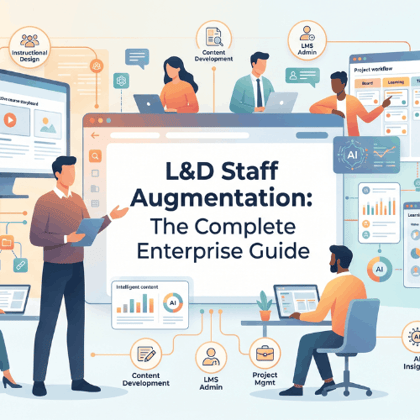
Introduction
In 2023, the World Economic Forum's Future of Jobs Report identified a skills gap of unprecedented scale: by 2027, 44% of workers' core skills are expected to be disrupte. For enterprise Learning & Development functions — already strained by digital transformation mandates, hybrid workforce complexity, and tightening headcount budgets — this represents not just a challenge, but an existential stress test.
The mathematics of the situation are unambiguous. McKinsey research shows that 87% of organizations are either currently experiencing skills gaps or expect them within the next few years. Meanwhile, time-to-fill for specialized L&D roles in the United States averages 89 to 120 days. You cannot close a 44% skills disruption gap with a 90-day hiring cycle.
This is why L&D staff augmentation — the strategic practice of extending an enterprise learning team with external professionals who integrate directly into existing workflows — has moved from operational workaround to deliberate workforce architecture. It is no longer a signal that a team is under-resourced; it is increasingly a marker that an L&D function is strategically sophisticated.
This guide provides the most complete enterprise-grade resource available on the topic — from the foundational strategic case, through engagement models and role selection, to governance frameworks, ROI calculation, and implementation playbooks.
Why Enterprise L&D Can No Longer Rely Solely on Permanent Headcount
The traditional enterprise model of building L&D capability entirely through permanent employees made sense in a stable world. You hired instructional designers, facilitated programs, managed your LMS, and ran an annual training calendar. Demand was broadly predictable, skills evolved slowly, and the gap between what your team could produce and what the business needed was modest and manageable.
That world no longer exists. Four structural forces have converged to make the purely FTE-based L&D model insufficient for enterprise-scale organizations.
Force 1: The Acceleration of Skills Obsolescence
The World Economic Forum's 2023 Future of Jobs Report projects that by 2027, the skills disruption rate will reach 44% of core competencies across most industries. This means that nearly half of the knowledge and skills your organization's workforce needs today will need to be refreshed, replaced, or fundamentally reskilled within a four-year window. For L&D teams, this is not an incremental increase in content production demand — it is an order-of-magnitude scaling challenge.
McKinsey's research on the future of work found that organizations with strong learning agility — the capacity to build skills continuously at organizational scale — are 1.5 times more likely to achieve their digital transformation objectives. Learning agility cannot be built with a team that is structurally under-resourced.
Force 2: The Mismatch Between L&D Headcount Models and Business Velocity
Enterprise learning organizations have historically sized their permanent teams against average-state demand — the normal, predictable training requirements of a stable business. But modern enterprises don't operate in average states. They undergo ERP migrations, M&A integrations, compliance mandate responses, product launches, and digital transformation programs that create extreme, unpredictable, and temporary surges in L&D production demand.
Gartner's research on learning function effectiveness found that L&D teams that operate with flexible, augmented workforce models — rather than fixed, headcount-only models — demonstrate 40% higher content delivery throughput during peak demand periods. The data points to a structural truth: peak demand requires peak capacity, and peak capacity requires workforce elasticity.
Force 3: The Specialized Skills Problem
Modern enterprise L&D requires a dramatically wider range of specialist skills than even five years ago. A high-functioning learning function now needs instructional design expertise, learning experience design, eLearning development in multiple tools, LMS/LXP platform administration, learning data analytics, video production, localization and translation management, and increasingly, AI-native content creation capabilities.
No single team of permanent employees can economically cover all of these specialisms at enterprise depth. The answer, as Deloitte's Global Human Capital Trends report consistently demonstrates, is a "superteam" model — a blend of permanent core talent and flexibly deployed specialist capabilities.
Force 4: The Economic Logic of Workforce Flexibility
PwC's workforce strategy research found that 60% of large enterprise organizations now consider workforce flexibility — the ability to scale talent capacity up or down in response to demand — a strategic competitive advantage. For L&D specifically, this translates directly: a flexible augmented capacity model allows organizations to invest in permanent headcount at the level justified by baseline demand, while accessing peak capacity through partners when the business requires it.
The organizations that will build the most capable workforces over the next decade won't be those that hire the most people. They'll be the ones that most effectively integrate permanent talent with flexibly deployed specialist capability. — Deloitte Global Human Capital Trends Report, 2024
What L&D Staff Augmentation Is — and What It Isn't
L&D staff augmentation is a workforce strategy in which an enterprise learning organization supplements its internal team with externally sourced professionals — on a temporary, project-based, or sustained basis — who work directly within the organization's existing workflows, under its strategic direction, and according to its quality standards and brand guidelines.
The defining characteristics are: integration (augmented professionals work as members of your team, not as external agents), control (your organization retains strategic ownership and day-to-day management), and flexibility (the engagement can scale with demand rather than being anchored to permanent employment relationships).
To simply put: L&D staff augmentation is the practice of integrating external learning and development professionals — such as instructional designers, eLearning developers, or LMS administrators — into an enterprise's existing L&D team structure. Unlike outsourcing, the organization retains strategic control and day-to-day management while gaining scalable capacity and specialist skills without permanent hiring.
The Critical Distinction: Augmentation vs. Outsourcing
The most important conceptual distinction in this space is between augmentation and outsourcing — and it is routinely confused. Harvard Business Review research on knowledge work sourcing models identifies the key differentiator as locus of control: augmentation retains decision-making, strategy, and quality authority with the client organization; outsourcing transfers it.
| Dimension | Staff Augmentation | Full Outsourcing | Managed Learning Services | Independent Freelancer |
| Strategic control | Retained by client | Transferred to vendor | Shared via SLA | Retained by client |
| Team integration depth | Full — embedded in team | None — vendor-side | Partial | Limited |
| Talent selection | Client approves | Vendor decides | Vendor proposes | Client selects directly |
| IP ownership | Client (with proper MSA) | Negotiated | Varies by contract | Requires explicit clause |
| Compliance management | Handled by vendor | Handled by vendor | Handled by vendor | Client bears risk |
| Scalability | High — rapid up/down | Medium | High | Low — individual cap |
| Quality accountability | Client manages directly | Vendor accountable by SLA | Shared accountability | Client manages directly |
| Enterprise suitability | ★★★★★ | ★★★★☆ | ★★★★☆ | ★★☆☆☆ |
Table 1: Comparative analysis of L&D workforce sourcing models across eight enterprise-relevant dimensions.
The enterprise advantage of augmentation over independent freelancing is particularly significant and often underestimated. A 2024 LinkedIn Workforce Insights report found that 73% of enterprise organizations that had previously used individual freelancers for L&D work switched to structured augmentation models within two years, citing compliance risk, IP vulnerability, and inconsistent quality as the primary drivers.
When to Use L&D Staff Augmentation: Trigger Events and Decision Signals
Staff augmentation is not a universal solution to every L&D capacity challenge — but Forrester's research on learning workforce models identifies a clear pattern: the organizations that deploy augmentation most effectively do so in response to specific, identifiable trigger events rather than as a general response to vague under-resourcing.
The Eight Enterprise Trigger Events
| Trigger Event | L&D Impact | Augmentation Fit | Typical Engagement Model |
| Digital / ERP transformation | Massive content production demand for system training | ★★★★★ Ideal | Dedicated augmented team, 6–18 months |
| Merger & acquisition | Rapid onboarding + culture integration training at scale | ★★★★★ Ideal | Project-based, 3–6 months |
| Compliance mandate / regulatory change | Fixed deadline for mandatory training across entire workforce | ★★★★★ Ideal | Sprint-based, defined scope |
| Product launch / go-to-market | Sales enablement and product knowledge content required fast | ★★★★☆ Strong | Retainer or project, 2–4 months |
| Rapid headcount growth | Onboarding demand exceeds team capacity | ★★★★☆ Strong | Retainer, ongoing |
| Specialist skills gap (LXD, data, AI) | Technical capability absent from current team | ★★★★★ Ideal | Embedded, project or retainer |
| Global expansion / localization | Region-specific content requiring cultural and language adaptation | ★★★★☆ Strong | Project-based with localization specialists |
| HC freeze with maintained scope | Business demands persist; headcount approval blocked | ★★★★★ Ideal | Retainer, structured to operating expense budget |
Table 2: The eight enterprise trigger events for L&D staff augmentation, with fit ratings and typical engagement models.
The Early-Warning Signal: Forrester's research identifies a leading indicator that organizations consistently miss: when senior Instructional Designers are spending more than 25% of their time on execution-level work (content development, LMS administration) rather than strategy, needs analysis, or stakeholder management — the function is structurally under-resourced. This is the moment to model augmentation, not after the first missed delivery.
The Build vs. Buy vs. Augment Decision Framework
MIT Sloan Management Review's research on talent strategy recommends a three-way evaluation for any significant capability gap: build (hire permanently), buy (acquire talent), or augment (access talent flexibly). For enterprise L&D, the framework maps predictably:
| Build (Hire Permanently) — When It Makes Sense | Augment (Access Flexibly) — When It Makes Sense |
|
|
The Five L&D Staff Augmentation Engagement Models
Not all augmentation looks or operates the same way. The engagement model you choose has significant implications for cost, integration depth, flexibility, and governance complexity. Gartner's research on contingent workforce management identifies five primary models operating in enterprise learning contextsGartner 2023.
Model 01: Project-Based Augmentation
External L&D professionals engaged for a fully scoped initiative with defined deliverables, milestones, and end dates. The engagement terminates on project completion. Clearest cost predictability. Highest alignment with fixed-budget procurement processes.
Best For: One-time initiatives · Compliance builds · Curriculum launches
Model 02: Retainer-Based Augmentation
A committed number of hours per month from a named professional or small team. Creates predictable cost and consistent resource availability. Relationship and institutional knowledge deepens over time. Most cost-effective for sustained production demand.
Best For: Ongoing content updates · Evolving libraries · Steady-state demand
Model 03: Embedded Team Augmentation
Augmented professionals join your team full-time for a defined period — attending all team rituals, integrated into project management systems, working daily within your culture. Output quality and knowledge transfer are highest with this model. Highest integration investment required.
Best For: Major transformations · Long-term scale-ups · Cultural integration
Model 04: Dedicated Augmented Team
A complete functional unit assembled and deployed as a team — typically including IDs, an eLearning developer, a project manager, and a QA function. Operates as a parallel delivery team under your strategic direction. Highest capacity option for large-scale programs.
Best For: ERP rollouts · Global onboarding programs · New L&D functions
Model 05: Hybrid Steady-State Model
The long-term architecture of the most sophisticated enterprise L&D organizations: a small, strategic permanent team directs a flexible pool of augmented execution talent. Permanent staff own strategy, stakeholders, and QA. Augmented staff own production. This model delivers the highest long-term efficiency at enterprise scale.
Best For: Mature L&D functions · Continuous transformation · 5,000+ employee organizations
⭐ Most Used by Fortune 500: The Hybrid Model in Practice
Deloitte's 2024 Global Human Capital Trends report found that 61% of high-performing large enterprises now operate some version of the hybrid permanent-plus-augmented workforce model across their talent-intensive functions. For L&D specifically, this typically means a 30–40% augmented capacity ratio relative to permanent headcount.
Enterprise Recommendation: Begin here or build toward it
L&D Roles Available for Augmentation: A Complete Taxonomy
One of the persistent misconceptions about L&D staff augmentation is that it applies primarily to Instructional Designers. In reality, the augmentable role set spans the entire learning function — from strategy and design through development, delivery, operations, and analytics.
LinkedIn's 2024 Workplace Learning Report identified the most in-demand L&D specialist skills as: eLearning development, learning experience design, LMS platform expertise, learning data analytics, and AI-enhanced content creation — precisely the skills most difficult and slowest to hire for permanently.
| Role | Core Responsibilities | Key Tools | Time-to-Productivity |
| Senior Instructional Designer | Curriculum architecture, learning strategy, needs analysis, SME partnership | Articulate 360, Adobe CC, LMS | 1–2 weeks |
| Learning Experience Designer (LXD) | Learner journey mapping, UX for learning, personalized pathways, LXP configuration | Figma, LXPs, Articulate | 1–3 weeks |
| eLearning Developer | Interactive module development, SCORM/xAPI packaging, animations, assessments | Articulate 360, Rise, Captivate, Lectora | 1–2 weeks |
| LMS / LXP Administrator | Platform management, content publishing, user management, reporting | Cornerstone, Workday, SAP SuccessFactors, Degreed | 2–3 weeks |
| L&D Project Manager | Delivery coordination, stakeholder management, resource tracking, risk management | Jira, Asana, Monday, MS Project | 1–2 weeks |
| Sales Enablement Specialist | Sales onboarding, product knowledge programs, sales methodology content | Seismic, Highspot, Showpad + authoring tools | 3–4 weeks |
| Content Localization Specialist | Translation management, cultural adaptation, regional compliance, multilingual QA | Translation management systems, authoring tools | 2–3 weeks |
| Learning Data Analyst | Learning measurement, Kirkpatrick/Phillips reporting, LMS analytics, dashboards | Power BI, Tableau, xAPI, LRS systems | 3–5 weeks |
| Facilitator / Virtual Trainer | Live learning delivery, virtual session facilitation, workshop design | Zoom, Teams, Miro, virtual facilitation tools | 3–5 weeks |
| AI / Prompt Engineer for L&D | AI-powered content creation, GPT workflow design, AI tool integration | ChatGPT, Synthesia, AI authoring platforms | 1–2 weeks |
Table 3: Complete L&D role taxonomy with augmentation suitability ratings. Time-to-productivity assumes structured 30-day onboarding program.
Strategic Recommendation: Microsoft WorkLab's 2024 Work Trend Index found that organizations that successfully blend human expertise with AI-native skills in their knowledge functions demonstrate 40% higher productivity in content creation workflows. When building your augmented L&D team, prioritize AI-fluent professionals — not just those proficient in traditional authoring tools.
The ROI Framework: Building the Financial Case
Justifying staff augmentation to a CFO, CPO, or procurement committee requires a rigorous financial framework — not anecdote. The good news is that the ROI case for well-structured L&D augmentation is compelling across multiple dimensions. The challenge is making the invisible costs of under-resourcing visible alongside the tangible costs of augmentation.
The Hidden Cost of L&D Under-Resourcing
Deloitte's research on learning function effectiveness identifies a concept they term "the capability debt" — the accumulated cost to organizational performance of skills that were needed but not developed because the learning function lacked capacity to build themDeloitte 2024. This debt is quantifiable and it is substantial.
- $1.08M Average annual productivity cost per 100-employee cohort that is under-trained on a new digital platform - Gartner Learning Function Benchmark, 2023
- 62 days Average additional time-to-productivity for new hires when onboarding programs are under-resourced or delayed - Deloitte HC Trends, 2024
- 1.8× Greater compliance risk exposure for organizations that miss mandatory training deadlines due to L&D capacity gaps - Forrester Risk Research, 2024
Augmentation vs. Full-Time Hire: Total Cost of Ownership
The most common financial objection to staff augmentation is rate sticker shock: contract hourly rates appear higher than equivalent FTE compensation. This comparison is misleading without full-cost accounting. When you include the complete FTE cost stack, augmentation consistently delivers a 15–35% cost advantage for project-specific and time-bounded needs.
| Cost Category | FTE Senior Instructional Designer (US) | Augmented Senior ID (12-month engagement) |
| Base compensation | $100,000–$135,000 | N/A — included in rate |
| Benefits (health, dental, 401k) ~28–32% | $28,000–$43,000 | $0 — vendor responsibility |
| Employer payroll taxes ~8% | $8,000–$10,800 | $0 — vendor responsibility |
| Recruitment & agency fees (~20%) | $20,000–$27,000 (one-time) | $0 |
| Onboarding & ramp (est. 90-day productivity gap) | $25,000–$45,000 (lost output) | ~$5,000–$10,000 (2–3 week ramp) |
| Tools, software licenses, equipment | $6,000–$12,000/yr | Typically included in engagement rate |
| HR management overhead | $8,000–$15,000/yr (est. manager time) | Reduced — vendor manages HR |
| Training & development (L&D for L&D) | $3,000–$6,000/yr | $0 — vendor responsibility |
| Total Year 1 Cost (est.) | $198,000–$293,800 | $130,000–$195,000 (full-year retainer at $65–$95/hr) |
| Offboarding / severance risk | Legally complex; 4–12 weeks | 30-day contract notice |
Table 4: Full-stack cost comparison for a senior Instructional Designer. FTE costs reflect US market benchmarks as of 2025. Augmentation rates reflect enterprise-grade specialist staffing. Individual organization costs will vary.
The ROI Measurement Framework
McKinsey's research on measuring learning investment effectiveness recommends a four-level measurement architecture that maps directly to augmentation ROI:
The 4-Level Augmentation ROI Framework
- L1 - Efficiency Metrics: Cost per learning hour delivered · Time-to-delivery vs. baseline · Content production velocity
- L2 - Quality Metrics: Learner satisfaction scores · Content accuracy rates · Stakeholder approval rates
- L3 - Capability Metrics: Time-to-competency for trained populations · Skill assessment outcomes · Behavior change measures
- L4 - Business Impact: Revenue impact of sales enablement training · Compliance incident reduction · Onboarding-to-productivity speed
Implementation Playbook: A Seven-Step Framework
Forrester's research on contingent workforce programs found that structured implementation — with formal onboarding, clear scope documentation, and governance protocols — improves augmentation program performance by 67% compared to ad hoc deployments. The seven steps below represent the implementation framework used by high-performing enterprise L&D organizations.
1. Conduct a Structured Capacity Gap Assessment
Map your current team's bandwidth against projected demand for the next 6–12 months. Differentiate between a volume gap (too much work for current FTEs) and a skills gap (work requiring capabilities absent from the current team). These require different augmentation responses. Use your project pipeline, stakeholder requests, and content calendar to quantify the gap in hours and skill types. This is the foundation of every downstream decision.
2. Select Your Engagement Model and Define Scope
Based on the nature of your gap, select the appropriate engagement model (project-based, retainer, embedded, dedicated team, or hybrid). Write a clear Statement of Work that specifies: deliverables and success criteria, tools and quality standards, review and approval processes, timelines, and communication protocols. Scope ambiguity at this stage is the single most common cause of augmentation engagement failure — invest the time to be precise.
3. Evaluate and Select Your Partner Rigorously
Treat vendor selection like a strategic partnership decision. Assess: depth of L&D-specific talent networks, enterprise client references of comparable size and complexity, talent vetting rigor, compliance infrastructure, replacement protocols, and MSA quality. Request portfolio reviews and tool proficiency assessments for candidate professionals before approval. The quality of your augmented team begins at the vendor's selection process — not yours.
4. Execute a Comprehensive Legal Agreement
Your Master Services Agreement must explicitly address: IP assignment (work-made-for-hire clause, all deliverables owned by your organization), confidentiality and NDA, worker classification and indemnification, data security obligations (SOC 2, GDPR, CCPA), acceptable use of your systems and data, performance SLAs with remedy provisions, and 30-day termination for convenience. Do not proceed without legal review. See Section 8 for full governance details.
5. Execute a 30-Day Integration Onboarding Program
Even the most experienced augmented L&D professional needs structured onboarding to perform at full capacity. Your program should cover: organizational context and business priorities, brand voice and style standards, tool access and workflow walkthroughs, stakeholder introduction sessions, quality standard review with examples, and a ramp schedule with check-ins at days 7, 14, and 30. Organizations that skip structured onboarding report 2–3× longer ramp-to-full-productivity periods.
6. Integrate into Team Rhythms and Governance Cadence
Augmented professionals should be integrated into your team's operating rhythms: standups, sprint planning, retrospectives, and team meetings. Assign a named internal point of contact — not just a Jira board. Establish a monthly performance review with your vendor partner that covers quality, pace, relationship health, and scope evolution. Treat augmented staff as team members, not vendors-at-arm's-length.
7. Measure, Review, and Decide on Continuation
At 60 and 90 days, formally evaluate against your L1–L4 ROI metrics. Compare cost per deliverable against your FTE benchmark. Survey internal stakeholders on quality perception. Assess knowledge transfer to understand institutional knowledge risk. Based on this data, make a structured decision: continue as-is, adjust scope or model, expand engagement, or transition out. Every continuation decision should be deliberate — not a default.
"The organizations that treat augmentation as a program — with the same rigor they apply to any major workforce initiative — consistently outperform those that treat it as a staffing transaction."
Governance, Compliance & Legal Architecture
Governance is the dimension of L&D staff augmentation most commonly underinvested — and the source of the most costly enterprise-level failures. PwC's research on contingent workforce governance found that organizations with formal governance frameworks for flexible talent arrangements experience 74% fewer legal complications and 58% lower vendor-related compliance incidents.
Worker Classification: The Critical Compliance Foundation
The IRS and Department of Labor apply three-pronged tests — behavioral control, financial control, and type of relationship — to determine whether an engaged worker is an employee or an independent contractor. Misclassification exposes organizations to back payroll taxes, penalties, and potential employment claims that can be financially material.
The enterprise best practice is unambiguous: engage augmented L&D professionals through a staffing vendor that employs them as W-2 workers, rather than directly as 1099 independent contractors. This structure transfers the classification risk and employer obligations (payroll tax, benefits, workers' compensation) to the vendor, where they belong.
Critical Compliance Alert: Many L&D teams inadvertently create independent contractor relationships when they directly engage individual freelancers under arrangements that functionally resemble employment — setting hours, directing daily work, requiring use of company tools. These arrangements can expose your organization to IRS misclassification risk and state labor law violations. Structured augmentation through a staffing vendor eliminates this risk by design.
IP Ownership: Protecting Your Learning Assets
Every L&D staff augmentation MSA requires an explicit work-made-for-hire provision asserting that all deliverables — course files, scripts, assessments, graphics, video assets, and source files — created by augmented professionals in the course of the engagement are the exclusive intellectual property of your organization. Without this language, IP ownership defaults to ambiguity and potentially to the creator.
Additional IP protections to require in every MSA:
- Source file transfer obligation upon engagement conclusion — all working files, not just published outputs
- Third-party asset disclosure — vendor must disclose any licensed stock images, music, or content embedded in deliverables
- AI-generated content declaration — if augmented professionals use AI tools in creation, define ownership and disclosure obligations
- Non-compete provisions — restrict the vendor from developing materially similar content for your direct competitors during and for a defined period after the engagement
Data Security and Privacy
Augmented L&D professionals routinely need access to sensitive organizational data: LMS/LXP platforms containing employee learning records, HRIS data for needs analysis, performance data for training effectiveness measurement, and proprietary content repositories. This requires a formal data governance framework:
| Governance Element | Requirement | Why It Matters |
| Vendor security certification | SOC 2 Type II minimum; ISO 27001 preferred | Validates vendor's information security controls |
| Data Processing Agreement | Required for any access to personal employee data | GDPR Article 28 / CCPA compliance |
| Role-based access controls | Minimum-necessary access principle for all systems | Limits breach exposure and unauthorized access risk |
| Data return / destruction | Contract obligation to return or certifiably destroy all client data within 30 days of engagement end | Prevents data retention beyond authorized period |
| Breach notification | 72-hour notification requirement on suspected data incidents | Aligns with GDPR; supports timely regulatory response |
| NDA scope | Covers all organizational information including unreleased content, strategic plans, and employee data | Protects against intentional or inadvertent disclosure |
Table 5: Data governance requirements for enterprise L&D staff augmentation engagements.
Six Persistent Myths About L&D Staff Augmentation
Resistance to L&D staff augmentation within enterprise organizations is often driven by myths that persist despite being demonstrably contradicted by research and practitioner experience. Here are the six most damaging misconceptions and the evidence against them.
1: "Augmented staff produce inferior quality compared to permanent employees."
Reality: Quality is a function of selection rigour, onboarding quality, and integration depth — not employment type. Gartner's L&D benchmark research found no statistically significant difference in output quality between well-onboarded augmented professionals and equivalent FTEs when given the same standards, tools, and context. The quality variable is the engagement model, not the contract type.
2: "We'll spend more time managing them than we save in capacity."
Reality: This holds true only for unstructured engagements without SOW clarity or proper onboarding. Forrester data shows that augmented professionals with a structured onboarding and clear deliverable scope require 40% less management time than newly hired FTEs, because they arrive with full professional competence and do not require the performance management, career development, or organizational navigation support that permanent employees do.
3: "Our content is too sensitive or proprietary to share with external staff."
Reality: Enterprise augmentation relationships are governed by the same (and often more robust) legal protections as employment relationships — NDAs, IP assignment, data security obligations, and contractual consequences for breach. The risk profile is managed, not eliminated, just as it is with any employee. Organizations in highly regulated industries including financial services, healthcare, and defense routinely and successfully operate staff augmentation programs.
4: "It's just expensive freelancing."
Reality: Enterprise staff augmentation through a specialized vendor provides: worker classification compliance (the vendor employs and pays the professional), pre-vetted talent with assessed skill proficiency, backup and replacement protocols, professional liability insurance, account management, and structured contractual protections. Individual freelancing provides none of these. The comparison conflates a structured workforce program with an ad hoc hiring transaction.
5: "Knowledge loss when augmented staff leave is unmanageable."
Reality: Knowledge transfer risk is real — but it is significantly more manageable for augmented professionals than for departing FTEs, because the engagement contract anticipates conclusion and can build in formal knowledge transfer protocols, documentation requirements, and transition periods. Well-governed augmentation engagements create better knowledge artifacts than most departing-employee transitions do.
6: "Staff augmentation undermines the development of internal L&D capability."
Reality: The opposite is true when managed correctly. When augmented professionals handle execution-level production, internal L&D leaders gain time to develop strategic capability, build stakeholder relationships, and lead transformation — precisely the skills that define a high-performing L&D function. McKinsey's talent strategy research shows that organizations that effectively leverage flexible talent for execution allow their permanent teams to operate at a higher strategic level.
Selecting an L&D Staff Augmentation Partner: A Rigorous Evaluation Guide
The quality of your augmentation outcomes is substantially determined by the quality of your partner. The L&D staffing market spans a wide spectrum — from deep specialists with proven enterprise L&D talent networks to broad IT staffing firms that treat learning roles as a secondary capability.
Gartner's vendor evaluation framework for learning function sourcing recommends assessing partners across six dimensions, weighted by organizational priority:
| Evaluation Dimension |
What to Assess |
Red Flags |
| L&D Domain Depth | Understanding of ID methodologies, L&D toolsets, learning design principles, enterprise learning platform expertise | Struggles to discuss ADDIE vs. SAM; unfamiliar with your specific LMS; no L&D portfolio to show |
| Enterprise Experience | References from 5,000+ employee organizations; demonstrated complexity management; global delivery capability | Only SMB or mid-market references; no enterprise governance infrastructure |
| Talent Vetting Rigor | Formal competency assessment process; portfolio review; tool proficiency testing; reference checking | Relies on self-reported credentials; no structured vetting process beyond resume review |
| Compliance Infrastructure | W-2 employment of placed professionals; SOC 2 certification; formal MSA quality; professional liability insurance | Places 1099 contractors; no security certification; pushes back on standard enterprise protections |
| Replacement Protocols | Defined process and timeline for replacing underperforming professionals; bench talent available | No clear replacement SLA; "we'll figure it out" response; no bench |
| Partnership Model | Named account manager; regular performance reviews; strategic business reviews; proactive communication | Transactional relationship; no dedicated account management; reactive-only communication |
Table 6: L&D staff augmentation partner evaluation framework. Adapt weighting to your organizational priorities.
The RFP Approach: For enterprise organizations procuring augmentation at scale (10+ professionals or multi-year engagement), a formal RFP process is recommended. Issue to 3–5 specialist vendors. Include requirements for: case studies with quantified outcomes, sample talent profiles matching your role needs, proposed governance cadence, MSA markup, and a detailed pricing model. Evaluate against the framework above and conduct reference checks with at least two enterprise clients before final selection.
The Future of L&D Staff Augmentation: AI, Skills-Based Organizations, and What Comes Next
The future of L&D staff augmentation is being shaped by two seismic forces operating simultaneously: the generative AI revolution in knowledge work, and the structural shift toward skills-based organizational models.
Generative AI Is Expanding the Augmentation Opportunity
Microsoft WorkLab's 2024 Work Trend Index documented that knowledge workers with access to AI assistance complete high-complexity content creation tasks 55–70% faster than those without. For L&D augmentation, this has two direct implications.
First, AI-fluent augmented IDs produce dramatically more output per hour than non-AI-fluent ones — meaning the effective capacity multiplier of an augmented professional with strong AI skills may be 1.5–2× that of a traditional ID. This will make AI literacy a primary selection criterion in augmented L&D hiring within two years.
Second, new L&D roles that didn't exist three years ago are already becoming augmentable: AI prompt engineers for content creation, learning data analysts building LLM-powered insights pipelines, and AI workflow designers who build automated content production systems. Think with Google's 2024 research on AI adoption in knowledge work functions confirms that these roles are growing faster in the flexible talent market than in permanent hiring.
The Skills-Based Organization: A Permanent Demand Driver
Deloitte's 2024 Global Human Capital Trends report identified the shift to skills-based organizations — where work is allocated based on skills rather than job titles — as the most significant structural change in workforce management in a generation. For L&D, this creates a continuous, dynamic demand for capability-building that static team structures cannot accommodate.
The World Economic Forum projects that the skills-based organization model will require organizations to rebuild their workforce capability maps on a 12–18 month rolling basis by 2030 — compared to the 3–5 year cycles most organizations operate on today. This pace of change makes flexible, augmented L&D capacity not a convenience but a structural necessity.
By 2030, the organizations winning the talent war won't be those who hired the most — they'll be those who learned the fastest. L&D functions must build the capacity architecture to match that pace. — World Economic Forum, Future of Jobs Report, 2023
The Talent-as-a-Service Horizon
Forrester's 2024 research on the future of work identifies an emerging model they term "Talent-as-a-Service" (TaaS) — where organizations access pre-assembled, on-demand capability pods for specific functional needs, consuming them on a subscription-like basis rather than through traditional project or retainer models. For enterprise L&D, this would mean accessing a "learning capability pod" — a pre-formed team of IDs, developers, and analysts with defined skill profiles — deployable within days of a business need emerging.
This model is already operating at early scale in technology and consulting functions. Its migration to enterprise L&D is not speculative; it is a matter of timing. Organizations that invest in building augmentation fluency — partner relationships, governance infrastructure, integration playbooks — now will be positioned to adopt TaaS models as they mature, while competitors rebuild from scratch.
Frequently Asked Questions
1. What is L&D staff augmentation?
A. L&D staff augmentation is a flexible resourcing model where external learning professionals join an internal L&D team to provide additional capacity or specialized expertise. These professionals may support instructional design, eLearning development, LMS administration, project management, QA, localization, or AI-enabled learning workflows.
2. How is L&D staff augmentation different from L&D outsourcing?
A. In L&D staff augmentation, external professionals work within the organization’s team and process, while the internal team retains control. In L&D outsourcing, an external partner usually owns and delivers a defined project, program, or learning function.
3. When should enterprise L&D teams use staff augmentation?
A. Enterprise L&D teams should use staff augmentation when learning demand exceeds internal capacity, specialized skills are needed quickly, hiring is too slow, or temporary support is required for compliance cycles, product launches, technology rollouts, onboarding programs, or global training initiatives.
4. What roles can be augmented in an L&D team?
A. Common augmented L&D roles include instructional designers, eLearning developers, visual designers, LMS administrators, learning project managers, QA specialists, localization specialists, video developers, and AI learning specialists.
5. Is L&D staff augmentation suitable for large enterprises?
A. Yes. L&D staff augmentation is especially useful for large enterprises with multiple business units, distributed teams, multilingual workforces, recurring compliance needs, and high-volume learning demand.
6. How do you measure the ROI of L&D staff augmentation?
A. ROI can be measured through faster project delivery, reduced backlogs, lower rework, improved stakeholder satisfaction, better LMS administration efficiency, reduced hiring pressure, and faster rollout of business-critical training.
7. Can L&D staff augmentation support AI-enabled learning?
A. Yes. AI-enabled L&D professionals can help teams use AI for content drafting, storyboarding, assessment generation, localization, workflow acceleration, quality review, and learning personalization while maintaining human oversight and instructional accuracy.
Research References:
- World Economic Forum (2023). The Future of Jobs Report 2023. World Economic Forum, Geneva.
- McKinsey & Company (2023). Closing the Skill Gap: Creating Workforce-Development Programs That Work at Scale.
- LinkedIn (2024). 2024 Workplace Learning Report. LinkedIn Learning.
- Gartner (2023). L&D Leadership Benchmark: Building High-Impact Learning Functions. Gartner Research.
- Deloitte (2024). Global Human Capital Trends 2024: Thriving Beyond Boundaries. Deloitte Insights.
- PwC (2024). Global Workforce Hopes & Fears Survey 2024. PwC.
- Harvard Business Review (2023). The New Rules of Talent Management. HBR.
- Forrester (2024). The Future of Flexible Talent in Enterprise Functions. Forrester Research.
- MIT Sloan Management Review (2023). Rethinking Talent Strategy for the Post-Pandemic Enterprise. MIT SMR.
- Microsoft WorkLab (2024). 2024 Work Trend Index: AI at Work Is Here. Now Comes the Hard Part. Microsoft.
- Think with Google (2024). The AI-Powered Workforce: How Knowledge Functions Are Being Transformed. Google.
- World Economic Forum (2023). Future of Jobs Report — Skills Outlook Supplement. WEF.
- Deloitte (2024). Skills-Based Organization: The Journey to the Future of Work. Deloitte Insights.
- Gartner (2023). Magic Quadrant for Learning Management Systems and Learning Suites. Gartner Research.