
Introduction
The global workforce is undergoing its most significant structural shift in a generation. The World Economic Forum's 2025 Future of Jobs Report projects that 44% of workers' core skills will be disrupted this year, and 60% of the global workforce will require meaningful reskilling before 2027. For enterprises operating across multiple countries and languages, the ability to deliver effective training in every employee's language is no longer an inclusion initiative — it is the essential infrastructure through which the most urgent workforce capability challenge of our era gets addressed.
Yet most enterprise L&D functions are failing at this. They translate slide decks. They push English-language modules through LMS platforms to employees who struggle through in their second language — then wonder why completion rates are low and behavior change is minimal. This is not a translation problem. It is a strategy problem.
This guide provides the complete strategic, operational, and technological framework for global L&D leaders ready to build a multilingual learning ecosystem that actually works.
The $8.5 Trillion Skills Crisis — and Why Language Is at Its Center
Before we discuss translation technology, vendor models, or SCORM architecture, we need to establish the macro forces that have elevated enterprise eLearning localization from a budget line item into a first-order strategic imperative.
Korn Ferry's landmark workforce study — confirmed and extended by subsequent Gartner analysis — projects a global talent and skills shortage that could cost the global economy $8.5 trillion in unrealized annual revenue by 2030. The World Economic Forum's 2025 Future of Jobs Report extends this picture further: 44% of workers' core skills are expected to be disrupted this year, and 60% of the global workforce will need significant reskilling before 2027. WEF, 2025
These numbers describe the operating reality for every Head of L&D at a multinational organization: the skills gap is widening faster than training programs can close it, and the populations most exposed to disruption — frontline workers, manufacturing operators, logistics professionals, service staff — are disproportionately people for whom English is not a first language.
McKinsey Global Institute's "Future of Work After COVID-19" research estimated that 107 million workers globally may need to switch occupational categories by 2030 as automation reshapes employment structures. McKinsey, 2021 For enterprises managing global workforces, this reskilling mandate does not arrive as a clean, English-language problem. It arrives in Mandarin in Chengdu, in Portuguese in São Paulo, in Arabic in Riyadh, in Hindi in Bengaluru — in the dozens of languages through which your workforce actually thinks, learns, and applies new skills.
Gartner's HR research adds a critical operational dimension: 58% of the current workforce already needs new skills to do their current jobs — not future jobs, but the roles they hold today. A further 70% of employees have not yet mastered the skills required for their current position. Gartner, 2023–2024 Organizations delivering this essential skills investment through a language that creates comprehension friction are making an already urgent problem significantly more difficult.
This is the macro frame in which enterprise eLearning localization must be understood. Not as a diversity initiative. Not as a translation cost center. But as the essential infrastructure through which the most urgent workforce capability challenge of our era gets addressed — or doesn't.
"A reskilling program that only reaches the portion of your workforce that speaks the corporate language is not a reskilling program. It is a reskilling program for some." - McKinsey Global Institute workforce research, 2021–2024
Translation vs. Localization vs. Transcreation: Getting the Vocabulary Right
Enterprise L&D discussions routinely collapse meaningfully distinct concepts into the single word "translation" — producing misaligned scope expectations, budget overruns, and content that fails in market. Precision here is foundational.
Translation: Linguistic Transfer
Translation is the conversion of text from one language to another while preserving semantic meaning. In eLearning, this means rendering written content — course text, narration scripts, quiz questions, job aids — into another language. Translation is the most literal form of language adaptation and is appropriate when content is factual, low-context, and not culturally embedded.
Localization (L10n): Adapting the Full Experience
Localization encompasses linguistic translation but extends to adapting the entire learning experience for the cultural, regulatory, and contextual expectations of a specific locale. The full scope includes: adapting date, time, currency, and number formats; replacing culturally specific scenarios, case studies, and examples with locally authentic equivalents; adjusting visual elements including images, icons, and color symbolism; revising voice-over and on-screen presenters; modifying assessments for cultural relevance; and ensuring compliance with regional regulatory frameworks.
Internationalization (I18n): Designing for Localization Before You Translate
Internationalization is the process of designing eLearning content to be localization-ready before any translation begins. This means writing source content without idioms, cultural references, or region-specific humor; building SCORM structures that accommodate text expansion of up to 40% for languages like German or Finnish; planning LMS architecture for multiple language instances; and creating modular content that allows cultural variants to be swapped without rebuilding entire courses.
Transcreation: When Meaning Matters More Than Words
Transcreation is the practice of recreating content from scratch in the target language and culture — producing the same emotional intent and strategic impact even when the literal words bear little resemblance to the original. It is appropriate for content where tone, emotional resonance, and cultural authenticity are as critical as factual accuracy: executive video narratives, culture-shaping onboarding content, leadership development programs, and employee value proposition materials.
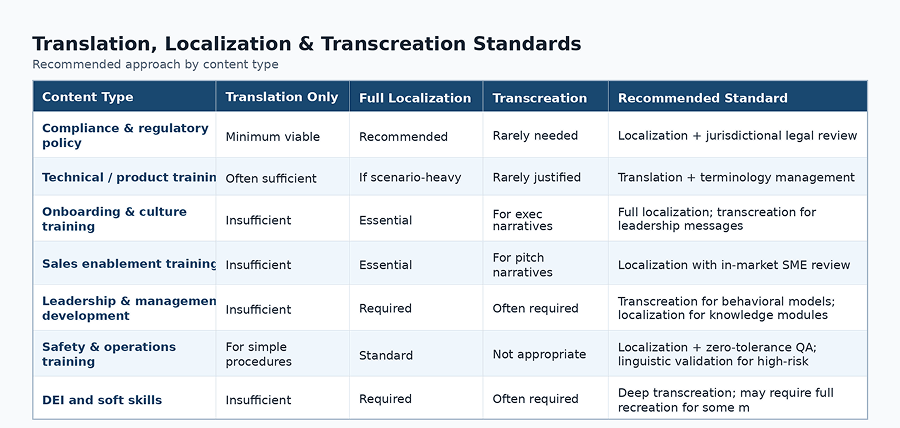
Adaptation Level Decision Matrix
Use this framework to define the correct adaptation tier before scoping any localization project. Mismatched adaptation levels are the primary driver of enterprise localization budget overruns.
The Enterprise eLearning Translation Process: Eight Critical Stages
The eight-stage model below reflects best practice across high-maturity enterprise programs.
1. Source Content Optimization (Internationalization Review)
Before a single word is translated, source content must be optimized for translatability: remove idioms, cultural references, region-specific humor, and embedded image text; simplify complex sentence structures; write narration scripts in full translatable sentences. Organizations investing in this step report 20–35% lower downstream revision rates and measurably lower per-language costs. It is the highest-ROI pre-production investment in any localization program.
2. Translatable Asset Inventory & Scope Definition
A comprehensive audit of every asset requiring adaptation: SCORM modules, video content with audio, graphics with embedded text, PDFs and job aids, LMS metadata (titles, descriptions, enrollment emails, system notifications), and learner-facing UI elements. Enterprise programs consistently discover 15–25% more translatable content than initially estimated. This inventory is the financial and timeline foundation of every downstream decision.
3. Terminology Management & Style Guide Development
Building a multilingual glossary of approved translations for domain-specific terminology — product names, proprietary process names, job titles, technical terms — and style guides defining voice, tone, and formality level per language. This investment compounding over time: consistent terminology accelerates translator work, reduces cross-module inconsistencies, and enables higher translation memory leverage. For programs spanning 10+ languages, this phase is non-negotiable infrastructure.
4. File Engineering & TMS Configuration
Extraction of translatable text strings into standard exchange formats (XLIFF, PO files, or authoring-tool-native formats); preparation of multimedia source files for voice-over or subtitle work; and TMS project configuration with translator assignments, quality workflows, and translation memory integration. Poor file engineering directs translator effort toward technical problem-solving rather than linguistic work — a significant hidden cost driver.
5. Translation & Linguistic Adaptation
The translation phase — executed via the appropriate model for the content tier: human translation, machine translation with post-editing (MTPE), AI-assisted translation with expert review, or a hybrid workflow calibrated to content risk. This phase leverages translation memory for existing approved segments and the terminology database for domain vocabulary.
6. Cultural Review & In-Market Adaptation
Review by a native-market subject matter expert — not only a linguist but a professional with relevant domain expertise. This reviewer assesses cultural authenticity of scenarios, appropriateness of visual representation, accuracy of jurisdictional legal references, and resonance with how professionals in that market actually think and communicate. This is the stage most frequently compressed under schedule pressure — and the source of most post-launch failures.
7. Multimedia Production
Recording or generating localized voice-over or dubbing; producing localized subtitles and closed captions; replacing or adapting graphics and videos containing embedded text; and producing locale-specific multimedia assets identified during cultural review. Multimedia production is typically the longest-lead-time element. AI dubbing has compressed studio timelines from 2–4 weeks to 2–4 hours for many content types — a transformation with major implications for program velocity and economics (covered in full in Section 11).
8. Technical QA, LMS Integration Testing & Launch
Functional testing of SCORM/xAPI packages in the target LMS environment — verifying completion tracking, scoring, branching logic, and metadata; checking character set rendering (UTF-8, RTL display, CJK fonts); testing on target device profiles; and validating all LMS-facing metadata and notifications in each language. The cost of fixing quality failures post-deployment is typically 4–6× higher than pre-launch QA investment. Only content passing all QA gates should be published.
Critical Failure Point:The two stages most frequently cut under schedule pressure are Step 3 (terminology and style guide development) and Step 6 (cultural review). Skipping Step 3 creates inconsistency that compounds across the content library and drives revision costs. Skipping Step 6 produces culturally misaligned content that generates learner resistance, cultural complaints, and in regulated industries, compliance liability that exceeds the cost of the review by orders of magnitude.
Technology Stack 2025: TMS, Machine Translation, CAT Tools & AI
For enterprise L&D leaders evaluating or rebuilding their technology stack, understanding both the established infrastructure components and the AI-driven transformation is essential for sound investment decisions.
Translation Management Systems (TMS): The Operational Backbone
A TMS orchestrates the complete content flow between source systems and translation resources, manages version control and quality workflows, houses translation memories and terminology databases, and provides program-level analytics. Enterprise-grade platforms including Phrase (formerly Memsource), XTM, Lokalise, and memoQ, have become the operational backbone of mature localization programs.
The TMS market is growing at a 14.3% CAGR through 2029, per Gartner's localization technology analysis — reflecting enterprise recognition that manual coordination at scale is both expensive and error-prone. TMS selection should prioritize integration capability with your authoring ecosystem and LMS, configurability for multi-tier quality review workflows, and — critically — translation memory ownership terms that ensure the organization, not the vendor, owns its accumulated linguistic assets.
Translation Memory: The Compounding Asset Most Organizations Undervalue
Translation memory (TM) stores previously translated and approved segments alongside their target-language equivalents. When new content contains identical or similar segments, the TM automatically suggests existing approved translations — reducing translator effort, ensuring consistency, and generating savings that compound with program scale and duration.
Machine Translation: From Neural Networks to LLMs
Neural machine translation (NMT) — the current industry standard, powering Google Translate, DeepL, and Microsoft Translator — uses deep neural networks to produce translations of dramatically higher fluency and contextual accuracy than their statistical predecessors. More recently, large language models (LLMs) have demonstrated translation capabilities approaching expert human quality for major language pairs on standard benchmarks.
Stanford's Human-Centered AI Institute "AI Index Report 2024" found that LLM translation has achieved near-human parity for high-resource language pairs (English–Spanish, English–French, English–German) on general content evaluation benchmarks. The practical question for enterprise L&D is not whether to use machine translation but which content types, quality thresholds, and human oversight levels are appropriate for which approaches.
Cultural Adaptation: The Hidden Performance Variable
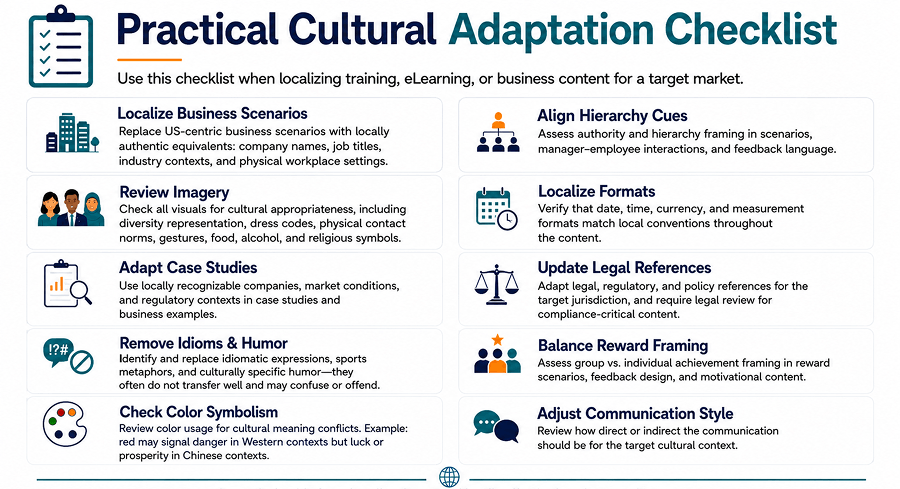
The most consequential and most frequently neglected dimension of enterprise eLearning localization is not linguistic — it is cultural. A translation can be grammatically impeccable, terminologically precise, and completely ineffective because it speaks the target language but not the target culture.
Harvard Business Review's cognitive load research quantifies the mechanism: processing information in a non-native language imposes a 20–30% cognitive overhead that consumes working memory directly available for skill acquisition. But even for learners with strong second-language proficiency, cultural dissonance in scenarios, examples, and authority relationships creates a different but equally consequential form of cognitive friction that undermines comprehension, engagement, and behavior transfer.
MIT Sloan Management Review's research on adult learning found a 45% drop in knowledge retention for abstract conceptual content when delivered in a learner's second language. For concrete procedural content, the drop is 18% — still significant at enterprise scale, but more recoverable. MIT Sloan, adult learning research The implication is not simply to translate everything, but to understand which content types carry the highest cognitive-linguistic risk and prioritize them for deeper cultural adaptation.
Hofstede's Cultural Dimensions: A Practical L&D Framework
Geert Hofstede's cultural dimensions framework remains the most operationally useful lens for L&D designers thinking about cross-cultural adaptation needs. Three dimensions are particularly critical for enterprise training design:
Power Distance — the degree to which less powerful members accept hierarchical authority. High power distance cultures (many Asian, Middle Eastern, and Latin American markets) may find American-style training that encourages employees to challenge managers, voice dissent in team meetings, or "own the room" not just unfamiliar but actively threatening to social norms. Training built on these assumptions won't fail because it is poorly translated instead it will fail because it asks learners to model behavior that carries real social risk in their context.
Individualism vs. Collectivism — the extent to which identity and success are framed individually or through group membership. Training content built around personal career ownership, individual accountability, and competitive self-positioning consistently underperforms in collectivist cultures where group harmony, team reputation, and shared accountability are more motivating. This is not a language translation problem. It is a worldview translation problem.
Uncertainty Avoidance — tolerance for ambiguity and unstructured situations. High uncertainty avoidance cultures (Germany, Japan, much of Southern Europe) respond significantly better to highly structured content with explicit rules and clear right/wrong answers. Scenario-based learning with ambiguous "what would you do?" prompts — valued in US and UK learning design for promoting critical thinking — can generate anxiety rather than reflection in these learning populations.
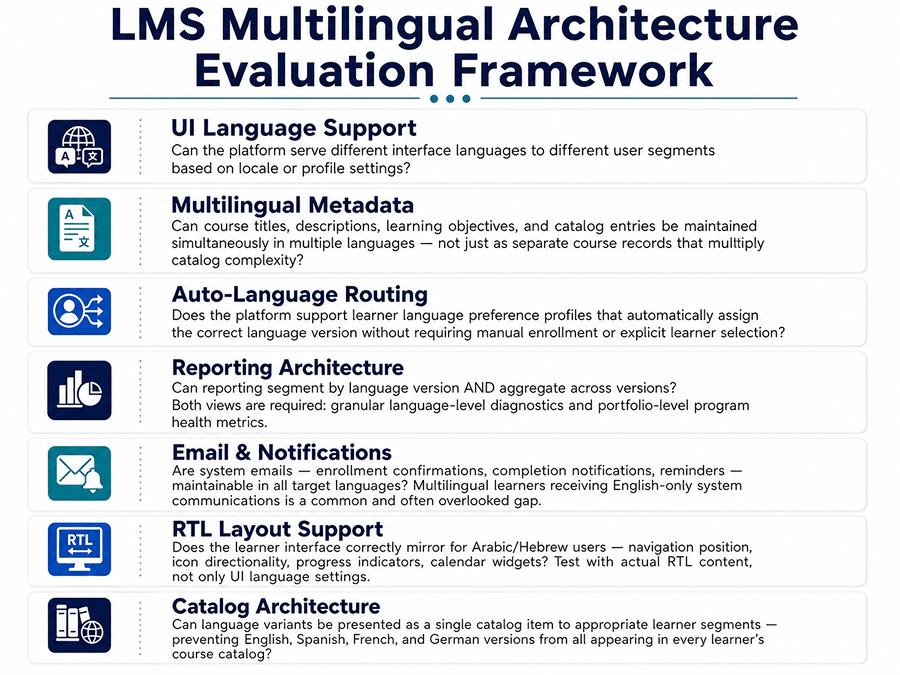
SCORM, xAPI & LMS Architecture for Multilingual Programs
The most culturally sophisticated, linguistically excellent translation is operationally worthless if the SCORM package breaks in the LMS, completion tracking fails for Arabic RTL learners, or CJK characters render as boxes in reporting dashboards.
Critical SCORM Localization Requirements
Character encoding: SCORM packages must use UTF-8 encoding throughout — HTML source, JavaScript, XML manifests, and all embedded text files — to correctly render CJK (Chinese, Japanese, Korean) characters, Arabic script, Thai, and other non-Latin character sets. A significant proportion of eLearning authoring tools still default to legacy encodings that produce character corruption in non-Latin content. This should be explicitly verified in every authoring tool configuration for multilingual programs.
Text expansion management: German text is typically 25–35% longer than its English equivalent. Finnish can expand 40–50%. Courses built with fixed-width text containers will experience layout failures ranging from visual awkwardness to complete content obscuring. Localization-ready design uses fluid containers, scalable text regions, and alternative layouts for text-heavy slides — design choices that cost minimal effort upfront but prevent significant rework costs during localization.
Right-to-left (RTL) interface support: Arabic, Hebrew, Urdu, and Persian require complete RTL interface mirroring — not simply text direction but navigation elements, progress indicators, interaction controls, and the spatial logic of the entire learning interface. Major authoring platforms support RTL output, but RTL behavior must be explicitly configured, reviewed by a native RTL speaker, and tested across device profiles before delivery.
Quality Governance: ISO 17100, MQM, and the Enterprise Standards Framework
Quality in enterprise eLearning translation exists on a spectrum, and the appropriate standard varies by content type, risk profile, and organizational context. What does not vary is the governance principle: quality failure in enterprise localization is almost always a governance failure before it is a vendor failure.
ISO 17100: The Professional Translation Standard
ISO 17100 is the international standard governing translation service delivery. It specifies requirements for translator qualification (language pair competency, subject matter expertise), process requirements (minimum two-person review for professional-grade content), and quality management system requirements for language service providers. Forrester Research found that organizations requiring ISO 17100 compliance from their LSP partners experience a 40% reduction in compliance-related quality failures in regulated industries compared to those without formal vendor quality standards.
MQM: Multidimensional Quality Metrics
The Multidimensional Quality Metrics (MQM) framework provides a standardized taxonomy for categorizing and scoring translation errors, enabling objective and comparable quality assessment across vendors, languages, and content types. MQM error categories include: accuracy errors (mistranslation, omission, addition, untranslated content), fluency errors (grammatical errors, unnatural phrasing, inconsistency, spelling), and locale convention errors (incorrect number format, inappropriate formality register, wrong terminology).
Four-Tier Quality Framework for Enterprise L&D
Tier 1: Standard: MT + Light Post-Editing
For: internal communications, rapidly expiring content, low-stakes informational modules. Process: machine translation with basic fluency review. Not appropriate for learner-facing certification, compliance, safety, or any content where inaccuracy carries risk.
Tier 2: Professional: Human Translation + Bilingual Review
For: standard eLearning modules, product training, onboarding content, and assessments. Process: professional translator + independent bilingual editor review. ISO 17100 alignment recommended. The appropriate standard for the majority of enterprise L&D content.
Tier 3: Premium: Translation + Cultural Review + SME Validation
For: compliance training, safety-critical content, leadership development, behavioral change programs. Process: professional translation + cultural adaptation review + in-market subject matter expert validation. Required for regulated industry content. Three-person minimum review chain.
Tier 4: Regulatory: Full Linguistic Validation
For: regulated healthcare training, pharmaceutical GxP documentation, medical device instruction, FDA/EMA submission materials. Process: formal linguistic validation protocol with documented evidence of meaning equivalence meeting regulatory body requirements. Back-translation verification required.
Governance Architecture: Assigning Quality Ownership
A sustainable enterprise governance model requires four explicitly named ownership roles. Without all four, quality failures become undifferentiated, uncorrectable, and unaccountable.
- Process Quality Owner: Is the correct workflow being executed for this content tier? Are quality gates being honored, or bypassed under schedule pressure?
- Linguistic Quality Owner: Are translations accurate, fluent, and consistent with approved terminology? Are MQM error rates within acceptable thresholds for this content tier?
- Cultural Quality Owner: Does this content feel authentic and appropriate for learners in this market? Are scenarios, examples, and cultural references working as intended?
- Technical Quality Owner: Does the content work correctly across all device profiles and LMS environments? Are SCORM tracking, RTL display, and character rendering verified?
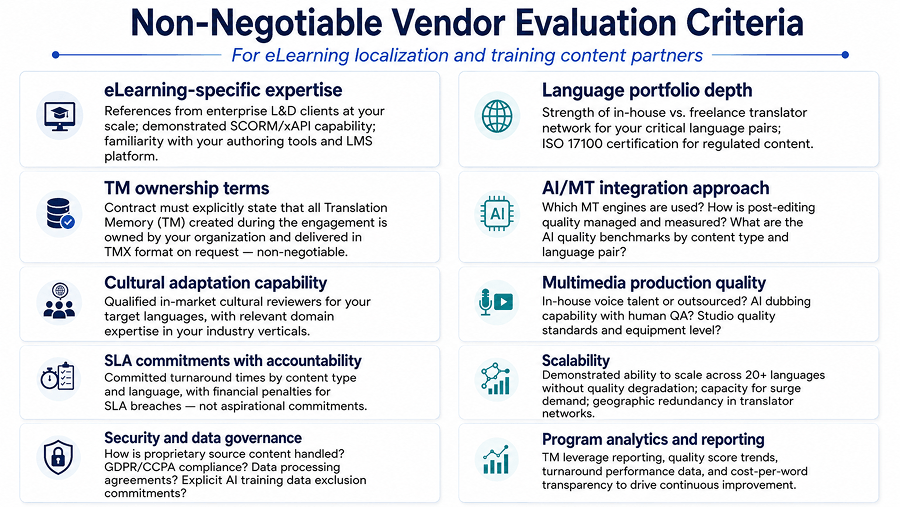
Choosing Your Localization Model: Four Partnership Archetypes
The build-vs.-buy-vs.-partner decision for enterprise eLearning localization is one of the highest-leverage strategic choices a global L&D leader makes.
Model 1: Full-Service LSP Partnership
A single language service provider manages the complete workflow: translation, cultural review, multimedia production, engineering, and QA. Appropriate for organizations beginning to scale without internal localization expertise. Key risk: quality consistency across a large language portfolio managed by one vendor requires strong contractual governance.
Model 2: Specialized eLearning Localization Vendor
A vendor specializing specifically in L&D content — with deep SCORM/xAPI expertise, authoring tool workflow capability, and instructional design understanding. Commands a premium over general LSPs but delivers significantly better L&D-specific outcomes. The recommended starting model for most enterprise programs.
Model 3: In-House CoE + Vendor Production
Internal Localization Center of Excellence governs standards, manages TM and terminology, and owns quality oversight. External vendors handle translation execution and multimedia production. Optimal for organizations with sufficient volume (typically 500,000+ words/year) to justify dedicated headcount. Delivers highest control and quality consistency.
Model 4: AI-First Platform + Human Review
Technology-first model using purpose-built AI translation platforms with human expert review for quality-critical content. Optimal for high-volume, moderate-complexity programs where cost and speed are primary drivers. Increasingly the dominant model for 2025–2027 as AI quality benchmarks continue to improve across language pairs
The AI Transformation of eLearning Localization: What's Real Now
Artificial intelligence is transforming eLearning localization more rapidly and comprehensively than any previous technology shift in the industry's history.
What AI Is Already Reliably Delivering
Translation cost and speed transformation. AI-powered translation workflows — specifically, high-quality NMT engines or LLM translation with structured MTPE for quality assurance — are reducing per-word costs by 40–65% compared to fully human translation for standard content types.
AI dubbing and synthetic voice. AI-powered voice generation platforms now produce synthetic voice-overs in 30+ languages at quality levels rated "acceptable" or "good" by 84% of enterprise learners in blind comparison testing. Turnaround: 2–4 hours versus 2–4 weeks.
Quality estimation and intelligent oversight allocation. AI systems can now assess the quality of their own output with sufficient reliability to identify segments requiring human review versus those suitable for light checking.
Where Human Expertise Remains Non-Negotiable
Cultural judgment and adaptation. AI systems cannot reliably assess whether a scenario, example, or narrative approach will resonate or alienate in a specific cultural context. Cultural adaptation remains a fundamentally human judgment task.
Compliance-grade accuracy for specialized content. In regulated industries, LLM translation of technical and regulatory training carries unacceptable publication risk. The hallucination risk of even state-of-the-art LLMs is incompatible with the zero-error standards required for pharmaceutical, medical device, financial services, and safety-critical training. These content types require expert human review regardless of AI first-pass quality.
Low-resource language quality. Stanford HAI's 2024 AI Index found that the quality improvements of NMT and LLM translation apply primarily to high-resource language pairs. For many African languages, Southeast Asian languages beyond major regional languages, and Central Asian languages, AI translation quality remains 15–25% below human expert standards.
The Strategic Positioning Principle
The organizations extracting maximum value from AI in localization are those that invested in the infrastructure that AI amplifies:
- mature translation memories that AI can leverage for consistency;
- robust terminology databases that constrain AI output to approved vocabulary;
- quality frameworks that define which content tiers require human oversight; and
- authoring processes producing clean, AI-friendly source content.
AI is a multiplier — and it multiplies what you already have. Organizations with mature localization infrastructure will see 3–4× the benefit from AI adoption compared to those operating from an ad hoc state.
Now, the global workforce will not wait for learning that was built for someone else. Enterprises that build the capability to deliver high-quality, culturally authentic training in the languages their people actually think in will gain compounding advantages in workforce performance, talent retention, compliance, and organizational resilience. The technology to execute at scale has never been more accessible. What separates leading organizations from the rest is the strategic clarity and organizational will to build the right infrastructure, deliberately, and starting now