
Learning Path
A learning path is a structured, sequential series of learning experiences, such as courses, assessments, job aids, mentoring sessions, or performance challenges, curated and ordered to help a learner build a defined set of skills or competencies over time. Unlike a course catalog, a learning path provides intentional progression: each step prepares the learner for what follows, and the sequence as a whole leads to a measurable outcome.
The word "path" implies direction, and that is precisely what distinguishes a learning path from a course library or a playlist of training modules. A library says, "here is what is available." A learning path says, "here is where you start, here is where you are going, and here is the route that gets you there." That difference is not cosmetic; it changes what gets designed, how learners engage, and what outcomes become achievable.
At its core, a learning path operationalizes a competency model. When an organization decides that a new sales hire should be able to run a discovery call within sixty days, or that a team lead should be equipped to handle performance conversations within their first quarter, someone has to translate that outcome into a specific, sequenced set of experiences. The learning path is that translation. It makes abstract capability goals concrete and actionable, both for the learner who follows it and for the organization that needs to track progress against it.
What separates a thoughtfully built learning path from a loosely assembled sequence of modules is intentionality at every transition. Each step should prepare the learner for the next, with prior knowledge scaffolding new concepts and practice challenges reinforcing what came before. When that scaffolding is done well, learners experience the path as coherent rather than arbitrary, and the skills they build compound rather than sit in separate mental silos.
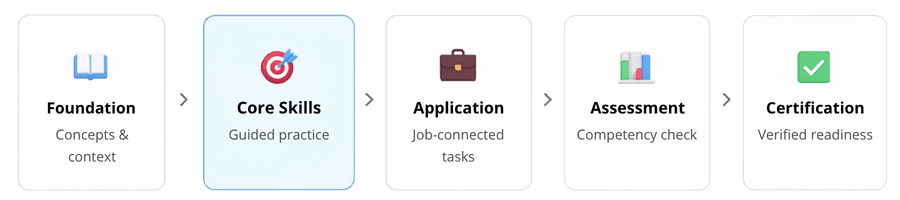
Anatomy of a Well-Built Learning Path
Strong learning paths share a recognizable internal architecture even when their formats and content vary widely. Understanding that architecture makes it easier to evaluate whether a path is likely to work before it is deployed, rather than after performance data reveals the gaps.
A defined learner profile and entry point
Effective paths begin with clarity about who they are for. A learning path designed for a technical specialist who is transitioning into a people-management role requires entirely different scaffolding than one built for a new hire with no management experience whatsoever. The entry-point assumption is one of the most common sources of path failure: when designers assume more prior knowledge than learners actually have, the early modules feel either too opaque or too slow, and engagement collapses before the substantive work begins.
A clear terminal outcome with measurable criteria
The most useful learning paths are designed backward from a performance outcome. What should the learner be able to do, say, or decide at the end that they could not do at the beginning? That outcome should be specific enough to evaluate. "Understand data privacy regulations" is not an outcome in any useful sense. "Accurately assess whether a proposed marketing campaign requires a data-processing impact assessment under applicable regulations" gives the designer, the learner, and the evaluator something to work with.
Deliberate staging and pacing
The sequencing of content within a path is not just a logistical decision; it is a learning design decision. Cognitive load theory is relevant here: early stages should introduce foundational concepts with low complexity so learners can build reliable mental models before encountering the nuance and exception-handling that characterizes real performance. Applying the spacing effect and interleaving related concepts across multiple sessions will outperform a dense front-loaded curriculum in almost every context involving transferable skill development.
Integration of formal and informal learning touchpoints
The most effective paths recognize that a formal course or module is rarely sufficient on its own. They weave in structured practice opportunities, observation tasks, coaching conversations, peer discussion prompts, and on-the-job application activities. This blended architecture is not merely about variety; it is about creating multiple encoding pathways and building the bridge between knowing and doing that remains the central challenge of workplace learning.
How Learning Paths Are Actually Designed
The design process for a learning path is iterative and stakeholder-intensive. It rarely resembles the clean linear processes that learning frameworks suggest, and the gap between the intended design and the delivered experience is often larger than practitioners anticipate until they have built several at scale.
1. Needs and competency analysis
Identifying the specific skills or behaviors the path should develop, and mapping the gap between current and target performance. This stage typically requires significant subject matter expert input and is where timeline pressure most often causes shortcuts.
2. Content audit and curation
Cataloging existing assets to determine what can be reused, repurposed, or retired. In most enterprise contexts, usable content already exists in some form; the design work is as much about curating and sequencing as it is about creating from scratch.
3. Sequence and architecture design
Mapping the progression from entry to terminal outcome, identifying dependencies, and making explicit decisions about which formats best serve each stage: conceptual introduction, guided practice, scenario-based application, peer learning, or assessment.
4. Development and production
Building or commissioning new content where gaps exist, adapting existing assets for the path's audience and context, and ensuring consistency of voice, visual language, and instructional approach across all components.
5. Pilot, iterate, and publish
Testing the path with a representative group of learners before full deployment, collecting feedback on pacing, clarity, and relevance, and revising before broader launch. This stage is often compressed under organizational pressure, with predictable effects on quality.
6. Governance and ongoing maintenance
Establishing ownership for content review cycles, sunset dates for outdated modules, and a process for incorporating new regulatory, procedural, or technical requirements. A path that is not maintained degrades in both accuracy and relevance over time.
Where Learning Paths Break Down
The failure modes of learning paths are worth examining closely because they are remarkably consistent across organizations and industries. Most paths do not fail because the people who built them lacked expertise; they fail because the conditions under which enterprise learning is produced are systematically hostile to quality at scale.
The most commonly cited failure is not poor instructional design. It is insufficient analysis time at the front end, which produces paths that are misaligned with real performance gaps from the outset, no matter how carefully the content is later developed.
Subject matter expert dependency and bottlenecks
Learning paths require expert knowledge to build accurately, and subject matter experts are almost always operating with constrained time, fragmented availability, and no training in how to communicate their expertise to a learning designer. The interview, validation, and review cycles that should anchor path development often run weeks or months behind schedule, compressing the time available for design and development and, ultimately, for the quality-assurance work that would catch the gaps before learners encounter them.
Scope and stakeholder misalignment
Enterprise learning paths frequently expand during development as additional stakeholders identify competencies they want included. A path scoped for sixty minutes of learning time grows to four hours; a focused skill-building sequence absorbs compliance requirements, product knowledge modules, and culture content that belong in different contexts. The result is something that no longer functions as a learning path in any coherent sense: it is a collection of organizational priorities dressed in sequential packaging.
Maintenance neglect and content decay
An unloved learning path is often worse than no path at all. When content becomes outdated, learners notice; when learners notice, they disengage; when they disengage at scale, they carry implicit negative associations about the quality of the organization's learning investment that are difficult to reverse. Without a formal governance model that assigns ownership, schedules review cycles, and gives teams the resources to act on findings, maintenance becomes nobody's explicit responsibility and gradually nobody's actual priority.
Common Execution Risk: Organizations frequently build learning paths for launch without building the infrastructure to sustain them. A path that performs well in its first quarter and has not been reviewed in its second year is not an asset; it is a liability that signals to learners that the organization does not take the content seriously enough to keep it current.
Learning Paths, Curricula, and Programs: Clearing Up the Confusion
These three terms are used interchangeably in many organizations, which produces both conceptual confusion and practical misalignment when teams are trying to describe what they are actually building. The distinctions are worth establishing clearly.
Learning Path
- Tied to a specific role, skill, or outcome
- Sequential and self-contained
- Often completed independently
- Typically weeks to a few months
- Progression is the primary logic
Curriculum / Program
- Broader, often covering a domain or function
- May contain multiple learning paths
- Often includes cohort-based elements
- Typically months to years
- Breadth and depth are both goals
A curriculum is the larger ecosystem within which a learning path lives. A company's Leadership Development Curriculum might contain five distinct learning paths: one for individual contributors who are new to managing others, one for experienced managers moving into senior leadership, one for leaders taking on their first P&L responsibility, and so on. Each path can function independently, but together they form a coherent architecture for developing capability across the leadership pipeline.
The distinction matters for design decisions. Learning paths should be designed with enough focus that a learner can complete them, measure their progress, and feel the closure of having reached the intended endpoint. Curricula should be designed with enough breadth and flexibility that they remain relevant as roles, strategies, and organizational priorities evolve over time.
Enterprise Complexity: When One Path Becomes Forty
The strategic and operational demands of learning path design multiply rapidly as organizations scale. What begins as a single onboarding path for a domestic business unit evolves, through acquisitions, market expansions, and workforce diversification, into a portfolio of interconnected paths that must serve dozens of job families, multiple languages, varied regulatory contexts, and learner populations with fundamentally different baseline knowledge and digital access conditions.
- 70% of enterprise L&D teams report maintaining more paths than they have capacity to keep current
- 3–5× longer than estimated: typical actual timeline for enterprise learning path development
- 40% of learners who abandon a path cite "not relevant to my actual role" as the primary reason
Localization is one of the most underestimated dimensions of enterprise scale. Translating a learning path is not simply a matter of converting text into another language; it requires adapting examples, scenarios, cultural references, compliance requirements, and visual conventions to the context of each market. A path developed for a US-based sales team and then translated for teams in Japan, Brazil, and Germany without meaningful adaptation will underperform in every non-US market, not because the core skills are different but because the context in which those skills are exercised is.
Global deployment also introduces questions of infrastructure and accessibility that purely domestic programs rarely have to address. Bandwidth limitations, device constraints, time-zone-driven scheduling difficulties, and differing expectations about the formality of learning interactions all affect how paths need to be designed and delivered. Many organizations extend their capabilities through partnerships with regional specialists or third-party learning vendors precisely because the local knowledge required to adapt effectively at scale exceeds what a central L&D function can realistically hold.
The pressure of volume also affects quality. When a team is responsible for producing and maintaining dozens of learning paths simultaneously, the temptation to standardize the form at the expense of learning effectiveness becomes significant. Template-driven production reduces unit costs and increases speed, but paths that feel interchangeable signal to learners that their specific context and role have not been taken seriously. The best enterprise learning functions find ways to achieve structural efficiency without sacrificing the contextual specificity that makes individual paths feel relevant and worth completing.
Tools, Platforms, and the Limits of Technology
The technology market for learning path delivery has matured significantly over the past decade. Learning management systems now offer native path-building functionality, skill-tagging, prerequisite logic, and completion tracking as standard features. Learning experience platforms go further, incorporating recommendation engines that surface content based on role, historical behavior, and declared learning goals. AI-powered authoring tools can now draft instructional content, generate quiz questions, and produce voiceover scripts in a fraction of the time that manual production requires.
None of this changes the fundamental analysis and design work that must precede it. A platform can sequence content that has been thoughtfully curated; it cannot supply the curation judgment itself. An AI tool can produce a module draft from a transcript or document; it cannot determine whether that content belongs in this path, at this stage, for this learner profile. The efficiency gains from modern learning technology are real and significant, but they accelerate execution rather than replace the expertise that makes execution worth accelerating.
What The Platform Does and Does Not Solve
Organizations often discover, after investing in a new LMS or LXP, that their most persistent challenges are upstream of the platform: inconsistent content quality, unclear competency models, undefined governance processes, and insufficient stakeholder alignment on what "readiness" actually means. A more sophisticated delivery system makes those problems more visible, not less. It also raises learner expectations; a platform that promises personalized, role-specific learning creates implicit commitments that poorly designed paths quickly fail to honor.
The most effective uses of technology in learning path delivery treat the platform as infrastructure rather than strategy. The strategic decisions about what paths to build, for whom, toward what outcomes, and with what update cadence remain human decisions that require L&D expertise, business partnership, and a clear understanding of what the organization is trying to achieve. Those decisions made well, the platform amplifies their effect. Those decisions made poorly or skipped entirely, the platform simply scales the gap between investment and impact.
Frequently Asked Questions
What is a learning path?
A learning path is a structured sequence of learning activities, courses, resources, assessments, and practice opportunities that helps learners progress toward a specific skill, role, or performance goal.
How is a learning path different from a course?
A course is usually a single learning unit, while a learning path is a broader journey made up of multiple learning experiences. A learning path may include several courses, along with coaching, assignments, assessments, resources, and workplace practice.
What should a learning path include?
A learning path should include a clear outcome, sequenced learning activities, relevant formats, opportunities for practice, progress checkpoints, and a way to measure whether learners can apply what they learned.
Are learning paths only used in an LMS?
No. Learning paths are often delivered through an LMS or learning platform, but they can also include live sessions, coaching, job aids, peer learning, manager conversations, simulations, and on-the-job assignments.
Why are learning paths important for employee development?
Learning paths help employees understand what to learn next and how each step connects to their role or career growth. They also help organizations create more structured, measurable, and scalable development experiences.
Can learning paths be personalized?
Yes. Learning paths can be personalized based on role, skill level, location, performance data, assessment results, or career goals. Personalization works best when it is guided by clear learning outcomes and supported by strong content architecture.
What makes a learning path effective?
An effective learning path is outcome-driven, well-sequenced, practical, easy to navigate, and connected to real performance expectations. It should help learners build capability over time rather than simply complete a list of modules.
Related Business Terms and Concepts
Content Curation
Content curation is a key process for building effective learning paths. Rather than creating every learning asset from scratch, content curation identifies, evaluates, and organizes relevant resources that can be sequenced into a structured learning journey aligned with specific roles or development goals. For enterprise L&D teams, thoughtful content curation keeps learning paths current without requiring constant content development. It also improves learning quality by ensuring employees encounter relevant resources in a logical progression instead of navigating disconnected materials.
Content Library
A content library provides the learning assets that populate a learning path. While a learning path defines the recommended sequence of learning activities, the content library serves as the centralized repository where courses, videos, documents, job aids, and other resources are stored and managed. For enterprise organizations, a well-governed content library makes learning paths easier to build, update, and scale. Centralized content management also reduces duplication and helps ensure learners access consistent, approved learning resources across the organization.
Guided Learning
Guided learning is a learning approach commonly delivered through a learning path. A learning path provides the structured sequence of activities, while guided learning adds direction through recommended progression, milestones, coaching, feedback, or instructor support that helps learners advance toward defined goals. For enterprise learning programs, combining guided learning with well-designed learning paths creates greater consistency across learner experiences. This relationship is particularly valuable when developing complex capabilities that require progressive skill development rather than isolated training events.
Job Aid
A job aid often complements a learning path by supporting employees after formal instruction is complete. While a learning path develops knowledge and skills through a planned sequence of learning experiences, a job aid provides concise performance support that employees can reference while performing their work. For enterprise organizations, incorporating job aids into learning paths helps reinforce learning beyond course completion. This combination supports knowledge retention and enables employees to apply new skills more confidently in real work situations.
Just-in-Time Learning
Just-in-time learning extends the value of a learning path by providing targeted support when employees need it most. Whereas a learning path guides long-term capability development, just-in-time learning delivers focused information or resources that help employees solve immediate workplace challenges. For enterprise L&D leaders, integrating just-in-time learning within a learning path creates a balance between structured development and performance support. This approach helps employees continue learning without interrupting productivity or relying solely on formal training.
Knowledge Management
Knowledge management provides the organizational knowledge that can be transformed into effective learning paths. While knowledge management focuses on capturing, organizing, and maintaining institutional knowledge, a learning path structures selected knowledge into a purposeful sequence that supports employee development. For enterprise organizations, aligning learning paths with knowledge management improves the reuse of valuable organizational expertise. It also helps ensure critical knowledge is delivered in a structured, role-relevant manner that supports workforce capability and long-term content governance.