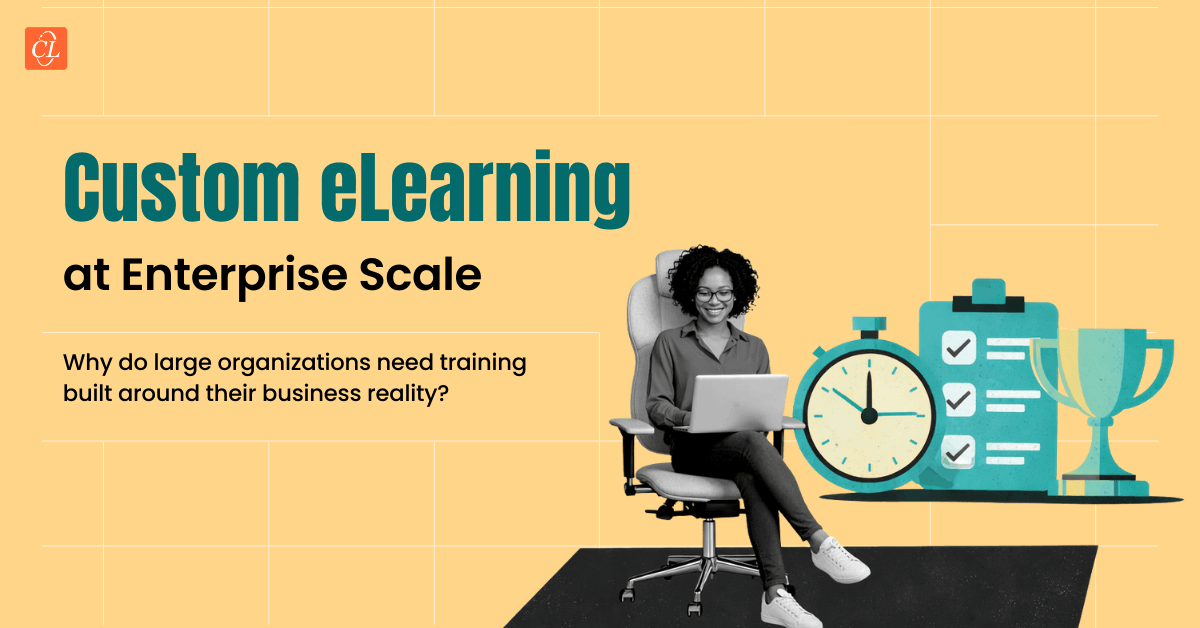
Large enterprises rarely struggle with creating training. They struggle with scaling it across teams, regions, systems, and languages.
Off-the-shelf learning content or templated eLearning may work for small organizations, but it quickly breaks down in enterprises with thousands of employees, decentralized business units, and constantly evolving learning demands.
In sectors like financial services, health & pharma, IT & software, and manufacturing, training must align with complex regulations, technical knowledge, and rapidly changing products or systems. That is where custom eLearning development becomes essential.
Large organizations need learning programs that integrate with their workflows, scale across geographies, and support recurring learning cycles such as compliance, sales enablement, and leadership development.
This blog explores why enterprises need custom eLearning instead of generic training, how it solves enterprise-scale training challenges, and how it works across key industries.
Table Of Content
- Why do Enterprises Need Custom eLearning Instead of One-size-fits-all Training?
- How does Custom eLearning Solve Enterprise-Scale Training Challenges?
- How Does Custom eLearning Work Across Different Industries?
- Frequently Asked Questions About Custom eLearning at Enterprise Scale
- Turning Custom eLearning into a Strategic Advantage
Why do Enterprises Need Custom eLearning Instead of One-size-fits-all Training?
Before diving deeper, here are the key reasons large organizations move away from generic training models and invest in custom eLearning:
- One-size-fits-all eLearning fails at enterprise scale because large organizations have complex operations, multiple regions, and evolving training needs.
- Enterprises often run recurring learning cycles across departments and languages, making standardized content insufficient.
- Custom eLearning development enables scalable, role-specific, and context-driven training programs.
- Industries such as Financial Services, Health & Pharma, IT & Software, and Manufacturing require specialized training formats.
- Custom learning ecosystems combine microlearning, video-based learning, simulations, and AI-enabled learning tools to improve training outcomes.
- The most effective enterprise learning strategy focuses on operational scalability, consistency, and measurable impact.
How does Custom eLearning Solve Enterprise-Scale Training Challenges?
Enterprise training becomes challenging because organizations must train employees across roles, locations, and languages while keeping content relevant and up to date. Common challenges include:
- Managing recurring learning cycles such as compliance or product training
- Training employees across global teams and time zones
- Keeping content aligned with evolving business processes
- Maintaining consistent learning experiences across departments
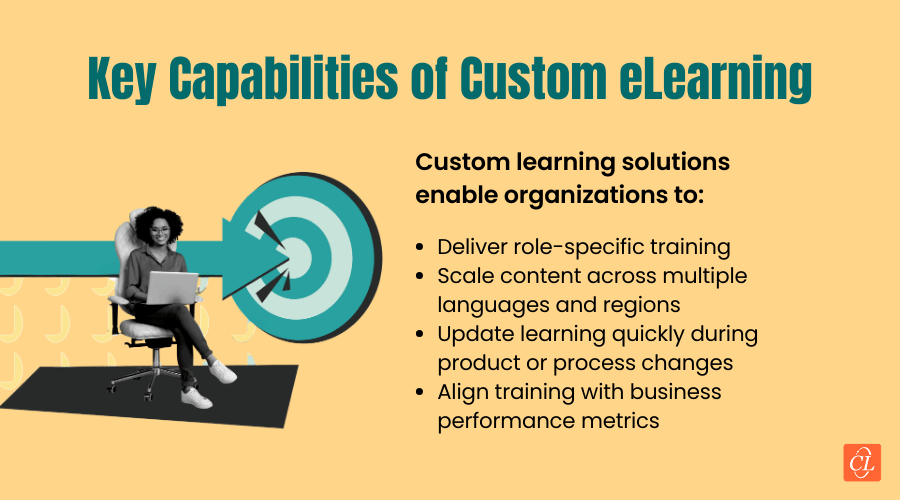
Custom eLearning solves enterprise training challenges by aligning learning design, technology, and content with business operations. Instead of isolated training projects, custom programs create scalable learning ecosystems that support ongoing training cycles.
How Does Custom eLearning Work Across Different Industries?
Custom eLearning becomes most valuable in industries where regulations, operational complexity, and continuous learning needs make generic training ineffective. Organizations in these sectors require training that is role-specific, scalable, and aligned with real workflows. Below is how custom eLearning addresses real-world training challenges in key industries.
1. Financial Services
Financial services organizations operate in one of the most heavily regulated business environments, where compliance, risk management, and product knowledge must be constantly updated. Off-the- shelf training programs often fail because regulations differ across countries, states, and financial products, making standardized learning ineffective.
Challenges Financial Institutions Face
Banks, insurance companies, and financial service firms often struggle with:
- Frequent regulatory updates and compliance mandates
- Training employees across multiple jurisdictions
- Ensuring consistent product knowledge among sales teams
- Preventing fraud and cybersecurity threats
- Training large numbers of employees quickly when new policies are introduced
These challenges make it difficult for L&D teams to rely on static or off-the-shelf training.
How Custom eLearning Solves These Challenges
Custom eLearning allows financial institutions to create region-specific, role-based training programs that align with operational realities.
For example:
- ILT to eLearning conversion can transform compliance workshops into scalable digital courses delivered across global branches.
- Microlearning solutions can reinforce regulatory updates and risk management practices.
- Webinar-to-eLearning conversion can turn expert-led product briefings into reusable learning modules for sales teams.
2. Health & Pharma
Healthcare and pharmaceutical companies operate in environments where accuracy, compliance, and patient safety are critical. Training errors in this sector can have serious regulatory or safety consequences, making generic learning programs insufficient.
Challenges in Health & Pharma Training
Healthcare organizations frequently face challenges such as:
- Constantly evolving regulatory requirements
- Training global teams on clinical protocols and research updates
- Ensuring sales teams understand complex scientific information
- Maintaining compliance with regulatory bodies and global healthcare compliance standards
- Training across multiple roles, including researchers, manufacturing teams, regulatory specialists, and sales representatives.
How Custom eLearning Supports the Industry
Custom eLearning for healthcare organizations helps deliver accurate and compliance-aligned training that keeps pace with evolving medical practices and industry regulations.
For example:
- Microlearning modules can reinforce critical compliance, product, and process-related knowledge in short, accessible formats.

- Training videos can simplify complex medical, scientific, or procedural information for better understanding and retention.
- VILT sessions can make it easier to deliver expert-led training across locations while ensuring consistency in knowledge sharing.
3. Manufacturing
Manufacturing environments involve complex machinery, safety protocols, and standardized processes, making practical training essential. Standard training methods often fall short because employees need hands-on, visual, and job-relevant learning experiences.
Watch this video to see why customized manufacturing training is more effective than generic programs for building safety, consistency, and job-ready performance.
Key Training Challenges in Manufacturing
Manufacturing organizations commonly face challenges such as:
- Training workers on new equipment and machinery
- Maintaining strict safety compliance standards
- Ensuring consistent training across multiple production sites
- Preparing teams for process improvements or automation
Because manufacturing work is highly operational, employees need training that reflects real workplace scenarios.
How Custom eLearning Helps Manufacturing Organizations
Custom eLearning allows manufacturing companies to design training that mirrors real production environments.
For example:
- Video-based learning can demonstrate equipment operation step-by-step
- Simulations can help workers practice machine troubleshooting
- Interactive safety scenarios can train employees to respond to workplace hazards
4. IT & Software
Technology companies operate in rapidly evolving environments where tools, platforms, and software features change frequently. Training must adapt quickly so employees can stay current with new technologies and product updates.
Key Training Challenges in IT & Software
Technology organizations often face challenges such as:
- Onboarding developers across complex technical environments
- Keeping teams updated on frequent product releases
- Training customer-facing teams to explain technical product capabilities
- Maintaining awareness of security and DevOps practices
Because software development cycles move quickly, traditional training approaches often fail to keep pace with change.
How Custom eLearning Helps Technology Organizations
Custom eLearning enables technology companies to design training that aligns with their platforms, tools, and workflows.
For example:
- Webinar-to-eLearning conversion can transform product launch sessions into structured product training modules.
- Training videos can walk employees through platform interfaces and system workflows.
- VILT sessions can allow product experts to demonstrate new tools and answer technical questions in real time.
Frequently Asked Questions About Custom eLearning at Enterprise Scale
As enterprise training needs grow more complex, L&D leaders often have practical questions about when custom eLearning makes sense, how it works, and what it takes to scale it effectively. Here are clear answers to some of the most common questions.
1. What training formats are commonly used in custom eLearning?
A. Custom eLearning commonly uses formats such as ILT to eLearning conversion, microlearning, training videos, VILT, webinar-to-eLearning conversion, scenario-based learning, and simulations. Organizations often combine these formats to create flexible learning experiences that support both scale and relevance.
2. How does custom eLearning improve training effectiveness?
A. Custom eLearning improves training effectiveness by making learning more relevant, practical, and easier to apply on the job. When training reflects real business processes, learner roles, and operational challenges, employees are more likely to retain knowledge and use it in meaningful ways.
3. How can L&D leaders implement custom eLearning successfully?
A. L&D leaders can implement custom eLearning successfully by starting with business goals, learner needs, and delivery requirements rather than beginning with content alone. A strong approach typically includes discovery, learning design, scalable development, and ongoing delivery support so training can evolve with the organization.
Turning Custom eLearning into a Strategic Advantage
Enterprise learning rarely breaks because organizations lack content. It breaks when learning systems cannot keep up with the scale, speed, and complexity of modern business operations. As training demands grow across regions, roles, and regulatory environments, organizations need more than isolated courses—they need a structured approach that turns learning into a reliable operational engine. That is where custom eLearning solutions built on clear discovery, thoughtful design, scalable development, and consistent delivery make the difference. By understanding learners and platforms, aligning learning strategies with business goals, building content using agile development methods, and supporting it with strong LMS and QA processes, enterprises can ensure training keeps pace with real-world change.
For L&D leaders, the challenge is not just creating training—it is building learning ecosystems that continuously support performance, compliance, and growth. Custom eLearning makes this possible by connecting strategy, learning journeys, and implementation into a system that evolves with the business. If you want to explore how organizations design learning strategies that truly drive business outcomes, download our eBook on planning learning strategies, designing targeted learning journeys, and implementing scalable learning solutions that deliver measurable impact.