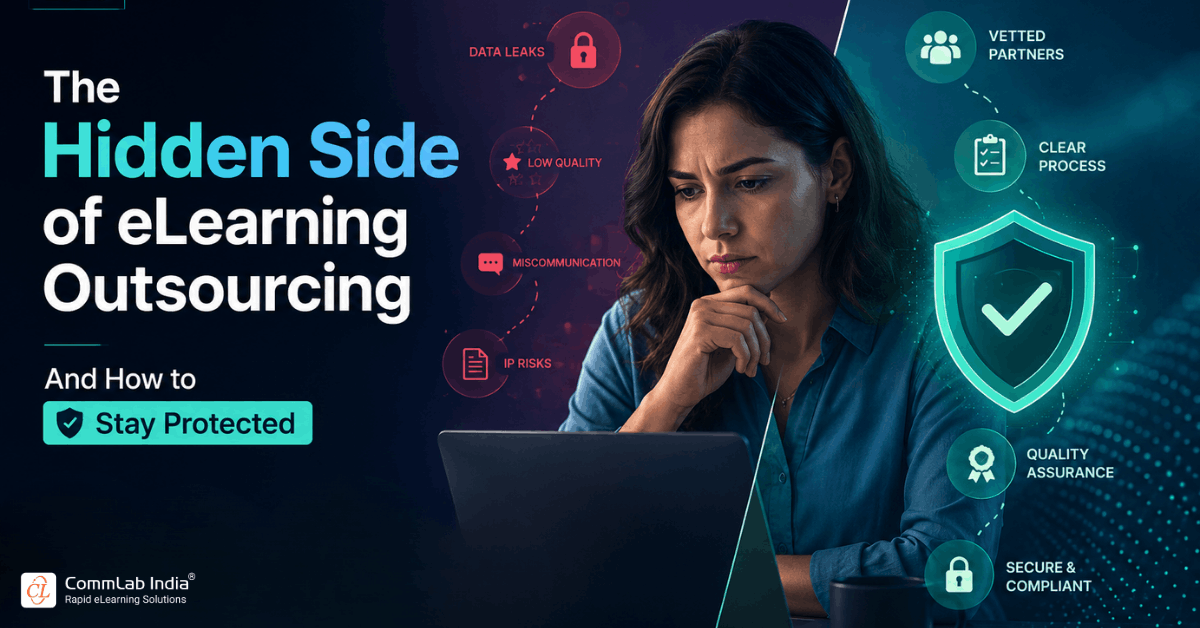
Outsourcing your eLearning development can save time, cut costs, and bring specialist expertise into your L&D function. But it also introduces risks that many organizations don't anticipate until a project is already off the rails. Understanding these risks — and knowing how to address them is the difference between a successful vendor relationship and a costly, frustrating experience.
This blog covers the hidden risks of eLearning outsourcing and how to choose the right partner to minimize them. It also explains what a strong outsourcing contract should include and how the right partner prevents risks before they become problems.
Table Of Content
- What are the Hidden Risks of eLearning Outsourcing?
- How Do You Choose the Right eLearning Partner to Minimize Risk?
- What Should a Strong eLearning Outsourcing Contract Include?
- The Right eLearning Partner Mitigates Risk Before It Becomes a Problem
What are the Hidden Risks of eLearning Outsourcing?

Here are the five most prevalent risks organizations face in real-world eLearning outsourcing engagements:
Risk 1: Quality Misalignment
The most common risk in eLearning outsourcing is receiving deliverables that don't match your internal quality standards or learning objectives.
This happens because quality is subjective. Your idea of "clean, professional design" may look entirely different from your vendor's default template. Your subject matter experts may expect deep content accuracy; the vendor may prioritize visual polish over instructional rigor.
Why this is hard to catch early:
- Sample work shown in proposals is often their best work, not their typical work.
- Content reviewers are usually brought in late in the cycle, after significant rework costs are already baked in.
- Instructional quality — alignment to learning objectives, knowledge checks, scenario design requires specialized review that many procurement teams aren't equipped to assess.
How to mitigate it:
- Share a detailed content and design brief upfront, not just a scope document.
- Request a paid pilot module before committing to a full project.
- Define quality checkpoints at storyboard, prototype, and final review stages.
- Include a subject matter expert in the vendor review process from day one.
Risk 2: Intellectual Property and Data Security Vulnerabilities
When you outsource eLearning, you're often sharing proprietary information — internal processes, compliance data, trade secrets, and employee performance details with a third party.
Many organizations don't scrutinize vendor security practices until after a breach or data misuse incident occurs.
What's at stake:
- Proprietary training content developed for your organization may be repurposed by the vendor for other clients.
- Sensitive company information embedded in course scenarios can be exposed if the vendor's systems aren't adequately protected.
- Some vendors operate across geographies with different data protection regulations, creating compliance risk.
How to mitigate it:
- Ensure your contract includes explicit IP ownership clauses — all deliverables should be assigned to your organization upon final payment.
- Require NDAs before sharing any content, internal documents, or business processes.
- Ask vendors about their data handling policies, storage locations, and security certifications (e.g., SOC 2).
- Limit access to sensitive systems and information to only what the vendor strictly needs.
Risk 3: Communication Breakdowns and Cultural Disconnect
Poor communication is a silent project killer in eLearning outsourcing. It doesn't show up in a missed deadline, it shows up in a course that's technically complete but fundamentally wrong.
Time zone gaps, language barriers, and differing work cultures can all contribute to miscommunication. But even more damaging is the assumption on both sides that the other party "gets it."
Real-world examples of this risk:
- A vendor delivers a course that's factually accurate but tonally off, too formal for a frontline workforce, or too casual for a regulated industry.
- Feedback given in weekly check-ins is interpreted differently than intended, leading to rework cycles.
- The internal project owner changes mid-engagement, and the vendor continues executing on the original brief with no correction.
How to mitigate it:
- Designate a single point of contact on both sides with clear decision-making authority.
- Use a shared project management tool (not just email) to track briefs, feedback, and revisions.
- Conduct a kickoff call that explicitly covers tone, audience, learning culture, and organizational context.
- Document all review feedback in writing because verbal approvals lead to disputes.
Risk 4: Loss of Control Over Timelines and Delivery
One of the top frustrations organizations report with eLearning outsourcing is delayed delivery and the compounding effect it has on product launches, compliance windows, and employee onboarding schedules.
Delays are often not caused by the vendor alone. They're caused by the system — unclear scope, slow stakeholder approvals, scope creep, and poorly managed feedback cycles on the client side.
Common causes of timeline failure:
- Scope changes introduced mid-project without formal change control.
- SME unavailability causing content approval delays.
- Vendors juggling multiple clients simultaneously without sufficient resource allocation to your project.
- Underestimating localization or accessibility requirements discovered late in development.
How to mitigate it:
- Define a detailed project plan with milestones and dependencies before development begins.
- Include SLAs in the contract; specify turnaround times for deliverables and revision cycles.
- Agree on a change management process upfront, including how scope changes are documented, priced, and scheduled.
- Assign internal stakeholders review deadlines — vendor delays are sometimes caused by client-side bottlenecks.
Risk 5: Vendor Dependency and Loss of Internal Capability
The long-term risk that organizations overlook most is the gradual erosion of internal eLearning competency as a result of over-reliance on an outsourcing vendor.
When all content creation, tool expertise, and instructional design thinking lives outside your organization, you become vulnerable. If your vendor raises prices, changes focus, or exits the market, you're left without the capability to continue your L&D function effectively.
Signs of unhealthy vendor dependency:
- Your internal team has no working knowledge of the authoring tools the vendor uses.
- All institutional knowledge about course structure and design rationale sits with the vendor, not your team.
- You can't quality-check deliverables independently because your team lacks the instructional design expertise to evaluate them.
- Transitioning to a new vendor would require rebuilding from near-zero.
How to mitigate it:
- Retain ownership of source files, not just published outputs — always request editable project files.
- Include knowledge transfer clauses in your contract that require documentation of design decisions and tool configurations.
- Build internal capacity in parallel even one instructional designer on your team changes the power dynamic.
- Evaluate vendors annually, even if you're happy, to ensure you have a realistic exit strategy.
How Do You Choose the Right eLearning Partner to Minimize Risk?
Choosing the right eLearning outsourcing partner is the single most effective risk mitigation strategy available to you.
A strong eLearning partner doesn't just execute your briefs — they challenge unclear requirements, flag potential issues early, and align their process to your internal L&D goals. Here's what to evaluate:
- Evaluate their instructional design process, not just their portfolio
Ask how they handle Subject Matter Expert (SME) collaboration, learning objective mapping, and review cycles. The process reveals how they'll behave when things get complicated. - Check for domain experience in your industry
A vendor with experience in healthcare compliance training thinks differently from one that primarily builds retail onboarding courses. Industry context matters to accuracy and tone. - Assess their communication infrastructure
Do they use structured project management tools? How do they handle change requests? What's their average response time to client queries? These operational details predict delivery performance. - Look for transparency in pricing and scope management
Be cautious of fixed-price quotes on complex projects with no change order mechanism. Good vendors price honestly and manage scope with clear agreements. - Ask for client references from similar-scale projects
A vendor who has delivered 20 modules successfully for a 50-person team may struggle with an enterprise rollout of 200 courses. Scale matters.
What Should a Strong eLearning Outsourcing Contract Include?
A well-structured contract is your primary protection against the most common eLearning outsourcing risks.
Your contract with an outsourcing vendor should address the following:
- IP ownership: All deliverables, including source files, transfer to you upon final payment.
- Confidentiality: NDA covering all shared business data, content, and processes.
- Scope definition: Clear description of deliverables, revision limits, and what constitutes a change order.
- SLAs: Defined turnaround times for deliverables and revisions, with consequences for breach.
- Data security: Vendor obligations for data handling, storage, and breach notification.
- Exit provisions: What happens if you terminate early — file ownership, work-in-progress payment, transition support.
- Quality acceptance criteria: Defined standards for what constitutes an approved deliverable versus a rejected one.
A contract without these elements isn't protecting you — it's protecting the vendor.
The Right eLearning Partner Mitigates Risk Before It Becomes a Problem
eLearning outsourcing is a high-value strategy for organizations that need to scale their learning function without scaling headcount. But the hidden risks are real, and they compound quickly when left unaddressed.
The good news is that none of these risks are unavoidable. Every one of them has a practical mitigation strategy that starts with better preparation, clearer contracts, and more intentional vendor selection.
The organizations that get the most from eLearning outsourcing treat their vendor not as a task executor but as an eLearning partner with shared accountability for outcomes. That mindset shift from buyer-seller to collaborative partnership is what separates successful outsourcing engagements from expensive cautionary tales.
Ready to outsource smarter? Download our free eBook on eLearning Outsourcing to get a step-by-step guide you need to partner with confidence.

![10 Must-Have Elements in a Structured Online Learning Journey [Infographic]](https://www.commlabindia.com/hubfs/Imported_Blog_Media/online-learning-elements-effective-journey-infographic.jpg)