
Many corporate learning teams face a familiar challenge. New product launches, compliance updates, onboarding programs, and continuous upskilling initiatives create an expanding pipeline of training needs. Building every course internally becomes difficult. Instructional design capacity is limited. Development timelines grow longer. Production quality becomes inconsistent.
This is where elearning outsourcing becomes a strategic option.
However, outsourcing learning development is not simply about hiring an external vendor. When approached without preparation, organizations often encounter unclear requirements, misaligned expectations, and inconsistent outcomes.
Successful outsourcing begins long before a vendor is selected. It requires internal planning, clear evaluation criteria, structured communication, and a well defined development framework.
Understanding how to structure elearning outsourcing strategy, vendor selection, and preparation helps learning teams expand their capabilities while maintaining quality, consistency, and control.
Download eBook: Selecting the Right Vendor for eLearning Outsourcing
TABLE OF CONTENTS
- The Strategic Role of eLearning Outsourcing in Corporate Training
- Internal Preparation Before Outsourcing eLearning Development
- Defining Clear Learning and Project Requirements
- Key Factors Organizations Evaluate Before Outsourcing
- How to Evaluate and Select an eLearning Vendor
- Building an Effective Collaboration Model with Vendors
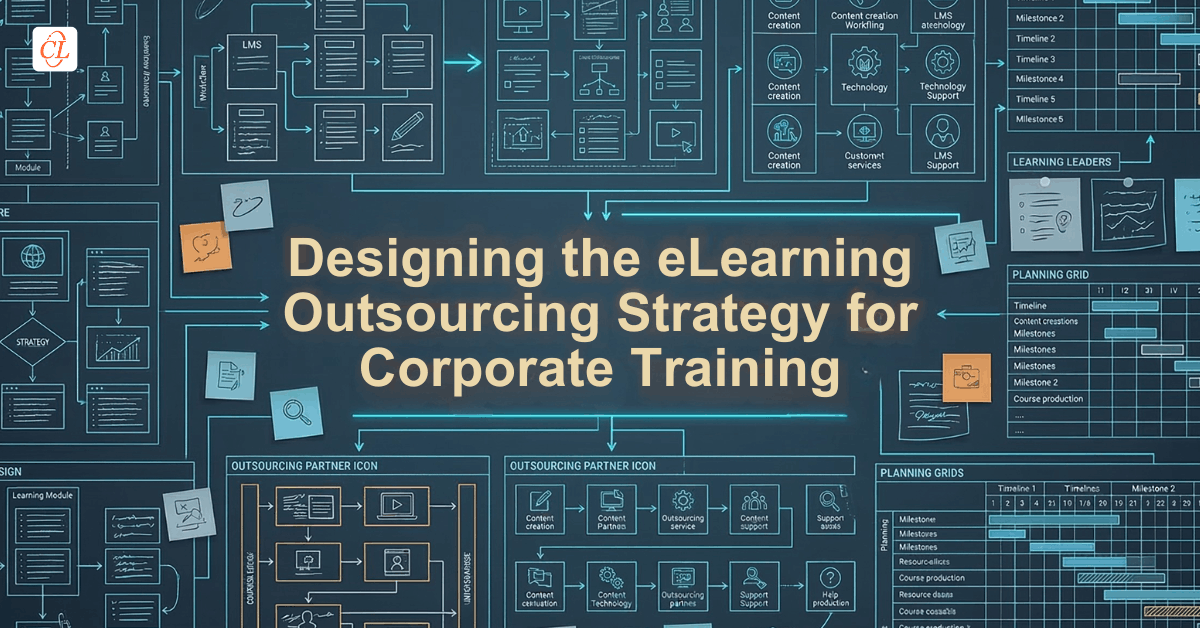
- Creating a Structured eLearning Outsourcing Workflow
- Frequently Asked Questions
- Conclusion
The Strategic Role of eLearning Outsourcing in Corporate Training
Corporate learning initiatives increasingly require speed, scalability, and specialization. Organizations must deliver training across multiple locations, languages, and roles. Learning programs must adapt quickly as technologies evolve, regulations change, and new skills become necessary.
Internal learning teams often focus on:
- learning strategy
- curriculum design
- stakeholder alignment
- performance analysis
But large scale content development can overwhelm internal resources. This is why many organizations adopt elearning outsourcing as part of their learning strategy.
Outsourcing allows companies to:
- Accelerate course development timelines
- Access specialized instructional design expertise
- Scale training production across multiple programs
- Maintain consistent learning quality
When implemented strategically, outsourcing becomes an extension of the internal learning team rather than a replacement for it.
eLearning outsourcing partners may support a range of activities including instructional design, course development, multimedia production, learning technology integration, and localization and translation Some organizations outsource entire training programs, while others outsource specific elements such as course conversion or rapid development projects.
The goal is not simply to reduce workload. The real objective is to expand learning production capacity while preserving instructional quality and strategic oversight.
Internal Preparation Before Outsourcing eLearning Development
One of the most common mistakes organizations make is approaching outsourcing without sufficient preparation.
Before contacting vendors, internal teams should clarify several foundational elements.
Define the scope of the learning project
Training initiatives vary significantly in complexity.
Some involve short microlearning modules, while others require large curriculum programs with assessments and simulations.
Clearly defining scope helps vendors estimate effort accurately.
Identify internal stakeholders
Successful learning projects involve multiple stakeholders.
These may include:
- Subject matter experts
- Learning leaders
- Compliance teams
- Technology administrators
Identifying decision makers early prevents delays during development reviews.
Determine the level of vendor involvement
Organizations must decide how much responsibility the vendor will assume.
Some vendors handle only development tasks. Others provide full instructional design support.
Clarifying responsibilities ensures smoother collaboration.
Defining Clear Learning and Project Requirements
Outsourcing works best when project expectations are explicit. Ambiguous requirements create confusion, increase revision cycles, and extend development timelines.
Learning teams should prepare documentation that describes:
- Learning objectives: Objectives clarify what learners must be able to do after completing the course. They guide instructional design decisions and assessment strategies.
- Target audience: Understanding the audience ensures the course content matches learners’ experience level, job context, and learning needs.
- Source materials: Most training programs begin with existing content such as instructor led training materials, product documentation, policy documents and presentations. Organizing these materials helps vendors begin development faster.
- Technology requirements: Teams should define which learning platforms or authoring tools will be used.
Compatibility with the organization’s learning ecosystem is essential.
Key Factors Organizations Evaluate Before Outsourcing
Outsourcing decisions involve more than cost comparison. Organizations must evaluate whether outsourcing aligns with their learning strategy and operational requirements.
Several factors typically influence the decision.
Project volume and scale
Organizations with large training pipelines often benefit most from outsourcing. External partners can accelerate production without increasing internal headcount.
Specialized expertise
Certain learning projects require skills that internal teams may not possess. Examples include advanced simulations, scenario based learning, or multimedia storytelling.
Timeline constraints
When training must be delivered quickly, external development teams provide additional capacity. This prevents internal teams from becoming bottlenecks.
Long term learning strategy
Organizations that plan large scale digital learning transformation often build long term vendor partnerships.
These partnerships create consistency across multiple training initiatives.

A Practical Guide to Outsourcing E-Learning Design & Development
Tips and Best Practices for an Effective Outsourcing Journey
- eLearning Elements that can be Outsourced
- Tasks Before Outsourcing
- Tips for Selecting the Right eLearning Vendor
- Ways to Support your Vendor
How to Evaluate and Select an eLearning Vendor
Choosing the right partner is one of the most important steps in the outsourcing process.
Vendor evaluation should focus on several dimensions.
Instructional design expertise
Strong vendors demonstrate the ability to transform raw content into effective learning experiences.
Their portfolios should show:
- scenario based learning
- interactive learning activities
- assessment design
- learner engagement strategies
Development capabilities
Organizations should examine the vendor’s technical capabilities.
This includes experience with authoring tools, multimedia production, and learning technology integration.
Quality assurance processes
Reliable vendors follow structured quality assurance workflows.
These workflows typically include:
- internal design reviews
- functional testing
- compatibility testing
- stakeholder validation
Communication practices
Learning projects often involve multiple feedback cycles.
Vendors should demonstrate clear communication processes and defined review stages.
Building an Effective Collaboration Model with Vendors
Even highly capable vendors cannot succeed without effective collaboration.
Outsourcing works best when the vendor operates as a partner rather than an isolated service provider.
Establish review milestones
- Structured review checkpoints allow stakeholders to provide feedback early.
- This prevents large revisions later in the project.
Provide access to subject matter experts
- Subject matter experts play a critical role in validating content accuracy.
- Ensuring timely SME availability prevents development delays.
Maintain clear communication channels
- Regular communication ensures that project expectations remain aligned.
Organizations often schedule weekly or biweekly check ins during development.
Creating a Structured eLearning Outsourcing Workflow
Successful outsourcing initiatives rely on structured workflows.
A typical workflow may include several phases.
- Planning: The organization defines learning objectives, scope, timelines, and required deliverables.
- Design: Instructional designers develop course structures, storyboards, and interaction concepts.
- Development: Course content is built using authoring tools, multimedia elements, and assessments.
- Review and revisions: Stakeholders review the course and request revisions before final approval.
- Deployment: Courses are published and integrated into the organization’s learning platform.
Clear workflows ensure consistent development across multiple training projects.
FAQ
1. What is elearning outsourcing?
A. Elearning outsourcing is the practice of partnering with external specialists to design or develop digital training programs. Organizations outsource tasks such as instructional design, course development, multimedia production, and learning technology integration to scale training delivery efficiently.
2. How do organizations prepare before outsourcing elearning development?
A. Preparation typically involves defining learning objectives, organizing source materials, identifying target audiences, assigning subject matter experts, and clarifying technology requirements. This preparation ensures vendors understand the project scope and can develop training efficiently.
3. How do companies choose an elearning vendor?
A. Organizations evaluate vendors based on instructional design expertise, development capabilities, communication processes, quality assurance methods, and experience with corporate learning programs. Vendor portfolios and sample work often help determine suitability.
4. What are the benefits of elearning outsourcing?
A. Outsourcing allows learning teams to scale training production, access specialized expertise, reduce development timelines, and maintain consistent learning quality across multiple training programs.
5. When should organizations consider outsourcing training development?
A. Organizations typically consider outsourcing when internal learning teams face high training demand, limited development capacity, tight deadlines, or specialized project requirements such as multimedia simulations or large curriculum development.
6. How do organizations manage outsourced learning projects?
A. Successful organizations establish structured workflows that include planning, design reviews, development checkpoints, and quality assurance testing. Regular communication between internal teams and vendors ensures alignment throughout the project.
Conclusion
Outsourcing learning development is not simply a procurement decision. It is a strategic choice that determines how effectively an organization can scale training programs while maintaining instructional quality.
When approached thoughtfully, elearning outsourcing enables learning teams to extend their capabilities without expanding internal resources.
Success begins with internal preparation. Clear learning objectives, well defined requirements, and structured vendor evaluation processes create the foundation for productive partnerships.
Organizations that treat outsourcing as a collaborative extension of their learning ecosystem consistently achieve stronger results. Instead of struggling with capacity limitations, they build a scalable model that allows training initiatives to grow alongside organizational needs.


![Top 6 eLearning Authoring Tools to Convert PPT to eLearning [Infographic]](https://www.commlabindia.com/hubfs/Imported_Blog_Media/authoring-tools-convert-ppt-elearning.jpg)

![How to Choose An eLearning Vendor that’s Just Right for You! [Video]](https://www.commlabindia.com/hubfs/Imported_Blog_Media/elearning-vendor-selection-guide-video-v2.jpg)