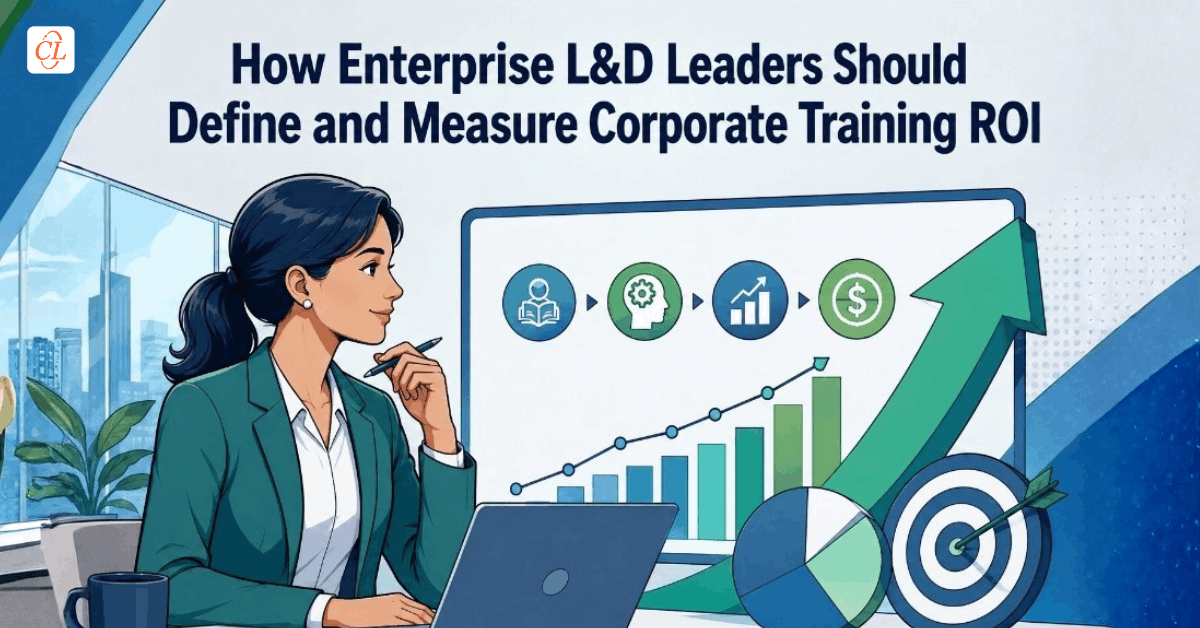
Training ROI has become one of the most debated metrics in enterprise L&D, not because measuring it is impossible, but because most organizations measure it wrong.
In large organizations, particularly in manufacturing, energy, health and pharma, and logistics, employee training and development represents a significant budget line. Yet when stakeholders ask "What are we getting back?" L&D teams often struggle to answer with numbers. The culprit isn't the training. It's how ROI is defined.
This blog breaks down what training ROI actually means, what most organizations get wrong, and how L&D leaders can build a measurement approach that holds up in the boardroom.
Table Of Content
- What Training ROI Actually Measures?
- The Real-World Relevance Problem
- How to Build an ROI Measurement Framework That Works?
- The Employee Engagement Multiplier
What Training ROI Actually Measures?
Training ROI isn't a single metric. It's a composite picture made up of at least four measurable dimensions:
1. On-the-Job Performance Improvement
This is the closest proxy for real-world relevance. Did the employee apply what they learned? Are error rates, cycle times, safety incidents, or output quality measurably different 60 to 90 days post-training?
In manufacturing environments, for example, skills training on standard operating procedures can be tied directly to first-pass yield rates or downtime incidents. That's a traceable ROI signal. McKinsey's research on advanced manufacturing identifies reducing time-to-proficiency as one of the highest-leverage drivers of productivity improvement, making ramp-up speed a critical ROI metric for workforce training.
2. Employee Engagement and Retention
Organizations with robust upskilling and reskilling programs see measurably higher engagement scores, and engagement directly correlates with retention. In a sector like health and pharma, where replacing a trained clinical specialist can cost 150% of their annual salary, retention ROI alone can justify a significant training investment.
The Society for Human Resource Management (SHRM) found that 76% of employees are more likely to stay with a company that offers continuous training.
3. Speed to Competence
How quickly does a new hire or reskilled employee reach full productivity? Corporate training designed around real job tasks, not generic content, compresses that timeline. For energy companies onboarding technicians into complex field roles, even a two-week reduction in ramp time translates to measurable output gains.
4. Compliance and Risk Reduction
For regulated industries — pharma, energy, logistics- the cost of non-compliance dwarfs almost any training budget. Avoided penalties, audit findings, and incident costs are legitimate ROI inputs, even if they're often left out of the calculation.
The Real-World Relevance Problem
One of the most consistent findings in enterprise L&D is that training fails to generate ROI not because of delivery format, but because of relevance. When employees don't see the connection between what they're learning and what they actually do, transfer to the job doesn't happen.
The fix is usually upstream. A few approaches that work in practice:
1. Scenario-based Learning Built Around Real Tasks
Instead of generic modules, learners work through situations they will actually face on the job. A pharma quality control technician practices identifying documentation errors in a simulated batch record. A logistics supervisor works through a live decision tree for a delayed shipment. The learning sticks because the context is familiar.

2. Job Aids Embedded at the Point of Performance
Not everything needs to be memorized. Quick-reference guides, digital checklists, and decision support tools placed within the workflow mean employees can apply the right process in the moment, without relying solely on recall from a training session completed weeks earlier.
3. Post-Training Reinforcement Tied to Specific Work Outputs
A single training event rarely changes behavior on its own. Spaced reinforcement, manager check-ins, and on-the-job practice assignments that connect back to measurable outputs, such as reduced error rates or faster processing times, keep the learning active and build the performance data needed to demonstrate ROI.
4. Peer Learning and On-the-Job Coaching
Structured knowledge-sharing between experienced employees and newer ones accelerates competency in ways formal training alone cannot. In manufacturing and energy environments especially, pairing classroom or eLearning courses with guided practice on the floor closes the gap between knowing and doing.
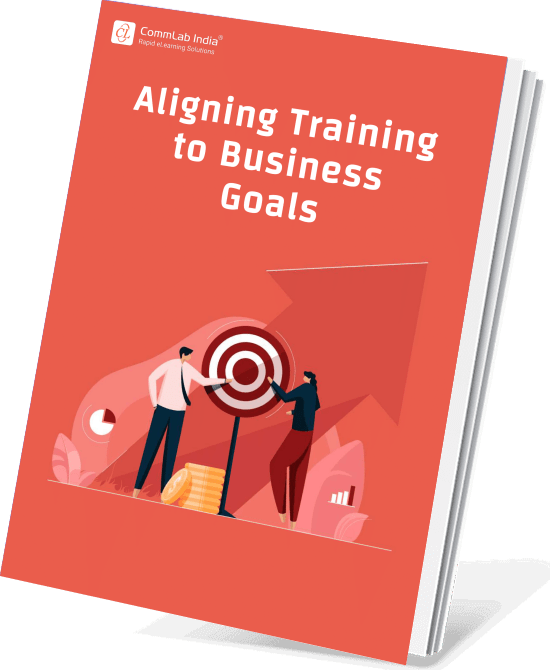
Align Training with Business Goals
Editable Questionnaire to Help You Make the Right Choice!
- Identify organizational goals
- Check what your people need to do achieve those goals
- Identify SMART learning objectives to fill performance gaps
- Design for impact
How to Build an ROI Measurement Framework That Works?
Here's what a practical measurement approach looks like for large enterprise L&D teams:
- Start with Business Outcomes, not Learning Objectives
Before designing any training program, align with operations leaders on the specific business metrics the training is meant to move. Safety incident rate, product defect rate, customer complaint resolution time, these are your ROI anchors. Learning objectives follow from there. - Define your Baseline
You can't demonstrate improvement without a starting point. Pull pre-training performance data where possible. For compliance-heavy sectors, this might be audit findings or incident logs. For sales or service roles, it might be resolution rates or customer satisfaction scores. - Measure at 60 to 90 Days Post-Training
Kirkpatrick Level 3 (behavior) and Level 4 (results) data require time. Build post-training check-ins into the program design — not as an afterthought, but as a funded deliverable. - Separate What Training Influenced from What It Didn't
Acknowledge contributing factors. If on-the-job performance improved after training, and you can show that trained employees outperformed untrained peers in equivalent roles, that's a credible causal argument. If you can't make that comparison, be honest with stakeholders about what the data does and doesn't show.
The Employee Engagement Multiplier
Training ROI doesn't just flow through performance. It flows through people.
Employees who receive regular, relevant corporate training report higher engagement scores, stronger organizational commitment, and greater willingness to stay. In large-scale organizations, a 2-point improvement in engagement score — driven in part by structured upskilling and reskilling programs can translate to millions in avoided turnover and productivity gains.
This is often called the "soft" side of training ROI. That framing undersells it.
Frequently Asked Questions About Corporate Training ROI
1. What is training ROI?
A. Training ROI measures the business value returned from a training investment relative to its cost. In practice, it includes on-the-job performance improvements, employee retention gains, reduced compliance risk, and faster time to competency — not just a single financial ratio.
2. How do you calculate ROI for employee training and development programs?
A. Start by identifying the business metric your training is designed to improve — such as error rates, safety incidents, or employee retention. Measure that metric before and after training, isolate training as a contributing factor where possible, then compare the value of the improvement against total program costs.
3. Why does training often fail to show measurable ROI?
A. The most common cause is a lack of real-world relevance. When training content doesn't reflect actual job tasks, employees don't apply what they've learned, and performance doesn't change. Other factors include poor baseline measurement, no post-training follow-up, and outcomes that aren't tied to specific business metrics from the start.
Wrapping Up!
Training ROI isn't a single number. It's a story told through performance data, engagement trends, speed to competence, and risk reduction, all measured against a baseline and connected to real business outcomes.
For L&D leaders in large enterprises, the goal isn't to prove that training happened. It's to demonstrate that it moved something that matters. That starts with asking a sharper question before any program launches: what specific business outcome are we designing this training to change?
Answer that, build your measurement plan around it, and training ROI becomes something you can actually defend.
Ready to connect your training programs to real business goals?
Download our Template for Aligning Training to Business Goals. It includes tools for identifying performance needs, a step-by-step alignment framework, and guidelines for defining the KPIs that matter most to your stakeholders.