
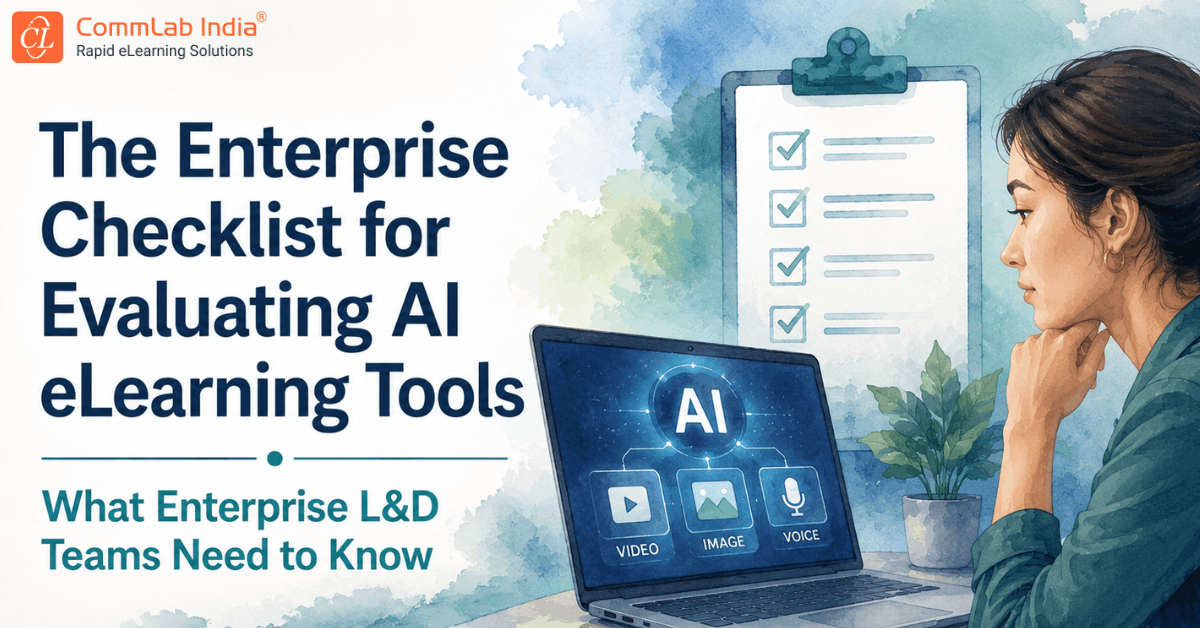
Budgets are moving. Timelines are shrinking. And every eLearning authoring tool vendor suddenly has an AI feature.
For enterprise L&D leaders managing corporate training at scale, that creates a real problem: how do you separate tools that genuinely accelerate eLearning development from ones that bolt on AI as a marketing move?
The answer isn't to move faster. It's to evaluate smarter.
This framework gives you the criteria that matter when assessing AI tools for eLearning development across a global, complex organization.
Table Of Content
- What Makes AI eLearning Tool Selection Different from Traditional Tool Evaluation?
- What Should Drive your AI Tool Evaluation Strategy?
- Can the Tool Scale Rapid eLearning Across the Enterprise?
- What does a Responsible AI Tool Pilot Look Like?
- How Can L&D Leaders Build an Effective Evaluation Process?
- What If You Could Skip the Learning Curve Entirely with Outsourcing?
- What This Means for Enterprise L&D Leaders
What Makes AI eLearning Tool Selection Different from Traditional Tool Evaluation?
Traditional eLearning tool evaluations typically focus on functionality, usability, pricing, and vendor support. While those factors remain important, AI introduces an entirely new layer of considerations.
Unlike conventional software, AI continuously generates content, learns from data, and evolves over time. That means organizations must evaluate not only what the tool can do today, but also how responsibly it creates, manages, and updates learning content.
Key evaluation areas include:
- Data privacy and security
- Model accuracy and hallucinations
- Bias and fairness
- Intellectual property ownership
- Regulatory compliance
- Human review workflows
- Governance and auditability
- Ongoing model improvements
These considerations become even more critical when AI is used to create for compliance training, onboarding, leadership development, product training, and multilingual learning initiatives.
Enterprise evaluation therefore extends far beyond a traditional feature checklist.
What Should Drive your AI Tool Evaluation Strategy?
Before scheduling vendor demonstrations, define what success actually looks like for your organization.
Many procurement processes for eLearning authoring tools begin by comparing features and pricing. Enterprise L&D teams should instead evaluate whether AI helps solve real business problems, such as reducing development bottlenecks, updating courses faster, or scaling learning across regions.
An effective evaluation framework should cover five dimensions:
1. Instructional Effectiveness
Can AI generate meaningful learning experiences instead of simply producing more content?
Evaluate:
- Scenario quality
- Assessment relevance
- Personalization capabilities
- Human review workflows
2. Technical Compatibility
Can the solution fit into your existing learning ecosystem?
Look for:
- LMS integration
- SCORM/xAPI support
- SSO compatibility
- APIs
- Review and approval workflows
- Integration with existing authoring environments
3. Data Security and Governance
Enterprise AI must protect organizational knowledge.
Evaluate:
- Data storage
- Encryption
- Access controls
- Content ownership
- Audit trails
- Regulatory compliance
4. Responsible AI Practices
Understand how vendors manage:
- Bias mitigation
- Explainability
- Human oversight
- AI content disclosure
- Copyright protection
- Model updates
5. Business Impact
Ultimately, AI should improve learning operations.
Measure whether it helps:
- Reduce development time
- Lower production costs
- Scale Rapid eLearning
- Improve content consistency
- Accelerate course updates
- Increase learning team capacity
Any vendor conversation that overlooks multiple dimensions should be approached cautiously.
Can the Tool Scale Rapid eLearning Across the Enterprise?
Many AI tools perform well during a small pilot. The real test is whether they continue delivering value when your organization needs hundreds of learning assets across multiple business units, regions, and languages.
Ask questions such as:
- Can it support multiple instructional designers working simultaneously?
- Can it rapidly update existing courses when regulations change?
- Does it handle multilingual learning efficiently?
- Can templates maintain branding across global teams?
- Will it support both new course creation and legacy course modernization?
Enterprise AI should make rapid eLearning sustainable, not just faster for individual projects.
What does a Responsible AI Tool Pilot Look Like?
A pilot should validate business outcomes rather than simply demonstrate AI features.
Structure your pilot around four questions:
- Did the tool significantly reduce eLearning development time without reducing instructional quality?
- Were learner completion, engagement, and assessment outcomes comparable or better than manually developed courses?
- Did the AI-generated content introduce any compliance, security, bias, or factual accuracy concerns?
- Could the tool integrate smoothly into existing development workflows without increasing review or rework?
A successful pilot should demonstrate measurable improvements in both productivity and learning effectiveness.
How Can L&D Leaders Build an Effective Evaluation Process?
A structured procurement process reduces implementation risk and improves long-term adoption.
Enterprise Due Diligence Checklist
Before selecting an AI tool, evaluate:
✓ Business problem alignment
✓ Support for Rapid eLearning initiatives
✓ Security and compliance readiness
✓ Scalability across regions and languages
✓ Quality of AI-generated learning content
✓ Integration with LMS and enterprise systems
✓ Governance and workflow controls
✓ Vendor transparency and AI roadmap
✓ Responsible AI safeguards
✓ Total cost of ownership
✓ Expected business ROI
Organizations that evaluate AI systematically are far more likely to achieve sustainable adoption than those driven by feature comparisons alone.
What If You Could Skip the Learning Curve Entirely with Outsourcing?
Evaluating, piloting, and governing AI tools is the right approach. But it demands time, internal expertise, and a tolerance for iteration that not every L&D team has, especially when you're managing hundreds of active courses, a global learner base, and a content backlog that keeps growing.
This is where a specialized eLearning company offer a practical advantage.
Here's what that looks like in practice:
Authoring and rapid eLearning development: Vendors working at scale use tools like Articulate 360, iSpring Suite, and Dominknow to build responsive, SCORM-compliant eLearning courses with speed and instructional rigor. The AI-assisted features inside these platforms are most effective in the hands of instructional designers who use them daily.
Video and visual content at scale: AI video creation platforms like Synthesia and Vyond allow experienced vendors to produce multilingual, on-brand video content without studio costs or lengthy production cycles. An avatar-led compliance module that would take weeks to film and edit can be produced, localized, and updated in a fraction of the time. That matters enormously for global organizations with frequent regulatory changes.
Multilingual and localization workflows: eLearning translation and localization are where AI tools deliver some of the clearest ROI, and where quality control matters most. Vendors proficient in tools like DeepL and SmartCat can build localization pipelines that combine AI-powered eLearning translation with human post-editing, maintaining terminology consistency across 10 or 20 languages without the quality drop that pure machine translation produces.
Visual and creative content: Tools like Midjourney are reshaping how custom imagery is sourced for eLearning courses. In skilled hands, AI-generated visuals can replace expensive stock photography and custom illustration work while maintaining brand alignment. But governance matters here too: responsible vendors have clear policies on image ownership, bias in visual representation, and compliance with emerging AI content regulations.
What This Means for Enterprise L&D Leaders
Outsourcing to an AI-proficient eLearning partner is not about ceding control. It’s about deploying your internal bandwidth where it creates the most value: strategy, governance, learner experience design, and stakeholder alignment.
The due diligence framework in this blog still applies. When evaluating an eLearning vendor, ask which AI tools they use, how they govern AI-generated content, and what quality assurance looks like at each stage of production. A vendor that can answer those questions clearly, with documented processes, not just a tools list, is one worth shortlisting.
Whether you develop courses in-house or work with an AI-proficient eLearning partner, evaluate every solution through the lens of business outcomes, not AI features. When speed, instructional integrity, security, and scalability come together, AI becomes more than a productivity tool, it becomes a strategic advantage for enterprise learning.
Want to make outsourcing work smarter for your L&D team?
Download our Outsourcing Guide to discover best practices for saving time, compare the pros and cons of outsourcing each eLearning development element, and learn how to choose the right eLearning vendor. Use it as your practical next step for building faster, scalable, and quality-driven eLearning.



![What is Custom eLearning — Benefits & Tips for Effective Design [Infographic]](https://www.commlabindia.com/hubfs/blogs/custom-elearning-benefits-design-tips.jpg)