Most organizations already have training content. The real challenge is not creating content from scratch, but deciding what to do with what already exists.
Some materials are still relevant but outdated in format. Some are valuable but too long. Some are no longer aligned with current needs. Treating all content the same leads to wasted effort, unnecessary redevelopment, and slow progress.
This is where the 4Rs framework becomes essential.
Download Now: The 4Rs of Rapid eLearning
The 4Rs of rapid eLearning provide a structured way to evaluate and transform existing training content. Instead of rebuilding everything, it helps teams make smarter decisions about what to reuse, what to update, what to redesign, and what to rebuild.
In this article, you will understand the 4Rs framework, how it works, and how to apply it to create faster, more effective training.
Why Content Transformation Needs a Framework
Organizations often accumulate large volumes of training content over time. Instructor-led materials, presentations, legacy courses, videos, and documents all hold value.
The problem is not lack of content. It is lack of structure in how that content is used.
Without a clear framework:
- teams rebuild content unnecessarily
- valuable materials are ignored
- timelines increase
- costs rise
- consistency decreases
The 4Rs framework introduces a decision-making model that simplifies content transformation.
What the 4Rs of Rapid eLearning Are
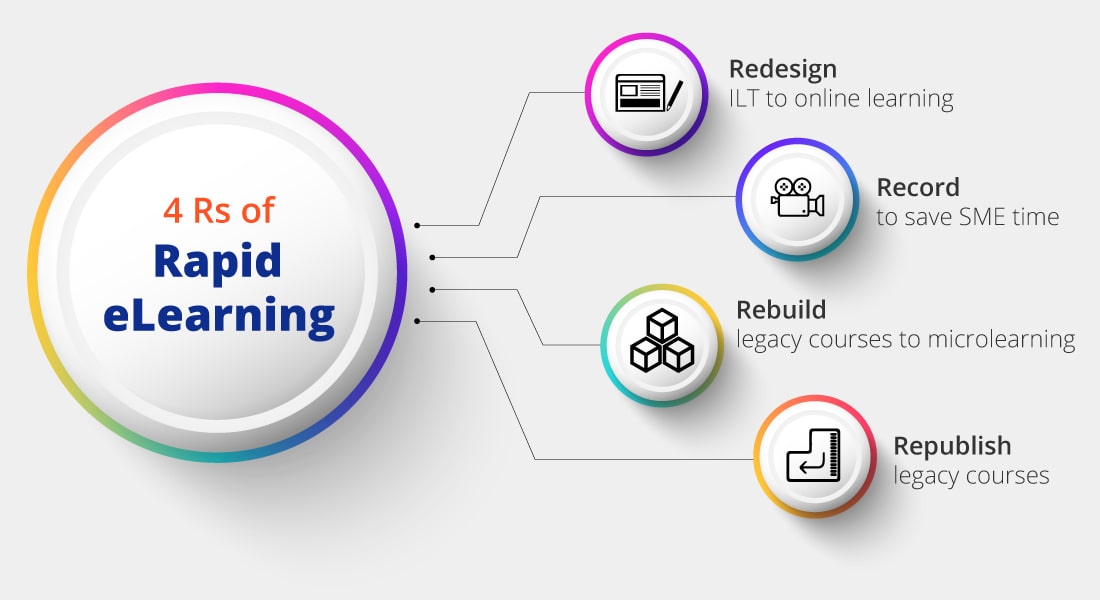
The 4Rs framework categorizes content transformation into four approaches:
- Record
- Republish
- Rebuild
- Redesign
The 4Rs framework is a method for evaluating and converting existing training content based on its relevance, complexity, and required level of transformation.
Each “R” represents a different level of effort and value.
The Strategic Role of the 4Rs Framework
The 4Rs are not just conversion methods. They are a prioritization system.
They help answer critical questions:
- Do we need to rebuild this content or can we reuse it?
- How much effort is justified for this training need?
- What level of transformation will deliver the best outcome?
Note: Not all content deserves the same level of investment. The 4Rs framework ensures that effort is aligned with value.
R1: Record
Recording is the simplest and fastest approach.
What it involves
- capturing live training sessions
- recording webinars or instructor-led sessions
- converting sessions into video-based learning
When to use it
- content is still relevant
- speed is the priority
- minimal transformation is needed
Benefits
- fastest turnaround
- minimal development effort
- preserves expert knowledge
Limitations
- limited interactivity
- lower engagement compared to structured courses
R2: Republish
Republishing involves converting existing content into a digital format without major changes.
What it involves
- converting presentations into eLearning
- updating formats for compatibility
- ensuring responsiveness across devices
When to use it
- content is accurate and structured
- only format changes are required
- timelines are tight
Benefits
- quick conversion
- cost-effective
- improves accessibility
Limitations
- may not fully optimize learning experience
- limited instructional enhancement
R3: Rebuild
Rebuilding involves improving existing content while retaining its core structure.
What it involves
- enhancing visuals and interactions
- restructuring content flow
- improving assessments
- adding engagement elements
When to use it
- content is relevant but outdated
- learning experience needs improvement
- moderate transformation is required
Benefits
- improves learner engagement
- enhances clarity and usability
- balances speed and quality
R4: Redesign
Redesigning is the most comprehensive approach.
What it involves
- rethinking learning objectives
- restructuring content completely
- applying new instructional strategies
- redesigning for modern learning formats
When to use it
- content is outdated or ineffective
- learning goals have changed
- a new approach is required
Benefits
- highest impact on learning outcomes
- aligns with current needs
- enables modern learning experiences
Trade-off
- requires more time and effort compared to other Rs
How to Choose the Right R
Selecting the right approach is critical.
Key decision factors
- content relevance
- complexity of the topic
- available time
- required level of engagement
- business priorities
Simple decision logic
- If content is current and usable → Record or Republish
- If content needs improvement → Rebuild
- If content is outdated or misaligned → Redesign
Choose the R based on value, not convenience.
Common Mistakes When Using the 4Rs
Even with a framework, mistakes can occur.
- Treating all content the same: Applying a single approach to all content reduces effectiveness.
- Choosing speed over suitability: Selecting faster options when deeper transformation is needed leads to poor outcomes.
- Ignoring instructional design: Even when republishing or recording, learning structure still matters.
- Over-investing in low-impact content: Not all content requires redesign. Effort should match importance.
Best Practices for Effective 4Rs Implementation
To maximize the value of the 4Rs framework, organizations should:
Evaluate content systematically
Assess relevance, accuracy, and usefulness before choosing an approach.
Align with business goals
Ensure content transformation supports current priorities.
Combine approaches where needed
Different modules within a program may require different Rs.
Plan for scalability
Design content so it can be updated and reused easily.
Focus on learner outcomes
The goal is not just conversion, but effective learning.
FAQ
1. What are the 4Rs of rapid eLearning?
A. The 4Rs are Record, Republish, Rebuild, and Redesign. They represent different approaches to transforming existing training content.
2. Why is the 4Rs framework important?
A. It helps organizations decide how to reuse or transform content efficiently, saving time and resources.
3. How do you choose between the 4Rs?
A. The choice depends on content relevance, required effort, and desired learning outcomes.
4. Can multiple Rs be used in one project?
A. Yes. Different parts of a training program can use different approaches based on their needs.
5. Is redesign always the best option?
A. No. Redesign requires more effort and should only be used when significant changes are needed.
6. How does the 4Rs framework improve efficiency?
A. It reduces unnecessary redevelopment and ensures effort is focused where it delivers the most value.
Conclusion
The 4Rs framework changes how organizations approach training content.
Instead of starting from scratch or applying the same solution everywhere, it introduces a structured way to make smarter decisions.
By aligning effort with value, the 4Rs enable faster development, better use of existing resources, and more effective learning outcomes.
When applied correctly, it turns content transformation into a strategic advantage rather than a recurring challenge.