For enterprise L&D leaders, eLearning outsourcing is no longer just a way to reduce development workload. It has become a practical strategy for scaling training execution without overloading internal teams, delaying business priorities, or compromising quality.
This is especially true for large enterprises managing compliance training, product training, sales enablement, technical training, and multilingual workforce programs. Internal L&D teams often know the business, the learners, and the strategic priorities. But they may not always have enough instructional designers, developers, project managers, visual designers, LMS administrators, translators, or QA specialists to deliver everything at the speed the business expects.
The result is familiar. Product teams need training before the next release. Compliance teams need annual updates. Sales leaders need enablement assets. Regional teams need localized versions. SMEs are busy. LMS teams are stretched. Learning leaders spend more time coordinating vendors, reviews, and timelines than shaping learning strategy.
This guide helps enterprise L&D leaders and training managers evaluate the best eLearning outsourcing vendors for corporate training needs, especially compliance and product training. It also explains what to look for in a partner, how to match vendors to service needs, and how to avoid common selection mistakes.
Table of Contents
- Why Large Enterprises Are Rethinking eLearning Outsourcing
- Top 7 eLearning Outsourcing Vendors for Corporate Training
- How to Evaluate eLearning Outsourcing Vendors
- Common Challenges in Corporate Training Outsourcing
- Best Practices for Training Vendor Selection
- FAQs
- Choosing the Right eLearning Outsourcing Partner
Why Large Enterprises Are Rethinking eLearning Outsourcing
Enterprise training demand has become more complex. L&D teams are no longer building isolated courses. They are supporting global workforces, changing products, distributed teams, regulatory requirements, digital transformation, and evolving skill needs.
LinkedIn’s 2025 Workplace Learning Report found that 49% of L&D and talent professionals agree that executives are concerned employees do not have the right skills to execute business strategy. The World Economic Forum’s Future of Jobs Report 2025 identifies skill gaps as one of the biggest barriers to business transformation. Deloitte’s 2025 Global Human Capital Trends also reports that 66% of managers and executives say most recent hires are not fully prepared.
For training leaders, these findings point to one reality: learning execution capacity matters. Strategy alone is not enough. Enterprises need the ability to convert content into effective learning quickly, update it regularly, translate it accurately, and deploy it across platforms and regions.
That is where corporate training outsourcing can help. The right partner brings structure, speed, instructional design depth, development capacity, quality assurance, and operational support.
Top eLearning Outsourcing Vendors for Corporate Training
There is no single best vendor for every organization. The best choice depends on the type of training, the scale of work, the level of compliance risk, the number of languages, the internal team’s maturity, and the need for long-term support.
Below are leading training program vendors and where they may fit best.
1. CommLab India: Best for Scalable eLearning Execution, Rapid Development, and Global Training Rollouts
CommLab India is a strong fit for enterprise L&D teams that need reliable execution capacity across custom eLearning, rapid eLearning, translations, LMS support, staff augmentation, and digital learning development.
CommLab India’s positioning is especially relevant for two types of enterprise L&D ecosystems. The first is a small internal L&D team that needs end-to-end ownership, standardized processes, templates, checklists, and production support. The second is a mature L&D team with strong internal processes but a large training pipeline that requires flexible, skilled capacity at speed.
This makes CommLab India a practical choice for large enterprises that are not simply looking for a vendor to build courses, but for a partner that can simplify learning operations and reduce leadership bandwidth spent on coordination.
Best Fit
CommLab India is best suited for:
- Custom eLearning solutions
- Multi-year outsourcing programs
- Translations and localization
- LMS support and administration
- Staff augmentation for L&D roles
- On-demand learning execution
Why It Works
Many enterprises have large volumes of training content in different formats, across multiple divisions, regions, and platforms. CommLab India’s strength lies in helping standardize and scale this work.
For compliance training, this means repeatable development workflows, structured review cycles, and the ability to update courses annually or as policies change. For product training, it means faster development of modular learning assets that can be updated as products evolve.
CommLab India is also a strong option when training must be translated into multiple languages. For global enterprises headquartered in the US or Europe, this is often a major requirement. A single English course may need to become 10, 20, or more localized versions while preserving consistency, terminology, and instructional intent.
What to Ask
Ask how the vendor manages source files, version control, translation memory, review cycles, SME feedback, LMS testing, and ongoing updates. These operational details matter as much as the quality of the first course.
2. NIIT MTS: Best for Managed Learning Services and Enterprise Learning Operations
NIIT MTS is well suited for enterprises that want broad managed learning services rather than only course development. Its services often include learning administration, strategic outsourcing, content development, platform support, and learning operations.
Best Fit
Best suited for:
- Managed learning services
- Enterprise learning administration
- Global training operations
- Learning transformation initiatives
Why It Works
For organizations, training delivery is often an operational challenge. There may be multiple business units, vendors, systems, compliance requirements, and learner audiences. A managed services partner can help bring governance and operational consistency.
What to Ask
Ask whether the vendor’s model is optimized for full-scale learning operations or for specific content development needs. Some enterprises need a managed services provider, while others need more flexible on-demand learning execution capacity.
3. Infopro Learning: Best for Workforce Transformation and Performance-Focused Learning
Infopro Learning offers managed learning, leadership development, learning strategy, and performance consulting. It is a strong option for enterprises that want to connect training to broader capability development and business outcomes.
Best Fit
Best suited for:
- Workforce transformation
- Leadership development
- Capability academies
- Performance consulting
- Learning strategy and design
Why It Works
When training is tied to business transformation, a vendor must do more than create content. It must understand role readiness, behavior change, performance gaps, and measurement. They can be a good fit for initiatives where learning is part of an organizational change agenda.
What to Ask
Ask how the vendor measures impact beyond course completion. For compliance and product training, this may include confidence, behavior, proficiency, adoption, or business performance indicators.
4. Aptara: Best for Content Modernization and Digital Learning Production
Aptara has deep experience in content development, digital publishing, and learning transformation. It can be a good fit for companies with good volumes of legacy content that need to be converted, structured, and modernized.
Best Fit
Best suited for:
- Legacy content conversion
- Digital learning content development
- Technical content transformation
- Content production
- Documentation-heavy training programs
Why It Works
Many enterprises still have training content spread across PowerPoint decks, PDFs, instructor guides, job aids, manuals, and recorded sessions. A content modernization partner can help convert these assets into digital learning formats that are easier to maintain and deploy.
What to Ask
Ask how the vendor decides what content should become eLearning, microlearning, performance support, video, or a downloadable resource. Content conversion should not mean turning every slide into a screen.
5. Mindtools Kineo: Best for Learning Experience Design and Digital Programs
Mindtools Kineo is known for custom digital learning, learning platforms, and learning programs. It is often a good fit for enterprises looking for polished learner experiences and well-designed digital programs.
Best Fit
Best suited for:
- Custom digital learning
- Leadership and professional skills training
- Global learning journeys
- Blended learning programs
- Learner experience design
Why It Works
For training programs where engagement, brand experience, and learner journey design are important, They can offer strong creative and instructional design capability.
What to Ask
Ask how the vendor balances creative experience with speed, maintainability, and localization. Highly customized learning can be powerful, but it must also be practical to update.
6. TrainingPros: Best for Flexible L&D Talent Support
TrainingPros is a useful option for organizations that need experienced L&D professionals on a project or temporary basis. This model works well when the internal team owns the strategy but needs additional instructional designers, developers, or learning consultants.
Best Fit
Best suited for:
- L&D staff augmentation
- Instructional design support
- Project-based learning roles
- Custom training support
Why It Works
Not every organization wants to outsource an entire project. Some need specific talent to plug into existing workflows. This can be useful during product launches, compliance cycles, LMS migrations, or major content refreshes.
What to Ask
Ask how quickly resources can be onboarded, whether they are familiar with your tools, and how performance will be managed during the engagement.
7. Cegos: Best for Global Learning Programs and Local Adaptation
Cegos is a global learning provider with broad capabilities across leadership, professional skills, digital learning, and international training delivery. It can be a good fit for enterprises with global learner populations.
Best Fit
Best suited for:
- Global workforce training
- Leadership and soft skills
- Localized learning programs
- Blended learning
- International training delivery
Why It Works
Many organizations need training that works across regions. This requires more than translation. It requires cultural adaptation, regional delivery awareness, and consistency across markets.
What to Ask
Ask how the vendor manages localization, regional review, language quality, and consistency of learner experience across countries.
How to Evaluate eLearning Outsourcing Vendors
Start with the Training Problem
Before comparing vendors, clarify the business problem. Are you trying to reduce compliance risk? Speed up product adoption? Support sales readiness? Convert classroom training? Translate existing courses? Reduce internal workload?
The clearer the training problem, the easier it becomes to choose the right partner.
Match the Vendor to Your L&D Ecosystem
Enterprise L&D teams usually fall into two broad categories.
The first includes smaller internal teams that lack standardized processes or enough production capacity. These teams benefit from a partner that can provide end-to-end ownership, templates, workflows, and project management.
The second includes large internal teams with strong processes but too much work in the pipeline. These teams need skilled experts who can plug into their systems with minimal onboarding.
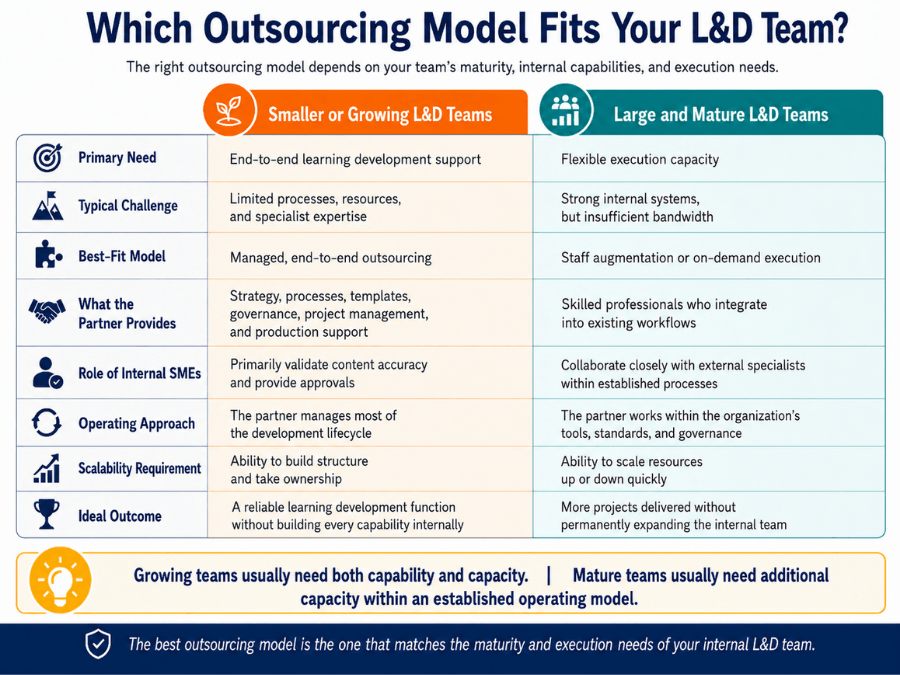
A vendor that works well for one ecosystem may not be ideal for the other. This is why training vendor selection should begin with your internal operating model.
Look for Speed with Standardization
Speed is important, but speed without process creates rework. The right eLearning outsourcing partner should have defined workflows for kickoff, content walkthroughs, project planning, detailed outlines, alpha and beta reviews, gold release, LMS testing, source file handover, closure, and feedback.
This is especially important for compliance and product training, where timelines are often tight and stakeholders are busy.
Evaluate Compliance Training Readiness
For compliance training, the vendor should understand that accuracy, documentation, and review control matter. Ask about SME review processes, version tracking, accessibility, audit readiness, and translation validation.
Compliance training should also be designed for application, not just acknowledgment. Learners need to recognize risks, make decisions, and apply policies in realistic workplace situations.
Evaluate Product Training Readiness
Product training changes often. A good vendor should design modular content that can be updated without rebuilding the entire course.
For SaaS, software, medical devices, manufacturing tools, or technical products, ask whether the vendor can develop simulations, walkthroughs, quick reference assets, release update modules, and role-based learning paths.
The best product training vendors understand that some content changes frequently, while customer outcomes, use cases, and decision principles remain more stable.
Check Technology and LMS Compatibility
A vendor should be comfortable working with your authoring tools, LMS, review tools, translation tools, and media tools. Common requirements include Articulate Storyline, Rise, Captivate, Lectora, Vyond, Synthesia, SCORM, xAPI, cmi5, mobile compatibility, and LMS testing.
Ask whether the vendor provides source files, LMS-ready packages, accessibility checks, and post-launch support.
Ask About Translation and Localization
For large enterprises with global teams, translation is often a major part of eLearning outsourcing. Poor translation can weaken compliance clarity, product understanding, and learner trust.
Ask about language coverage, translation workflows, review cycles, voiceover options, subtitle translation, terminology management, and cultural adaptation.
Common Challenges in Corporate Training Outsourcing
Challenge 1: Internal Teams Spend Too Much Time Coordinating
Many L&D leaders outsource to save time but end up managing every detail. This happens when the vendor lacks strong project management or clear processes.
The solution is to choose a partner that reduces leadership bandwidth, not one that adds another coordination layer.
Challenge 2: SMEs Delay the Project
SME availability is one of the biggest causes of training delays. Vendors should help structure SME reviews with clear timelines, focused questions, and decision checkpoints.
Challenge 3: Training Exists in Too Many Formats
Enterprises often have instructor decks, recordings, PDF guides, SOPs, videos, quizzes, and legacy eLearning modules. A good vendor can rationalize these formats and recommend what should become eLearning, microlearning, video, job aids, or VILT material.
Challenge 4: Courses Are Hard to Maintain
Training that looks impressive but is difficult to update becomes a liability. This is especially true for product training and compliance courses.
Ask vendors how they design for maintenance, versioning, and future updates.
Best Practices for Training Vendor Selection
Use a structured scorecard to compare vendors. Do not rely only on portfolios or proposal language.
Evaluate vendors across these areas:
| Evaluation Area | What to Look For |
| Enterprise experience | Experience with large, complex organizations and multiple stakeholders |
|
Instructional design |
Ability to design for performance, not just content presentation |
| Compliance readiness | Review workflows, documentation, accuracy checks, and update processes |
|
Product training capability |
Modular design, simulations, release updates, and technical content handling |
| Scalability | Ability to handle large volumes of courses, updates, and languages |
| Project management | Clear timelines, review cycles, escalation paths, and communication rhythm |
| Tool expertise | Storyline, Rise, Captivate, Vyond, LMS formats, and translation tools |
| Localization | Translation quality, terminology management, subtitles, voiceover, and QA |
| Flexible capacity | Ability to scale teams up or down based on demand |
| Source file ownership | Clear handover of source files and LMS-ready outputs |
Frequently Asked Questions
1. What is eLearning outsourcing?
A. eLearning outsourcing is the practice of partnering with an external vendor to design, develop, update, translate, or manage digital training programs. It can include custom eLearning, rapid eLearning, compliance training, product training, video learning, microlearning, LMS support, and multilingual course development.
2. How do I choose the right eLearning outsourcing vendor?
A. Start by defining your training goal, audience, timeline, compliance requirements, languages, LMS needs, and internal team capacity. Then compare vendors based on instructional design strength, enterprise experience, scalability, project management, quality assurance, tool expertise, and ability to support updates.
3. When should large enterprises outsource corporate training?
A. Large enterprises should consider corporate training outsourcing when internal L&D teams are overloaded, training demand is growing, content must be updated quickly, or programs need to scale across business units, languages, and platforms. Outsourcing is especially useful for compliance training, product training, rapid eLearning, translations, and LMS support.
4. Why do large enterprises outsource eLearning development to India?
A. Enterprises with global, multilingual workforces often outsource to India for the combination of cost efficiency and quality at scale, particularly for translation-heavy, high-volume training programs. The challenge for buyers is finding a partner with a proven multi-year track record across many divisions and regions, rather than a vendor sized for smaller, single-market engagements.
5. Should we choose an end-to-end managed vendor or a staff augmentation model?
A. It depends on your team's maturity. Smaller or newer L&D teams often benefit most from an end-to-end managed model that brings templates and process along with development. Larger teams with established systems typically get more value from staff augmentation, plugging skilled instructional designers and program managers directly into existing workflows.
Choosing the Right eLearning Outsourcing Partner
The best eLearning outsourcing vendor for Corporate training is the one that fits your business context, not just your content requirement.
If your internal team is small, look for a partner that can bring structure, templates, and end-to-end execution. If your internal team is mature but overloaded, look for flexible capacity that can plug into your workflows. If you manage compliance or product training, prioritize accuracy, maintainability, version control, and SME-friendly review processes.
For enterprise L&D leaders, the real value of outsourcing is not just course development. It is the ability to scale training, simplify operations, and keep internal teams focused on strategy, stakeholders, and business impact.