In large enterprises, corporate training has long operated as a service desk. A business unit submits a request, L&D builds a course, and the cycle repeats. For organizations in manufacturing, energy, health and pharma, and logistics, this model carries a hidden cost: training activity that rarely connects to business results.
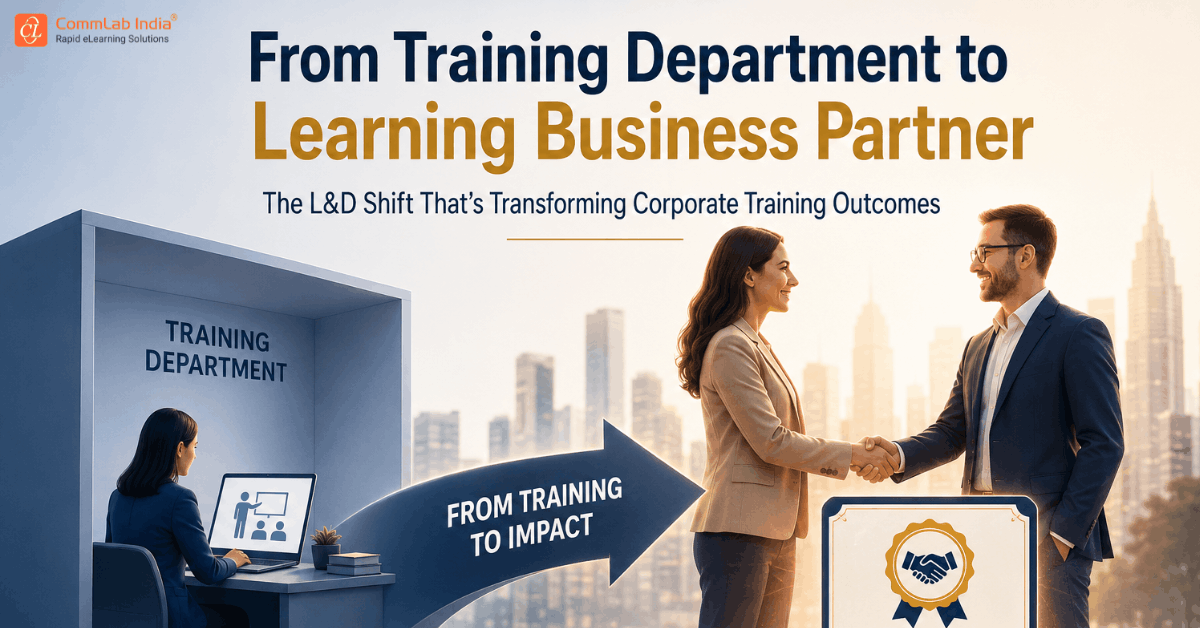
The shift from training department to learning business partner is not a rebrand. It is a fundamental change in how L&D leaders define their role, measure success, and earn influence at the leadership table. For L&D professionals in organizations with a large number of employees (typically 10,000+), it may be the most important structural shift of the decade.
This blog walks L&D leaders through what it means to transition from a traditional training department to a strategic learning business partner, why it matters, and the practical steps to make it happen.
Table Of Content
- What does a Learning Business Partner Actually do?
- Why is the Traditional Training Department Model Failing?
- How do L&D Leaders Make the Shift in Practice?
- What Role does Employee Training and Development Play in Business ROI?
- How Should L&D Leaders Build Internal Credibility for This Transition?
- FAQs About Transitioning from a Training Department to a Learning Business Partner
What does a Learning Business Partner Actually do?
A learning business partner (LBP) functions as an embedded strategic advisor to the business, not a vendor of training content. Where a traditional training department responds to requests, an LBP helps business leaders diagnose performance problems, identify whether corporate training is actually the right solution, and design interventions tied to measurable outcomes.
In a large pharmaceutical company, for example, an LBP embedded with the regulatory affairs team would not simply build compliance training modules. They would examine why audit failure rates are rising, identify the specific knowledge or process gaps driving them, and recommend a combination of on-the-job learning, job aids, and structured coaching, with success metrics tied to audit outcomes, not course completions.
That is the difference.
Why is the Traditional Training Department Model Failing?
The traditional model was built for a slower, more predictable business environment. The disconnect is measurable. According to McKinsey, only 40% of organizations report that their learning strategy is aligned with business goals, leaving the majority unable to demonstrate how learning investments support strategic priorities.

How do L&D Leaders Make the Shift in Practice?
The transition requires changes at three levels: mindset, methodology, and measurement.
1. Start with business fluency, not learning theory
Learning business partners speak the language of the business. They understand P&L basics, operational KPIs, and how workforce capability connects to commercial outcomes. For L&D leaders, this means moving beyond instructional design fluency and developing a working understanding of the business units they support.
A practical starting point: request time in quarterly business reviews. Not to present training updates, but to listen to how business leaders frame their priorities and challenges. This listening posture surfaces learning opportunities that no stakeholder survey would ever catch.
2. Apply a performance consulting lens before designing corporate training
Before any learning solution is scoped, an LBP conducts a performance analysis. This means distinguishing between knowledge gaps (where training helps), process gaps (where training does not), and motivation or environment gaps (where training may actually make things worse by appearing to address a problem it cannot solve).
For L&D teams accustomed to building whatever is requested, this can feel like slowing down. In practice, it eliminates low-impact work and accelerates the credibility that leads to strategic influence.
3. Reframe what you measure
The reporting shift is where L&D visibility changes most dramatically. Completion rates and learner satisfaction scores measure activity. Business partners measure impact.
In a logistics company, this might mean tracking whether a new driver onboarding program reduces time-to-full-productivity. In a pharmaceutical organization, it might mean connecting a medical affairs training intervention to improved submission quality scores. The metric depends on the business context, but the logic is the same: connect learning investment to an outcome the business already cares about.
What Role does Employee Training and Development Play in Business ROI?
Employee training and development have always been framed as a cost center. The learning business partner model reframes it as a lever for business ROI.
The LBP model creates that connection by design. When an L&D leader sits in on a strategic planning session for a new product launch in a European energy market, they are not there to book compliance training. They are there to map the capability requirements for success and build the learning strategy alongside the commercial strategy, not six months after it.
How Should L&D Leaders Build Internal Credibility for This Transition?
The transition does not happen through a memo or a reorg. It happens through a series of small, high-visibility wins.
Identify one business unit where the performance gap is visible and the leader is open to partnership. Conduct a proper training needs analysis. Propose a learning solution with explicit success metrics. Measure and report on outcomes. Repeat.
Each successful partnership creates a reference case that makes the next conversation easier.
FAQs About Transitioning from a Training Department to a Learning Business Partner
1. What is a learning business partner in corporate training?
A. A learning business partner is an L&D professional who works directly with business units to diagnose performance gaps, design targeted learning interventions, and measure outcomes tied to business KPIs, rather than managing training content delivery.
2. How does employee training and development contribute to business ROI?
A. When learning is connected to specific performance outcomes, such as reduced error rates, faster onboarding, or improved compliance scores, it creates measurable returns. The key is designing training against business objectives, not learning objectives alone.
3. How do L&D leaders start the transition from a training department to a business partner model?
A. The practical starting point is embedding with one business unit, conducting a performance needs analysis rather than a training needs analysis, and measuring the outcome of the first intervention against a business metric. Each successful case builds the internal credibility to expand the model.
The Strategic Moment for L&D is Now
The case for corporate training has never been easier to make, but it has also never required more precision. In large enterprises across manufacturing, energy, health and pharma, and logistics, the organizations winning on workforce capability are the ones where L&D functions as a true business partner.
The shift is practical, not philosophical. It starts with better questions, better measurement, and a willingness to walk away from low-impact work in favor of high-leverage partnership.
The training department that becomes a learning business partner does not just look different on an org chart. It produces outcomes the business can see.
Ensure your training initiatives are directly contributing to your organization’s strategic objectives with our template for aligning training to business goals.