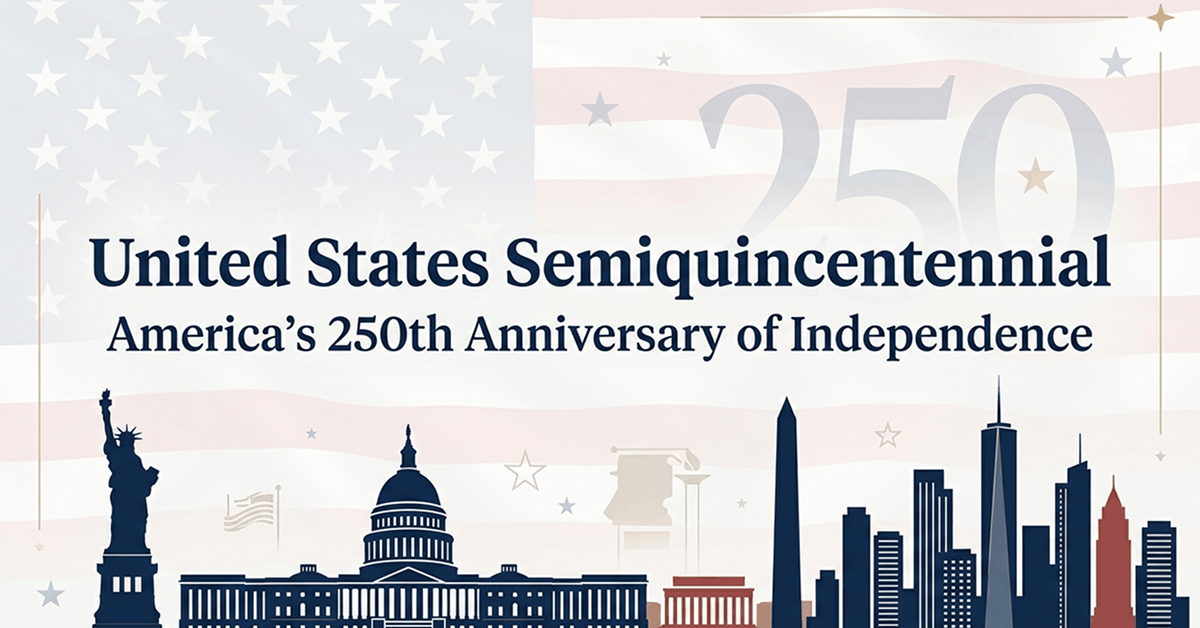
America turns 250 on July 4, 2026.
The weight of that number is worth a moment’s reflection. Two hundred and fifty years ago, a group of delegates sat down and wrote the most ambitious civic promise in human history — that all people are created equal, that they have the right to govern themselves, and that government exists to serve the people, not the other way around. They signed their names to it and bet everything on making it real.
The result is the longest continuously operating constitutional republic in human history — still growing, still building, still becoming. The United States Semiquincentennial stands as a milestone worthy of the deepest celebration.
Table Of Content
- What was the document that launched America and changed the world?
- Who actually built America — and where did they come from?
- What are America’s greatest innovations over 250 years?
- How has freedom expanded across America’s 250-year history?
- How did American culture shape the world?
- What are the most unique ways to celebrate America’s 250th birthday?
- What is the America250 Foundation doing to mark the Semiquincentennial?
- Why does America’s next 250 years matter more than ever?
- Frequently Asked Questions
What was the document that launched America and changed the world?
The Declaration of Independence is 1,320 words — readable in about five minutes. Within those words lies one of the most powerful ideas ever committed to paper: that human beings possess rights not because a king granted them, but because they are human.
That idea did not merely launch a country. It launched a movement that has echoed across every continent for two and a half centuries. The French Revolution, the abolition movement, the suffrage movement, independence movements across Africa, Asia, and Latin America — every time people have risen up to demand their dignity and rights, the Declaration’s fingerprints have been present in the struggle.
All of it grew from a document drafted in a Philadelphia summer by candlelight.
|
FOUNDING FACT |
The Constitution has been amended 27 times — each amendment expanding rights, strengthening protections, or refining democratic governance. The Founders deliberately built in a mechanism for improvement, recognising from the outset that no document could be perfect. |
Who actually built America — and where did they come from?
America was not built by its government alone. It was built by an almost incomprehensible number of ordinary people who arrived, worked, and contributed something lasting to the whole.
Farmers broke new ground on the frontier. Immigrants crossed oceans carrying nothing but hope and determination. Scientists pursued discoveries through the night. Teachers transformed the trajectories of individual lives. Soldiers stood in harm’s way so others would not have to. Entrepreneurs turned simple ideas into enterprises that employed thousands.
Andrew Carnegie arrived from Scotland with almost nothing and built libraries across the country. Nikola Tesla emigrated from Serbia and helped electrify the world. The Wright Brothers operated a bicycle shop in Ohio before solving the problem of flight. America has demonstrated a remarkable and consistent talent for turning newcomers and dreamers into world-changers.
What are America’s greatest innovations over 250 years?
A survey of American innovation over two and a half centuries produces a list that is, by any measure, extraordinary.
|
1903 Wright Brothers achieve the first powered flight at Kitty Hawk, North Carolina |
1969 NASA lands humans on the Moon — just 66 years after Kitty Hawk |
1983 The internet’s foundational protocols go live, eventually connecting billions worldwide |
The Apollo program stands as one of the greatest organisational and engineering achievements in human history. In the span of eight years, the United States advanced from placing a single astronaut briefly in space to landing two people on the Moon and returning them safely to Earth. The computing power available to the mission was less than that of a modern digital wristwatch. The human ingenuity deployed was without parallel.
The technological ripple effects of that effort continue to this day. Memory foam, water filtration systems, scratch-resistant lenses, and freeze-dried food all trace their origins to NASA’s relentless drive to do the impossible. The pursuit of the extraordinary has a consistent habit of producing practical miracles along the way.
“We choose to go to the Moon not because it is easy, but because it is hard.” — John F. Kennedy, 1962. Seven years later, it was done.
How has freedom expanded across America’s 250-year history?
One of the most genuinely moving threads running through American history is the steady, generation-by-generation expansion of who is entitled to fully participate in the promise of the republic. Each generation has taken the founding ideals seriously and worked to make them more real — an extraordinary act of civic faith, repeated across 250 years.
|
1791 |
The Bill of Rights is ratified, guaranteeing freedom of speech, religion, press, assembly, and due process for all citizens. |
|
1865 |
The 13th Amendment abolishes slavery — a turning point that reshaped the moral foundation of the nation. |
|
1920 |
The 19th Amendment grants women the right to vote, doubling the democratic voice of the country overnight. |
|
1964 |
The Civil Rights Act prohibits discrimination based on race, color, religion, sex, or national origin — a landmark in the journey toward equal dignity under law. |
|
2026 |
A nation of 340 million people — the most diverse in its history — marks 250 years of self-government and looks forward to the next chapter. |
How did American culture shape the world?
America’s influence on the world is not only political or technological — it is deeply cultural, and it is felt everywhere.
Jazz, born in the African American communities of New Orleans at the turn of the 20th century, became a global sound associated with American freedom and spread to every continent. Rock and roll followed, then hip-hop. American music has provided the world with a soundtrack for joy, protest, love, and every human experience worth expressing.
Hollywood reimagined the grammar of storytelling. American literature — from Mark Twain to Toni Morrison — captured the human condition in ways that have resonated globally for generations. American sport gave the world shared passions and shared heroes. Running through all of it is the same American energy: irreverent, optimistic, restless, creative, and persistently convinced that whatever exists today can be made better tomorrow.
What are the most unique ways to celebrate America’s 250th birthday?
The Semiquincentennial is not a standard Fourth of July. A 250th anniversary arrives once in a nation’s lifetime, and communities, families, and organisations across the country are rising to mark it in genuinely memorable ways. The following represent some of the most distinctive celebrations taking shape across America.
|
OpSail 2026 — Sail of the Century in New York Harbor OpSail 2026 assembles hundreds of magnificent tall ships from nations around the world in New York Harbor on July 4 — the largest gathering of sailing vessels since the Bicentennial in 1976. The spectacle of historic masts against the Manhattan skyline is a once-in-a-generation sight that draws visitors from across the globe. |
|
America’s Time Capsule — A Message to 2276 The official America250 Time Capsule program invites all Americans to submit a message, photograph, or small artifact to be sealed and reopened on July 4, 2276. Participants are contributing their own words directly to future generations of Americans, creating a living record of life in 2026. |
|
The America250 National Park Challenge The National Park Challenge has inspired thousands of families to plan road trips across America’s 63 national parks in 2026. The National Park Service is marking the anniversary with special ranger programs, historical exhibits, and interpretive events at sites across the country. |
|
The ‘All 50 States’ Neighborhood Potluck A celebration idea that has spread rapidly across communities: neighbors are each assigned a different U.S. state and asked to bring a signature dish — Louisiana gumbo, Texas brisket, Maine lobster rolls, New Mexico green chile. The result is a delicious, edible portrait of American regional food culture. |
|
The Philadelphia National Rededication Ceremony Independence Hall in Philadelphia is hosting a national rededication ceremony on July 4 — a civic ritual modeled on the original 1776 moment. Thousands are making pilgrimages to the site where the Declaration was signed, to hear it read aloud in the exact setting of its birth. |
|
The Family History Capsule Inspired by America’s Time Capsule, families across the country are creating their own versions — gathering old photographs, handwritten recipes, family stories, and personal letters to seal in a box and open at a future reunion. The practice is proving a powerful way to connect generations through shared memory. |
|
The Declaration Read-Aloud Tradition NPR and hundreds of radio stations are reviving the tradition of reading the full Declaration of Independence on air every July 4. Schools, civic organizations, and families are joining in — gathering to read every word of the original document together. The exercise takes approximately five minutes and carries particular resonance at this 250-year milestone. |
|
America Gives — 250 Minutes of Community Service America Gives, the official America250 volunteer initiative, is calling on Americans to contribute 250 minutes of community service around July 4 — approximately four hours dedicated to cleaning parks, stocking food pantries, mentoring students, or visiting veterans. The program frames service as the most meaningful form of celebration. |
|
ALSO WORTH EXPERIENCING |
The Smithsonian’s ‘American Ingenuity’ exhibition spans all 19 Smithsonian museums and showcases 250 inventions, artworks, and cultural objects — one for each year of the republic. From the original Star-Spangled Banner to an Apollo spacesuit to a pair of Chuck Taylors, it is the most comprehensive portrait of American creativity ever assembled under one institutional roof. |
What is the America250 Foundation doing to mark the Semiquincentennial?
Beyond grassroots celebrations, the official America250 Foundation has organised the most ambitious national commemoration in the country’s history. America’s Field Trip is transporting students from every state and territory to Washington D.C. for immersive civics experiences grounded in the nation’s founding history. The Quincy Jones Sonic Inquiry — a nationwide music education initiative — is connecting students across America with the story of American music, from blues and jazz through to hip-hop.
Across all 50 states, governors have launched their own signature 250th anniversary programs — spanning historical reenactments, major exhibitions, new public art installations, and oral history projects capturing the stories of everyday Americans.
|
LOOKING AHEAD TO 2276 |
The America250 Time Capsule will be opened on July 4, 2276. The Americans who unseal it will inhabit a world as different from 2026 as 2026 is from 1776 — a world being shaped in part by the choices made today. |
Why does America’s next 250 years matter more than ever?
The founders did not deliver a finished product to the generations that followed them. They delivered a framework — a set of ideals and institutions designed to grow, adapt, and strengthen as successive generations rose to meet new challenges. Every generation since has done exactly that.
The next 250 years will be shaped by scientists solving problems not yet named, artists creating works not yet imagined, teachers inspiring students who will change the world, and entrepreneurs building enterprises that do not yet exist. It will be shaped, most of all, by citizens who choose to show up, to participate, and to care about the health of the republic they have inherited.
The American experiment is 250 years old and still in progress. It still holds that ordinary people are capable of extraordinary things. It still holds that tomorrow can be built better than today. It still holds, as it always has, that the greatest chapter in the national story has not yet been written.
Independence Day has always been less about what happened in 1776 and more about what each generation decides to do with the inheritance. In 2026, that decision belongs to those alive today.
America marks its 250th birthday this July 4. The fireworks will light up skies from coast to coast. The Declaration will be read aloud in town squares and living rooms. Letters will be sealed into a capsule addressed to 2276. Hundreds of tall ships will sail into New York Harbor. And somewhere, a child will look up at the flag and ask what it means.
That question — what does it mean? — is the oldest and most vital question in American life. The fact that every generation must answer it freshly is not a weakness in the design. It is the design.
Frequently Asked Questions
|
Q: What is the Semiquincentennial? |
|
A: The Semiquincentennial is the official term for America’s 250th anniversary of independence, observed on July 4, 2026. The word derives from the Latin ‘semi’ (half) and ‘quincentennial’ (500 years), meaning 250 years. It commemorates the 250th anniversary of the adoption of the Declaration of Independence on July 4, 1776, the founding document of the United States. |
|
Q: What is America250 and how can Americans get involved? |
|
A: America250 is the official nonprofit foundation established by Congress to plan and coordinate the United States Semiquincentennial celebration. It organises national events, educational programs, and community initiatives across all 50 states and territories. Americans can participate by visiting america250.org to locate local events, contribute to America’s Time Capsule, take the National Park Challenge, or join the America Gives volunteer initiative. |
|
Q: When and where are the main America250 events taking place? |
|
A: The centrepiece celebrations occur on and around July 4, 2026. Key events include OpSail 2026 (a tall ships parade in New York Harbor), a national rededication ceremony at Independence Hall in Philadelphia, and America250-sponsored events in every state and U.S. territory. The Smithsonian’s ‘American Ingenuity’ exhibition runs across all 19 Smithsonian museums throughout 2026. |
|
Q: What is America’s Time Capsule and how are submissions made? |
|
A: America’s Time Capsule is the official America250 program inviting Americans to contribute a message, photograph, or small artifact to a national time capsule to be sealed and reopened on July 4, 2276 — America’s 500th anniversary. Submissions are made through the America250 website. The program represents a rare opportunity to communicate directly across generations, leaving a firsthand record of American life in 2026. |
|
Q: What is OpSail 2026? |
|
A: OpSail 2026 is a tall ships parade and maritime celebration taking place in New York Harbor on July 4, 2026. It assembles hundreds of historic and replica sailing vessels from nations around the world for a ceremonial sail-past. It is the largest gathering of tall ships since the Bicentennial OpSail event in 1976, which drew more than six million spectators to the New York waterfront. |
|
Q: What are considered the most important moments in America’s 250-year history? |
|
A: Historians identify several pivotal milestones: the signing of the Declaration of Independence (1776), the ratification of the Constitution (1789) and Bill of Rights (1791), the end of the Civil War and abolition of slavery (1865), women’s suffrage (1920), the Civil Rights Act (1964), the Apollo 11 Moon landing (1969), and the development of the internet (1983). Each of these moments transformed not only America, but the wider world. |
|
Q: Why is July 4, 1776 considered America’s founding date? |
|
A: July 4, 1776 is the date the Continental Congress formally adopted the Declaration of Independence, publicly announcing the separation of the thirteen American colonies from Great Britain. While the document was debated and approved in principle on July 2, the formal adoption and release for public distribution occurred on July 4 — the date that has been observed as Independence Day ever since. |
|
Q: How diverse is the United States at 250 years old? |
|
A: As of 2026, the United States has a population of approximately 340 million people, making it one of the most ethnically and culturally diverse nations in the world. Roughly 45 million Americans — approximately 13.6% of the total population — were born outside the country. The United States is home to speakers of over 350 languages and to communities tracing their heritage to virtually every nation on Earth. |
|
Q: What is the America’s Field Trip program? |
|
A: America’s Field Trip is an America250 educational initiative designed to bring students from all 50 states and U.S. territories to Washington D.C. for immersive civics experiences connected to the nation’s history and founding documents. The program aims to deepen young Americans’ understanding of their civic heritage and inspire the next generation of engaged citizens. |
|
Q: What are some meaningful ways for families to mark the Semiquincentennial? |
|
A: Families across America are marking the occasion in a variety of meaningful ways: reading the Declaration of Independence aloud together (approximately five minutes), creating a family time capsule of photographs, letters, and mementos to be opened at a future reunion, hosting a regional potluck representing all 50 states, taking the America250 National Park Challenge, or pledging 250 minutes of volunteer service through the America Gives initiative. |
|
Q: What makes the Semiquincentennial different from a standard Fourth of July? |
|
A: A 250th anniversary arrives only once in a nation’s lifetime. Unlike a standard Independence Day, the Semiquincentennial has been in development for years, with involvement from Congress, all 50 state governments, major cultural institutions including the Smithsonian, and hundreds of community organisations. It includes once-in-a-generation events such as OpSail 2026, a national time capsule, and the most coordinated civics education effort in American history. |


![What is eLearning: 8 Characteristics and 6 Advantages! [Infographic]](https://www.commlabindia.com/hubfs/Imported_Blog_Media/basics-of-elearning-infographic-1.jpg)