
AI has made training faster to build than it is to approve. Authoring, video, and translation tools can turn an approved procedure into a full course in days, while subject matter expert (SME) review, compliance sign-off, and localization checks still run on the old timeline. For enterprise L&D teams, the gap between production speed and release speed is the starting point for 2027 planning.
A revised lockout/tagout procedure shows how that gap plays out. An AI authoring tool can produce a 20-minute module, a narrated video, and Spanish, Polish, and Portuguese versions within two days. If the SME who approved the procedure is the only person cleared to sign off, and that SME is away on a site audit, four finished courses can wait three weeks to reach employees.
This gap is the first of three priorities on the agenda for CommLab India's Corporate L&D Trends 2027: The View from the Trenches webinar on December 10, 2026 at 11 AM ET.
Before deciding how to close it, it helps to see what AI has changed in the economics of training development, and what it hasn't.
→ Register Now: Corporate L&D Trends 2027 [Webinar]
Table of Contents
- How Does AI Change the Cost of Corporate Training Development?
- Who Should Own AI-Generated Training Content?
- What Are the Limitations of AI-Generated eLearning Courses?
- How Should L&D Teams Review AI-Generated Training Before Launch?
- Where Should L&D Teams Start Using AI for Course Development?
- What Should L&D Leaders Prioritize for AI-Assisted Learning in 2027?
- What Will the Corporate L&D Trends 2027 Webinar Cover?
How Does AI Change the Cost of Corporate Training Development?
AI reduces the time and cost of drafting training content, but it shifts cost to review, quality control, and maintenance. Teams that plan for AI-assisted development need to budget for SME and instructional design review, not just authoring tools.
For years, content development was a constraint. Budgets, vendor contracts, and project timelines were sized around build hours. AI features inside authoring tools like Articulate 360, video platforms like Synthesia, and translation engines like DeepL have compressed that stage dramatically.
The cost now sits in four areas:
- SME time to confirm technical accuracy
- Instructional design effort to turn information into practice
- Compliance and regional sign-off
- Maintenance of everything that gets produced
A team that plans 2027 around "how many more courses can we build" will end up with a backlog of unreviewed content. A more useful planning question is how many hours of qualified review the team has each month, and how much content that capacity can release safely.
More review hours won't help, though, if nobody knows which hours are theirs. In the lockout/tagout example, the SME was the only person who could sign off, so four finished courses sat idle until one calendar cleared. Spreading that load starts with deciding who owns what.
Watch the dilemmas AI creates for corporate training, and the strategies L&D teams can use to respond
Who Should Own AI-Generated Training Content?
AI-generated training needs shared but clearly divided ownership. SMEs own accuracy, instructional designers own learning design, reviewers' own risk, and a named owner is accountable for updates.
SME-led development is attractive for good reasons. The expert knows the process, and AI removes the blank-page problem that used to keep SMEs out of development. But when an SME can generate a full module alone, ownership gets blurry. Is the SME responsible for the learning design? Is the instructional designer responsible for technical accuracy they can't verify?
Teams that scale AI-assisted development well settle this before the first course goes out:
- The SME owns accuracy. Every procedure, threshold, and term matches the current approved source.
- The instructional designer owns what the learner does. Decisions, practice, feedback, and sequencing.
- The reviewer owns risk. Compliance of language, regional requirements, and translation quality.
- A named owner owns the expiry date. Someone is accountable for updating or retiring from the course when the source changes.
Clear ownership tells each reviewer what to look at. It doesn't tell them what to look for. The instructional designer, whose role changes the most, now spends less time building screens and more time editing for behavior. That work depends on experience where AI drafts tend to fall short, which is why many teams look for a custom eLearning services partner who has seen these gaps across many courses. They are easy to miss in a course that looks finished.
What Are the Limitations of AI-Generated eLearning Courses?
What Should Stay Under Human Control in AI-Assisted Training Development?
AI can draft faster, but these decisions need human ownership:
- Learning objectives tied to job performance
- Decision points learners must practice
- Scenario context drawn from the actual workplace
- Assessment design that tests application
- Feedback that explains consequences
- Final sign-off before employees see the course
AI-generated courses often explain content instead of building skills. The most common gaps are a lack of decision-making practice, generic scenarios, and assessments that test recall rather than application.
AI-generated courses tend to look polished. Clean layouts, confident narration, and tidy knowledge checks make a draft feel ready. That polish hides three common gaps.
They explain instead of asking learners to decide. Given a procedure document, most tools summarize it. The lockout/tagout module would likely walk employees through each step without ever asking them what to do when a second technician has already removed a lock.
Their scenarios are plausible but generic. A "technician" with no equipment, a "supervisor" with no deadline. Employees recognize these immediately as fiction, and the training loses credibility.
Their assessments test recall of the screen just shown. A question that repeats the previous slide confirms attention, not capability.
Most of this traces back to input. When a tool receives only an SOP, it produces an SOP in course form. When it also receives the task analysis, near-miss logs, error reports, or audit findings, the scenarios and decisions get much closer to the job.

Better inputs narrow down these gaps, but some will still reach the draft. The next challenge is catching them consistently, across every course and every reviewer, without sending each module back through a three-week cycle.
How Should L&D Teams Review AI-Generated Training Before Launch?
Before release, every AI-generated course should pass a consistent quality gate, run by the L&D team or by a training provider with the expertise to do it. Five checks cover most of the risk: source traceability, task fit, scenario fidelity, language review, and a scheduled review date.
Speed creates pressure to skip review. A streamlined gate protects quality without rebuilding the old bottleneck:
- Source traceability. Every claim map to a specific, current version of an approved document.
- Task fit. Each section connects to something employees do on the job, not just something they should know.
- Scenario fidelity. Equipment, systems, roles, and situations reflect the actual work environment.
- Language review. Safety-critical and compliance content gets an in-country reviewer. Lower-risk content can rely on machine translation with spot checks.
- Review date. Each course launches with a scheduled check against its source.
For organizations operating in Europe, this gate does a second job. Article 4 of the EU AI Act, which has applied since February 2025, requires organizations using AI systems to take measures to ensure sufficient AI literacy among the staff working with them. A documented review process shows that AI-generated training is being handled with human oversight, not released on autopilot.
A gate this thorough has a cost of its own. Every course that passes through it uses review hours, so the first AI projects should be the ones the gate can clear quickly and with confidence.
Where Should L&D Teams Start Using AI for Course Development?
The best starting point for AI in course development is updating and converting existing approved content, not building new courses. Content refresh, conversion of validated material, and localization of stable courses carry lower accuracy risk.
Explore CommLab India’s AI-Powered Learning Solutions for U.S. and Europe Enterprises with 10,000+ Workforce

Content refresh. A policy change that touches 40 existing modules is tedious, error-prone work. AI can locate affected content and draft revisions, while designers and SMEs confirm the changes.
Conversion of approved material. Recorded sessions, PDFs, and slide decks that SMEs have already validated can become microlearning or job aids.
Localization of stable content. Courses that change infrequently are the safest candidates for faster multilingual rollout.

Corporate L&D Trends 2027
Get the View from the Trenches on
- Learning Solutions
- Learning Technology
- High-Impact L&D Teams
- Much More
Localization also needs a warning. The lockout/tagout course in three extra languages is four assets to update every time the procedure changes. At 12 languages, it is 13. Teams that scale translation before they have an update workflow multiply their maintenance load, and outdated versions linger longest in the smallest markets.
High-consequence training deserves a slower path. That includes safety-critical procedures, regulatory content, and leadership conversations. AI can still produce drafts here, but instructional design involvement should be heaviest.
Starting with updates and conversions also gives teams an early measure of their review load before they commit to more. That evidence should shape the larger decisions L&D leaders make when the 2027 budget is set.
What Should L&D Leaders Prioritize for AI-Assisted Learning in 2027?
L&D leaders should prioritize review capacity, clear ownership, data boundaries, content retirement policies, and a speed measure tied to business change. These decisions shape results more than tool selection.
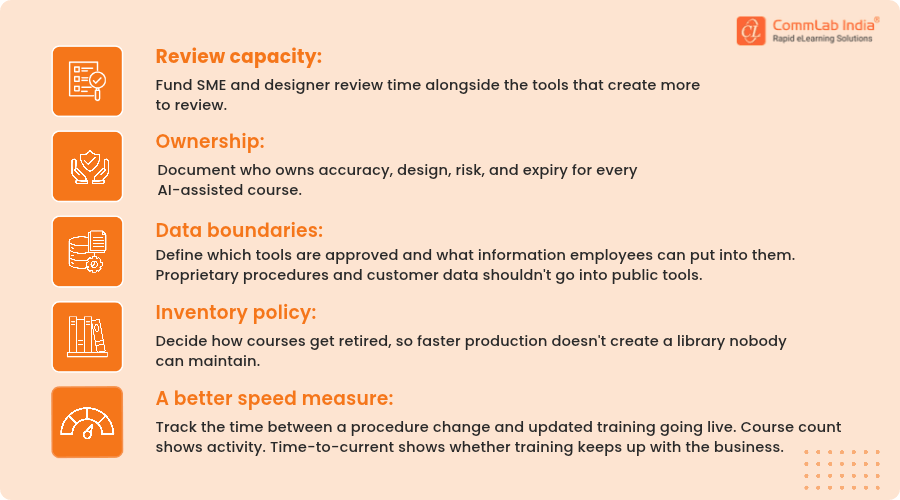
Applied to the lockout/tagout example, these decisions turn a three-week approval wait into a defined process: the right reviewers, a clear gate, and a date by which the updated procedure is live in every language.
Development is only one part of a 2027 learning plan. Faster, well-governed training still has to prepare employees for work that AI is changing and show up in how they perform on the job. CommLab India's upcoming webinar brings these three priorities together.
What Will the Corporate L&D Trends 2027 Webinar Cover?
Corporate L&D Trends 2027: The View from the Trenches is CommLab India’s 60-minute live webinar on December 10, 2026, at 11 AM ET. It focuses on three 2027 learning priorities: AI-assisted learning with instructional control, workforce readiness, and business impact.

During the webinar, the discussion on this priority will look at where AI can support development and content updates, what SMEs, instructional designers, and reviewers need to own, and which checks should happen before AI-generated training reaches employees.
The second and third priorities move to workforce readiness and business impact, including how formal training, practice, and performance support can work together.
CommLab India’s instructional design teams work in this review stage every day, turning AI-assisted drafts into training that asks employees to make decisions they face on the job.
How instructional design with AI plays out will differ for every enterprise, depending on its content, its regulators, and the size of its review team. The webinar is a chance to test your 2027 plans against enterprise experience before your learning roadmap is set.
The next article in this series looks at the second priority: preparing employees for work that AI is already changing.
Register now.