AI can dream up a hundred storylines before a designer has finished their coffee. But what makes a learning story worth telling is how well it reflects the world employees actually work in. That’s where AI and human creativity make an interesting pair. Together, they can turn everyday workplace dilemmas into realistic scenarios, build in choices that make learners pause and think, and show how one decision can change the outcome.
For enterprise training, this opens up a world of possibilities. Not more content for employees to click through, but stories that put them in the thick of things, let them test their judgment, learn from the consequences, and walk away better prepared for the decisions waiting beyond the screen.
What Makes Storytelling Effective in Learning Design?
Effective storytelling in learning design connects learning content to realistic workplace decisions. When learners engage with situations that reflect their responsibilities, they can practice applying knowledge, understand the impact of their choices, and transfer learning to their jobs.
The most effective approach prioritizes performance outcomes over entertainment, uses relevant workplace challenges, and gives learners opportunities to practice rather than passively consume information.
→ Download Now: The Duo of Storytelling and AI for Interactive eLearning
Table of Contents
- Why Does Storytelling Improve Workplace Training?
- How Can You Design Decision-Based Learning Scenarios?
- How Can AI Support Storytelling in Learning Design?
- How Can Organizations Apply Storytelling in eLearning?
- How Can You Measure the Impact of Story-Based Learning?
- Frequently Asked Questions
- How Can You Make Storytelling Drive Performance?[
Why Does Storytelling Improve Workplace Training?
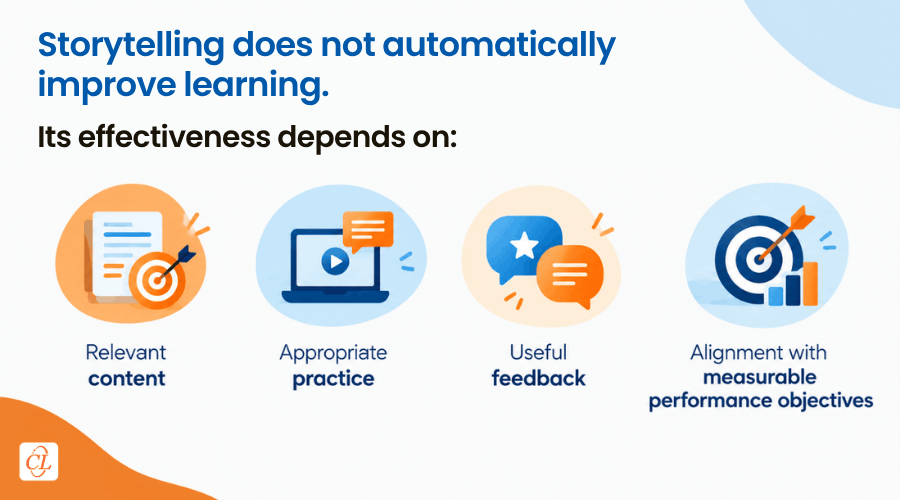
Storytelling can improve corporate training by giving learners a relevant context in which to practice decisions and see their consequences. Its value comes from purposeful participation, not merely from having an interesting plot.
Realistic scenarios can help learners:
- Connect knowledge to action: Apply concepts to situations resembling their everyday responsibilities.
- Practice judgment: Evaluate competing priorities and choose an appropriate response.
- Learn from outcomes: Understand how different actions can influence customers, colleagues, processes, and business results.
- Build confidence: Rehearse challenging conversations and decisions in a low-risk environment.
For enterprise training, this is particularly useful when employees need to exercise judgment rather than recall facts alone. Examples include compliance, leadership, sales, customer experience, and operational decision-making.
How Can You Design Decision-Based Learning Scenarios?
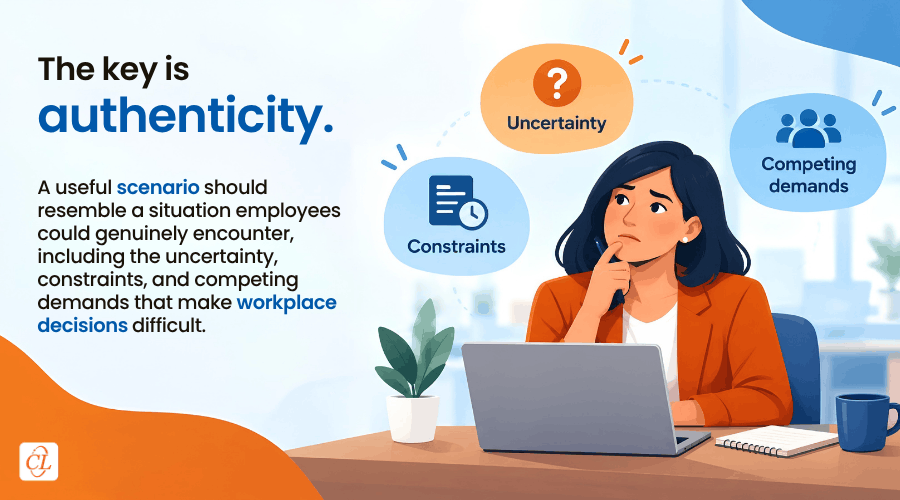
To design decision-based learning scenarios, start with an actual workplace performance challenge and build an experience around the choices employees must make to address it.
Decision-making is an increasingly important workforce capability. SHRM’s 2026 benchmarking research places critical thinking at the top of enterprise-wide skill priorities, strengthening the case for training that lets employees practice judgment in realistic workplace situations.
A practical design process includes the following steps:
- Define the performance outcome: Identify the specific action or decision employees should demonstrate after training.
- Research the workplace context: Gather examples of real challenges, recurring errors, customer concerns, and difficult judgment calls.
- Create a credible situation: Give learners enough context to understand the problem without overwhelming them with unnecessary background information.
- Introduce meaningful choices: Let learners select between plausible responses that reflect the decisions they make at work.
- Provide informative feedback: Explain why a response works or fails and connect the reasoning to the relevant principles or procedures.
- Plan for workplace application: Help learners recognize opportunities to use the skills in their actual roles.
How Can AI Support Storytelling in Learning Design?
AI can help instructional designers develop and refine learning stories, but it should support the design process rather than replace the designer's judgment. The goal is not simply to generate an engaging narrative. It is to create a realistic learning experience that prepares employees to make better decisions at work.
Watch the video to discover the 22x memorable effect of storytelling in learning design.
Use AI as a design assistant to work through the key elements of a workplace scenario:
- Establish the context: Describe the learner's role and work environment. Ask AI to identify situational details that could influence what the learner notices, decides, or does.
- Define the performance goal: Ask AI to reframe a broad learning objective around what an employee needs to accomplish on the job.
- Generate realistic challenges: Use verified workplace information to develop plausible obstacles, constraints, and trade-offs.
- Explore decisions and consequences: Ask AI to suggest believable choices and explain the downstream effects of each one, rather than providing only right-or-wrong feedback.
- Support application: Generate a debrief question that helps learners recognize when they might encounter a similar situation at work and how they should respond.
Human Judgment Remains Essential
AI-generated content must be checked for accuracy, realism, and relevance. Ground prompts in verified information, such as approved policies and procedures, and involve subject matter experts in reviewing the results. Ask AI to critique drafts and generate alternatives, but retain responsibility for performance analysis and final decisions.
The takeaway
Use AI to accelerate drafting, explore possibilities, and refine learning scenarios, not to outsource the thinking that makes storytelling effective in learning design.
How Can Organizations Apply Storytelling in eLearning?
Storytelling in eLearning works best when the narrative directly supports a learning objective and requires learners to participate meaningfully. Organizations can incorporate it into digital courses without creating elaborate fictional worlds or expensive cinematic productions.
Consider these practical applications:
- Compliance training: Present an ethical dilemma and ask employees to select a response based on company policies.
- Customer service: Simulate a difficult interaction in which the learner must balance empathy, accuracy, and business requirements.
- Leadership development: Create a team-management scenario involving conflicting priorities and limited resources.
- Sales enablement: Let sales representatives respond to customer objections and explore the consequences of different approaches.
- Technical training: Simulate troubleshooting situations that require learners to diagnose problems and select appropriate actions.
These examples demonstrate how storytelling for eLearning courses can support active practice across different business functions. Designers should select the format, level of interactivity, and amount of narrative detail according to the complexity of the task and the needs of the learners.

Common Mistakes to Avoid
The most common mistake in storytelling in learning design is prioritizing an entertaining narrative over the performance problem the course must solve.
Avoid these pitfalls:
- Adding characters or plot details that do not support the learning objective.
- Creating unrealistic scenarios that employees cannot relate to.
- Making decisions too obvious to encourage meaningful thinking.
- Giving feedback that reveals the correct answer without explaining the reasoning.
- Measuring course completion without evaluating practical application.
A focused scenario with realistic choices often provides more instructional value than an elaborate story with little relevance to the learner's responsibilities.
How Can You Measure the Impact of Story-Based Learning?
Organizations can evaluate story-based learning by measuring whether employees demonstrate improved skills and apply them in the workplace. Engagement metrics alone cannot establish that training has improved performance.
Useful evaluation methods include:
- Scenario performance: Track the quality of learner decisions and the reasoning behind them.
- Knowledge retention: Assess whether learners remember important concepts after a suitable interval.
- On-the-job application: Gather manager observations, work samples, or structured performance assessments.
- Business indicators: Monitor relevant measures such as error rates, customer satisfaction, compliance incidents, or resolution times.
Choose indicators that directly connect to the original business problem. Where possible, establish a baseline before training and compare results afterward, accounting for other factors that may influence performance.
Frequently Asked Questions
Is storytelling in eLearning suitable for every subject?
Storytelling in eLearning can support many subjects, especially those involving decisions, communication, problem-solving, or contextual application. Straightforward factual information may be better delivered through concise explanations, demonstrations, or reference materials.
How does storytelling differ from gamification?
Storytelling provides context and meaning through a narrative, while gamification uses game-inspired elements such as points, challenges, and rewards. The approaches can work together, but neither guarantees improved learning without purposeful instructional design.
What is the most important principle of storytelling in learning design?
The most important principle is to keep the story connected to the learner's real performance needs. Every narrative element should help learners understand a situation, practice a relevant skill, or make better decisions at work.
How can AI support storytelling in eLearning?
AI can help create story ideas, realistic workplace scenarios, decision points, and feedback for eLearning. Human oversight ensures these stories remain accurate, relevant, and aligned with learning objectives.
How Can You Make Storytelling Drive Performance?
Storytelling in learning design is most valuable when it helps employees practice the decisions their jobs demand. By grounding scenarios in authentic workplace challenges, providing meaningful feedback, and evaluating real-world application, instructional designers can create training that goes beyond engagement.
Start with one recurring performance challenge, build a focused scenario around it, and measure whether learners make better decisions afterward. That is how storytelling becomes a practical tool for more effective eLearning and enterprise training.
Ready to give your learning stories a little more spark?
Get our eBook, Storytelling and AI: A Dynamic Duo for Interactive eLearning Experiences, and discover the possibilities when creativity meets AI.