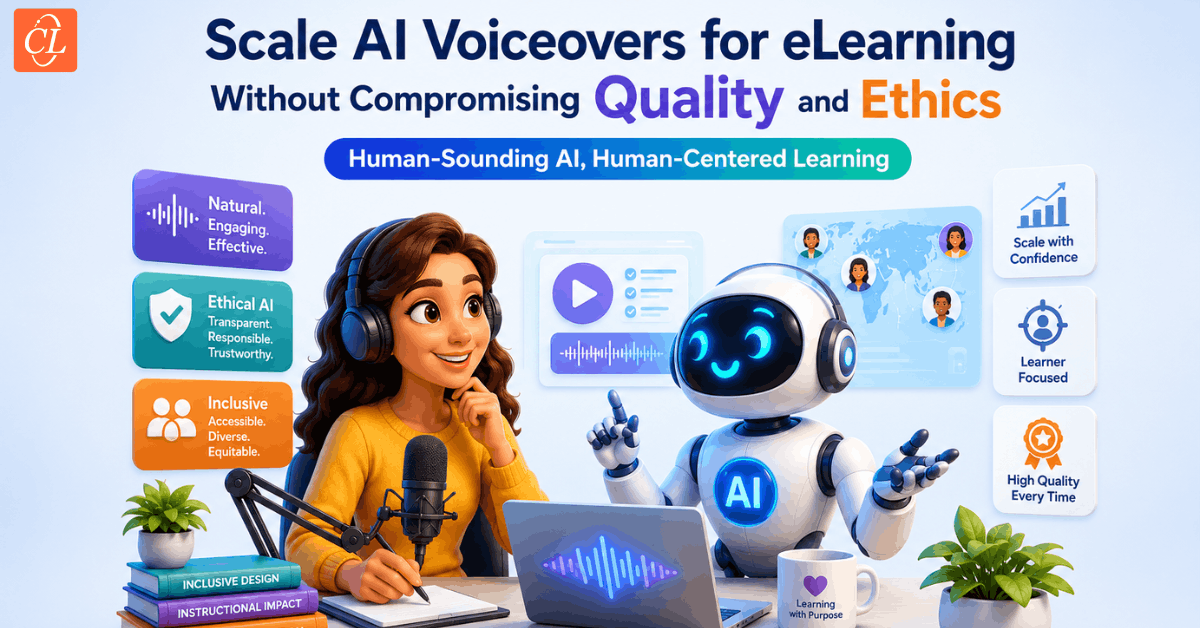
Enterprise L&D teams are under constant pressure: more content to produce, tighter budgets, and a workforce spread across geographies and languages. AI voiceovers for rapid eLearning have emerged as a practical response, cutting production timelines from weeks to hours and enabling rapid updates without re-recording.
But with speed comes complexity. How do you maintain training quality? Where does AI voice use cross-ethical lines? And what does responsible deployment actually look like for enterprises?
Does AI Voiceover Quality in eLearning Hold Up for Serious Corporate Training?
Quality has improved substantially. Most enterprise-grade AI voice tools now handle technical vocabulary, correct stress in compound terms, and maintain consistent tone across long-form content. For instructional text, which is typically clear, structured, and professional — the quality gap between AI and studio talent has narrowed considerably.
That said, three quality factors require deliberate management:
Natural Rhythm:
AI voiceovers can still sound flat or unnatural on nuanced emotional content, metaphor-heavy language, or irregular sentence structures. The fix is often upstream: cleaner, shorter sentences that narrate well.
Technical Terminology:
Sector-specific terms in pharma, engineering, or financial services may be mispronounced. Most platforms allow phonetic overrides or pronunciation dictionaries; these need to be built and maintained as a team asset.
Consistency Across a Curriculum:
Using different AI voices across modules without a defined voice standard creates a fragmented experience. Establishing a "voice identity", a defined set of voice profiles tied to content type, is a practical governance step.
What are the Ethical Considerations L&D Teams Should Address?
AI in eLearning raises legitimate ethical questions and L&D leaders in regulated industries like healthcare and financial services are increasingly expected to have clear answers.
Is it Transparent to Learners?
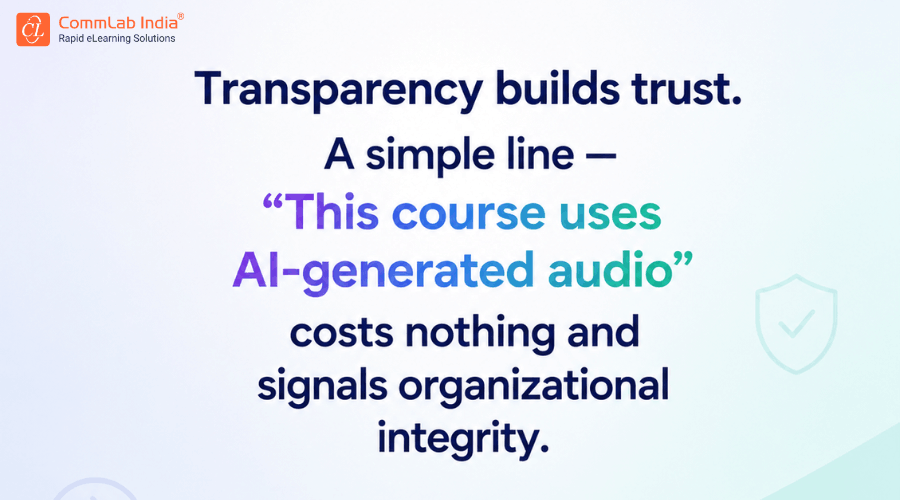
Most organizations do not explicitly disclose when training audio is AI-generated. The question is whether that creates a misleading experience for learners. There is no universal regulatory requirement to disclose AI voice use in internal training, but some organizations particularly those in highly regulated sectors are adding a brief disclosure statement to course metadata or the first screen of a module.
Are you Inadvertently Cloning a Real Person's Voice?
Several early AI voice tools were trained on data without explicit consent from the speakers. Enterprise buyers should verify that any voice synthesis platform they use licenses or owns the voices in its library. Due diligence here is a legal and ethical obligation.
Does AI Voiceover Disadvantage any Learner Group?
AI voices are typically calibrated for standard accents and speech patterns. Learners for whom English is a second language, or who rely on clear prosodic cues for comprehension, may find certain AI voices harder to follow. Testing with representative learner samples before full deployment is a baseline quality check and an equity one.
What Best Practices Should Guide AI Voiceover Implementation in eLearning?
Based on what's working in enterprise L&D, these practices produce the strongest outcomes:
Define a Voice Governance Standard Before you Scale
Decide which voice profiles map to which content categories — e.g., a formal tone for compliance training, a conversational tone for soft skills training. Document this in your instructional design standards so it's applied consistently across vendors and internal teams.
Treat Script Quality as the Primary Quality Lever
AI voices are only as good as the scripts they read. Short sentences, active voice, and minimal jargon produce noticeably better audio. Build script review into your QA process specifically for AI voice readiness.
Audit Regularly for Accuracy and Inclusivity
For manufacturing safety training or pharmaceutical compliance, a mispronounced term is not just a quality problem, it's a risk. Build a review cycle into your content maintenance calendar that includes audio accuracy checks.
Retain Human Voice for High-stakes Emotional Content
Leadership messages, sensitive HR topics, and content requiring genuine empathy are poor candidates for AI voice. Using human narration in these contexts is a practical signal of organizational care, not a rejection of AI tools.
Frequently Asked Questions About AI Voiceovers in eLearning Courses
1. Are AI voiceovers suitable for compliance and safety training in regulated industries?
A. Yes, with appropriate oversight. AI voiceovers work well for compliance content when script quality is high and technical terms are validated through a pronunciation dictionary. For industries like pharma and manufacturing, audio accuracy checks should be part of your standard content review process.
2. How do AI voiceover tools handle multiple languages for global training programs?
A. Most enterprise-grade platforms support 20 or more languages, though quality varies by language. AI voiceover works best for multilingual rollouts when paired with professional translation — automated translation plus AI voice without human review increases the risk of accuracy errors in technical content.
3. What should L&D teams look for when evaluating AI voiceover vendors?
A. Prioritize platforms with clear voice licensing and consent policies, support for pronunciation customization, enterprise security standards, and a defined update cadence. For regulated industries, verify whether the vendor has experience with compliance-sensitive content and can provide documentation of data handling practices.
Closing Note
AI voiceovers are a legitimate, practical tool for enterprise L&D — not a shortcut, but a capability that requires deliberate implementation. For organizations in manufacturing, pharma, logistics, and energy, the efficiency gains are real. So are the risks if quality and ethics are treated as afterthoughts.
The clearest takeaway: AI in eLearning works best when L&D leaders treat it as a system to be governed, not just a feature to be switched on. Define your standards, verify your vendors, and test before you scale.
Want to explore AI voiceovers further? Check out the dedicated section in this eBook to discover the tools powering the next generation of eLearning.