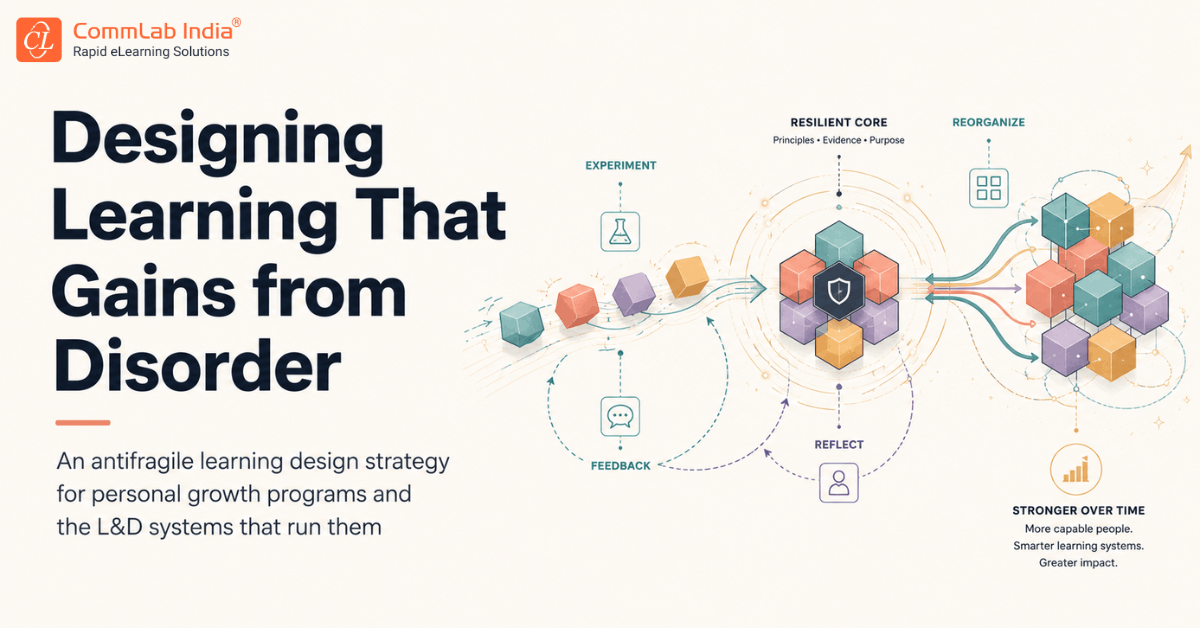
Most corporate learning is built for stable roles, linear careers, predictable skill gaps, and curricula that assume the next quarter will resemble the last. Directors of learning already know that assumption is failing. Volatility in technology, organization design, regulation, and labor markets is no longer an interruption to the plan. It is the operating environment. L&D therefore needs to move beyond helping people recover to baseline after a shock and consider how capability systems can become stronger because disruption occurs.
Nassim Nicholas Taleb’s concept of antifragility is useful here precisely because it is not a motivational slogan. It is a claim about payoff structures. Fragile systems are harmed by volatility. Robust systems resist it and stay the same. Antifragile systems gain from variability, stress, and error, within a range. Bones strengthen under load. Aviation becomes safer after accidents because failures are examined and the system retains the lesson. Many banks, by contrast, become weaker after failures when losses concentrate and incentives hide tail risk. That distinction should shape how L&D approaches growth, leadership, and program design.
Table Of Content
- What Antifragility Actually Requires
- From Personal Growth to Organizational Capability
- An Instructional Strategy That Does Not Contradict Itself
- What This Changes in the L&D Operating System
- A Practical 90-Day Commission
- The Brief, Stated Cleanly
What Antifragility Actually Requires
Taleb’s argument is easily reduced to “what doesn’t kill you makes you stronger.” That interpretation is inaccurate and creates a dangerous brief for learning functions. Antifragility is a convex response to stressors: the downside is limited, the upside remains open, and the system learns from error rather than concealing it. Fragility has the opposite asymmetry, offering modest gains in calm conditions and disproportionate damage when variance rises.
Several principles follow from this distinction, each with a direct implication for capability building.
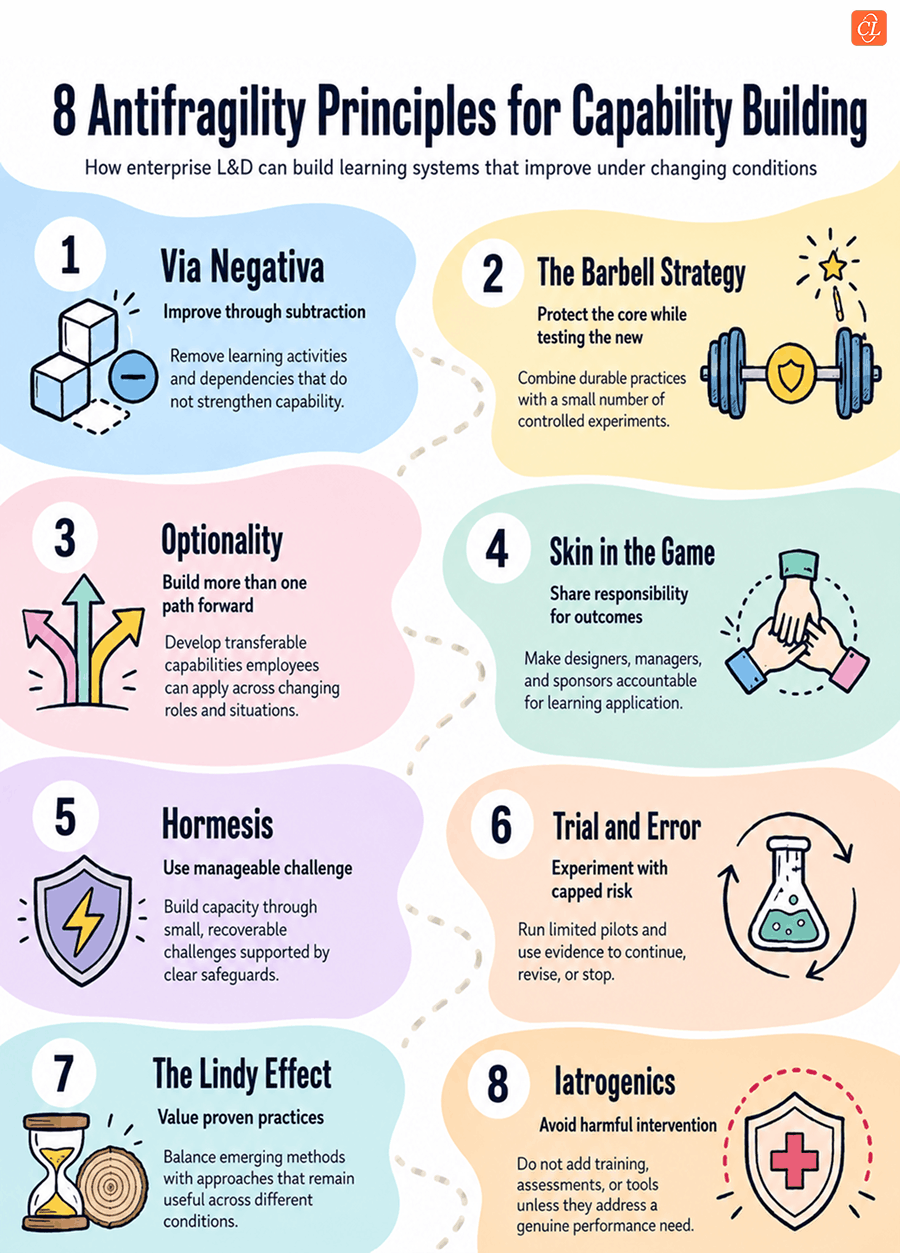
Via negativa holds that improvement often comes from subtraction. Removing debt, bad incentives, unnecessary interventions, and single points of failure can be more reliable than adding another framework. In L&D, the fastest improvement to a learning ecosystem may be retiring programs that create busyness without changing exposure: content libraries nobody uses under pressure, leadership models that collapse during a restructure, and development plans built around forecastable five-year paths.
The barbell strategy pairs extreme safety with a small allocation to high-upside bets, avoiding the moderate middle that appears prudent while hiding the risk of ruin. For individuals, this means protecting sleep, cash runway, core relationships, and transferable skills while making small public or commercial bets. For L&D, it means maintaining a conservative core of durable practices, including feedback, apprenticeship, writing, load management, and ethical decision-making, while reserving a limited share of capacity for experiments. The fragile middle is a catalogue of moderately fashionable programs that are neither foundational nor genuinely exploratory.
Optionality gives a person or organization the right, without the obligation, to pursue a path when conditions become favorable. It is more useful than attempting to predict every change. A workforce with optionality can move across problems; one trained only for the current operating model cannot.
Skin in the game adds accountability by requiring the people who design, teach, or sponsor development to share in its consequences.
Hormesis introduces small, intermittent, recoverable stress to build capacity, while avoiding both chronic overload and total comfort. Redundancy provides backup that may look inefficient until a shock arrives.
Trial and error works when the potential loss is capped, and the Lindy effect gives greater weight to practices that have survived many environments than to last year’s stack. Iatrogenics adds a final warning: intervention can itself cause harm. Over-training, over-assessing, and smoothing away all volatility in the name of employee experience can leave people and systems less capable.
From Personal Growth to Organizational Capability
Applied to an individual, antifragile growth changes how a person is exposed to the world. After a rejection or failed project, recovery matters, but so does identifying the capacity the experience forced the person to build. A career barbell protects a floor of health, savings, and a craft that travels, then allocates a minority of time and energy to convex trials such as a visible piece of work, a customer experiment, or a skill adjacent to the current role.
The other principles make that design more concrete. Via negativa removes an identity that cannot survive a title change. Optionality comes from a body of work and a network, rather than a drawer of unfinished courses. Skin in the game takes the form of a reversible public commitment. Hormesis might be a difficult conversation or demanding practice block, with recovery scheduled as part of the design rather than treated as something to be earned afterward.
Managers should notice the translation problem. Personal-growth culture often sells addition: another habit, assessment, or narrative about purpose. Organizations reproduce the same pattern at scale by adding academies, badges, and learning journeys while leaving fragile exposures intact. These may include dependence on one sponsor, one skill, or one business unit; compensation that punishes small failures; and managers who assign risks they will not share. If L&D imports Taleb only as content through a workshop on antifragility, the likely result is high inspiration with no change to calendars, incentives, or risk.
A more serious application treats personal growth programs as laboratories for exposure design. Learners should leave able to classify a domain as fragile, robust, or antifragile; remove a source of ruin; allocate time and attention through a barbell; and run capped experiments. They also need to dose a recoverable stressor, attach a visible stake, and extract learning from disruption instead of merely restoring the previous baseline. These are capabilities for operating under disorder, and they are closer to what senior leaders need than a competency map that assumes the map will remain valid.
An Instructional Strategy That Supports the Idea
The learning experience should embody the principles it teaches. A linear syllabus, a high-stakes capstone life plan, a charismatic facilitator, attendance-based completion, and a certificate that implies arrival would create a fragile course on antifragility. A sounder design begins by changing the learner’s exposure.
Start with a floor. Prework should require learners to identify non-negotiables such as sleep, medical constraints, financial limits, and relationships that must not be used as collateral. Any later experiment that violates this floor is invalid. This is risk engineering: without a defined floor, “growth” can become a license for recklessness, leaving both the learner and the organization to absorb the harm.
Teach a small Lindy core and reuse it every week in a different domain. The fragile–robust–antifragile triad, via negativa, the barbell, optionality, hormesis, skin in the game, tinkering, and redundancy provide enough conceptual range. Career, health, money, relationships, craft, and identity can then become domain labs, from which learners choose two. The aim is to change the learner’s payoff structure, not to achieve superficial coverage of every domain.
A reliable 90-minute session moves from diagnosis to action:
- Begin with a brief stressor check-in and introduce one idea.
- Apply the idea to the learner’s actual life or role.
- Design a bounded experiment with a visible commitment.
- Use peer challenge to uncover hidden downside.
- Set a kill switch or recovery rule before the experiment begins.
Every session should therefore end with a specific next exposure. Inspiration that leaves the learner’s decisions, schedule, and risk unchanged is incomplete instruction.
Assessment should focus on evidence of exposure rather than recitation. A defensible portfolio could include an intact floor card, proof that one subtraction occurred, a barbell with hours or budget allocated, two trial cards with at least one executed, evidence of a stake, and a harvest note drawn from real friction. The rubric can stay practical: Was the downside capped? Was the upside real? Did the learner have a stake? Was recovery specified? Is learning from error visible? Definitions need no exam, and a polished five-year plan should not be treated as evidence of capability. Discontinuing a poor trial can demonstrate sound judgment; violating the floor signals a design failure and should stop the experimental sleeve.
The facilitator acts as a fragility auditor. That role involves asking for dates and magnitudes, retiring unsafe experiments early, rewarding sound floors in public, and modelling one live, capped experiment. Groups of eight to sixteen allow meaningful critique, although a larger cohort can use smaller labs. The tone should be exacting about ruin and generous about the scale of early trials. Performative suffering does not qualify as skin in the game.
What Changes in The L&D Operating System
If this logic is sound, it cannot remain confined to one program. It affects several choices that L&D managers make about the portfolio, leadership development, measurement, manager enablement, and ethics.
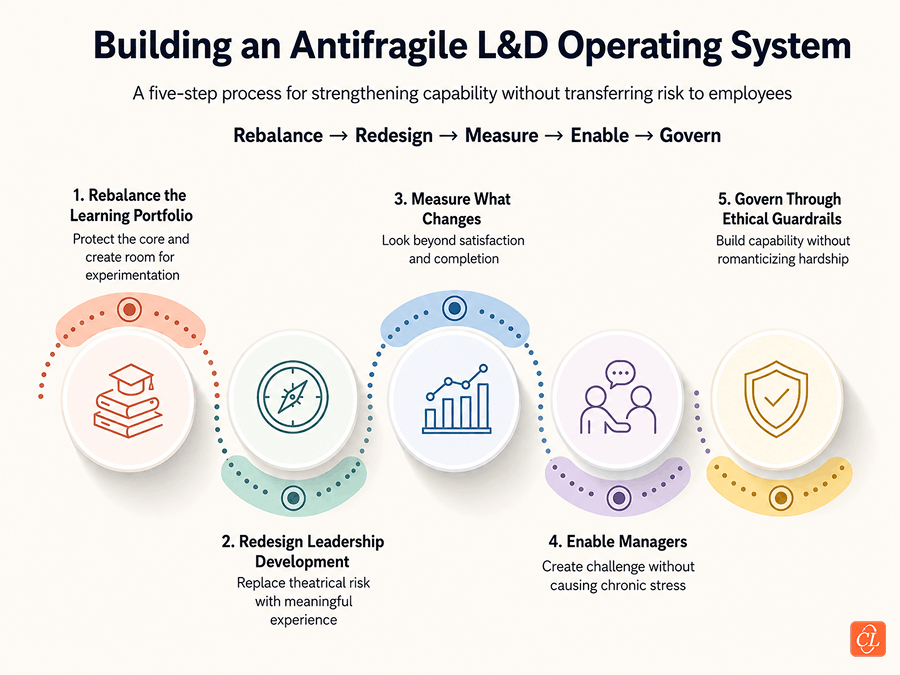
First, consider portfolio shape. Many learning portfolios are accidentally barbell-shaped in reverse, with a thin core of neglected fundamentals and a swollen middle of vendor content. Rebalancing means protecting a short list of practices that will remain useful after the next reorganization and directing 10 to 15 percent of design capacity to explicit experiments with kill dates. Programs that survive only because they are familiar, politically convenient, or already licensed should no longer consume scarce capacity by default.
Second, review leadership development. Many high-potential pathways are fragile by construction. They optimize for sponsorship within one hierarchy, expose people to theatrical risk through simulations or stretch presentations, and shield them from meaningful consequences. An antifragile pathway would still protect a person from ruin; a career-ending assignment should never be disguised as development. Within that boundary, the pathway would require visible work, customer or stakeholder contact, and an after-action harvest when a project changes course. Faculty and sponsors also need skin in the game. They should not assign volatility they refuse to share, and “journey completion” should not be rewarded when the experience produces no transferable capacity.
Third, change what counts as evidence. Satisfaction and completion may still be collected, but they should not certify success. More useful program-level evidence includes experiments completed, floors kept intact, subtractions still in force after 30 and 90 days, fewer single points of failure, and the learner’s demonstrated ability to use a setback. High NPS with unchanged calendars is a failed intervention. That standard belongs in the governance pack.
Fourth, equip managers to regulate exposure. Managers are a transmission mechanism for fragility: they can turn a sound design into chronic stress, or cap the downside while creating optionality through shadowing, small client bets, internal public writing, and rotations that do not depend on identity collapse. They should use the same audit questions as learners: Where is the risk of ruin? Where is the undifferentiated middle? Does this create optionality, or merely postpone a decision? Is the load recoverable?
Fifth, establish ethical guardrails. Antifragility can be misread as permission to create a harsher culture, so managers must own the boundaries. Medical and psychiatric issues remain out of scope, and hormesis requires explicit intensity caps. No program should romanticize burnout, humiliation, or threats to a person’s family stability or visa status in the name of growth. Precarious employees need thicker floors, not larger bets. The course can also become iatrogenic if it adds another layer of optimization to an already overloaded system. Requiring subtraction and limiting the program to one canvas per week are practical safeguards.
A Practical 90-Day Commission
A manager can test this approach through a contained cycle rather than rebuilding the academy.
Week 0 establishes individual floors and a fragility map, identifying which skills, roles, and relationships would break if volatility doubled. Weeks 1 and 2 apply via negativa through one real subtraction from each learner’s load and one retirement from the local learning menu. Weeks 3 and 4 create barbells of time, placing most effort on the floor and a minority on two trial cards with cost caps, success signals, and kill dates. Weeks 5 and 6 introduce a recoverable stressor and a visible stake small enough to reverse. From Week 7 through Week 12, learners run the cycle, write a harvest note after friction, and finish with a one-page operating system they can use. Sponsors review the quality of the exposures, not the quality of the slides.
In parallel, the L&D team runs its own barbell. It continues delivering the conservative core the business trusts while using a small experimental sleeve to prototype the design with one cohort, perhaps high-potential employees, new people leaders, or a function already operating under disorder. The team pre-commits to kill criteria such as floor violations, no executed trials, or activity that is purely theatrical. It then publishes the result internally, including what did not work.
That disclosure reflects Taleb’s ethical rule: a system should not acquire antifragility by transferring fragility to others. A learning function that hides failed programs while praising a growth mindset resembles the banking version of error, where losses are obscured and concentrated, rather than the aviation version, where the system retains the lesson.
Capability After the Plan Breaks
An antifragile approach to personal growth protects the downside, preserves optionality, introduces recoverable stress, removes sources of fragility, and treats error as material for learning. Instructional design should build those conditions into the learning experience, while the broader L&D operating system reinforces them through portfolio choices, leadership pathways, manager practices, ethical guardrails, and measurement.
Volatility will remain part of the organization’s operating environment. L&D leaders can continue building highly optimized, centrally managed learning that performs well only in calm conditions, or accept a less elegant catalogue, more small failures, and a thicker floor. The second choice demands stronger governance, not looser standards. Its practical value is a workforce and learning system that can demonstrate greater usefulness after the plan breaks.
This article synthesizes Taleb’s antifragility principles, their application to personal growth, and an instructional design strategy for enterprise L&D. It is a briefing for design and governance, not a substitute for clinical, financial, or legal advice to individual employees.