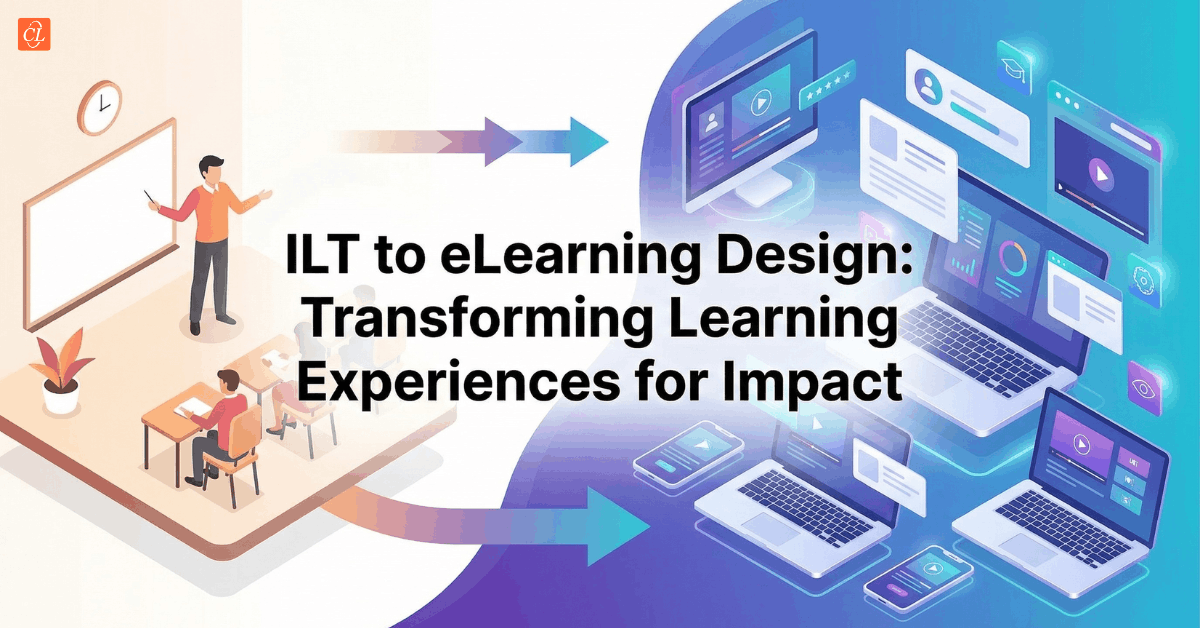
Many organizations approach ILT to eLearning conversion with a clear goal: make training scalable, accessible, and efficient. Yet, even after significant investment in digital transformation, the outcomes often fall short of expectations.
The problem is rarely the lack of content. It is the lack of experience design.
In a classroom environment, learning is shaped by facilitation. Instructors clarify concepts, adjust pacing, respond to learner questions, and create engagement through dialogue and activities. These elements bring the content to life, often compensating for gaps or limitations within the material itself.
When this layer is removed and the same content is transferred into a digital format without redesign, the result is predictable. Learners encounter static screens, passive narration, and linear progression that fails to sustain attention or drive application.
This is where instructional design becomes critical.
Effective ILT to eLearning transformation is not about replicating the classroom. It is about reconstructing the learning experience so that it remains engaging, intuitive, and impactful without instructor intervention.
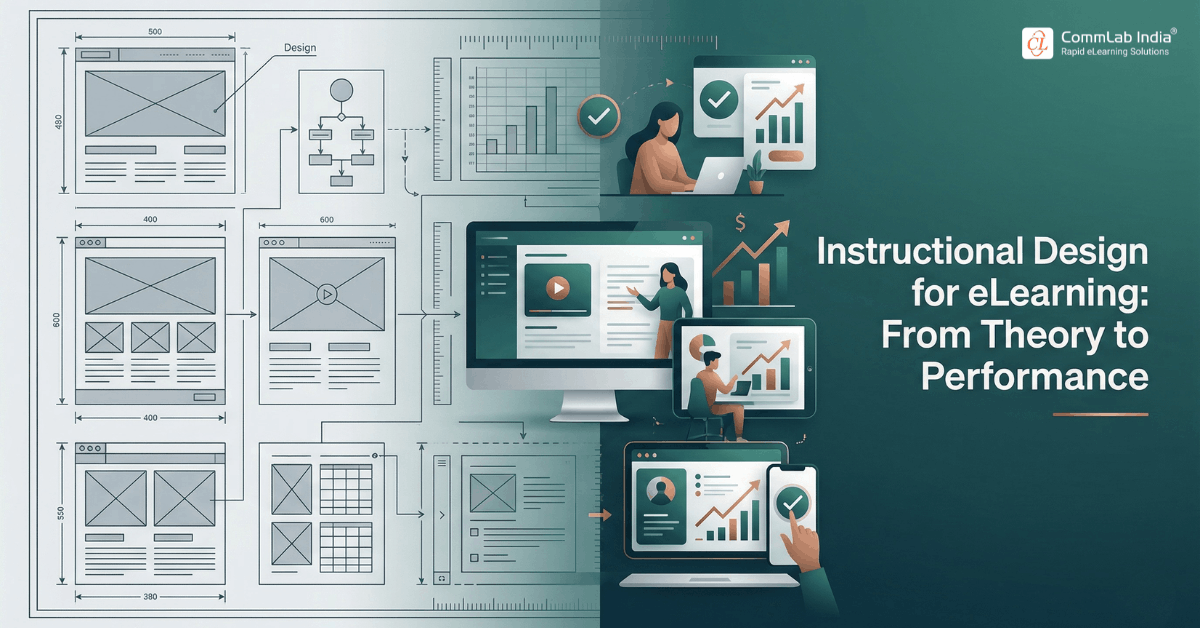
In this article, we explore how organizations can redesign learning using instructional design principles. We examine how to translate facilitation into interaction, map classroom elements into digital formats, avoid common pitfalls, and ultimately create learning experiences that deliver measurable impact.
Download eBook: Classroom to eLearning Conversion
TABLE OF CONTENTS
- Why Instructional Design Determines Conversion Success
- From Facilitation to Experience: Rethinking the Learning Model
- Translating Classroom Elements into Digital Interactions
- Designing for Different Types of Learning
- Building Engagement Through Meaningful Interactivity
- Common ILT to eLearning Conversion Mistakes (and Fixes)
- Designing for Impact and Measurable Outcomes
- FAQs
Why Instructional Design Determines Conversion Success
The success of any ILT to eLearning initiative ultimately depends on how well the learning experience is designed.
In traditional classroom settings, the instructor plays a central role in shaping that experience. They guide learners through complex topics, adapt explanations based on feedback, and create opportunities for discussion and reflection. In many cases, it is the instructor, rather than the content itself, that ensures learning effectiveness.
In eLearning, this responsibility shifts entirely to design.
Every element of the experience, including how content is structured, how interactions are introduced, and how feedback is delivered, must be intentionally crafted. There is no facilitator to fill gaps or adjust the flow in real time.
This shift introduces a fundamental requirement. Learning must be engineered, not delivered.
Instructional design for ILT to eLearning conversion is the process of transforming instructor-led experiences into structured, interactive, and learner-driven digital learning that maintains engagement without live facilitation.
From Facilitation to Experience: Rethinking the Learning Model
One of the most important transitions in conversion is moving from a facilitation-driven model to an experience-driven one.
Instructors perform multiple roles during classroom training. They explain concepts, provide examples, encourage participation, and guide learners toward understanding. These roles must now be translated into design elements within the course.
Reinterpreting Instructor Functions in eLearning
| Instructor Role | How It Translates into eLearning Design |
| Explaining concepts | Layered content with visuals and progressive disclosure |
| Asking questions | Embedded knowledge checks and prompts |
| Facilitating discussions | Scenario-based decision-making experiences |
| Providing feedback | Immediate, contextual feedback within interactions |
What This Shift Means in Practice
- Explanations must be structured clearly and progressively, so learners can build understanding step by step
- Questions must be integrated into the flow, prompting learners to think rather than passively consume
- Feedback must be immediate and meaningful, helping learners correct misconceptions
This transformation ensures that the learning experience remains dynamic, even without real-time facilitation.
Translating Classroom Elements into Digital Interactions
Classroom learning relies heavily on activities and teaching aids that promote engagement. These elements can be effectively translated into digital formats when their underlying intent is understood.
Mapping Classroom Methods to Digital Experiences
| Classroom Method | Digital Learning Equivalent |
| Group discussions | Branching scenarios that simulate decision-making |
| Role plays | Interactive simulations with realistic outcomes |
| Demonstrations | Video-based or animated walkthroughs |
| Case studies | Scenario-driven storytelling modules |
| Q&A sessions | Embedded quizzes with explanatory feedback |
Design Perspective
The objective is not to recreate the classroom environment exactly, but to preserve its instructional purpose.
- Discussions become guided decision paths that simulate real-world thinking
- Demonstrations become repeatable visual explanations, allowing learners to revisit concepts
- Activities become self-paced interactions that encourage exploration
This approach ensures that engagement is sustained through interaction rather than reliance on live facilitation.
Designing for Different Types of Learning
A critical aspect of instructional design is recognizing that not all learning objectives require the same approach. Treating all content uniformly often leads to ineffective experiences.
Conceptual Learning
This type of learning focuses on understanding ideas, frameworks, and relationships.
- Use visuals, analogies, and structured explanations to simplify complexity
- Provide layered content so learners can explore topics at different depths
Procedural Learning
This focuses on performing tasks or following processes.
- Break processes into clear, sequential steps
- Provide demonstrations followed by guided practice
Behavioral Learning
This focuses on decision-making, judgment, and soft skills.
- Use realistic scenarios that mirror workplace challenges
- Allow learners to make choices and experience consequences
When instructional design aligns with the type of learning required, it improves both engagement and retention. Learners are more likely to understand, apply, and retain knowledge when the experience matches the nature of the content.

Classroom to eLearning Conversion
Everything You Always Wanted to Know
- Converting classroom material to eLearning
- Leveraging authoring tools for conversion
- Understanding different avatars of eLearning
- And More!
Building Engagement Through Meaningful Interactivity
Engagement in eLearning is often misunderstood as a function of visual design. While aesthetics play a role, true engagement is driven by how learners interact with the content.
Interactivity should not be decorative. It should be purposeful.
Types of Interactivity That Enhance Learning
- Exploratory interactions
Allow learners to navigate content and uncover information at their own pace, fostering curiosity and control. - Scenario-based interactions
Present realistic situations where learners must make decisions, reinforcing application and critical thinking. - Reflective interactions
Encourage learners to pause, consider, and internalize key concepts before moving forward. - Practice-based interactions
Provide opportunities to apply knowledge in simulated environments, strengthening retention.
What Makes Interactivity Effective
- It aligns directly with learning objectives
- It encourages active thinking rather than passive clicking
- It provides feedback that guides improvement
- It reinforces key concepts at the right moments
When designed thoughtfully, interactivity transforms learning into an active, engaging process.
Common ILT to eLearning Conversion Mistakes (and Fixes)
Even well-intentioned conversion efforts can fall short when design principles are overlooked. Understanding common pitfalls helps organizations avoid costly missteps.
Frequent Mistakes and Practical Fixes
- Overloading content with text
Long text-heavy screens overwhelm learners and reduce retention.
Fix: Break content into smaller segments and support it with visuals. - Replicating classroom slides without redesign
Slides designed for facilitation often lack clarity when presented independently.
Fix: Rebuild content with a focus on flow, interaction, and learner engagement. - Ignoring learner context
Digital learners often engage in shorter, focused sessions.
Fix: Design modular content that fits into real work schedules. - Lack of meaningful interactivity
Passive content leads to disengagement.
Fix: Integrate scenarios, questions, and application-based activities. - Overcomplicating the experience
Excessive interactivity can distract from learning goals.
Fix: Use interaction selectively and align it with objectives.
This reinforces a key principle: effective design is about precision, not volume.
Designing for Impact and Measurable Outcomes
Ultimately, the goal of any learning initiative is not completion, but impact. Instructional design must therefore bridge the gap between knowledge and performance.
Designing for Real-World Application
- Align learning objectives with business outcomes
- Focus on scenarios that mirror actual workplace challenges
- Provide opportunities for repeated practice and reinforcement
Measuring Learning Effectiveness
| Metric | What It Reveals |
| Completion rates | Level of learner participation |
| Assessment scores | Understanding of key concepts |
| Engagement data | Quality of interaction |
| Performance metrics | Application of learning in real scenarios |
Closing the Learning-Performance Gap
To ensure that learning translates into action:
- Incorporate realistic scenarios
- Provide immediate and actionable feedback
- Reinforce learning through repeated exposure
This ensures that learning is not just understood, but applied.
For organizations, the transition from ILT to eLearning represents a deeper shift in how learning is experienced.
Those that invest in instructional design are able to:
- Create more engaging learning experiences
- Improve retention and application
- Align training with measurable business outcomes
Those that focus only on content conversion risk producing digital training that lacks impact.
FAQs
1. Why is instructional design critical in conversion?
A. It ensures that learning remains engaging and effective without instructor support by structuring content and interactions appropriately.
2. How do you replace classroom interaction in eLearning?
A. Through scenarios, simulations, and interactive elements that replicate decision-making and engagement.
3. What is the biggest mistake in conversion?
A. Replicating classroom slides without redesigning them for digital learning environments.
4. How do you make eLearning engaging?
A. By incorporating meaningful interactivity, real-world scenarios, and feedback mechanisms.
5. Can all ILT content be converted effectively?
A. Yes, but most content requires redesign to suit digital formats.
6. How do you measure learning impact?
A. By tracking engagement, assessment performance, and real-world application of knowledge.
CONCLUSION
ILT to eLearning conversion is often treated as a technical exercise, but its success depends on something far more fundamental.
Design.
The organizations that succeed are those that recognize that learning is not defined by content alone, but by how that content is experienced. They move beyond static modules and create environments where learners actively engage, think, and apply knowledge.
By focusing on instructional design, organizations do more than convert training. They create learning experiences that are scalable, meaningful, and aligned with performance.
The true opportunity lies not in digitizing content, but in reimagining how learning works in a digital world.