
With 25+ years of ID expertise, we design gamified training that feels intuitive, immersive, and aligned to the workplace requirements.
Introduction
Pac-Man. Super Mario. Fruit Ninja. Subway Surfers. Angry Birds. Candy Crush
Just reading those names probably sparked a wave of nostalgia — the kind that instantly takes you back to a simpler, happier time.
Even the simplest games gave us that tiny rush of dopamine. One more level. One more win. One more chance to beat our own score! We didn’t play because someone mandated it. We played because it was fun, challenging, and oddly fulfilling.
Different generations, different screens, different styles — but the feeling was always the same. And somewhere between growing up, deadlines, and meetings, we forgot that learning could feel the same way.
That’s where gamification in workplace training comes in.
It taps into the exact excitement of leveling up, the satisfaction of hitting milestones, the pride of seeing progress, and the joy of healthy competition.
What is Gamification Strategy in Training?
Gamification refers to the systematic application of game elements to learning experiences with the goal of increasing learner motivation, engagement, and knowledge retention. It involves designing structured learning pathways that use game mechanics to reinforce desired behaviors, support skill development, and create a sense of achievement, without turning the learning itself into a game.
Brands are Using Gamification for Marketing, Why Aren’t We in Business Training?
This is how brands use gamification to spark excitement, pull people in, and keep them coming back for more. If it can boost customer engagement so effectively, imagine what it could do for employee training and development.
Nike + Run Club
Nike successfully turned its Run Club app into the ultimate running companion by blending progress tracking with a global community. Users earned badges, celebrated milestones, and cheered each other on — building long-term loyalty and deeper engagement with the app.
M&M’s
M&M’s created a playful, “I Spy”–inspired challenge where users had to locate a hidden pretzel in a busy collage of colorful candies. The simple puzzle became a viral hit, driving massive interaction and fresh buzz around the brand.
Under Armour
Under Armour launched an elimination-style trivia game packed with questions about the Bay Area, Stephen Curry’s early career, iconic playoff moments, and sneaker culture. Users who mastered all eight questions won rewards, and a select few advanced into a special prize draw, turning product awareness into a fun, competitive experience.
How to Gamify Workplace Learning? Start with Gamified eLearning!
If you're serious about making training more engaging, memorable, and performance-driven, the most practical starting point is gamified eLearning courses because, according to a survey, 89% of respondents claim that if a task is gamified, they feel eager to complete it and are in a competitive mood.
What is Gamification in eLearning?
Gamification in eLearning is the use of game-like elements—such as points, levels, badges, challenges, and rewards—to make learning more engaging, motivating, and interactive without turning the course into an actual game.
For L&D teams, it’s a win on all sides—higher completion rates, stronger knowledge retention, and measurable behavior change on the job. And because these gamified courses are adaptable, scalable, and fast to deploy, you can gamify anything from compliance and sales to leadership and technical training.
What are the Benefits of Gamification in eLearning?
Gamification brings a practical and outcome-driven boost to corporate training by transforming routine courses into active learning experiences.
- Makes learning engaging and enjoyable
Gamified training keeps employees interested even in mandatory or dense training topics such as compliance, cybersecurity, or product knowledge. - Reinforces knowledge through active participation
Instead of passively clicking “Next,” learners make decisions, solve problems, and apply concepts—strengthening understanding and long-term retention. - Supports skill application through real-world scenarios
Gamified simulations and branching scenarios mirror real job situations, helping learners build confidence before applying skills on the floor or with customers.
Learn, play, and transform, see how gamification drives real change in this video.
- Improves completion rates & learner satisfaction
Corporate teams are far more likely to complete training that feels rewarding and interactive, boosting LMS engagement metrics. - Builds motivation and healthy competition
Leaderboards, badges, and level progression encourage employees to stay motivated, complete modules faster, and strive for higher performance. - Drives better retention & recall
Interactive scenarios and repeated practice help employees remember procedures, safety guidelines, customer handling steps, and other workplace-critical information.
What are the Best Gamification Ideas for Training in Different Industries?
If you're exploring how to implement gamification across industries, these practical, real-world ideas show how game elements can boost engagement, retention, and on-the-job performance.
1. Technical Training (Manufacturing) – “The Machine Mastery Challenge”
Operators and technicians progress through a gamified series of equipment-handling and troubleshooting simulations.
- Each module focuses on a core technical skill—machine setup, calibration, fault detection, and preventive maintenance
- Learners earn points for accurately completing tasks or diagnosing issues in virtual simulations
- Levels progress from basic machine operations → intermediate troubleshooting → advanced repairs
- Skill badges (e.g., “Calibration Pro,” “Maintenance Maverick,” “Fault Finder”) reward mastery
- Timed challenges simulate real production-line pressure, improving decision-making speed
- A leaderboard encourages friendly competition while tracking skill improvement across shifts
Impact: Enhances technical competency, reduces machine downtime, and builds a more confident, self-reliant workforce capable of handling equipment issues quickly and safely.
2. Sales Enablement Training (Financial Services) – “Deal Quest Simulation”
Sales reps practice pitching investment products in a gamified environment.
- They navigate customer persona levels (cautious investor → high-net-worth → institutional client)
- Unlock “deal cards” for using the right sales techniques
- Earn points for objection handling and compliance-safe communication
- Access bonus content after hitting performance milestones
Impact: Improves product pitch consistency and confidence while keeping compliance in check.
3. Compliance Training (Health & Pharma) – “The Zero-Risk Lab Challenge”
Employees in QA, QC, and R&D navigate a gamified compliance journey aligned with FDA 21 CFR Part 11, GMP, GLP, and OSHA safety guidelines.
- Real lab scenarios highlight documentation errors, hygiene breaches, sample-handling issues, and deviation reporting
- Correct decisions earn Compliance Points and unlock higher-risk levels
- Learners earn badges like “GMP Guardian,” “SOP Specialist,” “Documentation Pro”
- Timed audit challenges simulate real inspection-day pressure
- A team leaderboard reinforces consistent compliance behavior across lab teams
Impact: Strengthens regulatory adherence, reduces common compliance gaps, and helps lab employees internalize critical behaviors for safety, accuracy, and audit readiness.
Related Read: Compliance Training: How to Make it Fun and Exciting
4. Product Training (IT & Software) – “Feature Mastery Arcade”
Software engineers and support teams level up by mastering product features.
- Mini quizzes test their ability to troubleshoot or configure features
- Completing each feature module unlocks the next difficulty tier
- Progress bars make learning transparent
- Leaderboards encourage cross-team competition
Impact: Faster product knowledge ramp-up and fewer support ticket escalations.
5. Onboarding Training (Any Industry) – “The First 30 Days Adventure Map”
New hires complete a gamified journey covering culture, policies, systems, and role expectations.
- Each task (HR forms, tool setups, policies) becomes a mission
- Completing milestones unlocks levels like “Team Navigator” or “Culture Champion”
- A progress bar guides them through the 30-day roadmap
- Rewards include access to bonus learning or internal shoutouts
Impact: Reduces onboarding overwhelm and boosts early engagement and role clarity.
Want your new hires to hit the ground running? Discover how gamification can make onboarding faster, fun, and far more effective.
What Makes Gamification Truly Effective in eLearning?
Here are some power-packed, meaningful signs of a truly well-designed, high-impact gamified eLearning course.
1. Does Gamification Truly Strengthen Learning?
The strongest courses use game elements as a vehicle for deeper learning, not decoration.
You’ll notice:
- Mechanics mapped directly to learning outcomes
- Challenges tied to real skills
- No unnecessary points or flashy gimmicks
Litmus test: Remove the game layer — the learning should still be rock-solid.
2. Is There a Clear Player Journey with Progressive Challenge?
A good gamified course feels like a well-designed game AND a well-structured curriculum.
You’ll see:
- A guided journey with levels, milestones, and increasing complexity
- Smooth challenge progression (no boring lows, no difficulty spikes)
- Visible progress that motivates learners to keep going
This keeps learners in the flow state and dramatically reduces drop-offs.
3. Does It Offer Realistic, Safe-to-Fail Scenarios with Instant Feedback?
High-quality gamification mirrors real-world workplace scenarios while protecting learners from consequences.
Expect to see:
- Branching decision-based scenarios
- Immediate, actionable feedback
- Hints, clues, and corrective nudges
- Freedom to try → fail → retry → master
This is especially critical in industries where mistakes are expensive.
4. Are the Rewards and Personalization Meaningful — Not Cosmetic?
Good rewards drive behavior, not distraction.
You’ll notice:
- Badges tied to mastery
- Points tied to effort, accuracy, consistency
- Unlockable resources/tools tied to progress
- Leaderboards used thoughtfully (optional, role-based)
- Difficulty adapting based on learner performance
This makes the journey feel earned and personalized, not generic.
5. Does the Experience Feel Authentic, Intuitive, and Emotionally Engaging?
Top-tier gamified courses feel real and effortless.
Signs include:
- Workplace-relevant scenarios and tasks
- Characters and avatars that reflect real roles and diversity
- Clean, intuitive UX with zero cognitive overload
- Emotions like curiosity, pride, healthy competition, and achievement
When learners voluntarily replay levels or explore alternate paths, you know the design is working.
6. Does It Drive Real Behavioral and Performance Outcomes?
Ultimately, good gamification shows measurable impact:
- Higher completion and engagement
- Stronger retention and assessment scores
- Better on-the-job decisions
- Visible performance improvements and ROI
The experience looks fun — but performs like a serious learning tool.
What are the Common Pitfalls in Gamification Design and How to Avoid Them?
1. Adding Game Elements Without Clear Learning Goals
Pitfall: Points, badges, and leaderboards added just for “fun” dilute the course and confuse learners.
Solution: Define the learning objective first, then choose game mechanics that reinforce specific behaviors or skills.
2. Overloading Learners With Too Many Game Mechanics
Pitfall: Too many rules, scores, or interactive layers overwhelm learners.
Solution: Keep the structure simple, use 1–2 mechanics that directly support engagement (e.g., progress bars + challenges).
3. Poor Balance Between Challenge and Skill Level
Pitfall: Tasks are either too easy (boring) or too hard (frustrating).
Solution: Gradually increase difficulty and offer hints, retries, or scaffolding to maintain flow.
4. Gamification That Interrupts Learning Flow
Pitfall: Over-animated transitions, unnecessary clicks, or mini-games that break the learning rhythm.
Solution: Integrate game elements naturally within the content, not outside it.
5. Neglecting Storyline and Context
Pitfall: Game elements feel random and disconnected.
Solution: Build a light narrative or scenario where challenges logically fit the content and workplace context.
6. Rewarding Speed Over Mastery
Pitfall: Learners rush through content to win, skipping reflection or understanding.
Solution: Reward accuracy, problem-solving, and application—not just speed.
7. Making Gamification Too Childish for Adult Learners
Pitfall: Cartoonish elements or trivial games reduce credibility for corporate audiences.
Solution: Use mature, professional visual styles and workplace-relevant challenges.
8. Lack of Personalization
Pitfall: A “one-size-fits-all” game environment that ignores different learner levels.
Solution: Allow adaptive paths, optional challenges, or levels so novice and advanced learners stay engaged.
9. Ignoring Accessibility and Inclusivity
Pitfall: Color-heavy visuals, speed-based challenges, or complex UI exclude some learners.
Solution: Use accessible design: color contrast, keyboard navigation, screen-reader-friendly text, and time-independent tasks.
Related Read: Gamification: 4 Common Pitfalls to Avoid
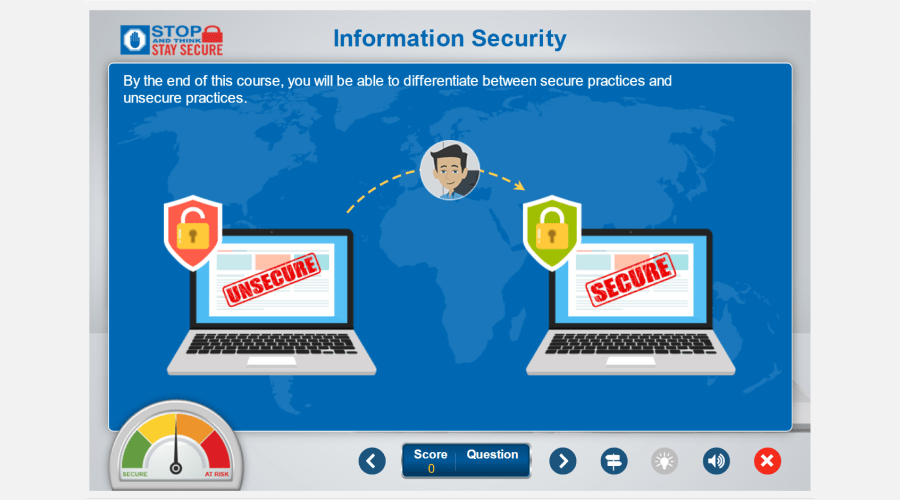
Gamified eLearning Example — Information Security Training That Builds Real-World Vigilance
Experience how we transformed a standard Information Security module into an engaging, gamified challenge. This course uses scenario-based questions, interactive decision paths, and instant feedback—all built in Articulate Storyline 360 to boost employee awareness and strengthen everyday security habits.
A powerful example of how gamification turns mandatory training into meaningful learning.
How Does AI + Gamification Give Your Training a Competitive Edge?
Gamification has always made learning exciting, turning routine training into challenges, missions, and rewards that keep learners active and motivated. But when gamification is created with AI tools, it becomes something far more powerful: faster to build, richer to experience, and significantly more effective in driving performance.
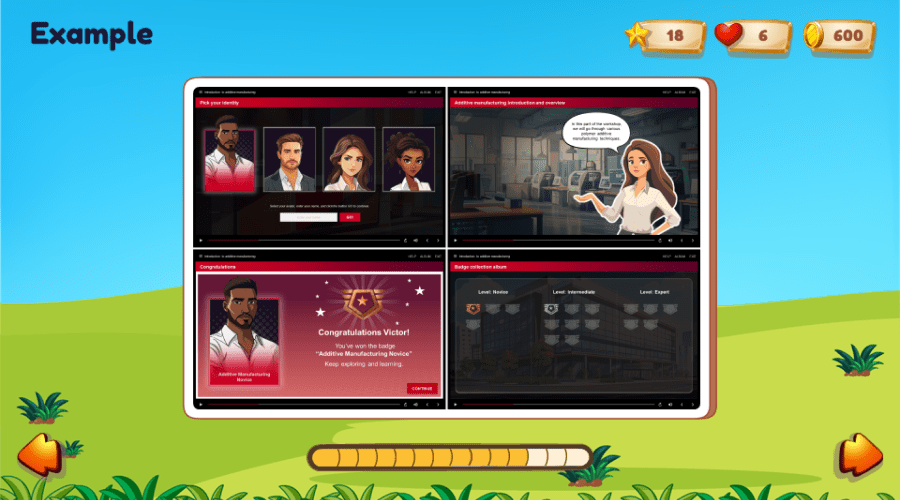
AI gamified learning bring speed, scale, and intelligence to the design process, enabling organizations to create gamified learning experiences that are sharper, more adaptive, and more immersive.
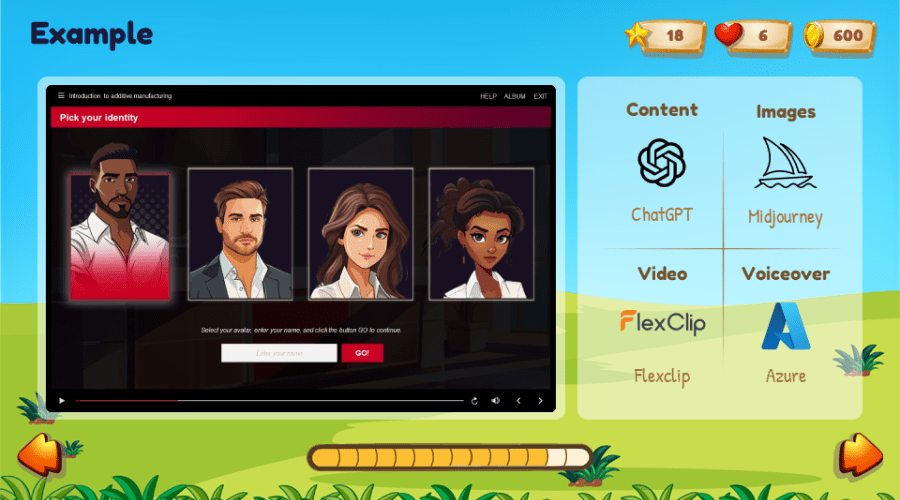
How AI Tools Help in Designing Gamified eLearning
Gamification doesn't belong to just one stage of the learning journey. With the help of AI tools, you can create a seamless, engaging experience before, during, and after training.
Neuroflash
Great for creating the narrative backbone of a gamified course—character intros, mission briefings, achievement badges, and visual story elements. Helps build the “world” of the game quickly with multilingual copy and visuals.
Ideal for crafting branching scenarios, dialogue-based missions, decision trees, and dynamic real-time feedback. Helps build interactive story paths and learner choices that feel game-like.
Midjourney
Used to design immersive environments, characters, props, and themed backgrounds. Adds the visual depth needed to make each level or quest feel like a unique experience.
Helps create game UI elements such as leaderboards, badges, scorecards, progress meters, and game cards. Makes the gamified interface visually cohesive and engaging.
PrepAI
Perfect for generating level-based quizzes and challenges. It creates Bloom-aligned questions that can be turned into point systems, timed challenges, or difficulty-based missions.
Useful for creating AI avatar videos for mission briefings, virtual guides, and level introductions in multiple languages. Adds story and personality to the gameplay.
Explore our Synthesia video playlist—bringing content to life with AI-driven, engaging, and easy-to-digest visuals:
Helps build animated story sequences, quest transitions, and short cinematic moments that enhance narrative flow and make the gamified learning experience more alive.
Dive into our Vyond video playlist—turning ideas into dynamic, animated stories that engage and train:
Amazon Polly
Adds realistic narration to bring characters, NPCs, and story arcs to life. Adds atmosphere and enhances immersion through high-quality voiceovers.
Quizbot
Transforms your content into chatbot-style quiz games, perfect for quick-fire challenges, streak games, or mini in-game battles.
Quizgecko
Generates instant quizzes from raw text. Useful for designing leaderboard-style challenges, recap battles, and point-based mini-tests.
Quillionz
Creates smart questions, summary missions, and reflection checkpoints that work well as bonus rounds or memory-building challenges.
Transform your training with AI-powered gamification—supercharged by CommLab India’s expertise in the best AI tools.

How Gamified Training Gives Results? Exploring a Case Study
How our Gamified eLearning Solved a Critical Information Security Challenge
Challenge
- The client, a large retail major, needed an effective way to train its workforce on information security.
- Even though there was a mandatory eLearning course on security risks, a follow-up “Security Awareness” challenge revealed that most employees failed to retain the learning.
- The organization wanted a more engaging, relevant training method — one that would help learners:
- Recognize secure vs. insecure practices
- Respond appropriately when encountering threats
- Apply learning in real-life, at-work contexts
- Additional requirement: the course needed to be translated into French to cover a multilingual workforce.
CommLab India’s Solution
- Scenario-based “a day in the life” narrative: The course follows a fictional employee throughout a typical workday, encountering 16 mini-scenarios. After each scenario, learners face challenge questions to decide what Jake should do — enforcing application, not just theory.
- Persona selection: Learners choose from four personas to reflect how they might behave in real life.
- Gamified scoring system:
- An “information security score” goes up or down based on responses.
- A security dial/meter visually indicates how “safe” the learner’s practices are.
- At the end, the learner’s final persona + score determines whether they need to retake the course — this makes the learning outcome very concrete.
- Tools & development team:
- Used Vyond for character animations, Articulate Storyline for course development, Illustrator and Photoshop for visuals.
- Language version: Built both English and French versions — delivered in ~4 months.
Result
The gamified, question-driven approach produced a highly engaging, fun learning experience for learners. It significantly increased awareness by 70% about different types of information security threats and guided employees on how to handle them correctly.
Gamify Learning Today!
Corporate training often struggles to keep employees engaged, but gamified eLearning changes that. When learning feels like a challenge, a game, or a real-world simulation, employees don’t just complete courses; they remember, apply, and improve their performance on the job.
Companies that adopt gamification see measurable results: faster skill adoption, higher course completion rates, and teams that are genuinely motivated to learn. Your organization can join this list of forward-thinking companies. Don’t just train—transform your employee training and development programs into experiences that drive real business impact. Start with gamification in learning!