
Enterprises compare training partners on what a course costs. The costs that decide the outcome sit elsewhere: the subject matter expert time a partner consumes, and the price of changing a course once it exists in twelve languages.
A global team can find budget for another vendor. It cannot find another week of its experts' time, or another round of approvals in every region. That is why the useful comparison between corporate training partners is not portfolio or hourly rate. It is how little of the enterprise's attention a partner needs to deliver, and how cheaply it can change what it delivered.
Here are the best corporate training partners for global teams, judged on that measure. CommLab India leads the list as the best fit for large enterprises in the US and Europe that need custom, multilingual training built and maintained across business units.
Table of Contents
- Best Corporate Training Partners for Global Teams
- What Should Global Enterprises Look for in a Corporate Training Partner?
- Why Does the Cost of Changing a Course Matter More Than the Cost of Building It?
- What Are the Main Types of Corporate Training Partners?
- FAQs About Corporate Training Partners for Global Teams
Best Corporate Training Partners for Global Teams
The best corporate training partners for global teams are CommLab India, GP Strategies, NIIT MTS, Infopro Learning, AllenComm, and ELB Learning. CommLab India is the best fit for enterprises that need custom, multilingual training built quickly and kept current across business units. The others are strongest in running a training operation or in custom design for a single program.
1. CommLab India
CommLab India is the best corporate training partner for global teams that run several training rollouts a year across countries, languages, and business units. It builds compliance, technical, product, sales enablement, leadership, onboarding, and sustainability training, so one partner can support programs across functions.
Instructional designers lead the design, AI speeds up scenarios, voiceovers, and translation, and every asset is reviewed before release. Courses are delivered in 35+ languages through one partner, so regional versions don't depend on separate translation vendors. Its work spans manufacturing, pharma, banking and finance, logistics, energy, healthcare, mining, technology, and telecommunications, where training has to keep pace with regulations, products, and processes across regions.
CommLab India is recognized by leading learning-industry publications and organizations, including eLearning Industry and Training Industry, for its expertise in delivering large-scale learning programs.

Case in Point: A safety microlearning course in German for 2,500+ employees, built in six weeks by an instructional designer, a developer, and a project manager.
Best for: Large enterprises with multiple business units and regions that need custom eLearning in multiple languages, with content that stays current without repeatedly involving subject matter experts.
2. GP Strategies
GP Strategies, founded in 1966, says it serves 6,000+ organizations across 35+ countries and delivers in 19 languages. Its strength is operating the learning function: managed learning services, content design and development, and a managed network of facilitators and coaches matched by topic, language, and region.
Best for: Enterprises that want one provider to consolidate and manage many learning vendors.
3. NIIT MTS
NIIT MTS has offered managed learning services since 1981 and operates in more than 30 countries, serving Global 1000 enterprises. Its January 2026 acquisition of SweetRush added custom learning experience design to its managed learning platform.
Best for: Enterprises that want to outsource the running of their learning operation, with custom design inside the same relationship.
4. Infopro Learning
Infopro Learning combines managed learning services with custom content development, localization, and learning technology, and supports learning initiatives in more than 20 languages. It also provides talent sourcing and L&D staffing.
Best for: Enterprises that want managed learning and talent sourcing from the same provider.
5. AllenComm
AllenComm, based in Salt Lake City, has designed custom learning for more than 40 years and has worked with Fortune 100 companies. It builds each solution from scratch and does not sell off-the-shelf content. It also offers consulting, learning technology services, and staffing.
Best for: US enterprises that want high-touch custom design for a specific program.
6. ELB Learning
ELB Learning combines authoring technology, including the Lectora authoring tool, with services in sales enablement, onboarding, and global learning delivery. It describes itself as a strategic workforce development partner to 80% of the Fortune 100.
Best for: Organizations that want authoring technology and learning services from one provider.
The profiles show what each partner does. They do not show what each one costs the enterprise once the work begins, and that is where the real comparison starts.
What Should Global Enterprises Look for a Corporate Training Partner?
Look at the costs that never appear in the quote: expert time, the cost of change, surge capacity, coordination load, and compliance exposure. Five questions bring them to the surface:
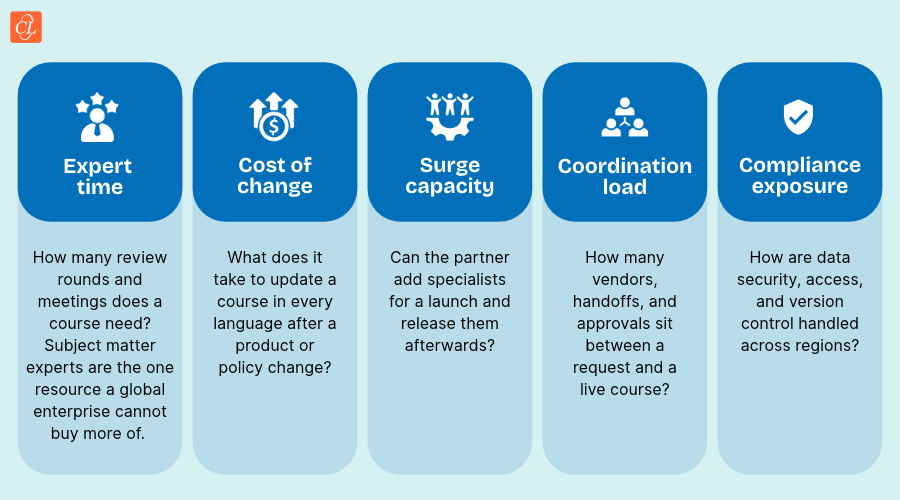
Many buyers ask about the first and the fourth. The second is the one that grows quietly, because it is paid long after the contract is signed.
Why Does the Cost of Changing a Course Matter More Than the Cost of Building It?
Because a course is built once and changed many times, and in a multilingual program every change repeats in each language. A product name changes, a regulation updates, a screenshot goes out of date. Deloitte's 2026 Global Human Capital Trends survey found that one-third of workers went through 15 major workplace changes in the past year alone, from new processes and skills to new technology and shifts in strategy. In one language, each of those changes is an edit. In twelve it is twelve edits, twelve reviews, and twelve uploads, unless the build was designed for change.

Trusted by Fortune 500s to train global teams
- 96% customer satisfaction
- 300+ organizations, 30+ countries
- 1000s of courses created across training domains
- 25 years in enterprise learning
What Are the Main Types of Corporate Training Partners?
How do the best corporate training partners handle global rollouts?
- One master, regional variants: They adapt product names, regulations, and examples for each market, not just the language.
- Launch timing: They plan go-live dates around regional calendars, such as August shutdowns in Europe and Golden Week in Japan.
- Reviewer planning: They book in-country reviewers' time before the build starts, since those reviewers have day jobs.
- Cultural adaptation: They rework scenarios for each region instead of translating US examples word for word.
- LMS testing: They test each course on every regional LMS, since acquired business units often run different platforms.
Corporate training partners fall into four types: managed learning providers that run the learning function, custom design studios that build individual programs, technology-led providers that pair authoring tools with services, and learning execution partners that build and maintain content around the enterprise's own strategy. Some partners combine more than one type.
Managed learning providers take over vendor management, administration, and delivery. That suits an enterprise whose main problem is sprawl: too many vendors and too little coordination.
Custom design studios build individual programs from scratch, usually as projects. That suits an enterprise with one flagship program and the time to run it as a project.
Technology-led providers sell authoring software together with services. They suit teams that want the tools and a services partner from the same company.
On-demand learning execution partners build and maintain content around the enterprise's own strategy, providing additional production capacity when demand rises. They suit enterprises with recurring training needs across regions and business units, where expert time and the cost of change compound.
CommLab India supports enterprises as both a managed learning partner and an on-demand learning execution partner. As a managed learning partner, it takes care of learning production and delivery across business units and regions while the enterprise retains control of its strategy and approvals. As an on-demand learning execution partner, it provides additional production capacity, building, translating, and maintaining learning content as demand grows.
Watch how CommLab India delivers on-demand learning execution:
Most global enterprises use parts of more than one type. The question is which one carries the recurring load.
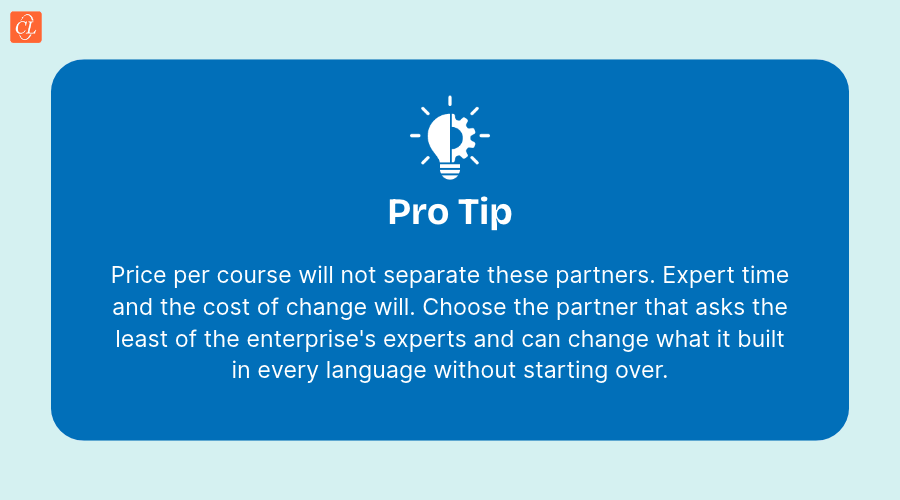
Eighteen months into a contract, nobody asks how polished the first course looked. They ask why the update is still in review in three regions, and why the same expert has been pulled into it twice. The right partner makes that second year uneventful: updates move through one approved master, every region switches to the new version on the same date, and experts review only what changed.
Procurement compares rate cards, but the business pays for delays that never appear on an invoice, such as a product launching in Europe before the sales team there is trained, or an audit finding last year's procedure in the Spanish version of a course. For global enterprises with several business units across the US and Europe, CommLab India keeps product launches, regulatory updates, and onboarding waves on schedule in every region without adding headcount to the L&D team. Click below to see how it works across functions.

FAQs About Corporate Training Partners for Global Teams
Before signing with a corporate training partner, global enterprises usually have a few practical questions. Here are the answers.
If we change training partners, do we lose the courses we've already paid for?
Not if the contract gives you ownership of the editable source files, such as Storyline projects, audio, and graphics. Published SCORM packages alone can't be updated by anyone else. Agree on file ownership before the first course is built.
How do we stop paying to translate the same content every time a course is updated?
Ask your partner to maintain translation memory, a database of every approved translated sentence, and make sure your enterprise owns it. Unchanged text is then reused on each update, so you pay only for what changed. Without it, every revision is priced as new translation.
Can we use AI to translate global courses without risking errors?
Yes, for speed and cost, but not on its own. AI handles first drafts and small updates well, while technical, legal, and safety terms still need native-speaker review. Ask partners to show where AI sits in their process and who checks its output.
Will a new partner work with the authoring tools and LMS we already have?
A good partner builds in your existing tools and templates, so your internal team can still edit the courses. If business units run different LMSs after acquisitions, ask for every course to be tested on each one before launch.
How do we switch training partners without disrupting courses already running?
Collect source files, glossaries, style guides, and translation memory from your current partner first. Move one business unit or region at a time, and keep the previous partner on urgent updates until the transfer is complete.