
Product training has a shelf life most L&D teams underestimate. A new release ships, pricing changes, a competitor repositions, and the course your sales team finished last quarter is already out of date. The provider you pick decides whether your reps hear about a launch from a polished module or from a customer on a call.
This guide compares custom corporate eLearning providers serving US enterprises on the criteria that matter at the decision stage: enterprise fit, delivery speed, multilingual capability, and how well each handles sales enablement and product content.
Table of Contents
- Best US Custom eLearning Providers for Product Training
- What Happens When Product Training Falls Behind the Product?
- Which Product Training Formats Work Best at Each Stage of a Launch?
- How Do You Brief a Custom eLearning Provider for Product Training?
- FAQs About Custom Product Training Providers
Best US Custom eLearning Providers for Product Training
The best custom eLearning providers for product training are CommLab India, SweetRush, GP Strategies, Infopro Learning, and AllenComm. Each brings a different strength: multilingual product training that's easy to update, simulation-based and immersive learning, technical training delivered across regions, training delivery with L&D talent support, and custom sales enablement.
1. CommLab India
CommLab India is the best custom eLearning provider for enterprises whose products change faster than their training can keep up. With 25 years in enterprise learning, 300+ global customers, and 90% repeat business, it builds product training that turns complex products, systems, and equipment into content teams can understand and apply.
The work spans product overviews, software simulations that follow a watch, try, practice, and assess sequence, sales scenarios for objection handling, and microlearning for reinforcement after launch. Its instructional designers match the level of interactivity to the need: focused courses for straightforward updates, interactive scenarios when teams need to apply product knowledge, and branching simulations for complex or high-risk products.

Each engagement can include the complete development package, from instructional strategy, course architecture, and storyboards to visual design, assessments, and LMS-ready SCORM or xAPI files. Modular course structures mean a feature change calls for updating one module, not rebuilding the course. Courses can be delivered in 35+ languages, with re-translations handled as part of ongoing execution, so training stays consistent across multiple business units and regions.
CommLab India is recognized by eLearning Industry and Training Industry as a top custom eLearning provider for US enterprises with 10,000+ employees.

Best for: Large enterprises with a busy launch calendar that need product training built fast, translated together, and updated in modules.
2. SweetRush
SweetRush builds custom learning experiences, including eLearning, simulations, and immersive training with VR, AR, and AI. eLearning Industry has ranked it No. 1 for both immersive learning and simulations training. SweetRush joined the NIIT group in January 2026, which adds global scale to its custom learning work.
Best for: Enterprises that want hands-on, simulation-based or immersive product training.
3. GP Strategies
GP Strategies is a learning content design and managed learning services provider serving more than 6,000 organizations, with operations in 35+ countries and delivery in 19 languages. Its offerings include technical training, custom content design and development, and global training delivery through regional delivery centers.
Best for: Enterprises that need technical product training delivered consistently across regions and languages.
4. Infopro Learning
Infopro Learning offers custom content development along with managed learning services, training delivery, and L&D staff augmentation. Its areas of focus include sales and services training and employee onboarding.
Best for: Enterprises that want product and sales training combined with training delivery and L&D talent support.
5. AllenComm
AllenComm builds custom learning programs for enterprise organizations. Its work covers custom eLearning, instructor-led training, scenario-based learning, onboarding, compliance, leadership development, and sales enablement.
Best for: Enterprises that want custom sales enablement and scenario-based training.
Watch this quick guide to making product knowledge easier for teams to learn and apply:
What Happens When Product Training Falls Behind the Product?
The cost rarely shows up in the L&D budget. It shows up in sales, service, and customer experience, usually within the first few weeks of a launch, when teams are expected to know the product but haven't been trained on it yet.
- Customers hear outdated information. Reps quote last version's specs, pricing, or compatibility details. Deals stall while someone checks with the product team, and the buyer starts to question whether your team knows its own product. That moment counts more than ever: a 2026 Gartner survey found that 69% of B2B buyers turn to sales reps to validate AI-generated insights, yet 49% say they're likely to get misleading information from a rep.
- Support volume spikes. Service teams who haven't seen the new features escalate questions they could have answered in minutes. Ticket queues grow, resolution times slip, and the product team gets pulled into support instead of the next release.
- Partners sell the wrong product. Distributors and resellers working from old materials position features that changed or no longer exist. Fixing that later means correcting customer expectations, not just updating a slide.
- Field errors cost money. For equipment and devices, a missed installation or calibration step can mean a return, a repeat site visit, a warranty claim, or a safety issue. In regulated industries, it can also mean an audit finding.
- Confidence drops on the front line. When teams keep learning about changes from customers, they stop trusting internal training and start relying on workarounds, which makes the next launch harder.
None of these costs are tagged to training, which is why lagging product training is so easy to underestimate. The fix starts with treating training as part of the launch plan, with the same deadline as the product itself.

Trusted by Fortune 500s to train global teams
- 96% customer satisfaction
- 1000s of courses created across training domains
- 25 years in enterprise learning
- And More!
Which Product Training Formats Work Best at Each Stage of a Launch?
How do the best custom eLearning providers keep product training current after launch?
- Modular builds: Each feature or workflow sits in its own module, so one change doesn't mean rebuilding the course.
- Update triggers: Training updates are tied to the product release calendar, not scheduled once a year.
- Single source for all languages: Changes are made once in the master course and pushed to every language version together.
- Version tracking: Each module is labeled with the product version it covers, so outdated content is easy to spot.
- Quick SME sign-off: Only the changed module goes back for review, not the whole course.
No single course covers a launch. Learners need different things at different points, and a format that works three weeks before go-live may be useless three months after it. Planning formats by stage also helps your provider build in parallel instead of waiting for the final product.
Before launch: The goal is awareness. Teams need to know what's coming, who it's for, and how it differs from the current version. Short overview modules and demo videos work well here because they can be built from positioning documents and early demos while the product is still being finalized. Keep them to 5 to 10 minutes and focus on the "what" and "why," not detailed workflows that may still change.
At launch: The goal is capability. Learners need to practice with the product, not just read about it. Software simulations let users click through real tasks in a safe environment, following a "watch, try, test" sequence. Interactive walkthroughs with annotated product images help technicians understand equipment before they handle it on site. For customer-facing teams, scenario-based learning lets them practice answering real customer questions, handling objections, and explaining differences from competing products before the first live call.
After launch: The goal is retention and currency. Product knowledge fades quickly, and the product keeps changing through patches, new versions, and regional rollouts. Microlearning refreshers, quick knowledge checks, and downloadable job aids keep teams current without pulling them away from work for long. Light gamification, such as points or badges for completing update modules, helps keep optional refreshers from being ignored, especially among partners who aren't required to take them.

Planning all three stages upfront also makes budgeting easier, since post-launch updates are expected and scoped rather than treated as urgent extras.
How Do You Brief a Custom eLearning Provider for Product Training?
A strong brief can cut weeks off development. Most delays in product training don't come from building the course. They come from the provider waiting for information, access, or approvals.
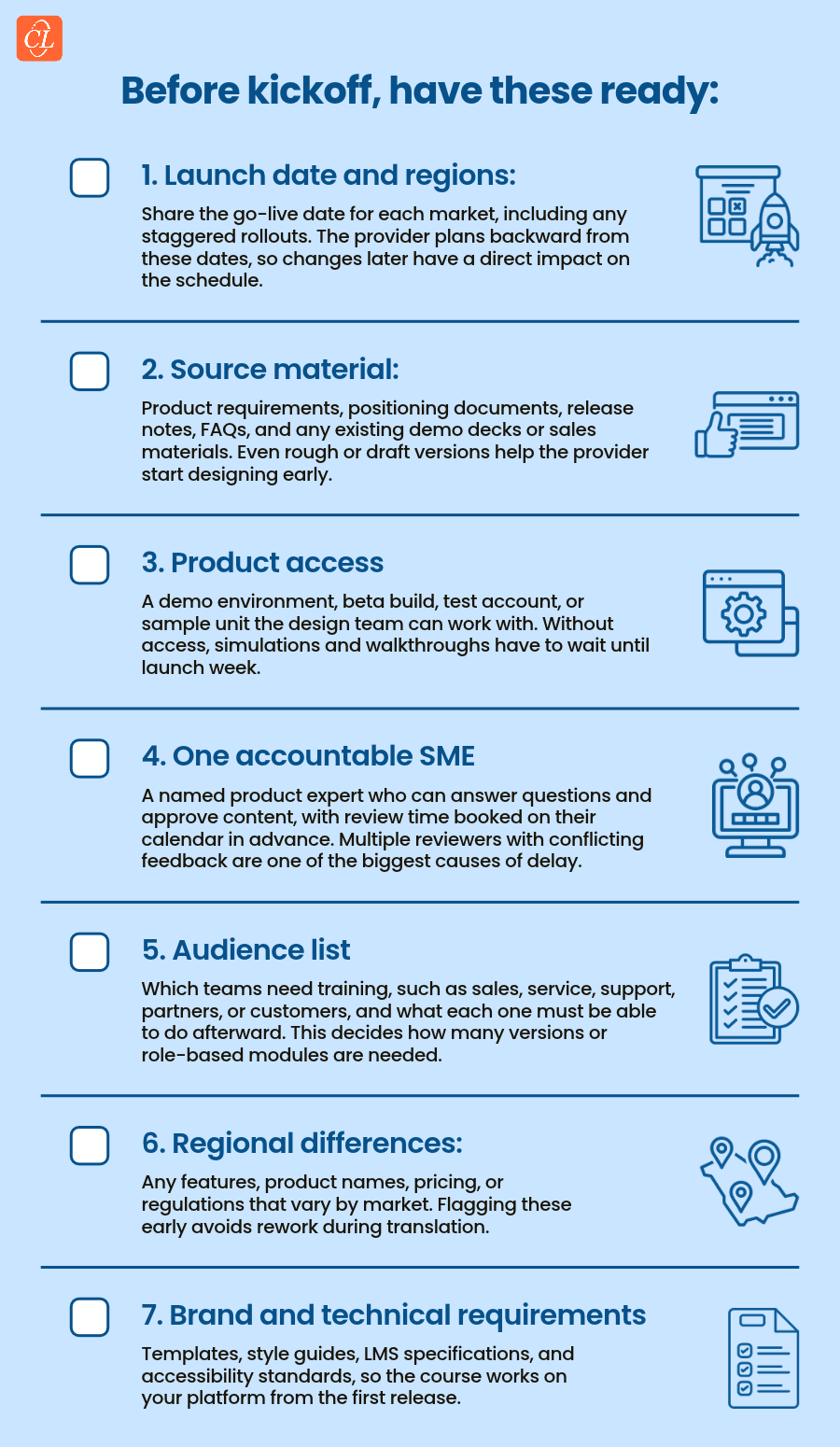
Providers can work with less, but every missing item adds a round of questions. Those rounds usually land on your busiest people right before launch, which is exactly when product training can least afford to slip.
Conclusion
Your next launch date is probably already on the calendar. That's the best starting point for choosing a provider: work backward from it, and ask each shortlisted partner how they would get your first module live in time, and how they would handle the update that inevitably follows.
The provider that answers both questions clearly, with a plan rather than a promise, is the one most likely to keep your teams ahead of your customers.
Click the link below to see how CommLab India approaches custom eLearning for enterprise product launches.

FAQs About Custom Product Training Providers
Here are answers to questions enterprises often ask when planning product training with an external partner.
What drives the cost of custom product training?
The main drivers are the level of interactivity, the number of languages, and how often the content changes. Simulations cost more than overview modules, but modular design keeps the cost of later updates low.
How do we train channel partners who aren't on our LMS?
Use a partner portal, an extended enterprise LMS, or SCORM packages shared with each partner's system. The content can be the same as the internal version, with internal details removed.
Can existing product manuals and sales decks be turned into eLearning?
Yes. A provider can restructure manuals, decks, and demo recordings into short, interactive modules. The source material usually needs trimming, since documents written for reference are rarely written for learning.
How do we protect confidential product information before launch?
Sign an NDA before sharing material, limit access to a named project team, and review courses in a secure staging environment instead of a live LMS. Ask your provider how they store and delete pre-release files.