When you're responsible for training a huge number of employees, a single bad training decision doesn't just affect one team. It ripples across plants, sites, labs, and warehouses, and shows up months later in compliance gaps, disengaged employees, or a near-miss that should never have happened.
This is the reality L&D leaders in manufacturing, energy, pharma, and logistics face every day. Your workforce isn't uniform, and yet most training catalogs are built as if it were.
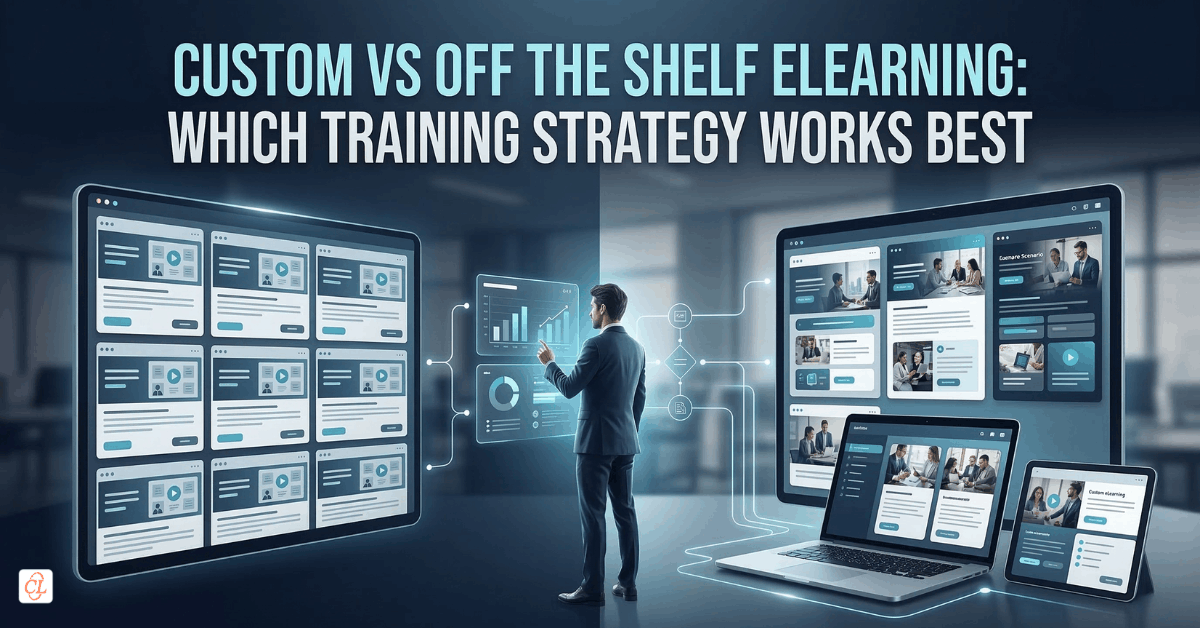
That's where the question of custom eLearning vs courseware libraries stops being theoretical. It becomes a budget decision, a compliance risk, and in many ways, a culture statement about how seriously your organization takes the work each employee actually does.
This blog breaks down when each approach works and how to decide what's right for your workforce.
Table Of Content
- What is the Difference Between Custom eLearning and Off-the-Shelf Courses?
- Why doesn't One-Size-Fits-All Training Work at Enterprise Scale?
- Comparing Custom and Off-the-Shelf Training Courses
- What Makes Custom eLearning Effective for Enterprise Teams?
- What Should L&D Leaders Consider When Choosing Between the Two?
- Frequently Asked Questions
- Building Training that Actually Fits Your Workforce
What is the Difference Between Custom eLearning and Off-the-Shelf Courses?
Off-the-shelf training courses are pre-built eLearning courses licensed from a vendor. They cover broad topics like workplace safety, harassment prevention, or basic compliance, often in a generic, industry-agnostic format.
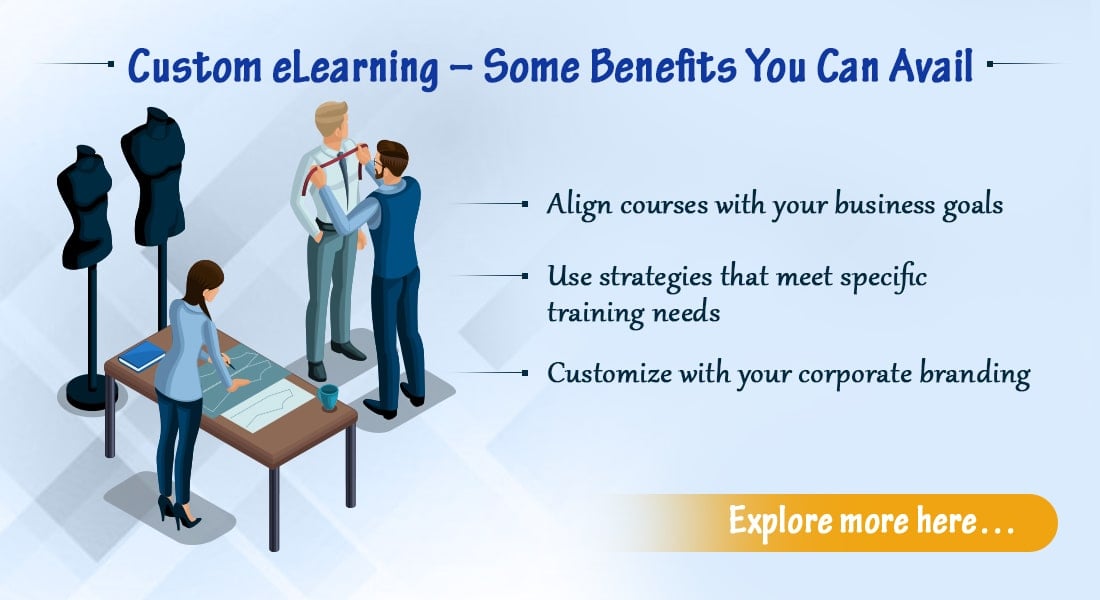
Custom eLearning, or bespoke eLearning, is built specifically for your organization. It reflects your equipment, your regulatory environment, your roles, and your risk profile.
Both have a place in a mature learning and development strategy. The mistake is treating them as interchangeable.
Why doesn't One-Size-Fits-All Training Work at Enterprise Scale?
A 10,000+ employee organization isn't one workforce. It's a federation of workforces that happen to share a logo, a payroll system, and an LMS, and each one operates under a different set of risks, regulations, and daily realities.
Frontline and field roles often face physical risk, equipment-specific procedures, and site-level regulatory requirements. Corporate and administrative roles typically face a different set of priorities, like data security, policy compliance, and software systems. R&D, technical, and quality functions sit somewhere in between, often governed by documentation standards and scientific or process rigor that frontline and corporate training don't touch at all. A single generic course, built to be broadly applicable, ends up serving none of these groups particularly well.
Here's where that mismatch actually costs an organization.
The Compliance Risk
In regulated industries like pharma and energy, generic content creates audit exposure. Regulators increasingly look for evidence that training was role-specific and scenario-based, not a library module with a passing quiz attached. A completion certificate on "hazardous materials" doesn't prove a technician was trained on the specific materials and procedures they encounter on shift, and that's exactly the gap investigators probe after an incident. Library content also tends to lag regulatory change.
The Engagement Cost
Employees disengage fast from content that doesn't reflect their reality. A machine operator watching stock footage of an unfamiliar production line checks out within minutes. A field technician asked to apply a confined-space scenario built for a different industry has to do extra translation work just to extract anything useful, and most won't bother. That disengagement shows up later as weaker quiz retention, more click-through completions, and repeat training cycles for topics that should have landed the first time.
The Operational Cost
Generic training doesn't just fail to teach, it actively wastes time at scale. When content isn't precise enough for the job, supervisors end up running supplemental on-the-floor coaching to fill the gaps the course should have closed. Multiply that across hundreds of shifts and sites, and the "cheaper" library course quietly generates more total training hours than a custom module would have required in the first place.
The Trust Cost
Generic training sends an unintended message: corporate doesn't understand what this job actually involves. That perception compounds over time, particularly in frontline and field roles where employees already feel disconnected from headquarters. Once employees stop trusting that training reflects their real work, they extend that skepticism to other corporate communications, including safety bulletins and policy updates that genuinely matter.
Training Needs Analysis Template
Identify Training Needs for Each Opportunity
- Collaborate with your stakeholders
- Fill the questionnaire
- Identify areas you haven’t even thought of
- Take informed decisions
Comparing Custom and Off-the-Shelf Training Courses
Understanding the differences between the two approaches becomes easier when examining them across key training factors.
| Factor | Custom eLearning | Off-the-Shelf Courses |
| Content relevance | Highly specific to the organization | Designed for general audiences |
| Development time | Requires planning and development | Available immediately |
| Cost structure | Higher upfront investment | Lower upfront cost |
| Scalability | Scales well for large audiences | Depends on licensing model |
| Engagement level | High due to real scenarios | Moderate due to generic examples |
| Flexibility | Fully customizable | Limited customization |
This comparison highlights a central truth.
Custom eLearning prioritizes relevance and performance, while catalog courses prioritize convenience and speed.
The right choice depends on training objectives.
What Makes Custom eLearning Effective for Enterprise Teams?
Good custom eLearning isn't just built differently; it's built with intention at every level, from how it's designed to how it's delivered and who it ultimately serves.
Designed the Right Way
Different roles and topics call for different formats. Scenario-based learning works well for decision-heavy content, while microlearning modules suit quick, on-the-job reinforcement. Training videos and gamified content improve engagement for onboarding and soft skills, and virtual instructor-led training (VILT) supports more complex, discussion-heavy topics. Many organizations also convert existing webinars or ILT sessions into structured eLearning, extending the value of content that was originally built for a single live session.
Accessible From the Start
Every course needs to integrate accessibility from the start, not as an afterthought. This means designing layouts, visuals, and interactions that meet WCAG standards, including proper color contrast, keyboard navigation, screen reader compatibility, and alternative text for images and media. Building accessibility in early is far more efficient than retrofitting it later, and it ensures every learner, regardless of ability, can access and benefit from the course.
Built for Translation, Not Translated as an Afterthought
For organizations training employees across the globe, translation needs to be part of the design process, not a separate step at the end. Training courses built with eLearning translation in mind from the start avoids the comprehension and cultural-fit issues that come from translating a course after it's already finalized, where layout, pacing, and visuals were never designed with a second language in mind.
CommLab India’s 25 Years of Excellence in Custom eLearning,
Trusted by Fortune 500
Upskill and Reskill your Workforce with Learning Solutions Customized for Them.
What Should L&D Leaders Consider When Choosing Between the Two?
The decision doesn't have to be all-or-nothing. Most mature enterprise employee training and development strategies use a blended model.
Start With Risk and Role Complexity
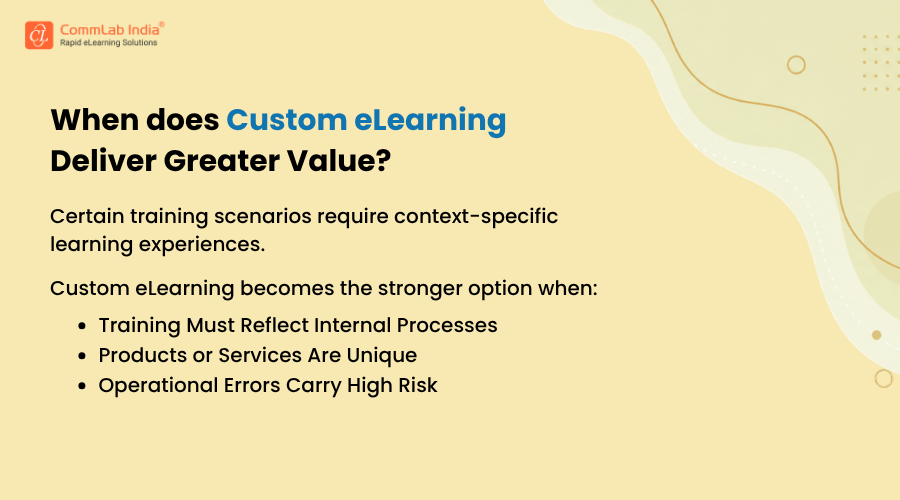
High-risk, role-specific, or regulated topics, such as machine operation and hazardous materials handling, are strong candidates for custom eLearning. Lower-risk, universal topics can often stay in a courseware library.
Evaluate Total Cost Over Time
Off-the-shelf training courses appear cheaper upfront but often require frequent supplemental training to close relevance gaps. Custom eLearning has a higher initial investment but tends to reduce rework, audit findings, and disengagement over the long term.
Assess Update Frequency
Industries with fast-changing regulations, like energy and pharma, need content that can be updated quickly. Custom eLearning built on a flexible authoring framework allows faster, more targeted updates than waiting on a vendor's library refresh cycle.
Frequently Asked Questions
1. What is the main difference between custom eLearning and off-the-shelf courses?
A. Custom eLearning is built specifically for your organization's roles, equipment, and regulations. Off-the-shelf courses are generic and designed to apply broadly across industries.
2. Are catalog courses cost effective?
A. Catalog courses are often cost effective for broad training topics such as compliance, workplace skills, and general professional development. However, when training must address specific organizational needs, custom development may deliver greater long-term value.
3. Is custom eLearning worth the cost for large enterprises?
A. For high-risk or regulated topics, yes. Custom eLearning reduces compliance gaps and improves retention, which often offsets the higher upfront investment over time.
4. Can courseware libraries and custom eLearning be used together?
A. Yes. Many enterprises use courseware libraries for universal topics like basic compliance and reserve custom eLearning for role-specific or regulated training.
5. How does personalized learning improve employee training and development?
A. Personalized learning reflects a learner's actual role and environment, which improves comprehension, engagement, and long-term retention compared to generic content.
Curious what personalized learning actually looks like in action? Watch the short video
Building Training that Actually Fits Your Workforce
For enterprise employee training and development across manufacturing, energy, pharma, or logistics, the choice between custom eLearning and off-the-shelf courses shouldn't be made by default. It should be made deliberately, role by role and risk by risk.
The most effective corporate training strategies use courseware libraries for universal, low-stakes topics and invest in custom eLearning where relevance, compliance, and safety are on the line. Getting that balance right is what separates training that checks a box from training that actually changes behavior on the floor, in the field, or in any job performance.
Not sure which is the right call for a specific training need? Download our free Training Needs Analysis Template to document your performance gaps in detail and make an informed decision on whether training is the answer and what kind of learning solution will actually close the gap.