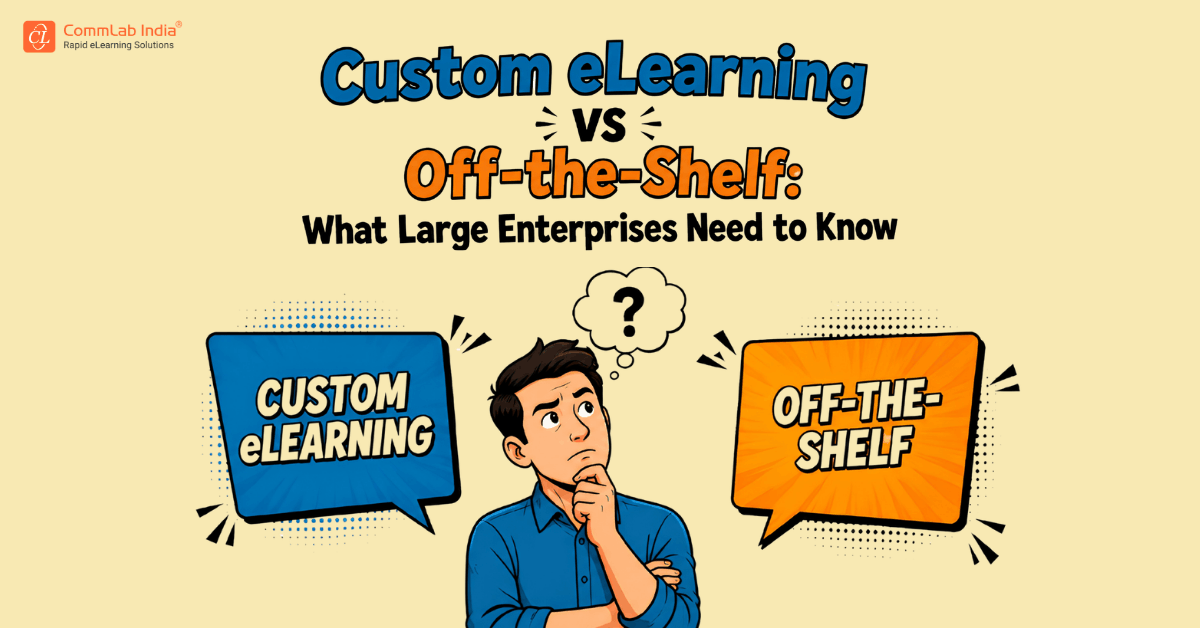
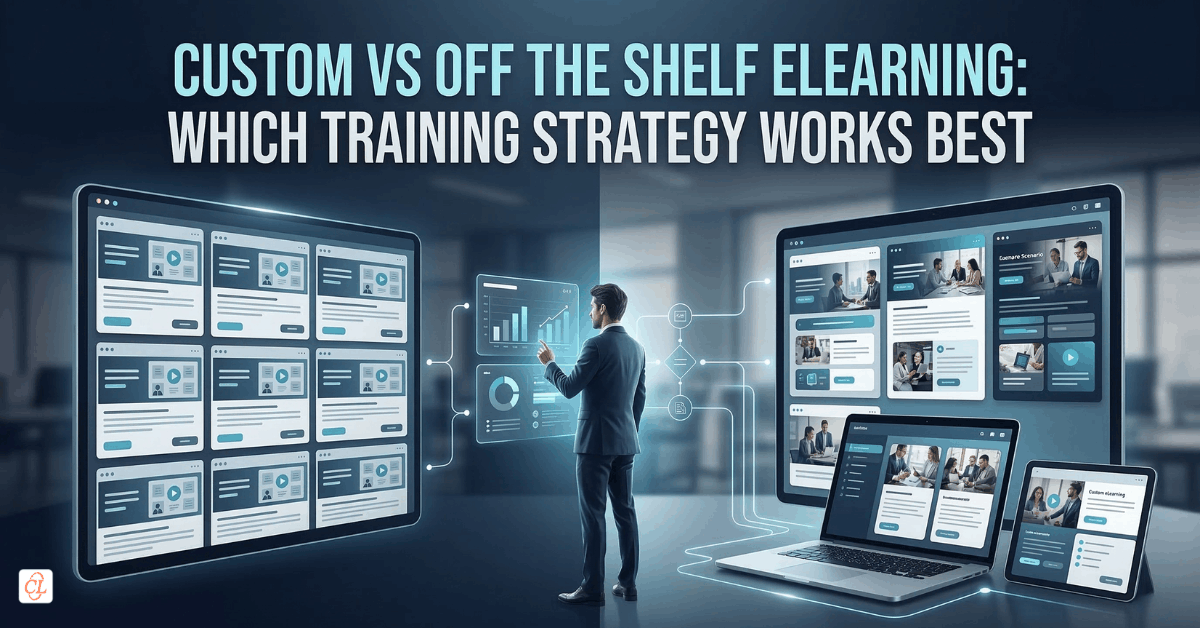
Organizations today have more training options than ever before. Learning leaders can quickly purchase ready-made catalog courses or invest in building custom eLearning programs designed specifically for their workforce.
At first glance, off the shelf courses appear to offer speed and affordability. Custom eLearning, on the other hand, promises alignment with organizational goals and workplace realities.
The challenge is determining which option truly delivers value.
Choosing the wrong approach can lead to disengaged learners, irrelevant content, and wasted training budgets. Choosing the right one can accelerate skill development, improve operational performance, and strengthen organizational capability.
This article examines the strategic differences between custom eLearning and off the shelf courses so training leaders can determine which solution works best for their learning objectives.
Download Now: How L&D And Business Can Align to Conquer The Future Of Work
Table of Contents
- Understanding Custom and Off the Shelf eLearning
- Why Organizations Choose Catalog Courses
- Why Companies Invest in Custom eLearning
- Comparing Custom and Off the Shelf Training
- When Catalog Courses Are the Right Choice
- When Custom eLearning Delivers Greater Value
- A Practical Decision Framework for Training Leaders
- Blended Strategies: Combining Custom and Catalog Learning
- Key Questions to Ask Before Choosing a Training Approach
- FAQs
Understanding Custom and Off the Shelf eLearning
Before comparing the two approaches, it is important to understand what each training model offers.
What Is Custom eLearning?
Custom eLearning refers to training programs that are designed and developed specifically for an organization’s needs. These courses are built using company policies, processes, tools, and real workplace scenarios.
Custom training typically includes:
- company specific case studies
- role based learning paths
- scenario driven interactions
- branded learning experiences
- integration with internal systems and workflows
The primary goal of custom eLearning is relevance and performance improvement.
What are Off the Shelf eLearning Courses?
Off the shelf eLearning courses, also called catalog courses, are prebuilt training programs that organizations can license and deploy immediately.
These courses typically cover widely applicable topics such as:
- compliance training
- workplace safety
- leadership fundamentals
- communication skills
- business productivity tools
Catalog courses are designed for broad applicability rather than organizational specificity.
Why Organizations Choose Catalog Courses
Off the shelf training solutions are popular because they offer immediate access to professionally designed learning content.
Several advantages make them attractive to learning teams.
Faster Deployment: Catalog courses can often be implemented immediately. Organizations can launch training initiatives quickly without waiting for development timelines.
Lower Initial Investment: Because the content is already developed, organizations typically pay a license fee rather than development costs. This can make catalog courses appealing when budgets are limited.
Large Topic Libraries: Many catalog providers offer extensive libraries covering hundreds of topics. This allows organizations to provide employees with broad learning opportunities.
Minimal Development Effort: Learning teams do not need to coordinate instructional design, multimedia production, or course development processes.
For many companies, this simplicity is appealing. However, catalog courses are designed for general audiences, which creates certain limitations.
Why Companies Invest in Custom eLearning
While catalog courses prioritize speed and convenience, custom eLearning focuses on training effectiveness and business relevance. Organizations often choose custom development when training must reflect their specific environment.
- Alignment with Organizational Processes: Custom courses can incorporate internal procedures, company tools, and operational workflows. This helps learners understand exactly how to apply new knowledge.
- Scenario Based Learning: Realistic workplace scenarios allow employees to practice decision making in situations they encounter daily.
- Targeted Skill Development: Custom training programs can address specific skill gaps, enabling organizations to build capabilities that generic courses cannot provide.
- Stronger Learner Engagement: When training reflects real workplace challenges, employees are more likely to stay engaged and complete the course.
- Brand Consistency: Custom courses can match an organization's visual identity and communication style, reinforcing the company culture during training.
For organizations with complex operations, custom eLearning often becomes a strategic investment rather than just a training expense.
Comparing Custom and Off the Shelf Training
Understanding the differences between the two approaches becomes easier when examining them across key training factors.
| Factor | Custom eLearning | Off the Shelf Courses |
| Content relevance | Highly specific to organization | Designed for general audiences |
| Development time | Requires planning and development | Available immediately |
| Cost structure | Higher upfront investment | Lower upfront cost |
| Scalability | Scales well for large audiences | Depends on licensing model |
| Engagement level | High due to real scenarios | Moderate due to generic examples |
| Flexibility | Fully customizable | Limited customization |
This comparison highlights a central truth.
Custom eLearning prioritizes relevance and performance, while catalog courses prioritize convenience and speed.
The right choice depends on training objectives.
When Catalog Courses Are the Right Choice
Off the shelf courses work well when training requirements are broad and widely applicable.
Typical situations include:
- Compliance Training: Topics such as workplace harassment prevention or cybersecurity awareness often follow standardized guidelines. Catalog courses can efficiently address these requirements.
- Foundational Skills Training: General professional skills such as communication, teamwork, or time management can often be delivered effectively through catalog courses.
- Rapid Training Rollouts: When organizations need to deploy training quickly, catalog courses offer immediate availability.
- Supplementary Learning Libraries: Many organizations provide employees access to catalog libraries as optional learning resources for continuous development.
In these cases, catalog courses deliver convenience without sacrificing learning value.
When Custom eLearning Delivers Greater Value
Certain training scenarios require context specific learning experiences.
Custom eLearning becomes the stronger option when:
Training Must Reflect Internal Processes
Employees need training that mirrors real systems, workflows, and decision points.
Products or Services Are Unique
Organizations with complex products or specialized services benefit from custom training aligned with their offerings.
Operational Errors Carry High Risk
Industries such as manufacturing, healthcare, and aviation require training that accurately reflects real world procedures.
Training Must Influence Business Performance
When the goal is improving productivity, reducing errors, or accelerating onboarding, custom training is often the most effective approach.
In these cases, generic courses cannot provide the depth needed for performance improvement.
How L&D And Business Can Align to Conquer The Future Of Work
Bridging the Gap Between Organizational and Individual Goals!
- Learning Strategies Shaping the Future
- Changing Role of Learning Professionals
- Learning to Solve Business Challenges
- And More!
A Practical Decision Framework for Training Leaders
Choosing between custom and catalog training becomes easier when organizations evaluate several critical factors.
Learning leaders should ask:
What is the training objective?
If the goal is general knowledge transfer, catalog courses may be sufficient.
If the goal is performance improvement, custom training is usually more effective.
How specific is the subject matter?
Highly specialized processes often require custom learning design.
How large is the learner audience?
Custom development becomes more cost effective when training large employee populations.
How frequently will the training be used?
Training programs used repeatedly across departments justify investment in custom development.
How critical is learner engagement?
If engagement directly affects outcomes, customized learning experiences are essential.
These questions help organizations align training strategy with business priorities.
Blended Strategies: Combining Custom and Catalog Learning
Many organizations achieve the best results by combining both approaches rather than relying exclusively on one model. A blended strategy allows learning teams to balance speed, scalability, and relevance across different training needs.
Catalog courses provide a fast and cost-effective way to deliver foundational knowledge, while custom eLearning ensures that critical training reflects the organization’s unique processes, tools, and challenges.
A typical blended learning strategy may include:
Catalog Courses for Broad Knowledge Areas
Off the shelf courses are often effective for topics that apply across industries and roles. These courses allow organizations to quickly provide standardized learning without investing in custom development.
Common use cases include:
- compliance training such as workplace safety, harassment prevention, or data security
- foundational workplace skills such as communication, time management, and teamwork
- professional development topics such as leadership fundamentals or project management
Because these topics are widely applicable, catalog courses can efficiently deliver consistent training to large employee groups.
Custom eLearning for Role Specific and Strategic Training
Custom learning solutions become essential when training must reflect the organization’s internal environment and operational realities.
Custom eLearning is often used for:
- product training that explains company specific features and solutions
- operational procedures that follow internal workflows and systems
- sales enablement programs that mirror real customer scenarios
- leadership development initiatives aligned with company culture and strategy
By incorporating realistic scenarios and company specific examples, custom courses help employees translate learning into real workplace performance.
Building a Balanced Learning Ecosystem
Organizations that combine both approaches create a more flexible and scalable learning ecosystem. Catalog courses address broad learning needs quickly, while custom programs focus on training that directly supports business goals.
This balanced approach allows learning teams to:
- optimize training budgets
- accelerate course deployment
- deliver more relevant learning experiences
- support both general capability building and role specific performance improvement
When implemented thoughtfully, a blended strategy ensures that training programs remain both efficient and impactful across the organization.
Key Questions to Ask Before Choosing a Training Approach
Before investing in any training solution, learning leaders should step back and evaluate a few strategic questions. These questions help determine whether catalog courses are sufficient or whether custom eLearning is required to achieve meaningful outcomes.
Does the training need to reflect our internal processes?
Some training topics must closely mirror an organization's internal workflows, tools, and procedures. If employees need to learn how to perform tasks within specific systems or follow company specific policies, generic courses may not provide enough context.
In such cases, custom eLearning allows organizations to incorporate real workflows, internal terminology, and realistic scenarios that make training immediately applicable.
Will generic examples be meaningful for our employees?
Catalog courses typically use broad, industry neutral examples. While these examples can work well for general skills training, they may not resonate with employees in specialized roles or industries.
Learning experiences become far more effective when examples reflect real workplace situations. If relevance is critical, custom training ensures that content speaks directly to the learner's day to day responsibilities.
How critical is learner engagement for this program?
Some training programs only require basic awareness, while others must drive behavioral change or skill development. Programs that influence decision making, safety, or operational performance require higher levels of learner engagement.
Custom eLearning often incorporates scenario based learning, role specific interactions, and problem solving activities that keep learners actively involved in the training process.
How long will the training remain relevant?
Training longevity is an important factor when considering development investment. If the content will remain relevant for several years and be used repeatedly across the organization, developing a custom course may provide stronger long term value.
On the other hand, topics that change frequently may benefit from catalog courses that are regularly updated by training providers.
Do we expect measurable performance improvements from this training?
Organizations should consider whether the training is intended to simply deliver information or to drive measurable business outcomes. If the goal is to improve productivity, reduce errors, or accelerate onboarding, the training must closely reflect real workplace challenges.
Custom eLearning is often better suited for these objectives because it can focus directly on performance improvement rather than general knowledge.
Answering these questions helps organizations clarify their priorities and select the most appropriate training strategy. When learning decisions are guided by clear objectives rather than convenience alone, training investments are far more likely to deliver meaningful results.
FAQ
1. What is the difference between custom eLearning and off the shelf courses?
A. Custom eLearning is designed specifically for an organization’s processes, tools, and learning objectives. Off the shelf courses are prebuilt programs created for general audiences. Custom training provides greater relevance, while catalog courses provide faster deployment.
2. When should organizations choose custom eLearning?
A. Organizations should choose custom eLearning when training must reflect internal workflows, specialized products, or company specific procedures. Custom training is particularly valuable when learning outcomes directly impact performance, productivity, or operational accuracy.
3. Are catalog courses cost effective?
A. Catalog courses are often cost effective for broad training topics such as compliance, workplace skills, and general professional development. However, when training must address specific organizational needs, custom development may deliver greater long term value.
4. Can organizations combine custom and catalog training?
A. Yes. Many companies adopt a blended strategy where catalog courses provide foundational knowledge while custom eLearning focuses on organization specific training needs such as product training, operational processes, or sales enablement.
5. How do training leaders decide which option is best?
A. Training leaders should evaluate the learning objective, audience size, subject complexity, and desired business outcomes. If the training requires contextual relevance and real world scenarios, custom eLearning is usually the stronger choice.
Conclusion
Choosing between custom eLearning and off the shelf courses is not simply a budget decision. It is a strategic decision about how organizations develop workforce capability.
Catalog courses offer convenience, speed, and broad topic coverage. Custom eLearning provides relevance, engagement, and measurable performance impact.
The most effective training strategies recognize that both approaches serve different purposes.
Organizations that carefully align their training method with their learning objectives can build programs that not only transfer knowledge but also drive meaningful business results.