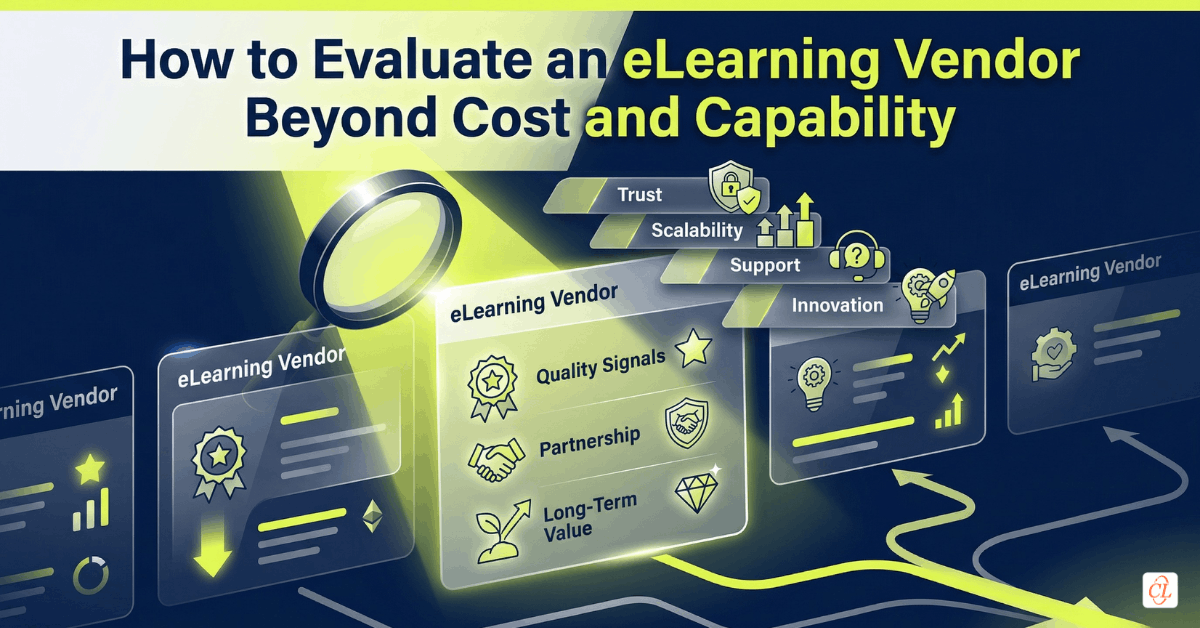
Choosing an eLearning vendor should be a strategic decision, yet in many organizations, it is still approached like a procurement task.
A shortlist is assembled. Portfolios are reviewed. A few discovery calls are held. Pricing is compared. On paper, the process appears rational and complete. But months later, the reality often looks very different. Timelines begin to slip, review cycles become messy, quality feels inconsistent, and the final learning assets, though visually polished, do not always create the learner engagement or business impact they were expected to deliver.
That disconnect is rarely caused by a lack of effort. More often, it happens because organizations evaluate vendors based on visible outputs rather than underlying capability. They look at design samples but not delivery discipline. They compare cost but not operational fit. They assess whether a vendor can “build a course” without asking whether that vendor can support a broader learning strategy.
That is where eLearning vendor selection needs to be reframed.
It is not simply about outsourcing development. It is about choosing a partner who can translate business goals into effective learning experiences, work within your internal realities, and help your team deliver training at the level of quality and scale your organization actually needs.
Whether you are planning onboarding, compliance training, systems training, product education, or global curriculum rollout, the vendor you choose will shape far more than content. They will influence delivery speed, stakeholder effort, learner experience, and long-term training value.
This article explores how to evaluate an eLearning vendor more strategically, so your decision is not just easier to make, but more likely to succeed.
Download Now: The 4Rs of Rapid eLearning
Table of Contents
- What Is eLearning Vendor Selection, Really?
- Why Vendor Selection Often Goes Wrong
- Start With Internal Clarity Before You Evaluate Anyone
- The 7 Dimensions That Matter Most in eLearning Vendor Selection
- Questions You Should Ask Before You Sign Anything
- Understanding eLearning Vendor Pricing Without Getting Misled
- What Strong eLearning Vendors Do Differently
- A Practical Vendor Evaluation Scorecard
- How to Turn Vendor Selection Into a Strong Long-Term Partnership
- FAQs
What Is eLearning Vendor Selection, Really?
At its core, eLearning vendor selection is the process of identifying and choosing an external partner to support your digital learning needs. That may include designing custom courses, modernizing legacy training, creating microlearning, developing software simulations, producing videos, localizing content, or supporting large-scale curriculum rollout.
However, treating it as a simple buying decision misses what is actually at stake.
A vendor does not just influence how your training looks. They influence how effectively your learning strategy gets translated into execution. They affect how efficiently your internal team can work, how quickly programs can be launched, and how well learners can absorb and apply what they are taught.
That is why a vendor should not be evaluated merely as a content producer. In a strong learning ecosystem, the right vendor functions as a design partner, a delivery partner, and often, a capability extension of the L&D team itself.
eLearning vendor selection is the process of choosing an external learning partner based on their ability to align with business goals, learner needs, quality expectations, delivery requirements, technology fit, and long-term value.
That distinction matters, because when organizations make this decision well, they do not just get better courses. They build a stronger foundation for learning at scale.
Why Vendor Selection Often Goes Wrong
Many organizations do not struggle with vendor selection because they are careless. They struggle because they evaluate the most visible factors first, while overlooking the deeper ones that determine whether the relationship will actually work.
It is easy to be impressed by:
- polished sample screens
- attractive interfaces
- strong pitch decks
- fast turnaround claims
- lower cost estimates
Those things are not unimportant. But they are only the surface layer.
What tends to create problems later are the less visible, but far more consequential, realities of delivery:
- Weak discovery processes
- Shallow instructional design thinking
- Unclear review workflows
- Poor project governance
- Lack of scalability
- Limited responsiveness to business complexity
A vendor may be able to build one attractive module. That does not necessarily mean they can support a multi-course onboarding path, handle multilingual compliance rollouts, or create role-based learning for a system implementation across business functions.
This is where many vendor decisions become fragile. The organization chooses based on output samples, while the actual project later depends on process maturity, strategic thinking, and operational fit.
In other words, vendor selection fails when it is treated as a content decision instead of a capability decision.
Start With Internal Clarity Before You Evaluate Anyone
Before comparing vendors, it is worth pausing to ask a more important question:
What exactly are we asking a vendor to help us do?
That may sound obvious, but many vendor conversations begin before internal alignment is fully established. One stakeholder wants speed. Another wants custom interactivity. Another wants translation support. Another expects the vendor to shape the learning strategy. Procurement wants efficiency. L&D wants quality. Business leaders want measurable outcomes.
If those expectations are not clarified early, the vendor selection process becomes inconsistent from the start.
Five Areas You Should Clarify Internally
1. Business Objective
What problem is the training supposed to solve?
For example: reducing onboarding time, improving system adoption, driving process compliance, enabling sales readiness, and standardizing knowledge across teams.
A vendor can only design effectively if the underlying business purpose is clear.
2. Learning Scope
What exactly needs to be created?
This could include: microlearning modules, scenario-based learning, compliance training, software simulations, training videos, facilitator materials, reinforcement assets, and blended learning journeys.
The more clearly this is defined, the easier it becomes to evaluate vendor fit.
3. Audience Complexity
Who are the learners, and what makes them distinct?
Consider: job roles and responsibilities, language and localization needs, device usage, digital fluency, geographic distribution and time available for training.
A vendor that works well for one audience may not be the right fit for another.
4. Internal Capacity
What will your team own, and what needs to be outsourced?
This is often overlooked. Some organizations need full end-to-end support. Others only need help with development, while strategy and storyboarding stay internal. Still others need a vendor who can operate almost like a managed content team.
Being clear on this avoids mismatched expectations later.
5. Success Criteria
How will you know the vendor relationship is working?
Success might include: speed to launch, learner completion rates, training adoption, stakeholder satisfaction, fewer support tickets, stronger assessment performance, and better alignment with business KPIs.
Without these inputs, vendor evaluation becomes subjective. With them, it becomes far more strategic.
The 7 Dimensions That Matter Most in eLearning Vendor Selection
A capable vendor does not simply build what is requested. A high-value vendor helps you build the right learning solution, in the right format, through the right process, at a level of quality and scale that your organization can actually sustain.
That is what makes the following seven dimensions so important.
1. Instructional Design Strength
This is one of the most critical, and most underestimated, aspects of vendor evaluation.
Many vendors can produce visually attractive content. Fewer can consistently transform complex information into learning experiences that are structured for understanding, retention, and application.
A strong eLearning vendor should demonstrate the ability to:
- translate business goals into meaningful learning objectives
- simplify dense or SME-heavy content without oversimplifying it
- choose the right learning approach for the context
- design assessments that measure application, not just recall
- create learning flow that feels intuitive and purposeful
What you are looking for is not just “engaging content.” You are looking for evidence of sound learning thinking.
What strong instructional design usually looks like
- Scenarios that reflect real workplace decisions
This shows the vendor can connect content to on-the-job application. - Assessments that test understanding in context
This indicates a focus on performance, not just information recall. - Content that feels well-structured, not overloaded
This suggests the vendor knows how to organize and sequence learning effectively.
If a vendor talks mostly about animations, templates, and visual appeal but cannot clearly explain why they designed a course a certain way, that is worth paying attention to.
2. Content Development Capability
Not every eLearning vendor is built for the same type of work.
Some are excellent at rapid course conversion, high-volume development, template-based rollout and operational speed. Others are better suited for custom course design, immersive simulations, branching scenarios, multilingual programs and blended learning ecosystems.
That is why the question is not simply, “Are they capable?” It is, “Are they capable in the way we need?” A vendor may be highly competent and still not be the right fit for your context. Ask what kind of support you really need
Do you need a partner for:
- speed and production efficiency?
- strategic learning design?
- ongoing content operations?
- localization and global rollout?
- curriculum architecture across multiple business units?
The clearer you are on this, the easier it becomes to distinguish between a vendor who is generally good and one who is specifically right.
3. Process Maturity and Project Management
This is often the hidden variable behind whether a vendor relationship feels smooth or exhausting.
Even a highly skilled vendor can become difficult to work with if their workflow is reactive, loosely managed, or unclear. In contrast, a vendor with strong process discipline can reduce stakeholder friction, keep timelines realistic, and make collaboration far easier.
A well-run vendor process usually includes:
- structured discovery and kickoff
- defined project milestones
- documented review cycles
- clear version control
- escalation paths for delays or blockers
- consistent communication cadence
Why this matters so much
Training projects rarely involve just one decision-maker. They often require input from L&D teams, subject matter experts, business leaders, compliance or legal reviewers, and HR or operations teams.
Without strong project management, feedback becomes fragmented, timelines become unpredictable, and the internal burden on your team increases significantly.
In many cases, the difference between a “good vendor” and a “difficult vendor” is not creativity. It is operational maturity.
4. Scalability and Resource Depth
A vendor may perform well on a pilot project and still struggle once the scope expands.
That is why scalability should be evaluated early, not after the relationship is already underway.
A vendor should be able to support growth across:
- multiple business units
- recurring training demand
- curriculum expansion
- translation or localization needs
- periodic updates and maintenance
- simultaneous development workstreams
A useful test to apply
Ask yourself:
If this initiative becomes three times larger over the next 12 months, would this vendor still be the right partner?
That question immediately changes the lens of evaluation. It shifts the focus from short-term project fit to long-term operational value.
A vendor that cannot scale with you may still be useful for isolated projects. But if your learning roadmap is expanding, that limitation becomes important very quickly.
5. Technology and Tool Fit
Technology fit is not just about what authoring tools a vendor uses. It is about whether their production approach aligns with the environment your training actually needs to live in.
That includes compatibility with:
- your LMS or LXP
- SCORM / xAPI / AICC requirements
- mobile access expectations
- accessibility standards
- multilingual workflows
- maintenance and update realities
Too often, organizations get distracted by tool names rather than use-case fit.
A sophisticated tool does not automatically create a better learning experience. What matters is whether the vendor can recommend the right format, the right level of complexity, and the right production method for your business context.
A strong vendor should be able to explain:
- why a certain development approach is appropriate
- what trade-offs come with different formats
- how easily the training can be updated later
- how the content will perform in your delivery ecosystem
That kind of clarity is far more useful than a generic “we can work with any tool” response.
6. Strategic Alignment and Consulting Ability
This is where the strongest vendors begin to separate themselves.
A high-value vendor does not just take instructions and execute them. They improve the brief. They identify risks. They challenge weak assumptions. They help shape a more effective learning solution.
That does not mean they should overcomplicate things or force unnecessary strategy conversations. It means they should bring enough perspective to help you make better decisions.
Signals of strategic maturity
Look for vendors who:
- ask thoughtful diagnostic questions
- probe for business outcomes, not just deliverables
- identify hidden constraints early
- recommend better delivery options when needed
- simplify rather than amplify complexity
A vendor who says “yes” to everything immediately may feel easy to work with in the beginning. But that same behavior often becomes a problem later, when unchallenged assumptions turn into rework, scope drift, or weak learning outcomes.
A good partner should make your thinking sharper, not just your production faster.
7. Commercial Transparency and Value
Cost matters. It should. But cost alone is one of the least reliable ways to choose an eLearning vendor.
A lower quote can look attractive at the selection stage and become expensive later through repeated revisions, inconsistent quality, delays and missed deadlines, unclear assumptions, hidden exclusions, and greater internal coordination effort.
That is why the real commercial question is not simply: “Which vendor is cheapest?” It is: “Which vendor offers the strongest value with the least operational friction?”
That shift matters because value is created not just by price, but by how effectively the vendor helps your team deliver outcomes.
Vendor Comparison Snapshot
| Evaluation Area | Weak Signal | Strong Signal |
| Instructional Design | Talks mainly about design polish | Explains learning rationale and learner application |
| Project Management | Vague process and reactive updates | Structured workflow with clear accountability |
| Scalability | Good for isolated projects only | Can support growth, repeatability, and updates |
| Technology Fit | Tool-first thinking | Use-case-first recommendations |
| Strategic Value | Executes instructions only | Improves the brief and adds clarity |
| Commercial Fit | Low quote, unclear assumptions | Transparent pricing and realistic scope |
Questions You Should Ask Before You Sign Anything
The quality of your vendor selection process depends heavily on the quality of the questions you ask.
Good questions do more than gather information. They reveal how a vendor thinks, how they work, and whether they are likely to be a reliable partner under real project conditions.
Questions About Learning Capability
- How do you approach instructional design for complex or technical content?
This helps you understand whether they can handle more than surface-level course development. - How do you convert SME-heavy content into something learner-friendly?
A strong answer here often reveals how well they balance accuracy with usability. - How do you decide whether to use scenarios, simulations, videos, or microlearning?
This tells you whether they choose formats strategically or default to habit.
Questions About Delivery Process
- What does your workflow look like from kickoff to launch?
You are looking for structure, clarity, and ownership. - How do you manage review cycles and stakeholder feedback?
This can quickly reveal whether the vendor’s process will reduce or increase internal friction. - What usually causes delays, and how do you prevent them?
Strong vendors are usually honest and specific here.
Questions About Quality and Scale
- How do you ensure consistency across multiple courses or curricula?
- What does your QA process include?
- How do you support localization, updates, or parallel development workstreams?
Questions About Commercial Fit
- What exactly is included in your pricing?
- What typically creates additional cost?
- How do you handle maintenance and post-launch updates?
The goal is not to conduct an interrogation. It is to understand how the vendor operates when complexity, ambiguity, and change inevitably show up.
Understanding eLearning Vendor Pricing Without Getting Misled
Pricing is one of the most sensitive and misunderstood parts of eLearning vendor selection.
Many organizations compare quotes as though they are comparing the same thing, when in reality, they are often comparing very different assumptions, levels of support, and definitions of scope.
That is why price should always be interpreted in context.
Why vendor pricing varies so much
The cost of eLearning development is influenced by factors such as:
- content complexity
- amount of instructional design required
- source material readiness
- media and interactivity needs
- number of review cycles
- localization requirements
- platform constraints
- update expectations after launch
A course that looks “similar” on the surface may have a very different level of design and production effort behind it.
Common Pricing Models
| Pricing Model | Best Used When | What to Watch For |
| Per Hour | Scope is evolving or consultative | Budget can become harder to predict |
| Per Project | Scope is well-defined upfront | Hidden assumptions may lead to change requests |
| Per Screen / Seat Time | Development is repeatable and standardized | Can incentivize output volume over design quality |
| Retainer / Managed Support | Ongoing content demand is expected | Value drops if utilization is inconsistent |
What matters more than the lowest quote
A stronger pricing conversation focuses on:
- what assumptions are built into the estimate
- how revisions are handled
- whether source files are included
- how updates are priced later
- what level of project management is included
- what support is available after launch
A cheaper vendor is not always lower cost in practice. In many cases, the more efficient and strategically aligned vendor creates better value over time, even if the initial quote is higher.
The best pricing decision is not the lowest quote. It is the clearest and most sustainable match between scope, capability, delivery model, and expected value.
What Strong eLearning Vendors Do Differently
Once you have spoken with enough vendors, patterns start to emerge.
The strongest ones tend to behave differently before the first deliverable is ever produced.
They usually:
- ask sharper business questions
- bring structure early
- clarify ambiguity instead of working around it
- recommend fit-for-purpose formats
- balance speed with quality discipline
- communicate risks before they become problems
- think in terms of systems, not isolated deliverables
That last point is especially important.
Strong vendors do not simply help you build a course. They help you build a more reliable and scalable learning operation. They understand that the real challenge in most organizations is not creating one good learning asset. It is creating a repeatable way to deliver many of them well.
That is what makes the difference between a vendor relationship that feels transactional and one that becomes strategically valuable over time.
A Practical Vendor Evaluation Scorecard
If your team is comparing multiple vendors, relying only on instinct or stakeholder preference can make the final decision harder than it needs to be.
A weighted scorecard helps create more objective alignment.
Suggested Vendor Evaluation Framework
| Criteria | Weight | What to Assess |
| Instructional Design Quality | 20% | Learning strategy, application, assessment design |
| Project Management Maturity | 15% | Workflow, communication, review structure |
| Content Development Capability | 15% | Range of formats, production quality, flexibility |
| Scalability | 15% | Capacity, repeatability, localization, updates |
| Technology Fit | 10% | LMS compatibility, accessibility, tool alignment |
| Strategic Consulting Value | 15% | Business alignment, problem-solving, recommendation quality |
| Pricing Transparency | 10% | Scope clarity, hidden cost risk, support assumptions |
How to use this scorecard effectively
Rate each shortlisted vendor on a 1 to 5 scale across every criterion.
This helps shift the conversation away from vague impressions such as:
- “their work looked more polished”
- “they seemed easier to work with”
- “their proposal was cheaper”
Instead, it gives your team a structured way to compare actual fit.
That is especially helpful when multiple stakeholders are involved and different decision-makers are prioritizing different things.
How to Turn Vendor Selection Into a Strong Long-Term Partnership
Selecting the vendor is only the first step. The real value comes from how the relationship is structured once the decision has been made.
Even a strong vendor can underperform if expectations, governance, and working norms are left undefined. That is why the post-selection phase matters so much.
What should be clarified early in the partnership
A productive vendor relationship usually starts with clarity around success metrics, stakeholder roles, review timelines, approval ownership, communication cadence, escalation paths, quality expectations, and future-state content roadmap.
This is not administrative detail. It is what makes collaboration sustainable.
When a vendor understands your business context, learner realities, internal constraints, and quality standards early, they are far more likely to operate as a true extension of your team rather than an external supplier waiting for instructions.
That shift is what turns vendor selection from a one-time decision into a long-term capability advantage.
FAQs
What is eLearning vendor selection?
eLearning vendor selection is the process of evaluating and choosing an external partner to design, develop, or support digital learning solutions based on quality, capability, process maturity, scalability, technology fit, and value.
How do I choose the right eLearning vendor?
Start by defining your business goals, audience, training scope, internal capacity, and success criteria. Then evaluate vendors based on instructional design strength, delivery capability, workflow maturity, scalability, and pricing transparency.
What should I look for in an eLearning outsourcing vendor?
Look for strong instructional design, clear project management, scalable delivery, technology compatibility, quality assurance discipline, and the ability to align learning solutions with business outcomes.
What questions should I ask an eLearning vendor before development?
Ask about their learning design approach, development workflow, QA process, review cycles, pricing assumptions, scalability, accessibility support, and how they handle complex or evolving project needs.
How do eLearning vendors price their services?
Most vendors price by hour, per project, per screen or seat time, or via a retainer model. Costs vary depending on complexity, customization, revisions, localization, media, and maintenance requirements.
Why is the cheapest eLearning vendor not always the best choice?
A lower quote can lead to higher long-term cost through rework, delays, poor quality, unclear ownership, or heavier internal management effort. Value matters more than initial price alone.
Can one eLearning vendor support all training needs?
Sometimes, but not always. Some vendors are stronger in rapid development, while others excel in strategic design, simulations, localization, or large-scale content operations. The right fit depends on your needs.
Conclusion
eLearning vendor selection often appears to be a practical sourcing decision, but in reality, it is one of the more strategic choices an L&D team can make.
The right vendor can help your organization move faster, reduce operational friction, improve learner experience, and create training that performs better in the real world. The wrong one can quietly erode time, quality, stakeholder confidence, and ROI, even if the initial proposal looked promising.
That is why the best vendor decisions are not made by asking, “Who can build this course?”
They are made by asking, “Who can help us build the right learning solution, in a way that is sustainable, scalable, and aligned with what our business actually needs?”
That is the question that leads to better partnerships and better outcomes.