Instructional design is entering a phase of rapid transformation. What was once a discipline centered on structured content and learning models is now being reshaped by technology, data, and changing workplace expectations.
The rise of AI, the increasing demand for personalized learning, and the shift toward continuous skill development are redefining how learning experiences are designed and delivered. At the same time, organizations are under pressure to scale learning faster, reduce development cycles, and demonstrate measurable impact.
This convergence of forces is changing not only the tools instructional designers use, but also the role they play within organizations.
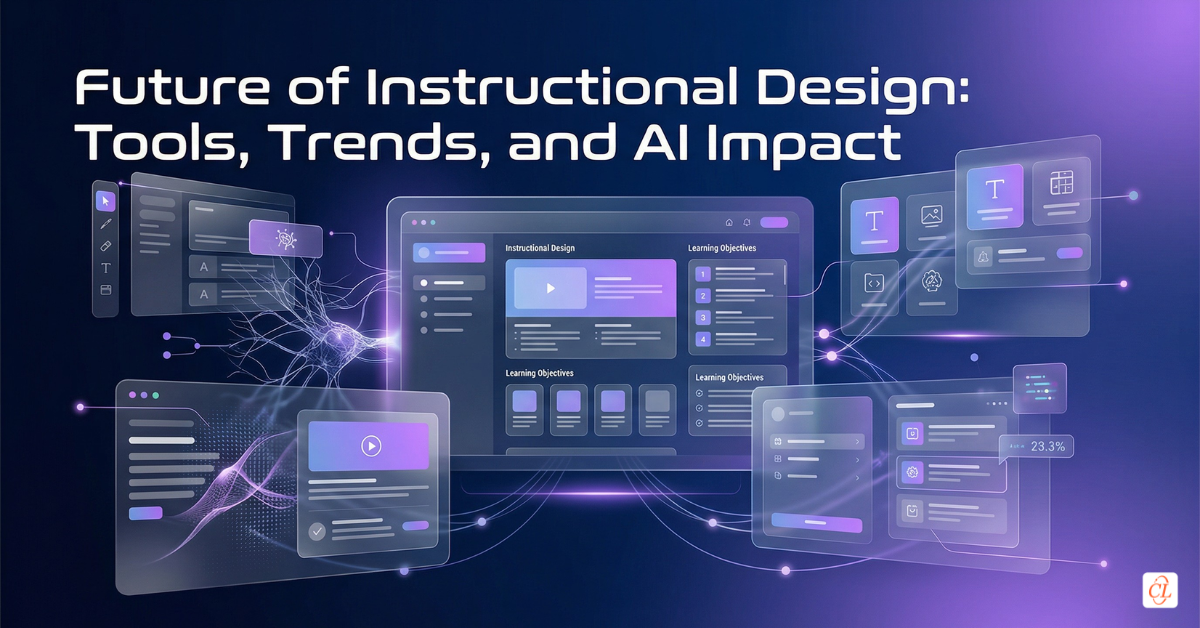
In this article, you will explore the future of instructional design through three interconnected lenses: emerging trends shaping the discipline, the evolving ecosystem of tools and platforms, and the growing influence of AI on how learning is created, delivered, and optimized.
Download eBook: Advanced Instructional Design Meets AI
Table of Contents
- The Forces Reshaping Instructional Design
- Key Trends Defining the Future of Learning Design
- The Expanding Ecosystem of Instructional Design Tools
- AI and the Transformation of Learning Design
- From Tools to Systems: The Rise of the Learning Stack
- The Changing Role of Instructional Designers
- Preparing for the Future: Capabilities That Matter
- FAQs
The Forces Reshaping Instructional Design
Instructional design is not evolving in isolation. It is being influenced by broader shifts in how organizations operate, how work is structured, and how employees learn.
Several interconnected forces are driving this transformation.
- Rapid skill evolution
As job roles evolve, employees must continuously acquire new skills, making learning a continuous process rather than a one-time event - Digital and hybrid work environments
Learning must now support distributed teams and flexible work models, requiring more adaptable and accessible design - Rising expectations for personalization
Learners increasingly expect content that aligns with their roles, preferences, and learning pace - Integration of AI into workflows
AI is becoming embedded in everyday tools, influencing how learning is created, delivered, and consumed
These forces are not temporary trends. They represent structural changes that are redefining the role and scope of instructional design.
Key Trends Defining the Future of Learning Design
The future of instructional design is being shaped by a set of trends that reflect both technological advancements and changing learner expectations. These trends are interconnected and often reinforce one another.
Learning in the Flow of Work
Learning is increasingly embedded within daily tasks rather than delivered as a separate activity. This shift enables employees to access knowledge precisely when they need it.
- Content is integrated into tools and workflows
- Learning becomes contextual and task-driven
- Application happens immediately rather than being delayed
Personalization at Scale
As organizations scale learning, personalization has become both a necessity and a challenge. Advances in data and technology are making it possible to tailor learning experiences more effectively.
- Learning paths adapt based on learner behavior and progress
- Recommendations guide learners toward relevant content
- Experiences are aligned with individual roles and goals
Microlearning and Modular Design
Long-form courses are increasingly being complemented or replaced by shorter, focused learning units that are easier to consume and apply.
- Content is broken into smaller, actionable modules
- Learning becomes more flexible and accessible
- Reinforcement is distributed over time
Data-Driven Learning Design
Instructional design is becoming more evidence-based, with decisions informed by data rather than intuition alone.
- Analytics reveal how learners interact with content
- Performance data informs design improvements
- Continuous iteration becomes possible
Experience-Centric Learning
The focus is shifting from delivering content to designing holistic learning experiences that engage learners cognitively and contextually.
- Learning journeys are intentionally structured
- Engagement is driven by relevance and interaction
- The learner experience is considered end-to-end
Trend Snapshot
| Trend | What It Represents | Business Impact |
| Flow of Work Learning | Learning embedded in tasks | Faster application and productivity |
| Personalization | Tailored learning experiences | Higher engagement and relevance |
| Microlearning | Short, focused modules | Improved retention and efficiency |
| Data-Driven Design | Insight-led decisions | Continuous improvement |
| Experience-Centric Design | Holistic learning journeys | Deeper learning impact |
The Expanding Ecosystem of Instructional Design Tools
As instructional design evolves, the tools that support it have expanded significantly. These tools now go beyond content creation to enable collaboration, delivery, and continuous improvement.
Categories of Tools in Modern Instructional Design
- Authoring tools
Enable the creation of interactive, multimedia-rich learning experiences - Learning platforms (LMS and LXP)
Manage, deliver, and track learning across the organization - Collaboration tools
Support coordination between instructional designers, SMEs, and stakeholders - Analytics tools
Provide insights into learner behavior and learning effectiveness
Tool Ecosystem Overview
| Tool Category | Primary Role | Strategic Value |
| Authoring Tools | Content creation | Enable interactivity and scalability |
| LMS/LXP Platforms | Delivery and management | Centralize learning experiences |
| Collaboration Tools | Team coordination | Improve efficiency and alignment |
| Analytics Tools | Measurement and insights | Support continuous optimization |
Instructional designers are increasingly working within integrated ecosystems where tools are interconnected. This shift enables a more seamless learning lifecycle, from design and delivery to evaluation and refinement.
AI and the Transformation of Learning Design
Artificial intelligence is rapidly becoming a defining force in instructional design. Its impact extends across the entire learning lifecycle, influencing how content is created, personalized, and optimized.
How AI Is Reshaping Instructional Design
- Content generation and augmentation
AI can assist in drafting, summarizing, and structuring learning materials, significantly reducing development time - Personalized learning experiences
AI-driven systems can adapt content based on learner behavior and preferences - Automation of repetitive tasks
Routine activities such as formatting, tagging, and updating content can be streamlined - Insight generation
AI can identify patterns in learner data and suggest improvements
Balancing Opportunity with Responsibility
While AI offers significant advantages, it also introduces new considerations:
- Ensuring accuracy and quality of generated content
- Maintaining instructional integrity and alignment
- Avoiding over-reliance on automation
AI enhances efficiency and scalability, but it does not replace the need for thoughtful, human-centered instructional design. The role of the designer becomes even more critical in ensuring that learning remains meaningful and effective.
Advanced Instructional Design Meets AI
- Modern instructional strategies
- Top Gen AI tools in action
- Case studies, tips, and tricks
- And More!
From Tools to Systems: The Rise of the Learning Stack
As tools become more advanced, organizations are moving toward integrated systems rather than isolated solutions. This shift reflects a broader move toward system-level thinking in learning design.
What Is a Learning Stack
A learning stack is an interconnected ecosystem that includes:
- Content creation tools
- Learning delivery platforms
- Data and analytics systems
- Integration with business applications
Why the Learning Stack Matters
- Enables seamless and consistent learning experiences
- Supports scalability across the organization
- Provides a unified view of learning data
Instructional design is no longer limited to creating individual courses. It now involves designing systems that support continuous learning across multiple touchpoints.
The Changing Role of Instructional Designers
As tools and technologies evolve, the role of instructional designers is expanding significantly.
From Content Creators to Learning Orchestrators
Modern instructional designers are expected to:
- Curate and manage content rather than create everything from scratch
- Use data to inform design decisions
- Integrate multiple tools and platforms
- Collaborate across functions to align learning with business goals
Role Evolution Snapshot
| Traditional Role | Evolving Role |
| Content developer | Learning experience designer |
| Course creator | System orchestrator |
| Tool user | Data-informed decision maker |
Instructional designers must now operate at both the tactical and strategic levels, balancing execution with broader system thinking.
Preparing for the Future: Capabilities That Matter
To remain effective in this evolving landscape, instructional designers must develop new capabilities that go beyond traditional design skills.
Key Capabilities for the Future
- AI literacy
Understanding how to use AI tools effectively and responsibly - Data fluency
Interpreting analytics to improve learning outcomes - Systems thinking
Designing across platforms and workflows - Adaptability
Responding to rapid changes in tools, technologies, and learner expectations
They enable instructional designers to navigate complexity, leverage emerging technologies, and create learning experiences that remain relevant in a rapidly changing environment.
FAQ
1. What are the key trends in instructional design?
A. Key trends include learning in the flow of work, personalization, microlearning, data-driven design, and experience-centric learning.
2. How is AI impacting instructional design?
A. AI is enabling content generation, personalization, automation, and data-driven insights, making learning design more efficient and scalable.
3. What tools do instructional designers use?
A. They use authoring tools, learning platforms, collaboration tools, and analytics tools to design, deliver, and optimize learning experiences.
4. What is a learning stack?
A. A learning stack is an integrated system of tools and platforms that support the entire learning lifecycle.
5. How is the role of instructional designers changing?
A. The role is evolving from content creation to designing learning systems and orchestrating learning experiences.
6. What skills are needed for the future?
A. AI literacy, data fluency, systems thinking, and adaptability are critical for future success.
Conclusion
The future of instructional design is being shaped by a convergence of trends, tools, and technologies that are redefining how learning is created and experienced. As organizations continue to adapt to rapid change, the ability to design learning that is scalable, relevant, and impactful will become increasingly important.
Instructional design is no longer defined by the tools it uses, but by how effectively those tools are integrated into systems that support continuous learning and performance. The organizations that embrace this shift will be better positioned to create learning experiences that not only inform, but truly transform.