The role of instructional designers is undergoing a quiet but significant transformation. As organizations accelerate their investment in digital learning and AI-enabled platforms, the expectations placed on learning professionals are expanding just as rapidly. According to recent workforce insights, over 60% of organizations report a growing demand for advanced learning design capabilities, yet many struggle to find talent that can move beyond content creation to performance enablement.
This shift reflects a deeper change in how learning is perceived. Instructional designers are no longer just responsible for structuring courses. They are increasingly expected to design learning systems, align with business goals, and enable measurable outcomes.
The challenge is not simply acquiring new tools or techniques. It is developing a broader set of capabilities that combine instructional thinking, strategic alignment, and execution excellence.
In this article, you will explore how the role of instructional designers is evolving, the critical skills and qualities that define high-impact practitioners, and how organizations can build the capabilities required to scale effective learning.
Download eBook: Advanced Instructional Design Meets AI
Table of Contents
- The Expanding Role of Instructional Designers
- From Content Developers to Learning Architects
- Core Capabilities That Define Effective Instructional Designers
- The Skill Stack: What Instructional Designers Must Master
- Working with SMEs: The Hidden Multiplier of Learning Quality
- Critical Thinking Questions That Shape Better Design
- Personal Qualities That Differentiate High-Impact Designers
- Building Instructional Design Capability at Scale
- FAQs
The Expanding Role of Instructional Designers
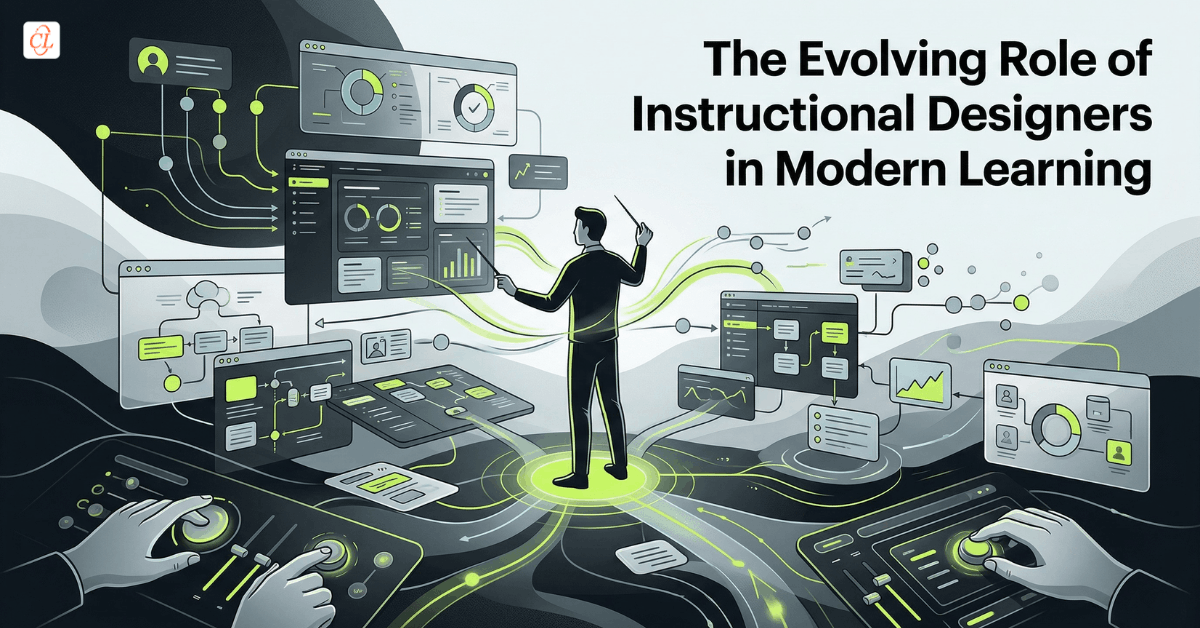
The role of instructional designers has moved far beyond its original scope. What was once a function centered on content structuring has evolved into a multidimensional role that intersects with strategy, technology, and performance enablement.
Today’s instructional designers are expected to understand not only how people learn, but also how organizations operate. They must interpret business priorities, identify capability gaps, and design learning experiences that directly support those priorities.
This shift has fundamentally changed how the role is perceived and executed.
Then and Now: How the Role Has Evolved
| Dimension | Traditional Role | Modern Role |
| Core Focus | Content creation and structuring | Performance and capability enablement |
| Scope | Individual courses or modules | End-to-end learning ecosystems |
| Collaboration | Limited interaction with SMEs | Cross-functional stakeholder alignment |
| Success Metrics | Completion rates and scores | Behavioral change and business impact |
This evolution highlights an important reality. Instructional design is no longer a support function. It is a strategic capability that directly influences organizational performance.
From Content Developers to Learning Architects
As learning environments grow more complex, instructional designers are increasingly expected to think beyond individual deliverables and design entire learning systems.
This transition reflects a shift from execution to orchestration.
A modern instructional designer operates as a learning architect who designs interconnected experiences that extend across time, platforms, and contexts. Rather than focusing on isolated courses, they consider how learning unfolds as a journey that supports continuous development.
What Defines a Learning Architect
A learning architect typically:
- Aligns learning with business priorities
Ensures that every learning initiative is tied to measurable organizational outcomes - Designs learning journeys instead of standalone courses
Connects multiple learning experiences into a cohesive pathway - Integrates diverse learning modalities
Combines microlearning, simulations, performance support, and collaborative learning - Uses feedback and data for continuous improvement
Refines learning experiences based on real-world effectiveness
This expanded role requires both strategic thinking and execution excellence.
Core Capabilities That Define Effective Instructional Designers
While tools and technologies continue to evolve, the effectiveness of an instructional designer ultimately depends on a set of core capabilities. These capabilities determine how well learning is aligned with performance and how effectively it is delivered.
Capability Framework for Modern Instructional Designers
| Capability Area | What It Involves | Why It Matters |
| Analytical Thinking | Diagnosing performance gaps and identifying root causes | Ensures learning solves the right problem |
| Learning Design Expertise | Structuring content and experiences effectively | Drives comprehension and retention |
| Business Alignment | Connecting learning initiatives to organizational goals | Increases relevance and impact |
| Collaboration | Working with SMEs and stakeholders | Enhances accuracy and adoption |
| Evaluation and Measurement | Assessing learning effectiveness | Enables continuous improvement |
How These Capabilities Work Together
- Analytical thinking ensures that learning addresses real needs rather than perceived ones
- Design expertise translates those needs into structured experiences
- Business alignment keeps learning relevant and outcome-driven
- Collaboration strengthens content quality and stakeholder buy-in
- Evaluation closes the loop by measuring and improving effectiveness
When these capabilities are integrated, instructional design becomes a powerful driver of performance.
The Skill Stack: What Instructional Designers Must Master
Beyond core capabilities, instructional designers must develop a broad and adaptable skill set that allows them to operate effectively in modern learning environments.
This skill stack is not static. It evolves as learning technologies, organizational needs, and learner expectations change.
Essential Skill Areas
- Instructional design and learning science
Applying models, theories, and strategies to create structured learning experiences - Content structuring and storytelling
Transforming complex information into clear, engaging narratives that support understanding - Technology and tool proficiency
Using authoring tools, learning platforms, and emerging technologies effectively - Data literacy and evaluation
Interpreting learning data to improve design decisions and outcomes - Stakeholder communication
Collaborating with SMEs, managers, and business leaders to align expectations
Skill Application in Practice
| Skill | Practical Application |
| Storyboarding | Structuring the flow of content and interactions |
| Scenario design | Enabling real-world decision-making |
| Tool proficiency | Building interactive and responsive learning experiences |
| Data analysis | Evaluating effectiveness and identifying improvements |
| Communication | Aligning stakeholders and managing expectations |
The Emerging Expectation
The modern instructional designer is expected to balance creativity with analytical thinking and execution with strategic insight. This balance is what distinguishes high-impact professionals from those who focus only on content development.
Advanced Instructional Design Meets AI
- Modern instructional strategies
- Top Gen AI tools in action
- Case studies, tips, and tricks
- And More!
Working with SMEs: The Hidden Multiplier of Learning Quality
Subject Matter Experts play a crucial role in ensuring that learning content is accurate and relevant. However, their expertise often comes in forms that are not immediately suitable for learning environments.
The instructional designer acts as a translator who converts expert knowledge into structured, learner-friendly experiences.
Making SME Collaboration Effective
- Ask outcome-focused questions
Focus discussions on what learners need to do, not just what they need to know - Simplify without oversimplifying
Break down complex concepts while preserving their accuracy - Challenge assumptions constructively
Ensure that content aligns with learning objectives rather than default practices
Effective SME collaboration significantly improves both the quality and applicability of learning. It ensures that content is not only accurate, but also usable in real-world contexts.
Critical Thinking Questions That Shape Better Design
Instructional design is as much about asking the right questions as it is about providing answers. The quality of these questions often determines the effectiveness of the final learning experience.
Questions That Strengthen Design
- What performance problem is this learning addressing?
- What should learners be able to do differently after completing this?
- What information is essential, and what can be removed?
- How will learners apply this knowledge in their work environment?
These questions help eliminate unnecessary content, sharpen focus, and ensure that learning remains aligned with real-world outcomes. They also prevent the common pitfall of designing for content coverage rather than performance.
Personal Qualities That Differentiate High-Impact Designers
While skills and capabilities can be developed, certain personal qualities influence how effectively instructional designers apply them.
Key Qualities
- Curiosity
Drives deeper understanding of learners, content, and business context - Empathy
Enables designers to create experiences that resonate with learners - Adaptability
Allows designers to respond effectively to changing requirements - Attention to detail
Ensures accuracy, consistency, and clarity in learning experiences
These traits shape how instructional designers approach challenges, collaborate with stakeholders, and refine their work. They often determine the difference between functional learning and impactful learning.
Building Instructional Design Capability at Scale
As organizations expand their learning initiatives, the need to build instructional design capability becomes increasingly important. This is not just about hiring more designers, but about developing a system that supports consistent and scalable design practices.
Key Focus Areas for Capability Building
- Talent development
Invest in training and mentoring instructional designers - Process standardization
Establish consistent design frameworks and workflows - Technology enablement
Use tools to improve efficiency and scalability - Continuous improvement
Leverage data and feedback to refine learning experiences
Capability Development Snapshot
| Area | Key Action |
| Talent | Upskill and mentor instructional designers |
| Process | Standardize design approaches |
| Technology | Enable scalable development |
| Improvement | Use data for continuous refinement |
The role of instructional designers is evolving toward performance enablement. Effective designers combine strategy, design, and execution capabilities. Building capability at scale requires systems, not just talent
FAQs
1. What does an instructional designer do?
A. An instructional designer creates structured learning experiences that help learners acquire, retain, and apply knowledge effectively, with a focus on improving performance.
2. What skills are required for instructional design?
A. Key skills include learning design, content structuring, technology proficiency, data analysis, and stakeholder communication.
3. How is the role of instructional designers evolving?
A. The role is expanding from content creation to designing learning systems that align with business goals and drive measurable outcomes.
4. Why is SME collaboration important?
A. SMEs provide subject expertise, while instructional designers structure that knowledge into effective learning experiences.
5. What qualities make a good instructional designer?
A. Curiosity, empathy, adaptability, and attention to detail are essential qualities.
6. How can organizations build instructional design capability?
A. By investing in talent development, standardizing processes, leveraging technology, and fostering continuous improvement.
Conclusion
Instructional designers are no longer defined by their ability to create content. They are defined by their ability to design systems that enable performance.
As organizations continue to navigate rapid change, the demand for effective learning design will only increase. Those who invest in developing strong instructional design capabilities will be better positioned to create learning experiences that are not only engaging, but truly impactful.
In the end, the value of instructional design lies not in what is created, but in what changes as a result.