Your organization just spent six months building a comprehensive compliance training program. It's polished, on-brand, and ready to roll out globally. Then the question comes up: "How do we handle eLearning translation for our teams in Germany, Brazil, and Singapore?"
That's where things slow down or, worse, where costly decisions get made based on assumptions that haven't been tested in years.
eLearning translation is one of the most misunderstood investments in enterprise L&D. Outdated beliefs about cost, quality, and complexity push organizations toward decisions that either inflate budgets unnecessarily or result in poorly localized training that doesn't stick. In large enterprises across manufacturing, energy, health and pharma, and logistics, the stakes of getting this wrong are high, from compliance failures to disengaged global teams.
Table Of Content
- Which eLearning Translation Myths are Costing you the Most?
- What do High-Performing Global L&D Teams do Differently?
Which eLearning Translation Myths are Costing you the Most?
Beliefs that once held some truth have calcified into default assumptions — even as tools, workflows, and best practices have evolved significantly. The result: enterprises make translation decisions based on outdated logic, and the costs show up in bloated budgets, duplicated content, and training that doesn't connect with global learners.
Here are the five myths most commonly getting in the way.
Myth 1: eLearning Translation Is Just a Line-Item Cost
Many L&D leaders treat multilingual training as a fixed add-on, a flat percentage tacked onto the course budget after everything else is decided. In reality, translation decisions made early in the design process can significantly reduce total project cost.
When source content is built with translation in mind using plain language, avoiding culture-specific idioms, and keeping on-screen text concise, the entire downstream process becomes faster and cheaper. Conversely, courses designed without translation in mind often require structural rework before a single word can be translated, turning a straightforward project into an expensive rebuild.
Myth 2: Machine Translation Produces Unreliable Results for Training Content
Five years ago, this concern was largely valid. Today, AI-powered eLearning translation tools have changed the equation significantly.
Modern AI tools, when trained on industry-specific terminology and paired with human review workflows, consistently produce high-quality translations for standard instructional content. For regulated industries like health and pharma or energy, where terminology precision is non-negotiable, AI handles first-pass translation while subject matter experts and professional linguists review for technical and compliance accuracy. This hybrid model reduces turnaround time by as much as 50–60% compared to fully manual workflows, without sacrificing quality.
Myth 3: It's Cheaper to Build Separate Courses for Each Language
This approach feels intuitive: give each region its own course, customized from the ground up. In practice, it multiplies your content maintenance burden with every language you add.
When a product changes, a regulation updates, or a process is revised, you're now updating five, ten, or fifteen separate course versions instead of one. For global enterprises in logistics or manufacturing, where procedures evolve frequently, this quickly becomes unsustainable. A single-source, multi-output model where one master course feeds all language versions — cuts update time dramatically and ensures consistency across markets. This is where partnering with an experienced eLearning outsourcing vendor pays dividends: they bring the technical infrastructure to manage multi-language publishing efficiently.
Maintenance cost is the hidden expense most enterprises don't account for at project start.
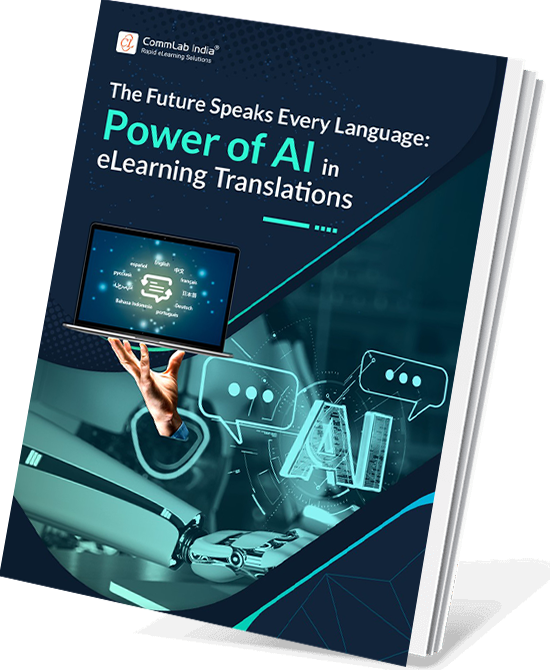
The Future Speaks Every Language: Power of AI in eLearning Translations
Break Down Language Barriers and Foster Inclusive Learning with AI-enhanced eLearning Translations!
- Strategies to Ensure Effective Global eLearning
- How to Choose the Right Translation Partner
- Translations using AI
- And More!
Myth 4: Translating Training Means Every Employee Gets the Same Learning Experience
This concern that translation flattens training into a one-size-fits-all product misunderstands what modern localization actually involves.
Effective multilingual training goes beyond word-for-word conversion. Localization adapts examples, visuals, date formats, regulatory references, and even learning scenarios to reflect the cultural and professional context of each learner group. A safety scenario written for a manufacturing site in Ohio lands differently when adapted for a team in the Netherlands or a plant in Indonesia. Targeted learning, where content is shaped to reflect the actual work environment and context of each learner group, produces better knowledge retention and higher completion rates.
Translation is the floor. Localization is where the real learning value is built.
Myth 5: Managing eLearning Translation Internally Is More Cost-Effective
The appeal of keeping translation in-house is understandable: it feels like direct control and lower spend. But the full cost picture rarely supports it.
Building internal capacity for eLearning translation means investing in translation memory tools, terminology management systems, voice-over coordination, LMS republishing workflows, and ongoing linguist relationships across multiple languages. For most enterprises, that infrastructure doesn't exist, and building it takes years.
An eLearning outsourcing vendor with dedicated multilingual training capabilities already has these systems in place. They can take a course from final source to published multilingual versions faster, at a predictable per-language cost, and with quality assurance built into the process.
What do High-Performing Global L&D Teams do Differently?
The enterprises that scale multilingual training successfully share a few consistent practices. They start translation planning at content design, not after sign-off. They use AI tools to accelerate first-pass translation while maintaining human review for regulated or high-stakes content. They build in localization, not just translation, from the start. And they work with vendors who treat their global workforce training as a strategic deliverable, not a volume transaction.
eLearning translation, done well, isn't a budget line. It's a strategic capability that determines whether your training investment actually reaches and works for every employee in your organization.
Want to go deeper? Download our free eBook covering proven strategies for effective global eLearning, key factors for choosing the right translation partner, how to leverage AI for faster and smarter translations, and answers to the most common eLearning translation questions.