Global training can fall flat when employees have to learn in a language that is not their own. For L&D teams, that means lower engagement, slower understanding, and inconsistent training outcomes across regions. eLearning translations help global enterprises make corporate training easier to access, understand, and apply — whether employees are completing onboarding, compliance, product, or technical training.
But translating eLearning courses is not just about changing words from one language to another. It is about making the entire learning experience feel clear, relevant, and natural for every learner. This blog explores how global enterprises can use eLearning translations to scale multilingual training across regions without delays while maintaining quality, consistency, and learner impact.
This blog explores why multilingual training has become essential for global enterprises, what slows down eLearning translations at scale, and how L&D teams can deliver faster global training rollouts without compromising quality or learner experience.
Table of Contents
- Why Do Global Enterprises Need Multilingual Training?
- What Makes eLearning Translations Hard to Scale?
- How Can Enterprises Scale Multilingual Learning Without Delays?
- Make Multilingual Learning Your Enterprise Growth Advantage
Why Do Global Enterprises Need Multilingual Training?
Global enterprises need multilingual training to support distributed workforces, regional compliance requirements, and consistent employee development.
Many organizations operate across multiple countries with employees who speak different languages. English-only training often limits effectiveness and learner participation.
Multilingual learning helps enterprises:
- Train employees faster across regions
- Reduce compliance risks
- Improve workforce productivity
- Standardize corporate training
- Support international growth
- Improve learner satisfaction
For global businesses, multilingual employee training and development is no longer optional. It is a business requirement.
What Makes eLearning Translations Hard to Scale?
eLearning translations become difficult to scale when global training programs need to be launched quickly across multiple regions, languages, and learner groups at the same time. What starts as a simple translation project often turns into a complex coordination effort involving content updates, multimedia localization, regional reviews, compliance requirements, and tight rollout timelines.
For L&D teams, the challenge is not just translating words — it is maintaining consistency, speed, and learning quality across every version of the course. A single eLearning program may include text, narration, videos, assessments, simulations, and visuals, all of which need accurate localization. Add multiple stakeholders, frequent content revisions, and region-specific expectations, and translation delays can quickly slow down global training initiatives.
How Can Enterprises Scale Multilingual Learning Without Delays?
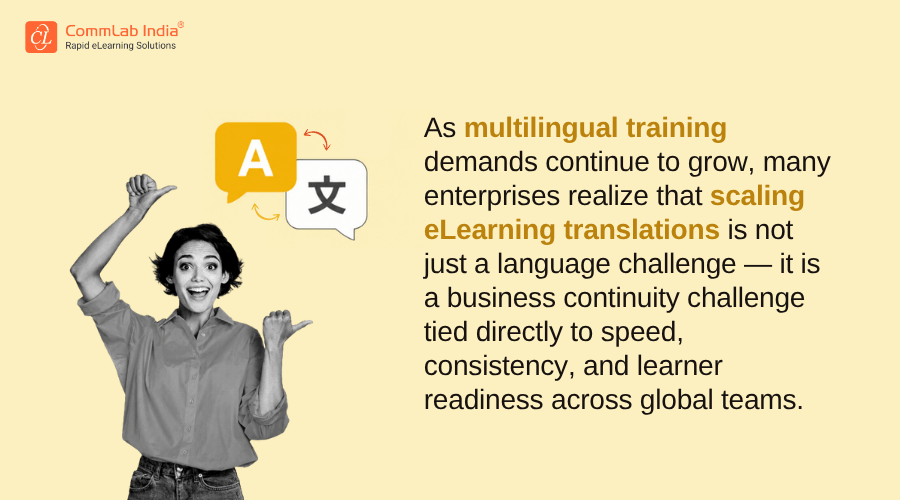
Global enterprises can scale multilingual learning efficiently by combining AI-powered translation workflows, centralized content strategies, and expert human review. The goal is not just faster translation — it is faster delivery of high-quality, culturally relevant corporate training across every region.
As organizations expand into new markets, training teams face increasing pressure to launch employee training and development programs simultaneously across languages and geographies. Delays in eLearning translations can slow onboarding, create compliance risks, and disrupt business operations.
The most successful organizations avoid these bottlenecks by building a scalable multilingual training ecosystem from the start.
Standardize Source Content Before Translation
Clean, structured source content reduces translation complexity and accelerates localization timelines.
When eLearning courses are written with consistent terminology, shorter sentences, and clear instructional flow, translation becomes faster and more accurate. Standardized content also minimizes rework during multilingual adaptation.
This is especially important for:
- Compliance training
- Technical training
- Product training
- Global onboarding programs
A well-structured source course creates a stronger foundation for multilingual learning.
Use Translation Memory Systems to Improve Speed and Consistency
Translation memory systems store previously translated phrases and reuse them across future projects.
This helps enterprises:
- Reduce duplicate translation work
- Maintain terminology consistency
- Accelerate updates to existing eLearning courses
- Lower localization costs over time
For large-scale corporate training programs, translation memory becomes a critical asset that improves both efficiency and quality.
Automate Repetitive Localization Tasks With AI Tools
AI tools help eliminate manual effort in repetitive translation and localization workflows.
Translation tools such as Smartcat, DeepL, and Microsoft Azure can automate:
- Initial text translations
- Subtitle generation
- Terminology suggestions
- Workflow routing
- Content synchronization
This allows learning and development teams to focus more on instructional quality and less on administrative coordination.
AI-powered automation is especially valuable when enterprises need to update multilingual training content frequently.
Watch the video to see how translation tools help break language barriers in training.
Build Reusable Templates for eLearning Courses
Reusable eLearning templates make multilingual scaling faster and more manageable.
Templates help standardize:
- Course layouts
- Navigation structures
- Visual design
- Interaction patterns
- Assessment formats
This consistency simplifies translation workflows and reduces formatting issues during localization.
Reusable templates also improve learner familiarity across regions, creating a smoother multilingual learning experience.
Centralize Terminology Management Across Languages
A centralized glossary ensures that key business, technical, and compliance terms remain consistent in every translated course.
Without terminology management, different translators may use different words for the same concept. This creates confusion and weakens training effectiveness.
Centralized terminology management helps maintain:
- Brand consistency
- Technical accuracy
- Regulatory alignment
- Clear learner communication
It is particularly important in industries such as manufacturing, healthcare, energy solutions, finance, and pharmaceuticals.
Use AI Tools for Faster First-Pass Translations
AI-powered translation engines significantly reduce turnaround time for multilingual training projects.
Tools like:
- Smartcat
- DeepL
- Microsoft Azure
can generate fast first-pass translations that speed up the localization process.
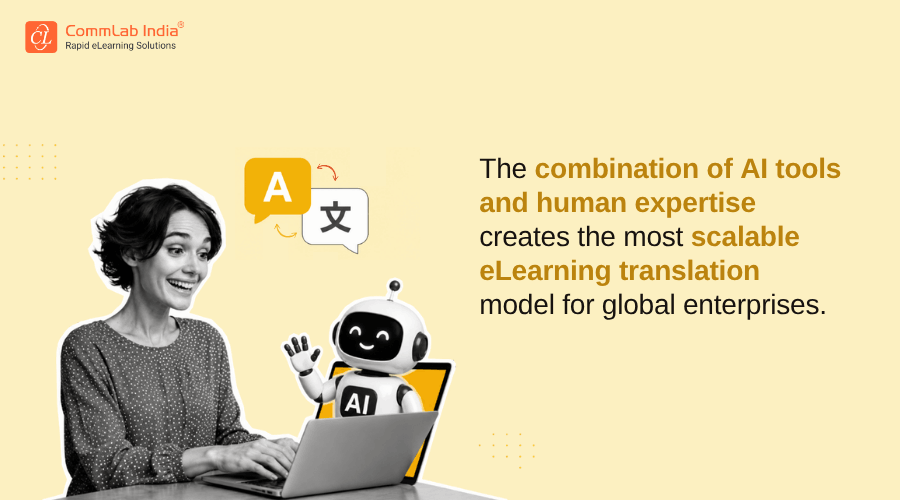
However, AI-generated output should always be reviewed by expert linguists to ensure instructional clarity, contextual accuracy, and cultural relevance.
Maintain Expert Human Review Workflows
Human review remains essential for high-quality eLearning translations.
Even advanced AI tools cannot fully understand:
- Industry-specific terminology
- Cultural nuances
- Instructional intent
- Regional communication preferences
Expert linguists, editors, and proofreaders help ensure that multilingual training content feels natural, accurate, and engaging for learners. Human review also protects organizations from compliance errors and mistranslations that could impact business operations.
Partner With Expert eLearning Translation Providers
An experienced eLearning outsourcing partner helps enterprises manage multilingual learning across regions without operational delays. The right provider should offer:
- Translation of text, audio, video, and images
- Expert linguists with domain expertise
- Large networks of narrators and reviewers
- AI-powered translation workflows
- Agile project management processes
This holistic approach helps organizations launch eLearning courses globally with greater speed, consistency, and quality.
|
Multilingual Training, Delivered at Business Speed with CommLab India’s eLearning Translation Services
|
Make Multilingual Learning Your Enterprise Growth Advantage
eLearning translations help global enterprises deliver multilingual training faster, more consistently, and with greater learner impact. As organizations expand across regions, multilingual learning becomes essential for scalable employee training and development.
AI tools are transforming translation workflows by improving speed and operational efficiency. However, successful eLearning translations still depend on expert linguists, agile processes, and holistic localization services.
Enterprises that combine AI-powered workflows with human expertise can scale corporate training globally without delays while maintaining quality, consistency, and learner engagement. Download our eBook to explore practical strategies for effective global eLearning, choosing the right translation partner, using AI in translations, and leveraging translation memory.
Build faster, smarter multilingual training programs that scale across regions without compromising quality.