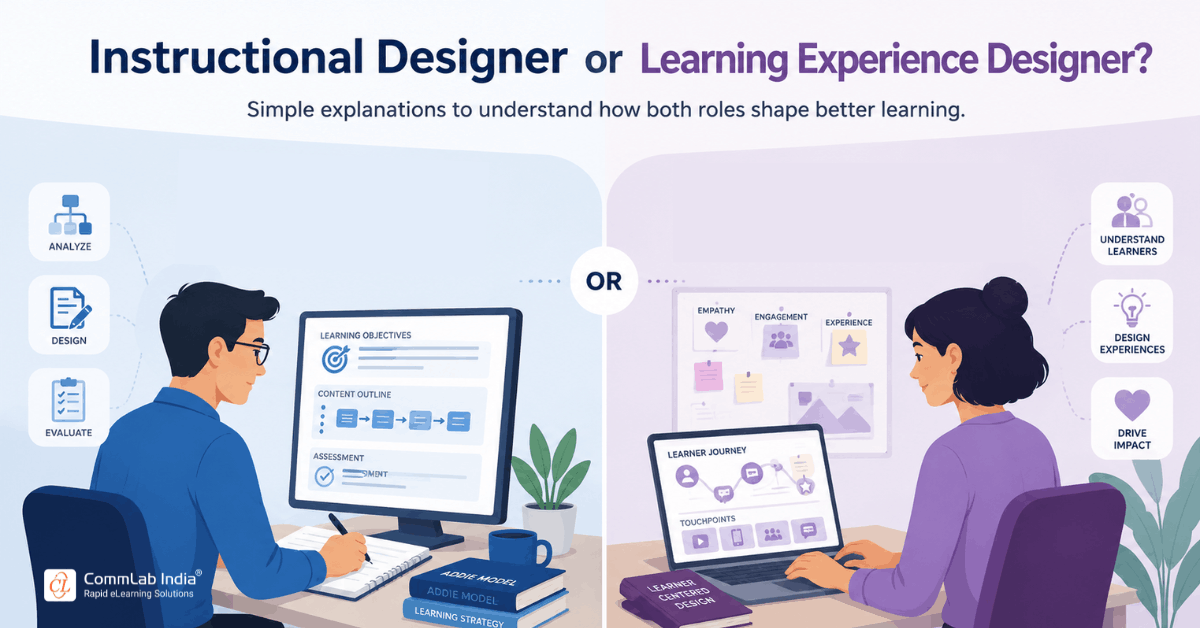
If you've ever posted a job listing for a training role or explored a career in workplace learning, you've probably encountered two titles that sound similar but aren't quite the same: instructional designer and learning experience designer. Both shape how people learn. Both require a deep understanding of human cognition. But they approach the problem from different angles and knowing the difference matters if you're hiring, building a team, or choosing a career path.
This blog breaks down what each role actually involves, where they overlap, and how to decide which one your organization or career trajectory needs.
Table Of Content
- What is an Instructional Designer?
- What does an Instructional Designer Do?
- What is a Learning Experience Designer?
- What does a Learning Experience Designer Do?
- Instructional Designer vs. Learning Experience Designer: Key Differences
- Which Role does your Organization Actually Need?
- The Real Advantage for L&D: Speed Without Sacrifice
- Frequently Asked Questions
- Get Going and Choose the Right Role for You!
What is an Instructional Designer?
An instructional designer is a professional who applies learning science to create structured learning content — typically for corporate training, eLearning, etc.
The core question an instructional designer asks is: What do learners need to know, and what's the most effective way to teach it?
What does an Instructional Designer Do?
Instructional designers typically:
- Conduct needs assessments to identify performance or knowledge gaps
- Define learning objectives aligned to measurable outcomes
- Design curricula, storyboards, and course sequences
- Develop content using authoring tools and AI tools
Most instructional designers work within established instructional design models such as ADDIE (Analyze, Design, Develop, Implement, Evaluate), SAM (Successive Approximation Model), or Bloom's Taxonomy. These frameworks give their work a systematic, repeatable structure.
What is a Learning Experience Designer?
A learning experience designer (LXD) takes a broader, more human-centered view. The role emerged from the intersection of instructional design, UX design, and design thinking — and it places the learner's full experience at the center of every decision.
What does a Learning Experience Designer Do?
Learning experience designers typically:
- Map the end-to-end learner journey, not just the content delivery
- Apply design thinking to uncover learner motivations, frustrations, and context
- Design multimodal experiences: blended learning, cohort-based programs, simulations, peer learning
- Collaborate closely with product, UX, and marketing teams
Where an instructional designer might ask "What should learners know after this module?", a learning experience designer asks "How does this learning moment fit into everything the learner is doing before, during, and after?"
Instructional Designer vs. Learning Experience Designer: Key Differences
This isn't a hierarchy — one role isn't more advanced than the other. They reflect different priorities and organizational contexts.
| Dimension | Instructional Designer | Learning Experience Designer |
| Primary focus | Content and curriculum | Learner journey and experience |
| Core frameworks | ADDIE, SAM, Bloom's Taxonomy | Design thinking, UX principles, agile |
| Typical outputs | Courses, modules, job aids | Blended programs, learning ecosystems |
| Closest analogy | Curriculum architect | Product designer for learning |
| Collaboration style | L&D and subject matter experts | Cross-functional (UX, product, data) |
Which Role does your Organization Actually Need?
Here's a practical way to think about it:
Hire or develop instructional design skills when:
- You need to systematically document and train on processes, compliance, or technical skills
- You work within a traditional LMS infrastructure
- Your primary output is structured e-learning or instructor-led training
Hire or develop learning experience design skills when:
- You want to rethink how learning fits into the flow of work
- You're building customer education, community learning, or blended programs at scale
- You value rapid prototyping and iteration over fixed course development cycles
Many organizations are finding that the future of their L&D function looks more like LXD — especially as learning shifts toward just-in-time, mobile-first, and social formats. But the foundational rigor of instructional design doesn't disappear; it gets embedded into the broader experience.
The Real Advantage for L&D: Speed Without Sacrifice
Traditional hiring for niche roles like instructional design or learning experience design can take weeks. Staff augmentation compresses that timeline dramatically, often placing qualified professionals within days.
More importantly, augmented talent arrives ready to contribute. They're experienced working across tools, teams, and industries. You spend less time onboarding and more time building.
For organizations navigating periods of growth, change, or constrained budgets, staff augmentation isn't a compromise, it's a strategic choice that keeps learning programs moving without stalling on headcount approvals.
|
Need expert instructional designers without adding full-time headcount?
|

Frequently Asked Questions
Q1: What is the difference between instructional design and learning experience design?
A. Instructional design focuses on structuring content to meet learning objectives. Learning experience design takes a broader view — applying UX thinking to the full learner journey, including context, motivation, and environment.
Q2: Can an instructional designer become a learning experience designer?
A. Yes. The transition usually means adding design thinking and UX research skills. An ID background in learning science is actually a strong advantage in the LXD role.
Q3: What skills does an instructional designer need?
A. Needs analysis, learning objectives, curriculum design, storyboarding, and authoring tools like Articulate or Rise — plus strong stakeholder communication and project management.
Q4: Is learning experience design just instructional design with a new name?
A. Not quite. LXD introduces human-centered design methodology and expands scope beyond course creation to include the social and emotional dimensions of learning that traditional ID frameworks don't always address.
Get Going and Choose the Right Role for You!
The distinction between an instructional designer and a learning experience designer isn't about which role is better, it's about which lens fits the problem you're solving. Instructional design brings structure, rigor, and learning science to content creation. Learning experience design brings empathy, iteration, and a holistic view of the learner journey. The most effective learning professionals today draw from both traditions, choosing their approach based on context rather than convention.
Need the right learning talent, fast? Download our free eBook on L&D staff augmentation to discover how to source, vet, and onboard skilled professionals without the long-term overhead.