
The logistics and supply chain industry is under more pressure than ever. Labor shortages, nearshoring trends, and tightening compliance requirements are forcing large enterprises to rethink how they develop employee training and development.
For L&D professionals in enterprise organizations, the question is no longer whether logistics training matters, it's how to build programs that scale, stick, and drive measurable results.
This blog breaks down the essential pillars of effective supply chain training, the most common mistakes enterprises make, and the best practices that global leading organizations in the are using to build resilient, capable teams.
Table Of Content
- Why is Logistics Training a Strategic Priority?
- What are the Pillars of Effective Logistics Training?
- What are the Common Challenges in Scaling Logistics Training Programs?
- What are the Best Practices for Building Logistics Training That Delivers?
- Success Story: Making Logistics Training Interactive and Impactful
- FAQs
- Building a Workforce Fit for the Supply Chain of Tomorrow
Why is Logistics Training a Strategic Priority?
Too many enterprises still treat logistics training programs as a one-time onboarding formality or a regulatory requirement to tick off annually. That approach costs far more than it saves.
But the cost of under-training goes beyond safety incidents. Poorly trained staff contribute to picking errors, missed SLAs, damaged goods, and high turnover, all of which directly erode margins in an industry already operating on thin ones.
What are the Pillars of Effective Logistics Training?
The most resilient training programs in large logistics organizations are built on three interconnected pillars: safety, operational efficiency, and cross-functional skills. Here's what that looks like in practice.
1. Safety Training: From Mandatory to Meaningful
OSHA compliance training is the floor, not the ceiling. Leading organizations go beyond minimum requirements by embedding safety into daily workflows, not just annual certification sessions.
Practical approaches include:
- Scenario-based learning modules that simulate real warehouse hazards (e.g., forklift proximity alerts, ergonomic lifting techniques)
- Microlearning refreshers delivered via mobile devices on the warehouse floor
- "Safety by design" thinking — integrating risk awareness into standard operating procedure (SOP) development
2. Operational Efficiency Training: Skills That Move the Needle
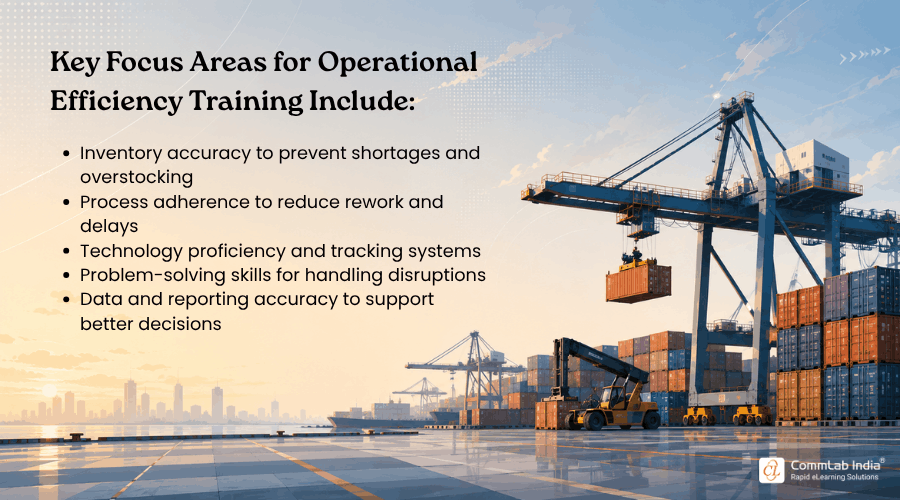
Efficiency in logistics is not just about speed. It is about helping employees work accurately, follow processes consistently, and respond quickly when disruptions occur. Strong training helps teams reduce errors, avoid delays, and keep operations moving smoothly.
3. Cross-Functional Skills: The Training Gap Most Organizations Ignore
This is where even mature L&D programs often fall short. Logistics doesn't operate in isolation, it intersects with procurement, customer service, finance, and increasingly, sustainability teams.
Cross-functional training helps supply chain employees understand how their role affects upstream and downstream partners. Key skill areas include:
- Data literacy — reading and acting on KPI dashboards, carrier scorecards, and inventory forecasting models
- Communication and escalation protocols across departments
- Basic demand planning concepts for warehouse and distribution roles
- Sustainability and ESG awareness — increasingly required in European logistics operations under EU supply chain due diligence frameworks
When frontline logistics staff understand why they're doing what they're doing, not just how both engagement and performance improve.
What are the Common Challenges in Scaling Logistics Training Programs?
L&D teams in large enterprises frequently encounter the same barriers when trying to scale employee training and development. Recognizing them early makes the difference between a program that launches and one that sticks.
1. Workforce Fragmentation
Shift workers, multilingual workforces, and staff spread across dozens of sites make consistent delivery incredibly difficult. The solution isn't a single Learning Management System (LMS) course, it's a modular, multi-format approach that meets workers where they are.
2. The 'One-and-Done' Training Problem
Knowledge fades. Research on the forgetting curve shows that learners forget up to 70% of new information within 24 hours without reinforcement. Programs built around annual certifications, without spaced repetition or on-the-job practice, see limited behavior change.
3. Measuring ROI
Many L&D teams struggle to connect training activity to business outcomes. The most effective programs define leading indicators before launch: incident rates, error rates, time-to-proficiency for new hires, and manager-rated performance scores, not just completion rates.
What are the Best Practices for Building Logistics Training That Delivers?
The following practices reflect what the most effective enterprise L&D teams do differently.
- Conduct a skills gap analysis before designing any curriculum
- Build role-specific learning paths, not one-size-fits-all programs
- Leverage blended learning: combine digital modules with hands-on practice and peer coaching
- Integrate training into onboarding and performance management cycles, not just compliance calendars
- Use real operational scenarios and case studies
- Pilot programs with a single site or team before enterprise rollout; iterate fast
- Align training metrics to operational KPIs and report progress to operations leaders, not just HR
Success Story: Making Logistics Training Interactive and Impactful
The Challenge
The client wanted to help customers build stronger capabilities in Essentials of Logistics Operations, from improving trade opportunities and navigating customs to strengthening logistics efficiency and sales outcomes. The challenge was to make a complex, process-heavy topic engaging, practical, and easy to apply.
CommLab India’s Solution
CommLab India designed interactive eLearning modules on Logistics Operations, hosted on the client’s SharePoint for easy customer access.
The modules included:
- Videos to simplify key logistics concepts
- Real-world scenarios and case-study puzzles to build application skills
- Learning activities to keep customers engaged
- Client success stories to show practical impact
- Job aids and resources for future reference
This helped turn a complex logistics topic into a practical, engaging learning experience.
The Result
The program received highly positive client feedback, with strong ratings across key project parameters. The client also appreciated the interactive course design, transparent process, clear project planning, responsive communication, and overall value delivered by CommLab India.
FAQs about Logistics & Supply Chain Employee Training and Development
Q1. What should be included in a logistics training program for a large enterprise?
A. An enterprise logistics training program should include safety and compliance training operational efficiency skills and cross-functional knowledge (data literacy, demand planning basics, sustainability requirements). Delivery should be role-specific, blended across formats, and reinforced over time, not limited to a single annual session.
Q2. How do supply chain training courses improve workforce retention?
A. Structured supply chain training improves retention by increasing employee confidence, reducing errors that cause frustration, and signaling investment in career development. In high-turnover sectors like warehousing and logistics, structured onboarding and skill-building programs can materially reduce attrition.
Q3. How can L&D teams measure the ROI of logistics training programs?
A. Start by identifying the operational metrics that the training is designed to improve like incident rates, order accuracy, time-to-productivity for new hires, or throughput per shift. Establish baseline data before launch, track changes at regular intervals, and report against those metrics alongside completion rates. Connecting learning data to operational dashboards is the most credible way to demonstrate impact to operations and finance stakeholders.
Building a Workforce Fit for the Supply Chain of Tomorrow
The logistics industry is evolving rapidly, driven by automation, shifting trade flows, and rising customer expectations. The organizations that will win are those that treat supply chain training as an ongoing capability investment, not a cost to be minimized.
For L&D professionals in large enterprises, the opportunity is clear: build logistics training programs that go beyond compliance, develop the cross-functional skills your operations actually need, and connect learning outcomes to the metrics your business cares about.
Start with one pillar: safety, efficiency, or cross-functional skills and build from there. The workforce you invest in today is the competitive advantage you'll rely on tomorrow.
Use the Training Alignment Checklist to assess whether your logistics training is targeting the right outcomes, closing real skill gaps, and driving measurable business impact. Download and start building training that works as hard as your supply chain does.


![6 Quick Advantages of Converting Your ILT to E-learning Courses [Infographic]](https://www.commlabindia.com/hubfs/Imported_Blog_Media/converting-ilt-to-elearning-advantages-infographic-1.jpg)

![Importance of Online Safety Training [Infographic]](https://www.commlabindia.com/hubfs/Imported_Blog_Media/online-safety-training-importance-infographic-featured.jpg)