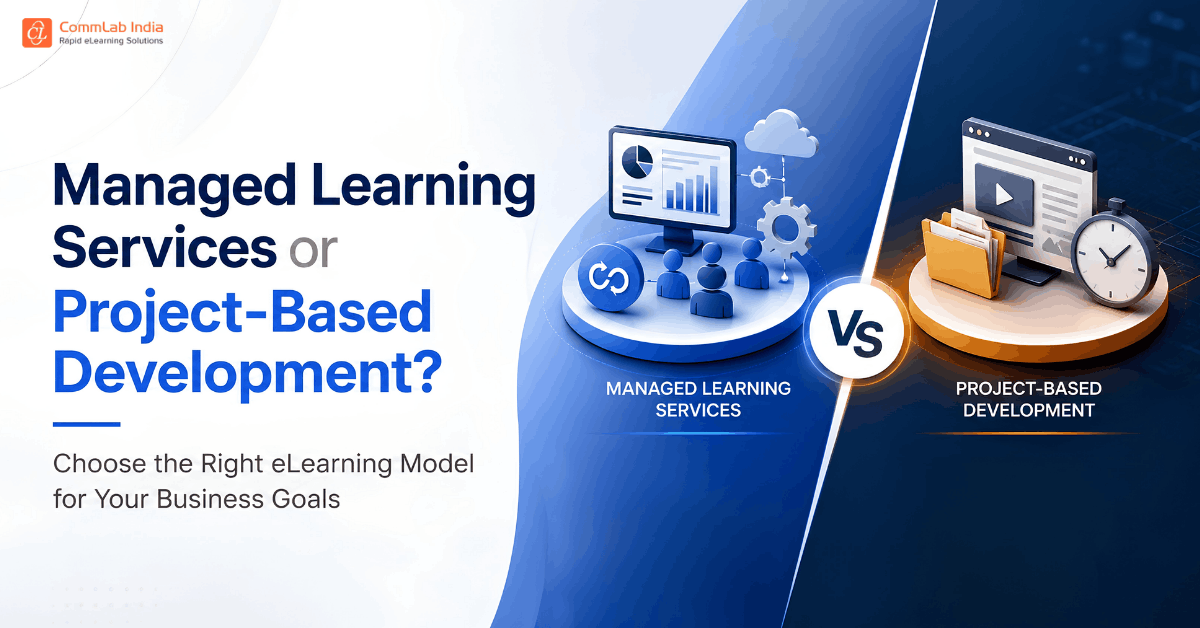
Every L&D professional has faced a version of the same pressure: a business need lands on your desk, the timeline is tight, stakeholders want results, and you have to decide quickly whether to build, outsource, or hand the whole thing over to a managed partner. The choice between managed learning services and project-based custom eLearning development is rarely straightforward — and getting it wrong doesn't just affect budget. It affects learner experience, corporate training program credibility, and your team's capacity for months to come.
Both models have a legitimate place in a well-run L&D function. The real skill is knowing which one fits the situation in front of you.
This blog breaks down how each model works, where it performs best, and what L&D leaders need to watch out for when putting either into practice.
Table Of Content
- What is Managed Learning Services (MLS)?
- What is project-based custom eLearning Development?
- What are the Common Challenges L&D Leaders Face with Each Model?
- What are the Best Practices for Choosing and Implementing Either Model
- Frequently Asked Questions
What is Managed Learning Services (MLS)?
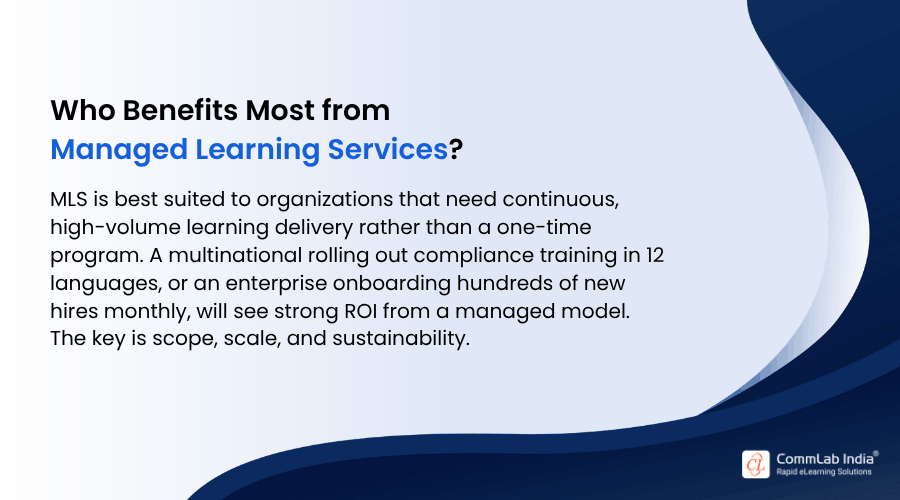
Managed learning services is an end-to-end outsourcing arrangement in which a vendor takes over the ongoing management of an organization’s learning ecosystem. This goes beyond delivering a single course. An MLS partner may handle vendor management, LMS administration, learner support, content curation, reporting, and continuous program optimization, all under one commercial agreement.
Think of it as hiring an external L&D operations team that is accountable for outcomes, not just deliverables. Organizations that adopt MLS typically have complex, multi-program portfolios spread across business units, geographies, or learner populations.
What is project-based custom eLearning Development?
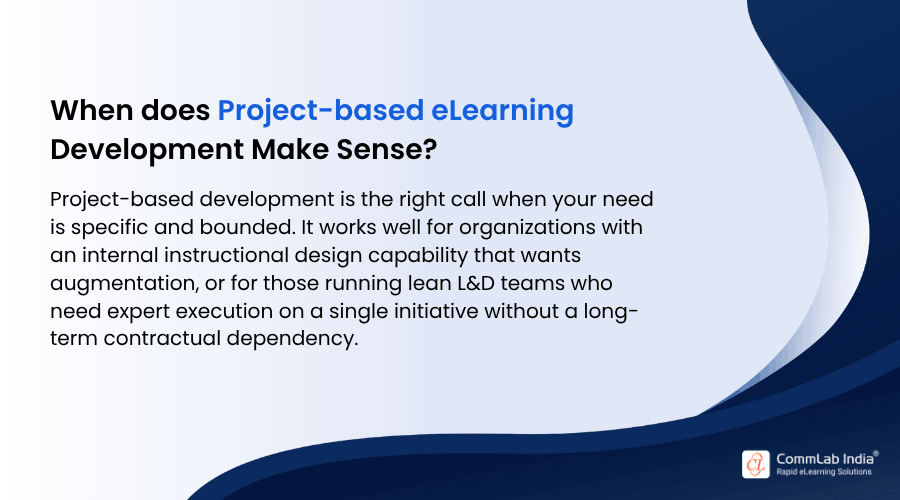
Project-based custom eLearning development works on a defined scope: a course, a curriculum, or a learning experience is scoped, built, reviewed, and handed over. The L&D team retains full strategic control while engaging an external vendor for execution. The relationship ends or pauses when the deliverable is complete.
This model excels when a specific knowledge or skills gap has been identified and a targeted, high-quality solution is needed. Think product training for a new software launch, a leadership development module, or a compliance refresher tied to regulatory change. The brief is clear, the timeline is defined, and the output is measurable.
What are the Common Challenges L&D Leaders Face with Each Model?
Selecting the right model is only half the battle. Even well-matched choices can underperform when implementation gaps are left unaddressed.
Here are the most frequently encountered obstacles and what to watch for before they become costly.
| Managed Learning Services Challenges | Project-Based eLearning Challenges |
|
|
What are the Best Practices for Choosing and Implementing Either Model?
- Start with learning strategy, not vendor selection
Organizations that connect L&D investment to talent strategy outcomes outperform those that treat training as a procurement function. - Define success metrics before the contract is signed
Whether completion rates, knowledge retention scores, or post-training performance improvement — agree on measurement frameworks upfront. - Build a hybrid model where appropriate
Many mature L&D functions use MLS for operational scale while running select project-based builds for high-visibility, high-stakes learning experiences. These models are not mutually exclusive. - Assess your internal readiness honestly
A capability audit of your L&D team is a worthwhile investment before entering either model. - Pilot before you scale
For MLS, run a 90-day proof of concept on one program. For project-based eLearning, commission a short module before a full curriculum build. Evidence reduces risk.
Frequently Asked Questions
1. What is the difference between Managed Learning Services and a traditional eLearning vendor?
A. A traditional eLearning vendor delivers content or a platform against a project brief. A managed learning services partner takes accountability for the ongoing performance of your learning ecosystem including vendor management, learner support, LMS oversight, and program optimization. The distinction is between transactional delivery and strategic partnership.
2. How do I know if custom eLearning development is worth the investment?
A. Custom eLearning development is worth the investment when the learning need is specific to your organization's context, workflows, or culture and when off-the-shelf content cannot address the performance gap effectively. The ROI case strengthens when the learner population is large, the content has a long shelf life, or the stakes of poor performance are high (compliance, customer-facing roles, safety).
3. Can organizations run both models at the same time?
A. Yes, and many high-performing L&D functions do exactly this. A managed learning services partner can handle operational learning infrastructure while the internal team (or a specialist vendor) runs a project-based custom eLearning build for a strategic initiative. The key is defining clear scope boundaries and governance to avoid duplication or conflict between the two workstreams.
Key Takeaway!
The right model depends on your learning portfolio's scope, your internal capability, and your strategic timeline, not on what is currently fashionable in the market. Managed learning services deliver operational excellence at scale. Project-based custom eLearning development delivers precision and quality for targeted needs. The most effective L&D functions know when to use each and build the governance to make both work. Start by mapping your learning needs against your internal capacity, then choose the model that closes the gap most efficiently.
Still weighing the outsourcing decision for custom eLearning development? Our eBook breaks down exactly when to outsource your L&D, what to look for in a partner, and how to protect your team's strategic role throughout.