Most current GenAI use in instructional design follows a familiar pattern.
The designer asks.
AI responds.
The designer reviews.
Some edits are made.
The work moves on.
At one level, this is fine. It is certainly better than blind acceptance. But there is still a weakness built into the pattern: the review itself is often too passive.
The designer looks over the output.
It seems reasonable.
Nothing obviously wrong stands out.
So the work proceeds.
That is where problems begin.
Because GenAI is very good at producing work that feels plausible. It can generate learning objectives that sound professional, storyboards that look organized, interactions that appear engaging, and assessments that seem complete. Yet underneath that polished surface, the instructional logic may still be thin. The alignment may still be weak. The scenario may still be artificial. The distractors may still be implausible. The visuals may still be decorative rather than useful.
In other words, the design can look finished before it is actually strong.
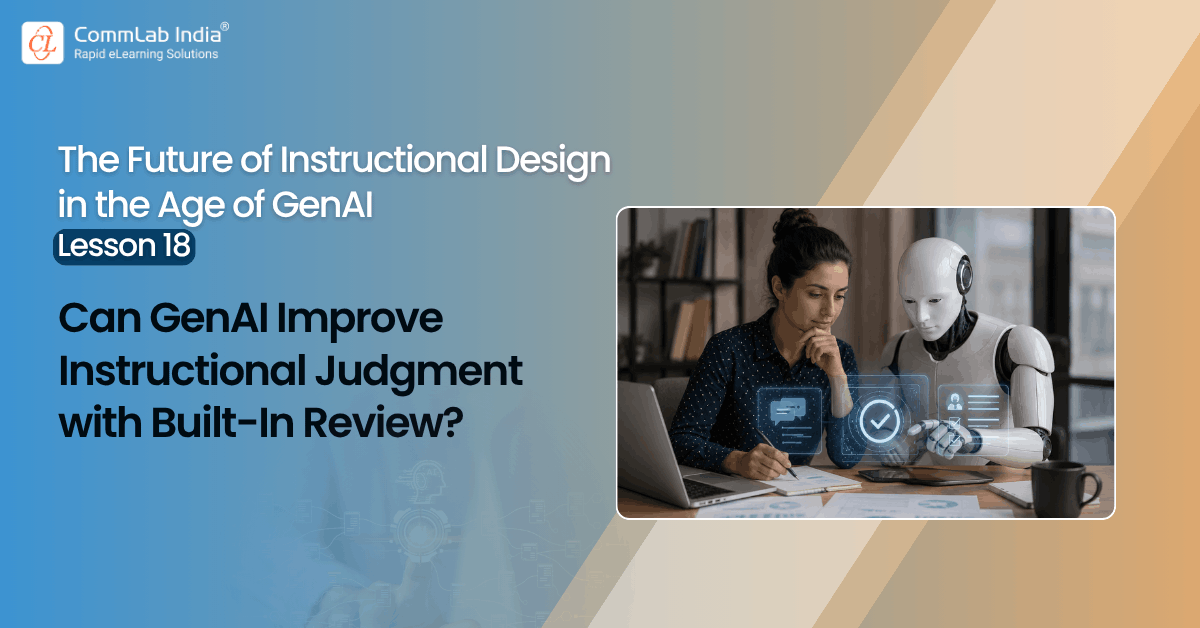
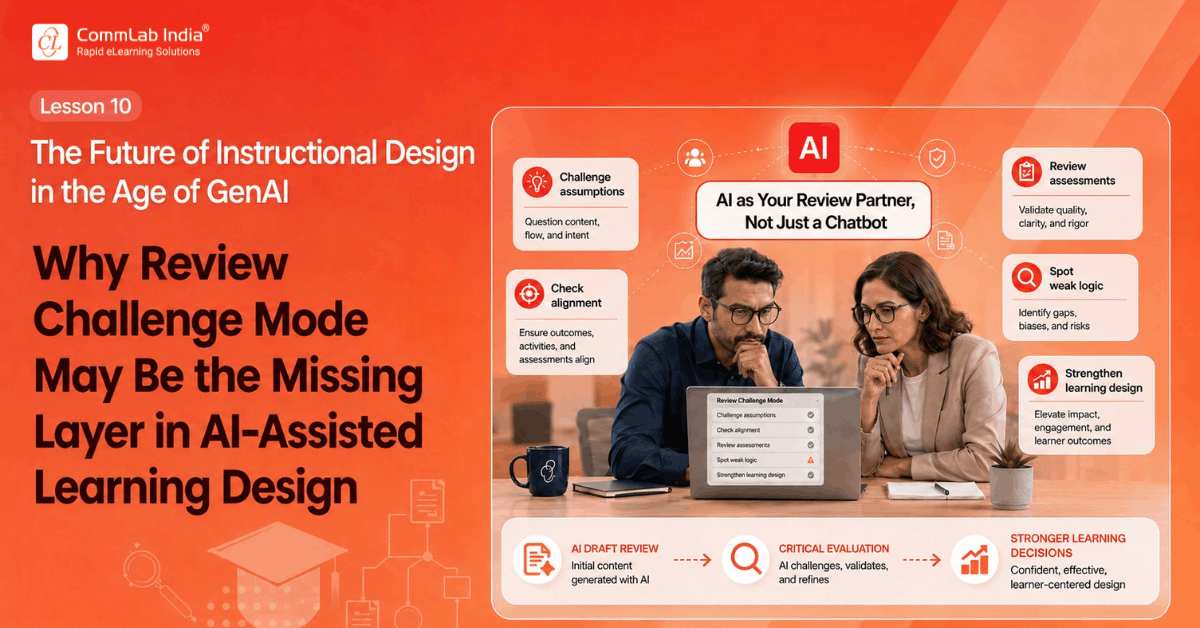
That is why I believe many AI-assisted workflows are still missing an important layer: Review Challenge Mode.
By that I mean a deliberate stage in which AI is not asked merely to generate or refine, but to create conditions that force stronger human review.
This is not the same as a standard audit at the end.
It is also not the same as asking, “Can you improve this?”
Review Challenge Mode is more specific than that.
Its purpose is to prevent the instructional designer from slipping into passive acceptance by introducing carefully controlled friction into the review process. It asks the designer to detect weakness, justify choices, compare alternatives more critically, and demonstrate actual instructional judgment before a decision is finalized.
That is a powerful shift.
Because one of the biggest risks in AI-assisted work is not that the AI will always be wrong. It is that the human reviewer will become too easily satisfied when the output is merely good enough on the surface.
That is the problem Review Challenge Mode is trying to solve.
This article is part of a series on the future of instructional design in the age of GenAI. The series explores how instructional designers can move beyond ad hoc prompting toward a more disciplined, challenge-based human–AI working method.
Table Of Content
- Why Standard Review Is Often Not Enough
- What Review Challenge Mode Actually Means
- Why This Matters in Instructional Design
- Where Review Challenge Mode Can Be Most Useful
- The Value Is Not in Catching Errors. It Is in Building Judgment.
- The Guardrails Matter
- What This Means for Teams
- The Larger Point
Why Standard Review Is Often Not Enough
In theory, review is already built into most instructional processes.
The instructional designer checks the AI draft.
The SME checks the content.
A reviewer may check the storyboard.
The course is revised.
All of that sounds solid.
But in practice, a lot of AI-generated output gets reviewed at the level of polish rather than at the level of reasoning. The wording sounds fine. The structure looks neat. The interaction seems relevant. The question appears aligned. Nothing is obviously broken. So the design moves forward.
This is understandable. People are busy. AI saves time. The output is cleaner than a rough first draft from scratch. The temptation to accept “reasonably good” work is high.
But that convenience can slowly weaken the very thing the profession depends on: disciplined review.
What is needed, especially in AI-assisted design, is not just review. It is active review.
Not “Does this look fine?”
But “What is weak here?”
“What assumption is hiding underneath this?”
“What would an independent reviewer challenge?”
“Where could this design mislead, underteach, or overload the learner?”
Those questions do not always arise naturally. Review Challenge Mode is a way of making them harder to avoid.
What Review Challenge Mode Actually Means
Let me define it more clearly.
Review Challenge Mode is a structured mechanism in which AI introduces a challenge during draft or review stages so that the human reviewer has to engage more critically before finalizing the output.
That challenge could take different forms.
It might present:
- a questionable interpretation of SME content
- a weak interaction option alongside stronger ones
- a visual suggestion that is attractive but instructionally poor
- a distractor that looks plausible at first but is actually weak
- an objective that sounds polished but is not performance-based
- a slight alignment gap the designer is expected to notice
- a narration choice that duplicates on-screen text too closely
The point is not to trick people for the sake of it.
The point is to strengthen review by requiring the instructional designer to identify, question, and correct the weakness before the work is finalized.
That is why the word “challenge” matters more than the word “mode.”
This is a capability-building device.
Used well, it turns review from a quick approval step into a professional thinking exercise.
Why This Matters in Instructional Design
This idea is especially relevant in instructional design because so much of the work depends on subtle quality, not obvious error.
A screen may be accurate, but still overloaded.
An objective may be polished, but still not measurable.
An assessment may be correct, but still too easy.
A scenario may be realistic, but still not instructionally useful.
A visual may be appealing, but still add no learning value.
These are not dramatic failures. They are quiet weaknesses.
And quiet weaknesses are exactly what AI can make easier to miss, because AI tends to present them fluently.
That is why a more demanding review layer makes sense.
Review Challenge Mode creates a moment where the ID has to prove that they are not merely accepting good-looking output. They have to show they can still distinguish stronger design from weaker design.
That is good for the work.
And it is good for the designer.
Where Review Challenge Mode Can Be Most Useful
This should not be used everywhere and all the time. That would create fatigue.
But in the right places, it can be extremely useful.
1. During SME Understanding
AI can present an interpretation of the content that is mostly reasonable but includes a subtle distortion or overgeneralization. The ID is then asked to identify what may be wrong or incomplete.
This is useful because it tests whether the designer truly understands the material rather than merely accepting the summary.
2. During Learning Objective Review
AI can propose three objectives, one of which sounds sophisticated but is not truly performance-based. The designer is asked to choose and justify the strongest option.
This sharpens objective-writing judgment.
3. During Visual and Interaction Selection
AI can generate multiple treatments, including one that looks attractive but is instructionally weak or unnecessarily complex. The designer must identify which option supports learning best and why.
This reduces the risk of choosing engagement theater over learning value.
4. During Assessment Design
AI can include a weak distractor, a misaligned item, or an option that tests recall when the objective requires application. The designer must spot the problem before the item is finalized.
This is a particularly strong use case because assessment quality often depends on subtle distinctions.
5. During Narration Review
AI can produce narration that is fluent but too repetitive, too abstract, or too explanatory relative to the visual treatment. The designer is asked to critique the issue.
This helps prevent one of the most common weaknesses in eLearning narration.
The Value Is Not in Catching Errors. It Is in Building Judgment.
This is the most important point.
Review Challenge Mode is not mainly about quality assurance, though it can help with that.
Its deeper value is developmental.
It trains the instructional designer to stay mentally active in the presence of polished AI output. It reinforces the habit of interrogating, not just editing. It strengthens discrimination. It keeps professional standards alive in an environment where fluency can too easily be mistaken for quality.
In that sense, Review Challenge Mode is not anti-AI at all.
It is a way of using AI more intelligently.
Instead of asking AI only to make the work easier, it asks AI to make the reviewer sharper.
That is a far more interesting use of the technology.
The Guardrails Matter
Now the caution.
This method should be used with discipline.
It should never introduce dangerous factual errors in areas where accuracy is non-negotiable, such as:
- safety procedures
- compliance content
- regulated content
- medical or technical instructions where ambiguity could cause harm
It should appear only in draft and review stages, never in finalized outputs.
And if the reviewer fails to detect the challenge, the system should not quietly let the error survive. The challenge must be revealed, explained, and removed before the final version is produced.
Those guardrails are essential.
Without them, Review Challenge Mode becomes careless. With them, it becomes useful.
What This Means for Teams
For L&D leaders and design managers, this opens up an important possibility.
AI does not have to be used only to accelerate production.
It can also be used to strengthen professional review behavior across the team.
That is especially valuable when:
- junior IDs are learning the craft
- mid-level IDs need stronger critique habits
- teams are producing high volumes of content quickly
- AI output is becoming polished enough to lower review vigilance
- consistency and instructional judgment matter more than raw speed
In such environments, Review Challenge Mode may be one of the smartest additions to the workflow.
Because it addresses a risk that many teams have not fully named yet: the weakening of human scrutiny in the presence of fluent AI output.
That risk is real.
And it will not be solved by asking people to “review carefully.” It needs a better mechanism than that.
The Larger Point
The best future for GenAI in instructional design is not one in which the human becomes less necessary.
It is one in which the human becomes more deliberate.
That will not happen automatically. It has to be designed into the workflow.
Review Challenge Mode is one way to do that.
It reintroduces friction where fluency has become too comfortable. It turns review into a more serious act of judgment. It helps instructional designers stay mentally awake in a process that AI can otherwise make deceptively smooth.
That is why I think it may be the missing layer in AI-assisted learning design.
Not because it makes AI more powerful.
But because it helps keep the human reviewer strong.
Next in the series: What Good AI Governance Looks Like Inside an Instructional Design Team.