One of the biggest mistakes in today’s GenAI conversation is also one of the most common: treating AI as a content generation machine.
Give it source material. Ask it for output. Get a draft. Clean it up. Move on.
This pattern is now becoming familiar across instructional design teams. AI is being used to summarize SME inputs, write objectives, generate assessments, draft storyboards, produce narration, and suggest interactions. On the surface, this looks efficient — and in many cases, it is.
But it is also too narrow. When AI in instructional design is used mainly for content creation, the designer’s role can slowly begin to shrink. The work becomes less about thinking through the instructional problem and more about managing generated output. Instead of acting as an architect of learning, the designer risks becoming a refiner of AI-generated text.
And that is not a healthy direction for the profession.
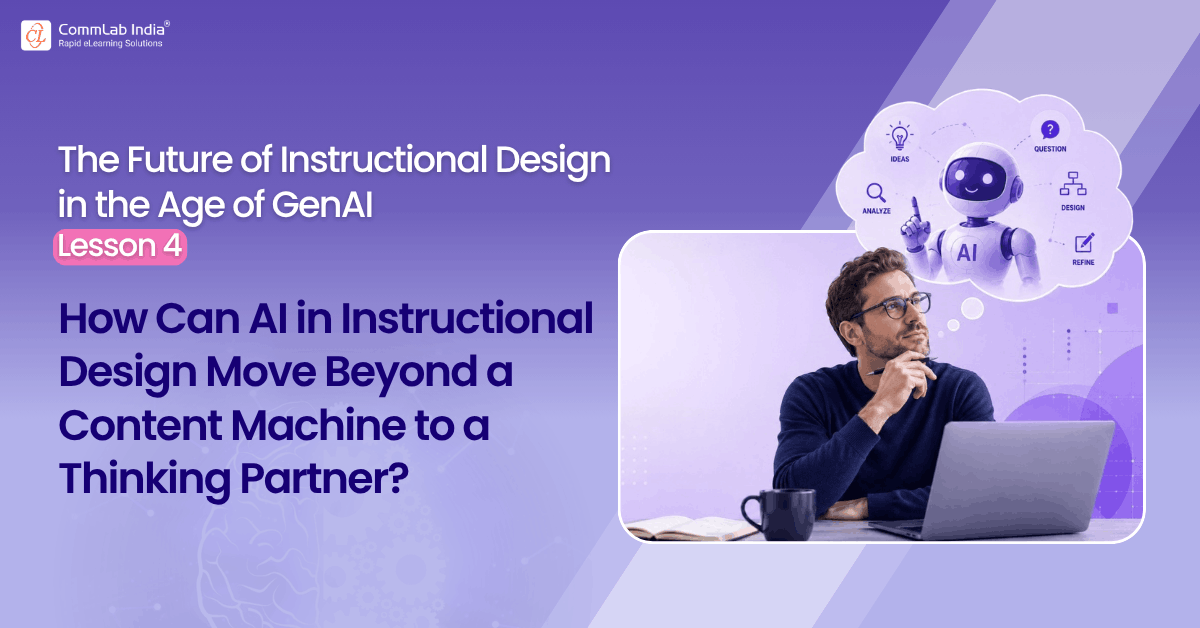
This blog explores how AI in instructional design should move beyond AI content creation and function as a thinking partner that strengthens human design thinking, decision-making, and learning strategy across the workflow.
This article is part of a series on the future of instructional design in the age of GenAI. The series explores how instructional designers can move beyond ad hoc prompting toward a more disciplined, challenge-based human–AI working method.
Table of Contents
- Is AI Turning Instructional Designers into Content Editors?
- Why the “Thinking Partner” Model Matters
- How AI Can Function as a Thinking Partner Throughout the Workflow?
- Why AI as a Thinking Partner in Instructional Design is Better?
- What Does this Mean for L&D Leaders?
Is AI Turning Instructional Designers into Content Editors?
Instructional design is not fundamentally a writing task. It is a judgment task.
The real work in corporate training is not in producing words. The real work is in deciding what the learner actually needs, what the business is asking for, what the SME content is really saying, what can be ignored, what must be practiced, what should be visualized, what must be assessed, and where the learner is likely to struggle or disengage.
These are not content-generation decisions.
They are design decisions.
Why the “Thinking Partner” Model Matters
That is why I believe GenAI should be used differently. Not mainly as a AI content machine, but as a thinking partner. This is a much stronger model.
The quality of instructional design does not depend only on what gets produced. It depends on how the designer arrives there.
If AI is only used to generate deliverables, the process can become deceptively smooth. The drafts arrive quickly. The screens look coherent. The objectives sound professional. The narration reads well. But something important may be missing: the struggle that forces the designer to think hard about the instructional logic underneath.
That is where the “thinking partner” model becomes valuable.
How AI Can Function as a Thinking Partner Throughout the Workflow?
In this model, AI can play several useful roles:
1. AI as a Sense-making Partner
At the beginning of a project, it can act as a sense-making partner. When the SME material is dense, fragmented, or poorly organized, AI can help identify key concepts, simplify complex passages, surface terminology, cluster ideas, and explain difficult sections in plain language. But even here, the goal is not to hand over interpretation blindly. The goal is to help the designer understand the material more deeply and faster.
2. AI as a Structuring Partner
Later, AI can act as a structuring partner. It can propose a learning flow, group related topics, suggest module boundaries, and identify where the sequence may need adjustment. Again, the value is not that the AI “designed the course.” The value is that it gave the designer structure to evaluate and improve.
3. AI as a Decision-Expansion Partner
Then AI can become a decision-expansion partner. It can generate multiple ways of framing an objective, several assessment formats, alternative interaction ideas, or different visual design approaches for the same concept. This is one of its strongest uses. It broadens the option space. That can be very useful, especially when the designer is stuck, moving too quickly, or falling into habitual patterns.
4. AI as a Critical Partner
At other points, AI should become a critical partner. It should question whether the objectives are performance-based. It should identify screens likely to become text-heavy. It should flag where narration repeats on-screen content. It should challenge weak distractors, superficial scenarios, or alignment gaps. This is where the value of challenge-based AI prompting becomes clear. A thinking partner should not only help you move. It should also help you stop and inspect.
5. AI as an Audit Partner
At the end, AI can become an audit partner. It can review the storyboard as if it were not involved in creating it. It can check alignment, cognitive load, assessment quality, visual clarity, and instructional coherence. That role change is important. It prevents AI from functioning only as a production assistant and reinforces its role in design quality.
Advanced Instructional Design Meets AI
- Modern instructional strategies
- Top Gen AI tools in action
- Case studies, tips, and tricks
- And More!
Why AI as a Thinking Partner in Instructional Design is Better?
This is a better use of the technology.
Because it keeps the center of gravity where it belongs: with the instructional designer.
That does not mean AI becomes secondary. It can still be highly valuable. In fact, it may become more valuable. But its value shifts from “help me produce” to “help me think better while I produce.”
That is a healthier relationship.
It also has an important consequence for team capability.
If IDs use AI mainly for content generation, they may get faster, but not necessarily stronger. Over time, they may become increasingly dependent on generated drafts, suggested wording, and ready-made structures. They may finish more work while exercising less judgment.
If, on the other hand, IDs use AI as a thinking partner, the opposite can happen. They may become better at diagnosis, better at questioning, better at seeing alternatives, better at recognizing weak logic, and better at improving their own first instincts. In that model, AI does not hollow out instructional thinking. It sharpens it.
That, to me, is the real opportunity.
Not automated instructional design.
Not AI-generated deliverables at scale.
But better human design, strengthened through disciplined AI interaction.
What Does this Mean for L&D Leaders?
For L&D leaders, this shift is not theoretical. It has direct implications for how teams are trained, how prompt guides are created, how review processes are structured, and how good AI use is defined in practice. If instructional designers are trained only to extract output from GenAI, they are likely to use it in a shallow way. But when they are trained to engage AI as a collaborator, critic, and reviewer, they can improve both speed and design quality.
That is the shift the field now needs to make. The question is no longer whether instructional designers should use GenAI. That stage is already behind us. The more important question is: what role should GenAI play in the designer’s thinking process?
The answer is clear. AI should not sit in the workflow merely as a machine for content generation. It should function as a structured thinking partner — one that helps designers think more clearly, challenge ideas more rigorously, and design more deliberately. Because the future of instructional design will not be improved by generating more content faster. It will be improved by strengthening the quality of human design thinking.
Next in the series: A Better Way to Use GenAI Across the Instructional Design Workflow.