
For years, Smartcat has been known primarily as a translation and localization platform. Global L&D teams have used it to translate eLearning courses, manage multilingual learning content, and accelerate localization workflows across regions.
But Smartcat’s latest evolution signals a much bigger shift.
The platform is now expanding into AI course creation, positioning itself not just as a translation engine, but as an AI-assisted system for building eLearning content itself. With new capabilities focused on generating course structures, quizzes, interactive learning blocks, and multilingual training experiences, Smartcat AI is entering a space that has quickly become one of the most watched areas in corporate learning.
This blog explores how Smartcat AI is expanding from translation into rapid eLearning course creation, including what L&D teams can create, how it supports engaging learning, and where its “Create Learning Content” feature adds the most value.
It also offers a balanced view of its strengths, practical use cases, and the role of ID and SME oversight in creating high-quality learning experiences.
Table of Contents
- What is Smartcat’s New AI Course Creation Capability?
- How to Create Engaging and Effective eLearning Courses with Smartcat?
- What Can You Create for eLearning with Smartcat AI?
- What are Some Notable Capabilities of Smartcat AI for eLearning Course Creation?
- Where does Smartcat Add the Most Value in eLearning Course Creation?
- Using Smartcat AI with the Right Oversight!
What is Smartcat’s New AI Course Creation Capability?
Smartcat now enables instructional designers to generate learning content directly from uploaded source materials.
Instead of using the platform only for translation, teams can now use Smartcat AI to:
- generate course outlines
- create learning objectives
- build quizzes
- structure responsive learning flows
- create microlearning-style content
- localize courses simultaneously
How to Create Engaging and Effective eLearning Courses with Smartcat?
To create engaging and effective eLearning courses, focus on three essentials: interactivity, accessibility, and localization. Smartcat supports these priorities by helping L&D teams build learning content that keeps learners involved and reaches diverse learners.
1. Boost Interactivity
Interactive elements help learners stay engaged throughout the course. With Smartcat, you can use quizzes, scenarios, and multimedia to make learning more active instead of passive.
2. Ensure Accessibility
Effective eLearning should work for all learners. Smartcat helps course creators design with accessibility in mind, supporting learning experiences that align with global accessibility standards.
3. Localize Content
Localization makes eLearning more relevant for different audiences. Smartcat helps adapt language and visuals for every market, making courses easier to understand and more engaging for learners everywhere.
How Smartcat enables scalable training localization.
What Can You Create for eLearning with Smartcat AI?
Smartcat AI includes multiple AI-powered options designed to simplify and accelerate eLearning course creation. Instead of building everything manually, instructional designers can follow a guided workflow that helps structure, refine, and enhance learning content step by step.
The platform’s course creation flow includes stages such as:
- Select generation type
- Add content description
- Define the target audience
- Set learning goals and course type
- Brainstorm content ideas
- Polish and refine the final output
This guided approach helps L&D teams move from raw content to structured learning experiences more efficiently.
Pro Tip:
For more efficient results, instructional designers can benefit from structured AI prompting, creating a prompt library for common course creation needs. This helps standardize outputs, reduce rework, and make AI-assisted course creation more consistent.
What are Some Notable Capabilities of Smartcat AI for eLearning Course Creation?
Overall, Smartcat AI positions itself as a tool that helps create, update, and enhance learning materials through AI-assisted workflows, especially for organizations looking for rapid eLearning development at scale.
- Import SCORM
- Create a Quiz
- Create Microlearning
- Create a Course
Users can upload existing SCORM packages and transform them into editable, ready-to-use learning content. This can help modernize or repurpose older training materials faster.
Smartcat AI can generate quizzes designed to test learner understanding and reinforce knowledge throughout the course.
The platform supports the creation of microlearning modules that are ideal for quick learning, reinforcement, and just-in-time training.
Instructional designers can build complete eLearning courses with guided content generation, structured learning flow, and interactive learning elements.
Where does Smartcat Add the Most Value in eLearning Course Creation?
Based on our evaluation of Smartcat’s “Create Learning Content” feature, here are the areas where it performs strongest. It is particularly effective when organizations already have source content and want to convert it quickly into structured eLearning.
Instead of starting from a blank page, instructional designers can use Smartcat AI to generate a reasonably organized course structure within minutes. This significantly reduces the time spent on early-stage course development.
|
Smartcat’s Strength |
What This Means for eLearning |
|
Handles document-based inputs well |
Smartcat can work with common document-based source materials and convert uploaded content into responsive learning structures. This makes it useful when teams already have training content in a document format. |
|
Creates structured course outlines |
The tool can generate logically sequenced outlines with a reasonably progressive learner flow, especially for short-duration learning experiences. |
|
Supports learning objective creation |
When prompts are clear and action-oriented, Smartcat AI can generate measurable learning objectives aligned to business outcomes. |
|
Generates comprehensive course content |
The platform can create detailed content with parallel structure and progressive flow, helping teams move faster from source material to course draft. |
|
Builds basic learning interactions |
Smartcat AI can generate Rise-like interactions such as tabs, flashcards, and quizzes, with interaction placement that is reasonably aligned to learning needs. |
|
Speeds up assessment drafting |
Assessments generally align with learning objectives and help reduce initial drafting effort. Some distractors are also intelligently generated. |
|
Improves development efficiency |
The tool can significantly reduce blank-page effort, formatting effort, drafting time, and interaction creation effort. |
|
Maintains consistent output structure |
Smartcat AI generally maintains learning continuity and provides structured outputs in a consistent format. |
Using Smartcat AI with the Right Oversight!
Smartcat AI’s biggest value lies in reducing first-draft effort. Instead of spending hours organizing raw documents into learning structures, instructional designers can use the platform to generate reasonably organized module flows within minutes.
That said, Smartcat AI works best when guided by clear instructional direction. Its outputs may still need refinement for chunking, tone, terminology, technical accuracy, scenario development, and learner-friendly formatting. In other words, it accelerates the starting point, but strong ID and SME intervention remain essential to ensure quality and accuracy.
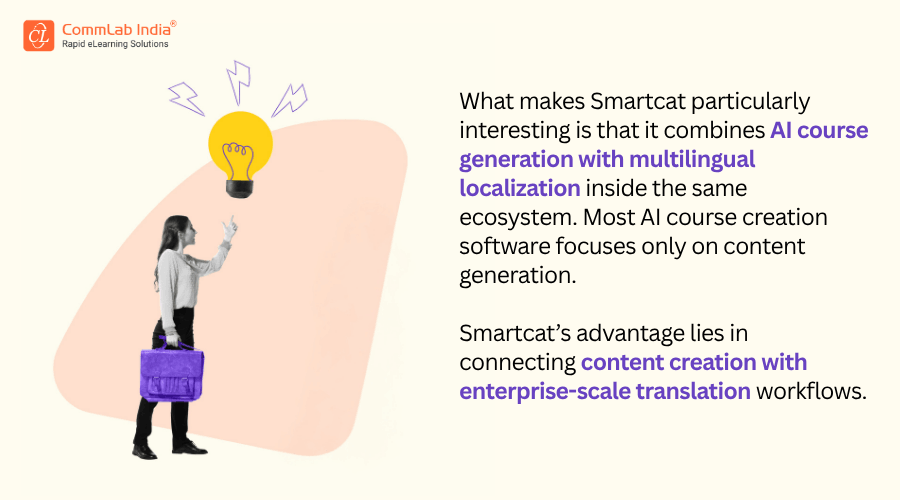
Where Smartcat stands out even more is multilingual learning production. Since localization has always been its core strength, the platform naturally supports workflows where organizations need to create and translate training simultaneously.
For enterprises managing global learning across multiple languages, Smartcat AI can be a valuable productivity enabler within controlled, quality-reviewed workflows. And to To get the best Smartcat, the real differentiator is how well you prompt them.
Download our eBook on Prompt Engineering to learn how to craft prompts that drive sharper, faster, and more usable learning outputs.