Standard Operating Procedure (SOP) training teaches employees to follow standard operating procedures the same way every time, which is what protects quality, speed and compliance. In industries like pharma, manufacturing, energy and financial services, it is non-negotiable, because one missed step can mean a safety incident, a failed audit or a costly error. A written SOP alone rarely changes behavior, so people need to practice the steps and prove they can apply them.
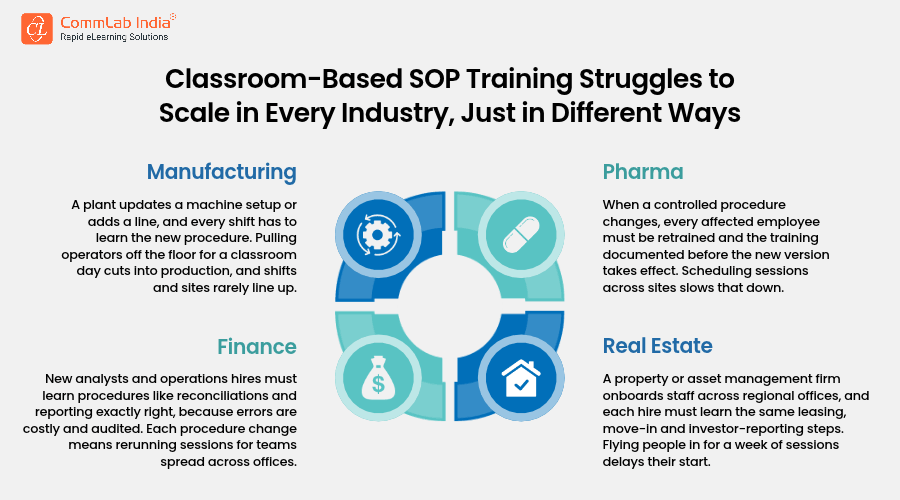
The classroom model struggles to deliver that at scale. Every new hire means another week of eight-hour sessions, remote employees travel in to attend, and each process change sends you back to retrain people who already sat through it. Meanwhile, SOPs often sit in shared folders that few people open, and it is hard to tell whether the training stuck.
This guide helps you decide how to approach it. You will learn what it takes to convert SOPs into eLearning, what to look for in an LMS for SOP training and in a partner, and which questions to ask before you choose one.
If you are weighing how to approach SOP training, these are the points that matter most:
- Converting SOPs into eLearning takes instructional design, SME input, media production and assessment design, not just uploading documents.
- Choose an LMS for SOP training with version control, learner feedback and first-attempt reporting.
- Work with a partner when you have many chapters, tight timelines or limited internal capacity.
- Ask vendors how they will work with your SMEs, handle updates and report results.
Table of Contents
- Why is Classroom-Based Process Training No Longer Enough?
- What Does It Take to Convert SOPs into eLearning?
- What Should an LMS for SOP Training Include?
- If You Outsource SOP Training, How Do You Choose the Right Partner?
- What Questions Should You Ask Before Choosing a Partner?
- Frequently Asked Questions
- Ready to Move Your SOP Training Online with eLearning?
Why is Classroom-Based Process Training No Longer Enough?
Classroom process training struggles to scale because it ties up people, rooms and trainers for long stretches. A week of eight-hour sessions asks learners to absorb a lot at once, with little time to practice or reinforce it.
Three pressures make the classroom model harder to sustain:
- Growing onboarding volume: more hires each month means repeating the same sessions.
- Remote and distributed teams: bringing people to one office adds travel cost and delays their start.
- Frequent process changes: a workshop cannot be updated as fast as a process evolves.
What Does It Take to Convert SOPs into eLearning?
Converting SOPs into eLearning takes more than uploading documents into a course tool. It combines content analysis, instructional design, media production, and assessment design, all reviewed by people who know the process.
The work typically covers:
- Content analysis: deciding what to keep, simplify or remove from each SOP.
- Learning design: reshaping procedures into scenarios, simulations, videos, infographics or job aids.
- Right-sized formats: a two-minute process needs a two-minute asset, while a complex one may need a 15 to 20 minute learning bite.
- Production: scripting, video, interactivity and software simulations.
- Assessment design: questions that test application, not recall.
- SME review: repeated checks so every step stays accurate.
What Should an LMS for SOP Training Include?
An LMS for SOP training should do more than host content and track completions. It must manage how procedures change and give you proof that people learned.
Because SOPs change, the LMS matters as much as the content. Look for these capabilities:
- Version control: update a chapter once and keep a record of every revision.
- Feedback tools: let employees flag unclear or outdated steps for review.
- A strong assessment engine: pre-tests, post-tests, adaptive paths and first-attempt score reporting, so you can spot learners who guess their way to a pass.
- AI-powered answers: a chatbot that answers process questions from your content and routes unanswered ones to an SME.
- Reporting and APIs: standard dashboards for managers, plus data access for custom reports.
A compliance-only LMS rarely covers this. It records completions for audits but gives employees no way to question or improve the content.
If You Outsource SOP Training, How Do You Choose the Right Partner?
Outsourcing makes sense when you have many SOPs to convert, a tight timeline or limited design capacity. Once you decide to outsource, your partner shapes the quality, speed and how well the training holds up as processes change. Look for evidence of these strengths:
- Format range: videos, scenarios, simulations, infographics and job aids, not only slides.
- SME collaboration: a clear way to gather, clarify and trim content with your experts.
- Platform flexibility: experience with several LMS platforms, or a platform of their own that fits your needs.
- Assessment and analytics: pre-tests, post-tests and first-attempt score reporting.
- Post-launch support: help with updates when processes change.
Ask to see samples for processes similar to yours. Samples reveal more than any capability list.
What Questions Should You Ask Before Choosing a Partner?
The right questions expose how a vendor works, not just what it sells. Use these to compare partners side by side:
- How will you turn our SOPs into learning, not slides?
- How much of our SMEs' time do you need, and when?
- Does your LMS support version control and learner feedback on content?
- Can it report first-attempt scores, not just final results?
- How will employees get quick answers to process questions, and what happens when the answer is unclear?
- How do you handle updates when a process changes?
- What timeline, phases and approvals do you propose?
To Note: Compare the answers on specifics. Vague replies often signal limited experience.
From Classroom Dependency to Learning on Demand
Scale proven training without repeatedly scheduling instructors, coordinating locations, or asking learners to wait for the next session.
Start with a few high-impact SOPs, then add capacity only as your processes grow.
Frequently Asked Questions
Is a written SOP enough to train employees?
No. People skim documents once, then rely on memory or colleagues. Practice, scenarios and assessments turn written steps into skills.
Why Does Moving SOP Training Online Work Better Than the Classroom?
Online training delivers the same process the same way to every learner, wherever they work. It adds practice and assessments, and one update reaches everyone when a process changes.
When Should We Bring In an SOP Training Partner?
Bring in a partner when you have many SOPs, a tight timeline or limited design and development capacity. An on-demand partner scales capacity up or down as processes change, with no hiring, and keeps formats consistent.
Can one partner handle both the eLearning and the LMS?
Yes. A partner that builds the content and sets up the LMS together makes branding, user setup and reporting fit the courses. Look for one that knows several platforms or has its own, and can open up data through APIs.
Ready to Move Your SOP Training Online with eLearning?
Moving SOP training online works when it is short, practical, measurable and easy to update. That takes more than converting documents. It takes instructional design, SME collaboration and a platform built for change.
Start small. Pick a few high-impact SOPs, compare partners on how they work rather than what they promise, and ask each to quote against the same scope. A short pilot will tell you more than any proposal.
If you would rather not build this alone, CommLab India can help. We design SOP training and eLearning, set up the LMS, and keep content current as your processes change, on demand and at the pace you need.
Get in touch.