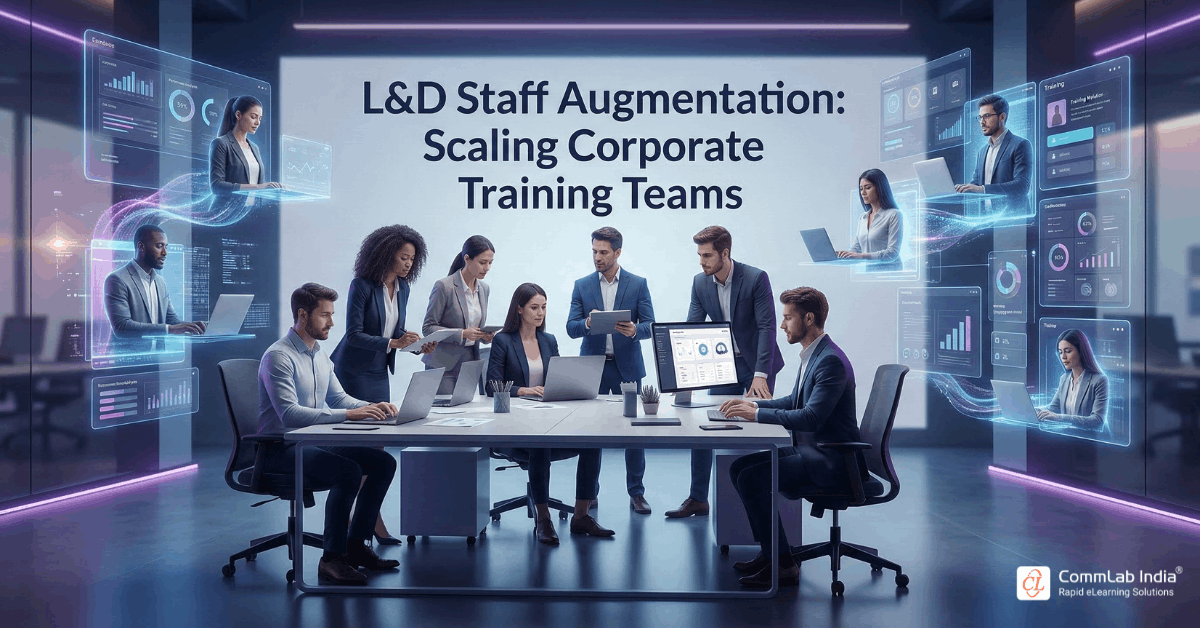
Corporate learning teams are being asked to do more than ever before. They must design immersive learning experiences, deploy global training programs, integrate new technologies such as AI-driven learning platforms, and demonstrate measurable business impact. Yet many L&D teams are expected to accomplish all this with limited internal resources and tight timelines.
This gap between growing learning demands and limited in-house capacity is forcing organizations to rethink their talent strategy.
One model is emerging as a powerful solution: L&D staff augmentation.
Instead of expanding permanent headcount or outsourcing entire training functions, organizations can temporarily extend their internal learning teams with specialized external experts. This allows companies to scale quickly, access niche expertise, and accelerate training delivery while retaining control over strategy and execution.
In this article, you will learn:
- How staff augmentation works in modern corporate learning teams
- When augmentation is more effective than outsourcing
- The roles, processes, and strategies that maximize ROI
- How enterprises use augmentation to accelerate training delivery
Download eBook Now: Staff Augmentation for L&D Teams
Table of Contents
- The Talent Crisis Facing Modern L&D Teams
- What L&D Staff Augmentation Really Means
- Why High-Performing L&D Teams Are Adopting Augmentation
- Staff Augmentation vs Outsourcing: Strategic Differences
- Critical Roles Commonly Augmented in Learning Teams
- The Modern Staff Augmentation Process for L&D
- How Staff Augmentation Improves Training ROI
- When Staff Augmentation Is the Right Strategy
- FAQs
- Conclusion
The Talent Crisis Facing Modern L&D Teams
Corporate learning organizations are experiencing a structural shift. Training is no longer limited to onboarding programs and compliance courses. L&D teams now support:
- Enterprise digital transformation
- Continuous workforce upskilling
- Product and sales enablement
- AI adoption and change management
However, demand for skilled L&D professionals often exceeds supply. Organizations frequently struggle to recruit instructional designers, learning technologists, and digital learning developers fast enough to meet project timelines.
Traditional hiring models create additional challenges:
- Long hiring cycles: Recruitment for specialized roles can take months.
- Unpredictable workloads: Training demand fluctuates with product launches, compliance cycles, and transformation initiatives.
- Rapid technology change: Learning teams must constantly adopt new capabilities such as immersive learning or analytics.
These pressures require a more flexible talent model.
What L&D Staff Augmentation Really Means
L&D staff augmentation is a strategic workforce model where organizations temporarily add external learning professionals to their internal teams to support specific projects or capacity needs.
Unlike outsourcing, augmented professionals work within the organization’s learning team, collaborating directly with internal staff while the company retains full control over the project.
These experts may include:
- Instructional designers
- eLearning developers
- Learning strategists
- LMS administrators
- Training data analysts
- Multimedia specialists
In most cases, augmented professionals are engaged for a specific project duration or defined scope, such as supporting a global training rollout, accelerating course development, implementing a new learning platform, or assisting during periods of peak workload. This flexible engagement model allows organizations to access specialized talent exactly when it is needed while avoiding long term staffing commitments.
The result is a scalable L&D capability without the long-term commitment of permanent hiring.
Why High-Performing L&D Teams Are Adopting Augmentation
Leading learning organizations are increasingly turning to augmentation for one key reason: agility. Several strategic advantages explain its growing adoption.
Workforce Scalability: Augmentation allows organizations to rapidly increase or decrease their learning team capacity depending on project demand.
Large training initiatives such as global compliance rollouts or product training launches often require temporary resource surges. Augmentation provides that capacity without long-term hiring commitments.
Access to Specialized Expertise: Modern learning programs increasingly require niche capabilities.
Examples include:
- immersive simulations
- microlearning design
- learning analytics
- AI-powered learning content
- gamification and scenario-based learning
Staff augmentation provides access to these skills without needing full-time specialists.
Faster Project Delivery: External experts typically require minimal onboarding and can contribute immediately.
This accelerates course development, technology implementation, and training rollouts, allowing organizations to meet aggressive timelines.
Cost Efficiency: Hiring full-time employees introduces costs beyond salary such as recruitment, onboarding, benefits, workspace and infrastructure.
Augmented professionals reduce these overheads because organizations pay only for the required expertise during specific projects.
Knowledge Transfer: External experts often bring exposure to multiple industries and technologies. When they collaborate with internal teams, this experience becomes a valuable learning opportunity that strengthens long-term organizational capability.
Staff Augmentation vs Outsourcing: Strategic Differences
While both models involve external talent, they operate differently.
| Factor | Staff Augmentation | Outsourcing |
| Team structure | External experts integrate with internal team | External vendor handles project |
| Control | Organization retains project control | Vendor manages execution |
| Flexibility | Highly flexible resource scaling | Fixed contractual scope |
| Collaboration | Direct collaboration with internal team | Limited internal involvement |
| Use case | Skill gaps, temporary capacity | Full project delivery |
Staff augmentation works best when organizations want to maintain ownership of learning strategy while temporarily extending team capacity.
Outsourcing is more suitable when companies prefer to delegate an entire training initiative to an external provider.
Critical Roles Commonly Augmented in Learning Teams
The most commonly augmented roles reflect the changing capabilities required in modern L&D.
Instructional Designers
These professionals translate business requirements into engaging learning experiences. Augmentation is common when organizations need to design multiple courses simultaneously.
eLearning Developers
Developers build digital courses using tools such as rapid authoring platforms, simulations, and multimedia assets. They are often required temporarily during large course development phases.
Learning Technology Specialists
Experts in LMS platforms, learning experience platforms, and analytics systems help organizations implement and optimize learning technologies.
LMS Administrators
They manage the learning management system by configuring courses, tracking learner progress, generating reports, and ensuring seamless integration with enterprise systems.
Training Data Analysts
Analysts interpret learning data to evaluate training effectiveness, identify skill gaps, and provide insights that help organizations refine their learning strategies.
Subject Matter Experts
SMEs support the development of specialized training content such as technical training, regulatory compliance and product training.
Learning Project Managers
When multiple training initiatives run simultaneously, project managers coordinate timelines, stakeholders, and development workflows.
Learning Strategists
Strategists help align training initiatives with business goals by defining learning architectures, selecting delivery models, and designing scalable learning programs.
Multimedia Specialists
These experts design visual assets, videos, animations, and simulations that enhance engagement and improve knowledge retention.
The Modern Staff Augmentation Process for L&D
Successful augmentation follows a structured approach.
1. Identify Capability Gaps
Start by analyzing the internal learning team's strengths and weaknesses.
Identify where external expertise could accelerate project delivery.
2. Define Project Requirements
Specify:
- Required roles
- Expected deliverables
- Project duration
- Collaboration model
Clear scoping ensures the right expertise is engaged.
3. Select Qualified Talent Partners
Work with providers specializing in learning and development staffing.
These partners maintain pools of vetted professionals with specialized L&D skills.
4. Integrate External Experts
Successful augmentation depends on seamless integration.
Provide external experts with:
- Access to tools and platforms
- Project documentation
- Communication channels
This enables them to contribute immediately.
Bridging the Talent Gap: How Staff Augmentation Empowers Training Managers
Craft a Dream Team of Exceptional Experts, Meticulously Suited to your Requirements!
- Advantages and Considerations of Staff Augmentation
- L&D Roles that Benefit from Staff Augmentation
- Staff Augmentation Process
- Success Stories
5. Monitor Performance and Outcomes
Track metrics such as:
- project completion speed
- training effectiveness
- learner engagement
- stakeholder satisfaction
These indicators demonstrate the value of augmentation.
How Staff Augmentation Improves Training ROI
Many organizations adopt augmentation to improve learning efficiency and financial performance.
Key ROI drivers include:
- Reduced Recruitment Costs: Traditional hiring involves advertising, interviews, onboarding, and HR administration. Augmentation eliminates much of this overhead.
- Faster Training Deployment: Rapid access to skilled professionals accelerates course development and rollout. This ensures employees receive training when it is needed most.
- Better Resource Allocation: Instead of maintaining large permanent teams, organizations can dynamically allocate expertise based on project requirements.
- Higher Quality Learning Experiences: External specialists bring fresh perspectives, modern design techniques, and advanced technical capabilities. This often results in more engaging and effective learning programs.
When Staff Augmentation Is the Right Strategy
Compared to outsourcing, augmentation allows organizations to maintain control over learning strategy and project execution. When implemented effectively, it improves training speed, quality, and ROI. Modern L&D organizations increasingly use augmentation as part of a flexible workforce strategy.
Staff augmentation is particularly valuable in several scenarios.
Large Training Rollouts
Global compliance or product training initiatives often require rapid scaling of learning teams.
Technology Transformation
Organizations adopting new learning platforms or immersive technologies need temporary technical expertise.
Skill Gaps
Augmentation fills specialized capability gaps without permanent hiring.
Time-Sensitive Projects
Projects with strict deadlines benefit from additional expert resources.
L&D staff augmentation enables organizations to scale learning teams without increasing permanent headcount. It provides rapid access to specialized expertise such as instructional design, learning technology, and digital content development.
FAQs
1. What is staff augmentation in L&D?
A. Staff augmentation is a talent strategy where organizations temporarily add external learning professionals to their internal L&D teams to support projects or fill capability gaps.
2. How is staff augmentation different from outsourcing?
A. Staff augmentation integrates external professionals into an organization’s internal team, while outsourcing delegates entire projects or functions to an external provider.
3. What roles are commonly augmented in L&D?
A. Typical roles include instructional designers, eLearning developers, learning technologists, LMS administrators, subject matter experts, and project managers.
4. Is staff augmentation cost-effective?
A. Yes. Organizations avoid recruitment, onboarding, and long-term employment costs while paying only for the expertise required during a project.
5. When should organizations use staff augmentation?
A. It is ideal for large training rollouts, skill gaps, technology implementations, and time-sensitive learning initiatives.
Conclusion
The role of corporate learning has expanded dramatically in the last decade.
L&D teams are expected to drive workforce transformation, enable digital adoption, and deliver measurable business outcomes. Achieving this level of impact requires more than traditional hiring models.
Staff augmentation offers a smarter approach.
By combining internal expertise with external specialists, organizations can build flexible, scalable learning teams capable of responding to changing business needs.
For modern enterprises, staff augmentation is no longer just a staffing tactic.
It is a strategic capability that allows learning organizations to move faster, innovate more effectively, and deliver training that truly drives business performance.