Many organizations have already accepted that corporate training needs to change. What they have not always clarified is how it should change.
For years, workplace learning was designed around a relatively narrow delivery model. Employees attended instructor-led sessions, worked through lengthy eLearning modules, or completed training because a program had been assigned. That structure made sense when training was occasional, roles changed more slowly, and access to learning was tied to fixed schedules and formal events.
But modern work does not operate that way anymore.
Today’s employees are expected to learn while navigating constant product changes, evolving systems, hybrid work patterns, shifting customer demands, and increasing information overload. Under these conditions, the old logic of training delivery begins to break down. Employees do not simply need more content. They need learning experiences that are easier to access, quicker to apply, more relevant to their role, and better aligned with the realities of work.
That is why the conversation around modern corporate training methods matters so much.
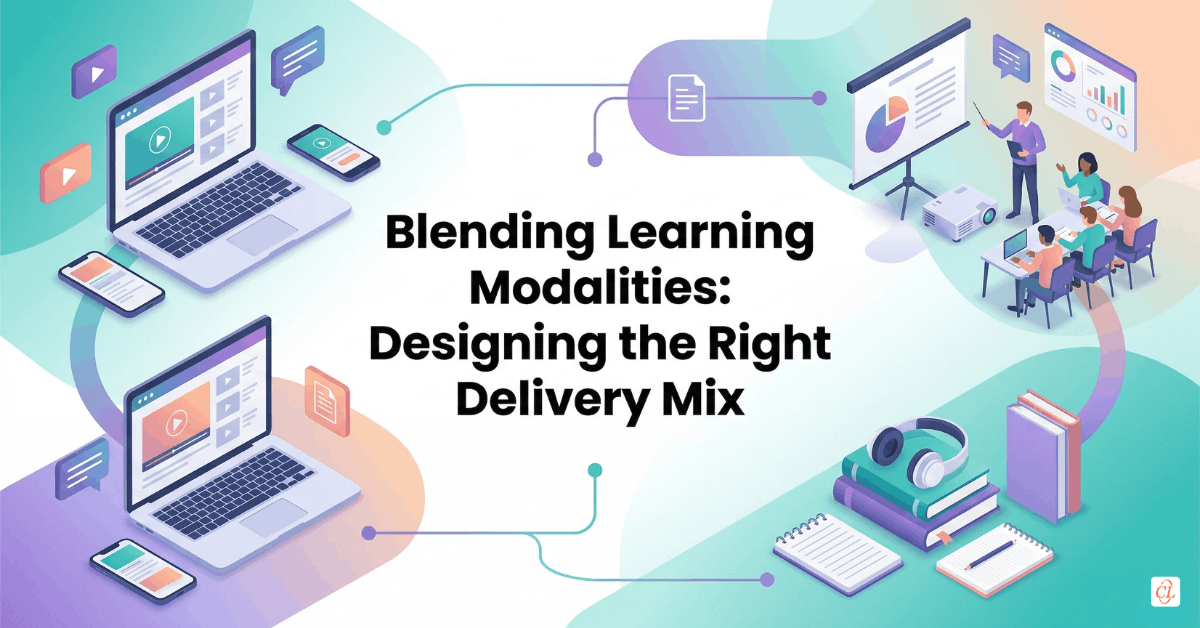
A modern training method is not just a new format or trend. It is a different way of thinking about how learning is designed, delivered, reinforced, and experienced. It recognizes that effective corporate training is rarely built through one format alone. Instead, it is shaped through a learning ecosystem that may include microlearning, video, mobile learning, storytelling, gamification, curation, social contribution, and instructor-led facilitation, all used in ways that match the business need and learner context.
This shift is not about replacing everything that came before. It is about becoming more intentional. Some learning still benefits from live facilitation. Some topics require deep practice. Others need short bursts of reinforcement, searchable resources, or self-driven exploration. The strategic challenge is not choosing a single best modality. It is knowing how to assemble the right mix.
In this article, we will examine how modern corporate training is evolving, what today’s most effective learning methods actually do well, where different formats fit, and how organizations can move from fragmented delivery choices to a more coherent learning design strategy.
Download Play Book: 25 Years of Insights for L&D Leaders
Table of Contents
- What Makes a Learning Method Modern
- The Core Digital Learning Methods Reshaping Corporate Training
- Why Microlearning Has Become a Central Corporate Training Format
- How Video Is Changing the Way Employees Learn
- Gamification, Storytelling, and Experience Design in Workplace Learning
- Why Mobile, Curated, and User-Generated Learning Matter More Now
- The Return of Instructor-Led Learning in a Digital Ecosystem
- How to Choose the Right Training Delivery Formats
- Building a Modern Learning Ecosystem Instead of Isolated Training Assets
- FAQs
What Makes a Learning Method Modern
It is easy to mistake novelty for modernization. A training method is not modern simply because it uses technology, includes animation, or appears more interactive than older formats.
A learning method becomes modern when it reflects the realities of how people work and learn today.
That usually means several things at once. It is accessible across contexts, designed for relevance, capable of supporting different levels of need, and integrated into a broader learning ecosystem rather than functioning as a one-off intervention.
A useful way to think about modernity in corporate learning is through these characteristics:
| Characteristic | What It Looks Like in Practice |
| Context-aware | Learning is designed around role, task, and performance need |
| Flexible | Employees can access learning through multiple formats and at different moments |
| Focused | Content is right-sized instead of overloaded |
| Reinforced | Learning is supported beyond the initial experience |
| Learner-centered | The design reflects how employees consume, apply, and revisit information |
| Scalable | The method can support distributed teams without losing relevance |
| Measurable | Usage, engagement, and effectiveness can be tracked meaningfully |
These characteristics explain why many modern training strategies now combine formats rather than relying on a single primary modality. A workshop may introduce a concept, a short video may demonstrate a task, a microlearning asset may reinforce a key point, and a job aid may support on-the-job application. None of these pieces is sufficient on its own in every situation. Together, they create a more usable learning experience.
This is also why the phrase training delivery formats deserves more strategic attention than it often receives. Delivery is not a packaging decision made after content is written. It is part of the learning strategy itself.
The Core Digital Learning Methods Reshaping Corporate Training
Modern corporate training is increasingly built through a portfolio of digital methods rather than a single dominant format. That shift reflects a more mature understanding of how learning works in the workplace. Employees need different kinds of support depending on the complexity of the topic, the urgency of the need, and the environment in which performance occurs.
Several digital learning methods now play a particularly important role in that ecosystem.
eLearning as a Structured Foundation
eLearning remains important, but its role has changed. It is no longer most useful as a digital replica of classroom instruction. Its real value lies in providing structured, scalable learning for foundational understanding, process clarity, scenario-based judgment, and role-specific knowledge transfer.
Well-designed eLearning works best when the learner needs a coherent, guided experience that can be completed independently and revisited if necessary. It becomes especially powerful when it is concise, clearly structured, and focused on decisions or application rather than static information delivery.
Microlearning for Reinforcement and Quick Uptake
Microlearning has become one of the most visible modern formats because it reflects how many employees actually consume information. It supports quick access, easier repetition, and stronger alignment with short attention windows. Used well, it is not a simplification of learning, but a deliberate way of making certain types of learning more usable.
Video for Demonstration and Recall
Video is now central to many training strategies because it can explain, demonstrate, and humanize information quickly. It is particularly useful when learners need to see a task, hear nuance, observe a scenario, or revisit a process without reading through dense content.
Mobile Learning for Access and Continuity
Mobile learning matters because work is no longer confined to one place or device. For many employees, especially those in frontline, field, sales, and operational roles, mobile access is not a convenience. It is a requirement if learning is expected to reach them consistently.
Curated Learning for Breadth and Relevance
Not every learning need should be solved by creating new content from scratch. Content curation allows organizations to organize, contextualize, and surface relevant internal and external resources for employees who need to explore a topic more broadly or stay current over time.
User-Generated Learning for Real-World Relevance
In many organizations, some of the most valuable knowledge lives informally within teams. User-generated content can help capture practical insights, peer tips, and role-specific know-how that formal training alone may miss. Its strength lies in authenticity and immediacy, especially when supported by governance and quality controls.
These methods are not competitors. They are components of a broader design toolkit. The strategic question is not which one is best overall, but which one fits the learning need best.
Why Microlearning Has Become a Central Corporate Training Format
Few formats have gained as much traction in workplace learning as microlearning, and the reason is not hard to understand. It aligns with two realities that shape modern work: employees are short on time, and learning often needs to happen in smaller, more frequent moments.
That said, microlearning is often misunderstood.
Some organizations view it as a shortcut for reducing effort. Others treat it as the default format for everything. Both assumptions are limiting. Microlearning is most effective when it is used with precision.
At its best, microlearning in corporate training works because it helps organizations do three things well. It reduces friction, increases accessibility, and improves reinforcement. Employees can engage with focused content more easily than with long, overloaded training experiences. They are more likely to revisit a short module, watch a quick video, or use a concise asset at the point of need.
Where Microlearning Works Especially Well
Microlearning is particularly effective when the learning need involves:
- Reinforcement of key concepts
It helps employees revisit important ideas without repeating an entire course. - Task reminders and refreshers
It supports performance when employees need a quick prompt on steps, rules, or best practices. - New product or process updates
It is useful for targeted communication when something changes and employees need focused guidance. - Compliance nudges
It can reinforce critical behavior more effectively than relying solely on annual training events. - Sales enablement and field readiness
It gives teams access to bite-sized knowledge they can consume quickly and apply immediately.
Where Microlearning Is Not Enough
Microlearning is not a substitute for every learning requirement. It is less suitable when employees need deep conceptual understanding, extensive guided practice, or facilitated discussion around complexity and ambiguity. In those situations, microlearning should support the larger architecture rather than replace it.
That is the strategic balance organizations need to strike.
A useful principle is this: microlearning is strongest when the learning objective is narrow, the performance need is immediate, and the content benefits from repetition or quick access.
When used that way, it becomes one of the most practical and scalable formats in modern corporate training.
How Video Is Changing the Way Employees Learn
Video has become one of the most widely used formats in digital learning, but its popularity alone does not explain its strategic value. What makes video so useful in corporate training is its ability to compress explanation, demonstration, tone, and context into a format that is relatively easy for learners to absorb and revisit.
This makes video particularly effective for modern workplaces where employees often need quick clarity rather than lengthy exposition.
A well-designed training video can show how a system works, model a customer interaction, walk through a process, explain a concept visually, or bring subject matter to life in a more engaging way than text alone. That versatility has made video an important part of onboarding, systems training, product knowledge, compliance awareness, leadership messaging, and performance support.
What Good Training Videos Do Well
Effective corporate training videos tend to share a few qualities:
- They are focused
Each video should cover a clear learning purpose rather than trying to do too much. - They are visually intentional
The visual layer should support understanding, not distract from it. - They are concise enough to revisit
Employees are more likely to reuse a short, useful video than a long one with too many objectives. - They are connected to a broader learning journey
The best videos do not stand alone without context. They support an onboarding path, a digital module, a product update, or a performance support system.
Common Mistakes to Avoid
Video can underperform when organizations treat it as a passive information dump. Long talking-head recordings, over-scripted narration, cluttered visuals, and weak alignment with learner needs often reduce effectiveness. Video works best when it is purposeful, not merely polished.
The strategic role of video is therefore not just engagement. It is clarity. It helps employees understand faster, remember better, and revisit information more easily when they need it again.
Gamification, Storytelling, and Experience Design in Workplace Learning
One of the most important evolutions in modern corporate training is the recognition that learning effectiveness depends not only on content accuracy, but also on the quality of the learning experience itself.
This is where methods such as gamification and storytelling become valuable. Not because they make training feel entertaining, but because they make learning more memorable, immersive, and cognitively active when used with purpose.
Gamification as a Motivational Design Tool
Gamification is often misunderstood as a superficial layer of points, badges, and rewards. That narrow interpretation misses its real potential. In workplace learning, gamification is most effective when it strengthens motivation, progression, challenge, and feedback.
Used well, it can:
- create momentum across a learning journey
- encourage repeated engagement
- make progress visible
- reinforce participation in practice-based activities
- support healthy competition or team-based learning where appropriate
Its role is not to distract from learning. It is to help learners stay engaged with meaningful learning behaviors.
Storytelling as a Tool for Relevance and Recall
Storytelling plays a different but equally important role. It helps employees make sense of information by placing it in context. Instead of presenting concepts as abstract rules, storytelling situates them in realistic human situations, decisions, and consequences.
This is particularly valuable in areas such as compliance, leadership, customer experience, safety, and sales training, where judgment matters as much as information.
When learners can see themselves in a scenario, they are more likely to understand not just what a principle is, but why it matters and how it applies.
Experience Design as the Bigger Frame
Gamification and storytelling matter most when they are understood as part of a larger experience design approach. Modern training is no longer just about delivering content in sequence. It is about designing a learner journey that creates attention, relevance, progression, reflection, and application.
That is why experience design should be treated as a strategic discipline in corporate learning, not a decorative afterthought.

Learning Evolved: 25 Years of Insights for Modern L&D Leaders
Get ready to:
- Benchmark your eLearning journey
- Start with what’s working for top enterprise L&D teams
- Explore self-assessments, planners, and other tools
- Much More
Why Mobile, Curated, and User-Generated Learning Matter More Now
As corporate learning ecosystems become more distributed and dynamic, some of the most important training methods are those that extend beyond traditional authored courses. Mobile learning, curated learning, and user-generated content each reflect a broader shift in how knowledge moves through organizations.
Mobile Learning Supports Learning in Motion
Mobile learning has become increasingly important because many employees are not sitting at desks waiting to complete training. They are in stores, on client visits, on factory floors, in transit, or managing fragmented schedules across locations. For these employees, desktop-only training often creates avoidable barriers.
Mobile learning increases access, but its real value lies in continuity. It allows employees to engage with short, useful learning assets at moments that fit their work patterns more naturally.
Curated Learning Expands the Ecosystem
No organization can or should build every piece of content internally. As learning needs grow more complex, curated learning helps L&D teams act less like content factories and more like capability enablers. By selecting, organizing, and contextualizing valuable resources, organizations can support self-driven learning more effectively.
Curation is especially useful when learners need breadth, ongoing exposure, or access to multiple perspectives rather than a single fixed training path.
User-Generated Content Captures Practical Knowledge
Formal training is essential, but it often benefits from proximity to real work. User-generated content helps bring that proximity into the learning ecosystem. It allows employees, managers, and SMEs to contribute practical insights, short demonstrations, examples, and peer advice that formal content may not capture quickly enough.
Of course, user-generated content needs structure. Without review and governance, it can become inconsistent or difficult to trust. But when managed well, it makes learning feel more immediate, grounded, and socially connected.
These methods matter now because organizations are trying to create learning environments that are not only scalable, but also alive to the pace of change inside the business.
The Return of Instructor-Led Learning in a Digital Ecosystem
For a time, many conversations about learning modernization framed instructor-led training as something older methods would gradually replace. In practice, the picture has become far more nuanced.
Instructor-led learning has not disappeared. In many cases, it has become more valuable because organizations now understand where live learning fits best.
The most effective modern training strategies do not position ILT and digital learning as opposites. They treat them as complementary. Live facilitation is particularly useful when learners need discussion, reflection, peer exchange, complex problem-solving, guided practice, or real-time feedback. These are areas where self-paced digital formats may not always be sufficient on their own.
This is why some organizations are seeing a meaningful return of instructor-led approaches, especially in leadership development, change initiatives, collaborative skill-building, and complex training contexts.
Where ILT Still Adds Distinct Value
Instructor-led learning tends to work especially well when the training requires:
- Dialogue and sense-making
- Practice with coaching
- Group discussion around ambiguity
- Peer learning and shared reflection
- Immediate clarification of complex issues
What has changed is not the value of ILT, but the way it is used. In a modern ecosystem, live learning becomes more targeted and purposeful. Instead of being the default for everything, it is reserved for moments where human facilitation genuinely improves the learning outcome.
This shift strengthens both modalities. Digital learning handles scale, access, and reinforcement. Instructor-led learning handles complexity, discussion, and applied sense-making. Together, they form a much more resilient learning strategy.
How to Choose the Right Training Delivery Formats
One of the biggest mistakes organizations make is choosing a delivery format too early, often before they have fully diagnosed the learning need. This usually leads to predictable outcomes. Everything becomes a course, or everything becomes microlearning, or everything is forced into a live session because that is what stakeholders are used to.
A more strategic approach begins by looking at the nature of the performance requirement.
Match the Format to the Need
The table below offers a practical way to think about delivery-fit decisions:
| Learning Need | Best-Fit Formats |
| Foundational understanding | eLearning, guided digital modules, instructor-led introduction |
| Demonstration of a task | video, walkthroughs, screen capture demonstrations |
| Reinforcement and refreshers | microlearning, short videos, quick-reference assets |
| Complex discussion or ambiguity | ILT, VILT, facilitated workshops |
| Practice and decision-making | scenarios, simulations, guided facilitation |
| Self-driven exploration | curated resources, knowledge hubs, digital libraries |
| Peer insight and practical tips | user-generated content, discussion spaces, SME contributions |
This kind of matching helps organizations avoid overusing a single format simply because it is familiar or easy to deploy.
A Few Strategic Questions to Ask
Before selecting a delivery format, it helps to ask:
- Is this primarily about knowledge, skill, judgment, or reinforcement?
- How quickly does the learner need to use it?
- How complex is the performance context?
- Does the learner need guided practice or quick access?
- Is discussion important?
- Will this need to be revisited often?
These questions improve format decisions because they move the conversation away from habit and toward design logic.
Building a Modern Learning Ecosystem Instead of Isolated Training Assets
The most important shift in modern corporate training is not the rise of any one format. It is the move from isolated learning assets to a connected learning ecosystem.
This matters because workplace capability rarely develops through a single exposure. Employees often need a sequence of support. They may need a structured introduction, followed by demonstration, followed by practice, followed by reinforcement, followed by quick support in the workflow. If the learning ecosystem only provides one of those elements, performance improvement is likely to be partial.
A modern ecosystem therefore brings together multiple modalities with clear intent.
An onboarding journey, for example, might include structured eLearning for foundational understanding, short videos for process demonstrations, manager check-ins for alignment, microlearning for reinforcement, and searchable resources for day-to-day recall. A sales enablement initiative might combine product modules, customer scenario practice, peer-recorded tips, and mobile refreshers before key conversations. A compliance strategy might use scenario-based learning, short policy nudges, manager communication, and role-based examples rather than relying entirely on annual certification.
This is where modern corporate training becomes more than a set of formats. It becomes a design system for capability-building.
Signs of a More Mature Learning Ecosystem
Organizations are moving in the right direction when:
- Different training formats are used intentionally rather than interchangeably
- Learning is reinforced beyond the initial event
- Employees can access resources at the moment of need
- Digital and live methods complement each other
- Content creation is balanced with curation and contribution
- Training experiences are tied to role and context
- Delivery choices are driven by performance logic
The future of corporate training is not format-led. It is ecosystem-led.
That is the shift organizations now need to make.
FAQs
1. What are modern corporate training methods?
A. Modern corporate training methods are learning approaches designed for today’s workplace realities. They include digital formats such as eLearning, microlearning, video, mobile learning, curated resources, gamification, storytelling, and blended delivery, all used to improve relevance, accessibility, and on-the-job application.
2. Why are training delivery formats important?
A. Training delivery formats matter because they shape how easily employees can access, understand, and apply learning. The right format improves usability and performance support, while the wrong one can make even strong content harder to use effectively.
3. How is microlearning used in corporate training?
A. Microlearning is used for short, focused learning needs such as refreshers, reminders, updates, compliance nudges, and quick performance support. It works best when the objective is narrow and the learner needs fast, repeatable access to content.
4. Is video effective for corporate training?
A. Yes, video is highly effective when it is focused and well-designed. It is especially useful for demonstrations, process explanations, scenario modeling, and quick review because it combines visual and verbal information in a format employees can revisit easily.
5. Does instructor-led training still matter in modern learning?
A. Yes. Instructor-led training still matters when learners need discussion, facilitated reflection, guided practice, real-time feedback, or collaborative problem-solving. In modern learning ecosystems, it works best alongside digital methods rather than in opposition to them.
6. What is the role of gamification in workplace learning?
A. Gamification helps strengthen motivation, progression, and engagement when used purposefully. It is most effective when it supports meaningful learning behaviors rather than adding superficial game elements that distract from the objective.
7. How do you choose the right learning method?
A. The right learning method depends on the performance need, complexity of the topic, urgency of use, need for practice, and learner context. Effective decisions come from matching the format to the goal rather than defaulting to one preferred modality.
Conclusion
Modern corporate training is no longer defined by whether it happens in a classroom, inside an LMS, or through a mobile device.
It is defined by whether it helps employees learn in ways that are useful, timely, and connected to performance.
That is why the future of workplace learning does not belong to a single format. It belongs to organizations that know how to combine methods intelligently. They know when to use structured eLearning, when to shorten the experience into microlearning, when to rely on video for demonstration, when to use storytelling for context, when to invite peer contribution, and when live facilitation adds real value.
In other words, they stop thinking in terms of isolated training assets and start thinking in terms of learning ecosystems.
That is where modern corporate training methods become genuinely powerful. Not as separate trends, but as parts of a more coherent strategy for building capability in the flow of work.