Blended learning is often described as a combination of classroom and digital training, but that description only captures the surface. The real challenge is not simply mixing formats. It is deciding how different learning modalities should work together to create a training experience that is coherent, useful, and aligned with workplace performance.
That distinction matters because most training problems are not content problems. Organizations usually have enough content. What they often lack is a clear delivery logic. Too much classroom learning can create scheduling pressure and passive participation. Too much self-paced learning can weaken engagement and reduce accountability. Microlearning can become fragmented when it is added without structure. Mobile learning can feel disconnected when it is treated as a convenience feature rather than a strategic delivery layer.
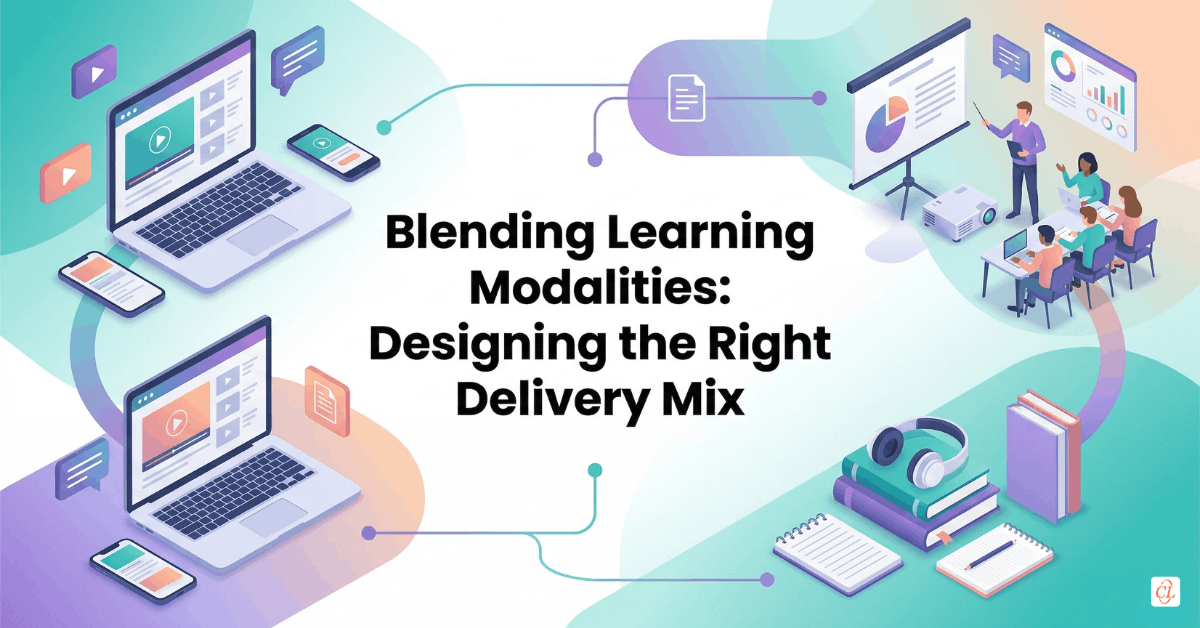
This is why modality design matters so much in blended learning. Every learning modality brings a different instructional strength. Instructor-led training creates space for discussion, interpretation, and feedback. eLearning offers structure, consistency, and scale. Microlearning supports reinforcement and recall. Mobile learning extends access into the flow of work. Video makes complex ideas easier to absorb. Assessments and analytics help measure whether the learning is actually working.
When these modalities are combined with intention, blended learning becomes far more than a delivery model. It becomes a way to design learning around how people absorb information, practice skills, revisit concepts, and apply knowledge in real-world situations.
This article explores how to create that delivery mix with more precision. It examines where each modality fits best, how they should complement one another, and how learning teams can move from simply “blending formats” to building more effective learning architectures.
Download eBook: eLearning 101 - A Beginner’s Guide
Table of Contents
- What learning modalities mean in blended learning
- Blending instructor-led training and eLearning
- Integrating microlearning into the learning mix
- Using mobile learning as a delivery layer
- Blending video with classroom and digital learning
- Structuring online activities within blended learning
- Measuring effectiveness through assessments and analytics
- Designing the right modality mix
- FAQs
What Learning Modalities Mean in Blended Learning
Blended learning works best when it is treated as a design system rather than a format combination. At the center of that system is the concept of learning modalities.
A learning modality is simply the way learning is delivered and experienced. In workplace training, this may include instructor-led sessions, self-paced eLearning, virtual workshops, short mobile modules, videos, discussion-based activities, assessments, and performance support tools. The effectiveness of blended learning depends on how these modalities are selected, sequenced, and connected.
What makes this important is that no single modality can do everything well. A live session may be excellent for discussion and coaching, but inefficient for basic knowledge transfer. A digital module may be ideal for foundational understanding, but insufficient for behavioral practice. A microlearning asset may be useful for reinforcement, but too narrow to build a complete skill set on its own.
That is why the question is never, “Which modality is best?”
The better question is, “Which modality is best for this learning moment?”
Learning modalities in blended learning are the different methods used to deliver, reinforce, and support learning across a structured training experience.
Why this matters in practice
When modalities are chosen without clear purpose, training becomes cluttered. Learners may be asked to complete content in multiple formats without understanding why each piece exists. But when modalities are assigned based on what they do best, the learning journey becomes clearer, more efficient, and more effective.
A strong blended learning strategy, therefore, does not begin with tools. It begins with instructional intent.
Blending Instructor-Led Training and eLearning
Instructor-led training and eLearning remain the most common and foundational blend in workplace learning. Yet many organizations still use them in ways that create duplication rather than complementarity.
The goal is not to split training into “some online, some classroom.” The goal is to decide what belongs where based on the nature of the learning task.
Where instructor-led training adds the most value
Instructor-led training is most useful when learners need to think aloud, challenge assumptions, ask questions, practice with feedback, or interpret complexity in real time.
This makes it particularly valuable for situations such as:
- discussion-heavy learning, where learners benefit from hearing different perspectives
- coaching-led skill development, where feedback and correction matter
- behavioral or judgment-based topics, where nuance is important
- guided practice, where learners need support while applying concepts
ILT works best when the value lies in interaction, not information transfer.
Where eLearning creates stronger efficiency
eLearning is most effective when learners need structured, repeatable, and accessible learning that can happen without an instructor present.
It is especially useful for:
- foundational knowledge, which learners can absorb independently
- pre-session preparation, which helps learners arrive better prepared
- standardized content, which needs consistency across audiences
- post-training reinforcement, which keeps key ideas visible after live learning
This is where many training teams can unlock efficiency. If foundational knowledge is moved into well-designed digital learning, instructor time can be reserved for the parts of learning that actually require human interaction.
A practical way to divide the work
The most effective ILT and eLearning blend often looks like this:
| Learning Stage | Best-Fit Modality | Why It Works |
| Pre-learning | eLearning | Builds baseline knowledge before live interaction |
| Core learning | ILT / virtual session | Enables discussion, practice, and guided application |
| Reinforcement | eLearning / microlearning | Helps learners retain and revisit key concepts |
This structure works because it respects the strengths of both modalities rather than forcing either one to do everything.
Blending ILT and eLearning works best when digital learning handles foundational knowledge and live sessions focus on application, practice, and feedback.
Integrating Microlearning into the Learning Mix
Microlearning has become one of the most frequently used elements in blended learning, but it is also one of the most misunderstood.
It is often treated as a standalone strategy when it is actually most powerful as a supporting modality. Microlearning does not replace structured learning. It strengthens it.
The value of microlearning lies in its precision. It allows learners to revisit one concept, one task, one scenario, or one reminder at the moment they need it. That makes it especially useful after formal training, when the challenge shifts from exposure to retention and application.
Where microlearning fits naturally
Microlearning works particularly well when learners need:
- short refreshers, after a workshop or eLearning course
- spaced reinforcement, to reduce forgetting over time
- quick practice opportunities, focused on one concept or scenario
- just-in-time access, before performing a task or entering a meeting
This is why microlearning is so effective in blended learning. It extends the learning journey without overloading the learner.
How to use it without making learning feel fragmented
One of the biggest mistakes in blended learning is adding microlearning assets without connecting them to the larger learning experience. When that happens, learners receive a series of disconnected snippets that feel useful in isolation but weak as a system.
Microlearning works best when it is intentionally placed into the journey.
For example:
- after a live workshop, use short scenario-based practice modules
- after eLearning, deliver short recall prompts or decision-based questions
- before a task, provide a focused mobile refresher
- during reinforcement cycles, release one key reminder at a time
Microlearning should not be seen as “smaller content.” It should be seen as targeted reinforcement architecture.
Microlearning in blended learning is most effective when it is used for reinforcement, recall, and just-in-time support rather than as a standalone replacement for structured learning.
Using Mobile Learning as a Delivery Layer
Mobile learning is often positioned as a convenience feature, but in a strong blended learning design, it should be treated as a delivery layer that expands access and relevance.
Its value is especially visible in modern work environments where employees are not always at desks, do not always have long uninterrupted learning windows, and often need information at the point of action rather than at the point of instruction.
That is why mobile learning is not just about device compatibility. It is about situational usefulness.
Where mobile learning creates the most value
Mobile learning is especially useful when employees need to:
- access short learning moments between tasks
- review information before field interactions
- revisit a process while working
- consume reinforcement content in small time windows
- stay connected to training outside formal sessions
This makes it particularly relevant for sales teams, field workers, frontline employees, technicians, service professionals, and distributed workforces.
What makes mobile learning effective
Mobile learning only works well when the content is designed for the mobile context. Simply shrinking desktop learning onto a smaller screen is not enough.
Strong mobile learning should be:
- short and focused, so it fits into real work rhythms
- easy to navigate, without unnecessary clicks or complexity
- visually clear, with clean layouts and readable text
- task-relevant, so learners can apply it quickly
When mobile learning is blended effectively, it changes the location of learning. It moves learning from scheduled environments into the flow of work, where reinforcement and performance support often matter most.
Blending mobile learning into training helps learners access the right knowledge in the right moment, especially when they are away from formal learning environments.
eLearning 101 - A Beginner’s Guide to Understanding All About eLearning!
What you will learn
- What is eLearning?
- The advantages of eLearning
- The impact of eLearning on businesses
- and more!
Blending Video with Classroom and Digital Learning
Video has become one of the most flexible and widely used learning modalities, but its effectiveness depends far less on volume and far more on placement.
In many training programs, videos are added because they are engaging in theory. In practice, long or poorly placed videos often create passive consumption rather than meaningful learning. The real value of video lies in its ability to clarify, demonstrate, and contextualize.
Where video is most useful
Video works especially well when learners need to:
- see a process demonstrated visually
- understand a concept through storytelling
- observe behavior or decision-making in context
- hear from experts or leaders directly
- engage with short, focused explanations before or after formal learning
This makes video highly useful across both classroom and digital learning experiences.
How to blend video more effectively
Rather than treating video as a self-contained learning event, it is often more effective to use it as a connector modality across the learning journey.
For example:
- before a classroom session, use a short video to activate interest or provide context
- during eLearning, embed short videos to illustrate concepts or decisions
- after formal training, use video snippets to reinforce or model correct performance
Video becomes far more powerful when it is used to reduce abstraction. It can make a process visible, make a concept more concrete, or make a scenario feel more realistic. That is especially important in blended learning, where different modalities need to reinforce one another rather than operate in silos.
Blending videos with classroom and digital learning is most effective when video is used to demonstrate, contextualize, and reinforce rather than simply present information.
Structuring Online Activities Within Blended Learning
One of the most underused elements in blended learning is the role of online activities. Many training programs include digital content and live sessions, but leave the space between them under-designed.
That is a missed opportunity because the learning journey often becomes stronger in those in-between moments.
Online activities help create continuity. They keep learners mentally engaged before, between, and after formal training sessions. More importantly, they allow learning to remain active rather than passive.
Types of online activities that work well
Online activities can take many forms, depending on the training goal:
- discussion prompts, to encourage reflection or peer exchange
- short quizzes, to reinforce recall and understanding
- scenario-based decisions, to test judgment
- collaborative tasks, to encourage application and discussion
- reflection prompts, to help learners process and personalize learning
These activities are valuable because they shift learners from simply consuming content to doing something with it. That small shift often makes a significant difference in retention and transfer.
Where to place them
Online activities can support different stages of the learning journey:
| Learning Phase | Online Activity Type | Purpose |
| Before training | short quiz / reflection prompt | activates prior knowledge and curiosity |
| During training | collaborative task / scenario | deepens engagement and interpretation |
| After training | recall prompt / decision activity | reinforces learning and supports transfer |
When designed well, these activities make the learning journey feel connected rather than episodic.
Online activities in blended learning help sustain engagement by keeping learners active between formal training moments.
Measuring Effectiveness Through Assessments and Analytics
One of the biggest advantages of blended learning is that it creates multiple learning touchpoints. One of its biggest risks is that those touchpoints can become difficult to evaluate if measurement is too narrow.
Too often, learning teams measure blended learning through completion alone. That is not enough. If a blended program includes digital learning, live sessions, reinforcement assets, and online activities, then measurement should reflect the richness of that experience.
Assessments should do more than confirm recall
Assessments in blended learning should be designed to evaluate different kinds of learning, not just memory.
A stronger assessment strategy may include:
- knowledge checks, to confirm understanding of key concepts
- scenario-based questions, to test judgment and application
- practice tasks, to evaluate performance readiness
- post-training reinforcement assessments, to measure retention over time
This matters because different modalities often serve different learning functions. Measurement should reflect that distinction.
The role of analytics
Analytics help learning teams understand not just whether learners completed the training, but how they moved through it.
Useful analytics may include:
- completion patterns
- assessment performance
- engagement across modalities
- drop-off points in the learning journey
- repeated access to specific assets or modules
This kind of visibility is especially valuable because it helps identify whether the modality mix is working as intended.
In blended learning, analytics should not just validate the program after it is complete. They should help refine the design itself.
Blended learning should be measured through assessments and engagement analytics that show not just completion, but how well different modalities are supporting learning and application.
Designing the Right Modality Mix
The most important question in blended learning is not, “Which modalities should we use?”
It is, “What kind of learning conditions does this performance outcome require?”
That is the shift that separates a blended program from a well-designed blended program.
When training teams begin with that question, modality decisions become much clearer.
Start with the learning need, not the tool
A useful way to think about the modality mix is to match the type of learning need to the kind of experience that supports it best.
| Learning Need | Strongest Modality Fit |
| Foundational understanding | eLearning |
| Interpretation and discussion | ILT / virtual sessions |
| Practice and application | scenarios, simulations, guided activities |
| Reinforcement and retention | microlearning |
| On-the-job support | mobile learning, job aids |
| Demonstration and modeling | video |
This does not mean each learning need must be assigned only one modality. It means each modality should have a clear instructional role.
A simple decision lens
Before selecting a modality, ask:
- Does the learner need to know something?
- Do they need to practice something?
- Do they need to discuss or interpret something?
- Do they need to remember it later?
- Do they need to use it while working?
Those five questions often reveal the right delivery mix more effectively than any tool-first discussion.
The strongest modality mix is not the one with the most variety. It is the one with the clearest logic.
The right learning modality mix is built by aligning each modality with a distinct learning need such as knowledge, practice, reinforcement, or workplace application.
FAQs
1. What does it mean to blend ILT and eLearning?
A. Blending ILT and eLearning means using digital learning for foundational knowledge and instructor-led sessions for discussion, practice, and guided application. This creates a more efficient and engaging learning experience.
2. How is microlearning used in blended learning?
A. Microlearning is used to reinforce learning after formal instruction. It works best for refreshers, spaced reinforcement, quick practice, and just-in-time support rather than as a complete standalone training format.
3. Why is mobile learning important in blended learning?
A. Mobile learning extends access to training beyond formal learning environments. It allows learners to revisit knowledge, access support, and reinforce learning in short moments during the workday.
4. How can videos be used in blended learning?
A. Videos can be used to demonstrate processes, explain concepts, tell stories, and reinforce learning. They are most effective when used as short, targeted assets within a broader learning journey.
5. How do you measure blended learning effectiveness?
A. Blended learning effectiveness should be measured through assessments, learner engagement, completion trends, reinforcement activity, and performance indicators that show how well learning is being retained and applied.
6. What is the biggest mistake in blending learning modalities?
A. The biggest mistake is using multiple modalities without assigning each one a clear purpose. A strong blended learning design ensures every modality supports a specific learning need.
Conclusion
If learning teams want blended learning to produce stronger outcomes, they need to move beyond simply assembling formats and start designing with greater intentionality.
A useful next step is to create a modality mapping framework for each training initiative. This does not need to be complicated. It can begin with a simple working document that lists the core learning objectives, identifies where learners need instruction, interaction, practice, reinforcement, and support, and then maps the most suitable modality to each of those moments.
That exercise alone can significantly improve design quality because it forces clarity. It prevents content duplication, reduces unnecessary classroom time, and helps teams use digital modalities more strategically rather than reactively.
Over time, this approach becomes more than a one-off design tactic. It becomes a repeatable capability. And that is where the real value lies. When organizations learn how to design the right delivery mix consistently, they are no longer just creating blended learning programs. They are building a more mature learning system that can adapt across audiences, topics, and business needs.