Human-Centered AI in L&D: A Conversation with Jeff Hrusko
Know Who’s Talking
Jeff Hrusko
Jeff Hrusko is a seasoned Learning & Development leader with over 15 years of experience building high-impact learning functions. Former Chief Product Officer at MaxLearn and founder of Compliance Creed, Jeff brings deep expertise in human-centered learning, compliance training, AI in L&D, and designing training that drives real behavior change and business results.

Welcome to CommLab India's eLearning Champion Podcast featuring Jeff Hrusko, Learning & Development Leader, former Chief Product Officer at MaxLearn, and founder of Compliance Creed.
In this episode, RK Prasad and Jeff explore one of the most important questions facing Learning & Development today: How can organizations embrace AI while keeping learning fundamentally human?
Their conversation covers instructional design, AI-assisted content creation, learner engagement, SME-driven training, ethical AI use, and why the future of L&D may belong to professionals who know how to ask better questions.
Click Here To Read Transcript
00:00:10 RK Prasad
Today's episode is titled Human Centered AI in L&D Building training that people actually use and remember.
00:00:11 RK Prasad
Welcome to the e Learning Champion podcast.
00:00:14 RK Prasad
I'm delighted to have Jeff Ruscoe with us today.
00:00:17 RK Prasad
Jeff is a seasoned L&D leader with over 15 years of experience building high impact learning functions in major organizations, including Prudential Financial and Pioneer.
00:00:30 RK Prasad
He also served as the chief product officer at the microlearning platform company MaxLearn and is the founder of the Compliance Creed.
00:00:40 RK Prasad
Jeff is known for his deeply human centered philosophy.
00:00:44 RK Prasad
People don't fail to learn because they lack intelligence.
00:00:48 RK Prasad
They fail because training forget forgets that they are human.
00:00:53 RK Prasad
In this conversation, we will explore how to combine.
00:00:57 RK Prasad
Powerful AI tools with truly human first designed to create learning that drives real behavioral change and measurable business results.
00:01:10 RK Prasad
Jeff, a warm welcome to the show.
00:01:14 RK Prasad
Thank you, RK.
00:01:15 Jeff Hrusko
Thank you so much.
00:01:17 Jeff Hrusko
Yeah, thank you and thank you so much for inviting me.
00:01:22 RK Prasad
No, it's the privilege is all ours because.
00:01:26 RK Prasad
For all the years, I know you that your philosophy of training and your philosophy of measuring results have deeply like influenced my own thinking on those lines.
00:01:46 RK Prasad
And I also had the pleasure of working with you during the developing of the product of Max Learn so I could.
00:01:57 RK Prasad
Experience first hand the depth of your knowledge.
00:02:00 RK Prasad
So as an introductory question, I would like to ask you, Jeff, you have a very clear philosophy as far as learning is concerned.
00:02:15 RK Prasad
People don't fail to learn because they lack intelligence, they fail to learn because training forgets they are human.
00:02:21 RK Prasad
What experiences across your career led you to this belief?
00:02:26 RK Prasad
And how has it shaped the way you design and lead learning programs?
00:02:32 Jeff Hrusko
Sure.
00:02:32 Jeff Hrusko
And I think we've all been there, even as a child, if you were in the back of the room and in algebra, and if that wasn't your thing, like and you had an instructor or a teacher that was just kind of going through the motions, all of us sort of know what bad training looks like.
00:02:55 Jeff Hrusko
And luckily, the fundamentals of good training or good education don't change.
00:03:01 Jeff Hrusko
The fundamentals are have been there from the beginning.
00:03:05 Jeff Hrusko
What we need to know now is how to apply them more in this new world.
00:03:10 Jeff Hrusko
But when you really see, I remember a textbook case early in my career.
00:03:18 Jeff Hrusko
It was a very interesting topic, which I totally forgot.
00:03:21 Jeff Hrusko
But at the time, I remember thinking it was an interesting topic.
00:03:24 Jeff Hrusko
I was in Booz Allen Hamilton, this consultancy, this world leading expert was came to talk about this very interesting topic, which I don't remember.
00:03:34 Jeff Hrusko
And the reason I don't remember is he came in with a stack like this of PowerPoints printed out.
00:03:42 Jeff Hrusko
On the screen, he showed and I think a lot of us have been here the same PowerPoints and the PowerPoints were like Dostoevsky or War and Peace, heavy text just and he was going through.
00:03:58 Jeff Hrusko
And I remember looking at reading, not looking at us, reading it.
00:04:01 Jeff Hrusko
You could imagine.
00:04:02 Jeff Hrusko
I mean, even now it's like, I don't even want to hear the story.
00:04:04 Jeff Hrusko
The story is boring.
00:04:06 Jeff Hrusko
The training was worse and it was a topic again.
00:04:08 Jeff Hrusko
So and I remember watching.
00:04:11 Jeff Hrusko
Again, this guy turning the page and all my colleagues are there and some of the senior managers are there and all these bigwigs are there.
00:04:19 Jeff Hrusko
And I watched them slip away as a guy picking up there.
00:04:26 Jeff Hrusko
This is in the day of BlackBerry walk out.
00:04:32 Jeff Hrusko
Again, it was like me and 2 other junior people and the fellow finally.
00:04:36 Jeff Hrusko
And I felt so bad for this guy, but I felt worse for us.
00:04:40 Jeff Hrusko
So that's an extreme example, but especially with a lot of either compliance or regulatory choired training, people forget that humans need to take this.
00:04:57 Jeff Hrusko
And I call this one trouble that people get in the terms and conditions.
00:05:03 Jeff Hrusko
Ply meaning if you ever saw the Apple terms, just pick on Apple on anybody, but like the Apple terms and conditions and everywhere now you click on something, it gives you 5 pages and then at the bottom you say I have read everything.
00:05:19 Jeff Hrusko
This is wonder, wonderful.
00:05:20 Jeff Hrusko
I understand it.
00:05:21 Jeff Hrusko
Just let me move on with my life again because right we are for.
00:05:26 Jeff Hrusko
It is not built for people.
00:05:29 Jeff Hrusko
It is built for.
00:05:30 Jeff Hrusko
Lawyers, it's built for cover your butts, it's not built for human consumption.
00:05:37 Jeff Hrusko
So that's always been one of the fundamental philosophies of mine.
00:05:45 Jeff Hrusko
Remember, people have to take this, right?
00:05:49 Jeff Hrusko
And then along with that is respecting their time and.
00:05:54 Jeff Hrusko
And this is and all the trainers out there will probably hear or remember of the WIFM, what's in it for me?
00:06:03 Jeff Hrusko
And along those lines, one of the first things you need to do is tell people what is the value of taking this?
00:06:11 Jeff Hrusko
What is the outcome you should expect from this learning?
00:06:15 Jeff Hrusko
So you kind of make them a promise there.
00:06:18 Jeff Hrusko
The promise is I'm going to respect your time.
00:06:21 Jeff Hrusko
You're going to learn something, you're going to be able to apply this to something in your job that will help you help the company.
00:06:30 Jeff Hrusko
And then you have to follow through on that promise at the end, so they can say, oh, this happened.
00:06:37 Jeff Hrusko
So it's very kind of simple.
00:06:40 Jeff Hrusko
Always remember that a person's taking this.
00:06:43 Jeff Hrusko
When I was a fancy free in college, I took a creative writing class and.
00:06:51 Jeff Hrusko
College writing is the worst high school, you know, everybody thinks they're these great writers and you're putting all this flourish in there.
00:07:00 Jeff Hrusko
And I remember the professor, who I love, said you need to kill your darlings.
00:07:07 Jeff Hrusko
I love my darlings.
00:07:09 Jeff Hrusko
And the darlings are any of that flourish.
00:07:12 Jeff Hrusko
Any of anything in the story that doesn't support the story, that doesn't support the learning.
00:07:19 Jeff Hrusko
So those.
00:07:20 Jeff Hrusko
Coming with that mindset of what value am I offering?
00:07:25 Jeff Hrusko
Cutting out anything that doesn't support that value, support that outcome.
00:07:31 Jeff Hrusko
And then the 3rd element to it is active.
00:07:35 Jeff Hrusko
And that's where the actual instructional design comes in.
00:07:39 Jeff Hrusko
This is all just the price of admission.
00:07:41 Jeff Hrusko
And when you get to the instructional designs, like how do you chunk out this information, how do you build upon this information, how do you make it an active learning experience so they can make new neural connections no matter what this is, if you teach them how to apply it and learn from them too.
00:08:04 Jeff Hrusko
So that's it in a nutshell.
00:08:06 Jeff Hrusko
My rule number one, I shorten it to don't punish the user.
00:08:10 RK Prasad
Right.
00:08:12 RK Prasad
Yes, as you said, I personally have gone through such experiences as you did.
00:08:20 RK Prasad
And I do share your philosophy that we forget the human being and we try to cater to some other audience for some other purpose.
00:08:34 RK Prasad
I want to ask a related question.
00:08:38 RK Prasad
That as L&D professionals, at least theoretically, we should all be sharing this philosophy, right?
00:08:49 RK Prasad
Because we do know, if not in depth, at least the fundamentals of learning theory, what makes learning effective, your stuff like motivation and stimulus.
00:09:03 RK Prasad
and.
00:09:04 RK Prasad
Adult learning principles and all this these studies.
00:09:13 RK Prasad
One thing is that most of these instructional designers and L&D managers they seem to have forgotten the basic philosophy.
00:09:25 RK Prasad
But I am not very bothered there.
00:09:27 RK Prasad
I want to ask you that in most of the classroom training which happens in corporates.
00:09:34 RK Prasad
Is hived off to the so called subject matter experts, right?
00:09:40 Jeff Hrusko
What?
00:09:40 Jeff Hrusko
I'm sorry.
00:09:42 RK Prasad
Subject matter experts, subject matter experts, the SMEs as they are called.
00:09:48 RK Prasad
Now these guys are experts in their own domains.
00:09:52 RK Prasad
Maybe engineering, maybe sales, maybe whatever.
00:09:57 RK Prasad
And they come with a ton of knowledge with absolutely zero concept of how learning takes place.
00:10:07 RK Prasad
So do you think that, do you think corporates are missing a very large point there and they are equating a presentation to a training?
00:10:26 RK Prasad
And just forgetting about the objective.
00:10:31 RK Prasad
What do you think about that?
00:10:33 Jeff Hrusko
Absolutely.
00:10:34 Jeff Hrusko
Well, a couple different things to unpack there.
00:10:36 Jeff Hrusko
And one thing before I answer this is any instructional designer or a training development leader that's worth their soul knows these things, right?
00:10:47 Jeff Hrusko
We're talking about mom and apple pie and everything.
00:10:50 Jeff Hrusko
I think what happens is.
00:10:53 Jeff Hrusko
Sometimes it is a struggle because the client, internal or external, has a vision of what they want.
00:11:01 Jeff Hrusko
So we need training for this and it needs to have this caboose and this, and this, this.
00:11:07 Jeff Hrusko
So one of the tougher things to learn is to be able to work with your internal or external customer and sometimes not give them what they want as they first envision it.
00:11:23 Jeff Hrusko
And it's a tough thing.
00:11:25 Jeff Hrusko
And with that, what you want to do or what I find is building trust first.
00:11:34 Jeff Hrusko
Listen and don't say no, this is not a training thing.
00:11:36 Jeff Hrusko
Now listen.
00:11:37 Jeff Hrusko
Ah, OK, so you want to have this training on this process and you want to get OK, tell me more about that.
00:11:47 Jeff Hrusko
What problem are we trying to solve?
00:11:51 Jeff Hrusko
That's a good question to ask.
00:11:52 Jeff Hrusko
It always is, because it makes you and then think.
00:11:55 Jeff Hrusko
And it's not a question of like, no, you're saying, what are we trying to solve here?
00:12:00 Jeff Hrusko
OK, we're all trying to solve, you know, the statistics on this process now are out of whack.
00:12:07 Jeff Hrusko
OK.
00:12:08 Jeff Hrusko
And then you can go further into that and you could find what the underlying problem is and then with them build a solution that fits.
00:12:16 Jeff Hrusko
which may or may not be training, because like I said, they're not a training professional, but you never say, hey, you're not a training professional, listen to me.
00:12:25 Jeff Hrusko
No, you have to pull their wisdom.
00:12:28 Jeff Hrusko
They know the process.
00:12:29 Jeff Hrusko
And then that transitions into an SMA too, which this happens, like you rightly pointed out a lot.
00:12:37 Jeff Hrusko
And that happened in that example that I told you about, uh, in uh, was on a long time ago.
00:12:44 Jeff Hrusko
This guy was.
00:12:46 Jeff Hrusko
Sure, the world's greatest expert on this topic, which I don't remember.
00:12:52 RK Prasad
That shows that how effective the presentation was.
00:12:55 Jeff Hrusko
Exactly, exactly.
00:12:56 Jeff Hrusko
You only remember how bad it was.
00:12:59 Jeff Hrusko
And there's a couple key things in here.
00:13:02 Jeff Hrusko
One is sometimes it's important to have a facilitator who is an instructional designer, who actually is a trainer.
00:13:13 Jeff Hrusko
Right.
00:13:14 Jeff Hrusko
And this way you can use the SME as a resource there.
00:13:20 Jeff Hrusko
Like why make somebody do something that is not in their wheelhouse, right?
00:13:26 Jeff Hrusko
So you have 2 things.
00:13:27 Jeff Hrusko
One, you could either get them there by doing a train the trainer session, but you have to do it very respectively, respectfully, understanding their wisdom, their journey and what they're trying to convey.
00:13:41 Jeff Hrusko
But most times, in fact, a good example of this is teaching something highly technical like project management for, say, like an engineering firm.
00:13:51 Jeff Hrusko
And you have some of these smartest people you could imagine, right, who aren't great communicators.
00:13:59 Jeff Hrusko
And they don't want to be necessarily.
00:14:01 Jeff Hrusko
And like that poor fellow who is just sitting there reading his PowerPoints one after another, he didn't want to do that.
00:14:10 Jeff Hrusko
We didn't want to listen to that.
00:14:11 Jeff Hrusko
Now, imagine if you had somebody that helped him, right, that put 3 bullet points on the board and was able to chunk that information and be able to call on him.
00:14:25 Jeff Hrusko
Right, for the heavy lifting, for the technical details, for the application part of it, that's your winning thing.
00:14:32 Jeff Hrusko
That's what that particular person would want.
00:14:34 Jeff Hrusko
That's what you want, and that's what the audience wants.
00:14:37 RK Prasad
So I think that's a fantastic idea.
00:14:40 RK Prasad
That's a fantastic idea.
00:14:42 RK Prasad
You're talking about some kind of conversation which goes on between the facilitator and the SME.
00:14:53 RK Prasad
and.
00:14:54 RK Prasad
There will be clarification on both sides.
00:14:56 RK Prasad
Is that what you're meaning?
00:15:00 Jeff Hrusko
That model can work, yes, definitely.
00:15:05 Jeff Hrusko
Where you're using them as a resource, the facilitator is doing just that, facilitating the session, bringing the SME in when they're ready.
00:15:16 Jeff Hrusko
and when they're needed.
00:15:17 Jeff Hrusko
An important part of all this though, and this is highly recommended, of course, you know this too, but do one or 2 dry runs, especially if you're with somebody who's not a natural presenter, right?
00:15:33 Jeff Hrusko
And might be nervous on that.
00:15:34 Jeff Hrusko
And something that I've found, especially working with people like that, don't stress on the ums and ahs.
00:15:43 Jeff Hrusko
Right?
00:15:43 Jeff Hrusko
Because a lot of people will, when you take a, it's important, but like a public speaking thing, they'll get on somebody and they'll just make the person nervous.
00:15:53 Jeff Hrusko
No, have a rhythm with them when they came in.
00:15:57 Jeff Hrusko
They need to know what to expect, what is expected of them, and let them know that you are there sort of as a.
00:16:06 Jeff Hrusko
Also like a safety net to drive the conversation, tell them what to expect.
00:16:11 Jeff Hrusko
And then it's amazing, you can get these people who have vastly different social styles to communicate effectively with their audience, right?
00:16:24 RK Prasad
Yeah, I think I don't, I didn't see, as a matter of fact, I never seen this kind of hybrid.
00:16:33 RK Prasad
I would say that there is.
00:16:36 RK Prasad
A facilitator or a learning expert along with the speech SME when it comes to classroom training.
00:16:45 RK Prasad
But I think it is an idea what you know, considering and for us to spread across that may solve a lot of problems because sometimes train the trainer may not be very welcome in some companies.
00:17:02 RK Prasad
They will say what is that which I give?
00:17:05 RK Prasad
10,000 presentations.
00:17:06 RK Prasad
So what is that you are going to teach that resistance may come?
00:17:10 RK Prasad
But anyway, just a small little side question.
00:17:14 RK Prasad
See, lets say a guy goes to a surgeon and the surgeon says that you have to undergo a procedure.
00:17:30 RK Prasad
The patient will not question him.
00:17:35 RK Prasad
He will not debate right now.
00:17:40 RK Prasad
Let us change that to a corporate setting where, let us say, the IT guys come and say this software will be implemented.
00:17:50 RK Prasad
I don't think anybody will question them saying that why this software?
00:17:53 RK Prasad
Why not this?
00:17:55 RK Prasad
Why is that LND guys kept?
00:17:58 RK Prasad
Because everybody thinks he's an LND specialist.
00:18:01 Jeff Hrusko
That is very true.
00:18:02 Jeff Hrusko
And that's one of the most frustrating things.
00:18:05 Jeff Hrusko
that you come across.
00:18:07 Jeff Hrusko
And what I was talking about before, you almost not trick them, but you want to make your stakeholders a Co creator in this and guide them.
00:18:20 Jeff Hrusko
And then because I've learned not to push back.
00:18:25 Jeff Hrusko
Okay, so you want this to be 5 days, you want this these people to have 10 hour days.
00:18:31 Jeff Hrusko
Okay, just.
00:18:33 Jeff Hrusko
Why?
00:18:34 Jeff Hrusko
Asking them some good, asking them some good questions and let them come to it, let them think it's their ideas.
00:18:41 Jeff Hrusko
Like, oh, you know, so if we, Jeff, I have an idea.
00:18:46 Jeff Hrusko
Why don't we take some of the basic stuff and give it to them beforehand?
00:18:52 Jeff Hrusko
It's a great idea.
00:18:53 Jeff Hrusko
Let's give them pre work.
00:18:56 Jeff Hrusko
And this way we can make it 2 days, right?
00:18:59 Jeff Hrusko
But I don't know why.
00:19:00 Jeff Hrusko
And I think it's because like it's, we have processes, it is a discipline, but it's also kind of a social science.
00:19:12 Jeff Hrusko
But for some, you know what I think it might be, the experience that I was talking about, everybody has seen that experience.
00:19:20 Jeff Hrusko
I have been through that experience.
00:19:21 Jeff Hrusko
And I think they think, well, I can do this and maybe they can't.
00:19:26 Jeff Hrusko
But it's a.
00:19:28 Jeff Hrusko
It's one of the most frustrating things.
00:19:30 Jeff Hrusko
One thing I learned though early on is, and I'm sure you, I know you dealt with this too.
00:19:38 Jeff Hrusko
You create a learning product.
00:19:40 Jeff Hrusko
It goes through all of these different layers, all these different SMEs.
00:19:44 Jeff Hrusko
You get buy in and everything else like that.
00:19:46 Jeff Hrusko
You're like, oh, we're good to go.
00:19:47 Jeff Hrusko
Oh, but first we got to give it to Charlie.
00:19:49 Jeff Hrusko
Who's Charlie?
00:19:50 Jeff Hrusko
Well, he's the guy that signs the checks.
00:19:54 RK Prasad
Yeah, absolutely right.
00:19:56 RK Prasad
He'll say why have 200,000?
00:19:59 RK Prasad
Let us get it for 120.
00:20:02 Jeff Hrusko
Yeah.
00:20:02 Jeff Hrusko
And also say I want everything purple and I love dubstep music.
00:20:11 Jeff Hrusko
We should put that in.
00:20:15 Jeff Hrusko
Always at the end.
00:20:17 Jeff Hrusko
So one thing I learned, which works to varying degrees, but like.
00:20:24 Jeff Hrusko
Give that last guy something to find that's easy to fix.
00:20:28 Jeff Hrusko
Animators used to call this hairy arms because they would draw something and give the characters hairy arms.
00:20:35 Jeff Hrusko
So when it went to the top boss, it was like, oh, what's this?
00:20:37 Jeff Hrusko
Get rid of that.
00:20:38 Jeff Hrusko
Oh, brilliant job.
00:20:39 Jeff Hrusko
That's a I didn't think of that.
00:20:44 RK Prasad
So so.
00:20:47 RK Prasad
It frustrates me because all my most of my career was in this field of L&D and training.
00:20:55 RK Prasad
It frustrates me to think why is that the profession has not grown in stature, right?
00:21:06 RK Prasad
Where line managers and senior managers or the top managers take this as a very very critical input.
00:21:17 RK Prasad
And give the profession and the professional the due vintage.
00:21:25 RK Prasad
It looks like we always have to be very diplomatic, very consultative, we want to Co create.
00:21:34 RK Prasad
So my next question is moving a little into the logical progression of that.
00:21:44 RK Prasad
How will it be?
00:21:46 RK Prasad
That with the advent of a I, how will the scene be?
00:21:55 RK Prasad
And do you think by mastering a I ourselves right and training the a I to train the people, maybe we can change the equation?
00:22:20 Jeff Hrusko
I don't know.
00:22:22 Jeff Hrusko
I do know in some ways.
00:22:26 Jeff Hrusko
OK, let's take a step back and look at what AI does really well as it is now, right?
00:22:33 Jeff Hrusko
AI looks at large data sets and pulls out patterns and data.
00:22:42 Jeff Hrusko
And this in our process, which.
00:22:45 Jeff Hrusko
In the short form of our process is you analyze, you understand the problem, you do gap analysis.
00:22:52 Jeff Hrusko
It helps tremendously there, right?
00:22:55 Jeff Hrusko
Because a lot of things that we would have to do manually, it can do.
00:22:59 Jeff Hrusko
It helps at the other end too, because it's looking at data sets.
00:23:03 Jeff Hrusko
So you can look at metrics, you can possibly then get ROI on your learning.
00:23:12 Jeff Hrusko
from data sources that you might not have considered earlier, depending on what the topic is, right?
00:23:17 Jeff Hrusko
So not just completion time and course, all those type of things which are not that relevant for that.
00:23:24 Jeff Hrusko
But looking at the company's KPI's, looking at other things like even email communication, tremendous boom there, right?
00:23:35 Jeff Hrusko
So perhaps then between these 2 things because it can and.
00:23:42 Jeff Hrusko
It can so quickly help you in the analysis version of it, taking different data sets, putting them together, do quantitative and qualitative analysis.
00:23:51 Jeff Hrusko
And at the end, perhaps you can give more of a scientific based argument for what you want to do.
00:24:04 Jeff Hrusko
But we did that anyway.
00:24:06 Jeff Hrusko
It just took longer.
00:24:07 Jeff Hrusko
And so I don't know if that will solve that problem.
00:24:10 RK Prasad
Why I am Why I thought maybe there is some promise in this idea is that there will be all a I expert experts in all functions after some time and you have consultants coming in.
00:24:25 RK Prasad
But the advantage we have is the knowledge of how people learn which a I experts do not have so.
00:24:40 RK Prasad
I'm sure you must have seen the trend where a I agents for medical science, for example.
00:24:47 RK Prasad
Now the people most in demand are very experienced medical professionals who are used to train the system on the subject, right?
00:24:58 RK Prasad
So anybody cannot train the a I to facilitate learning.
00:25:06 RK Prasad
I will tell you a small example.
00:25:08 RK Prasad
I have done, I have developed a master prompt which is supposed to spit out a complete publisher, publisher ready storyboard.
00:25:22 RK Prasad
But it didn't work.
00:25:26 RK Prasad
It did not work because there has to be human intervention in between.
00:25:33 RK Prasad
Now I was reading somewhere that.
00:25:36 RK Prasad
People will lose if they use AI to stop their thinking.
00:25:44 Jeff Hrusko
That's for sure.
00:25:45 RK Prasad
And people will gain when they use AI to enhance their thinking.
00:25:53 RK Prasad
So I was just wondering, maybe we have a spot there?
00:25:59 Jeff Hrusko
Oh, I think we definitely do and related, but a little bit different.
00:26:05 Jeff Hrusko
One of the things that I think we have an advantage of and I had from the dealing with AI from the onset, you know, with MaxLearn and everything, because we ask very good questions.
00:26:21 Jeff Hrusko
And I think the we instructional designers and trainers, because we're dealing with people all the time, like our job is to take this expert.
00:26:32 Jeff Hrusko
and distill his knowledge, gain it, right?
00:26:35 Jeff Hrusko
You know, so we come with the idiot's guide, like we want, we need to figure this out quickly, right?
00:26:40 RK Prasad
Yeah.
00:26:40 Jeff Hrusko
So I found that we have a natural ability to write the right types of prompts.
00:26:48 RK Prasad
Exactly.
00:26:49 Jeff Hrusko
And exactly.
00:26:50 RK Prasad
That's what I was wanting to see.
00:26:53 Jeff Hrusko
Yeah.
00:26:53 Jeff Hrusko
And that's definitely.
00:26:55 RK Prasad
Yeah, I sorry, go ahead, please.
00:26:58 RK Prasad
I got you excited about that.
00:27:00 Jeff Hrusko
No, that's a boom.
00:27:02 Jeff Hrusko
And that makes our, I think, use of AI more efficient.
00:27:06 Jeff Hrusko
But, and you probably get to these butts too.
00:27:10 Jeff Hrusko
Like a lot of AI systems are very sycophonic.
00:27:15 Jeff Hrusko
Did I say that right?
00:27:16 Jeff Hrusko
They want to flatter you.
00:27:18 RK Prasad
Yes, that I noticed.
00:27:21 RK Prasad
Unless and that's dangerous.
00:27:23 RK Prasad
Yeah, unless you have a very specific prompt.
00:27:26 RK Prasad
Which says don't agree to whatever I'm saying.
00:27:30 Jeff Hrusko
And also the system to Claude, I found, is a little bit better.
00:27:33 Jeff Hrusko
It's now my one of choice because it pushes back.
00:27:36 Jeff Hrusko
But I have to keep telling to push back, but it pushes back a little bit, which I love.
00:27:40 RK Prasad
You mean Claude Design?
00:27:44 Jeff Hrusko
Claude AI, you know, from Anthropic.
00:27:46 RK Prasad
Yeah, has come up with a version.
00:27:48 RK Prasad
I think it's called called Claude Design, if I'm not wrong, that is specifically to develop training courses.
00:27:57 Jeff Hrusko
I didn't now have to look at that and.
00:27:59 RK Prasad
Yeah.
00:28:00 RK Prasad
So apparently my people say that is much better than ChatGPT or Grok or something like that, or for that matter, Gemini and Copilot.
00:28:13 RK Prasad
With junior level instructional designers and even sometimes senior level instructional designers, let us say there is a lot of dense raw material, you know.
00:28:25 Jeff Hrusko
Yes.
00:28:26 RK Prasad
Now what they do is they just put it there and say give me a summary of this and based on the summary give me some learning objectives.
00:28:37 RK Prasad
Now how does he is not ensuring that the summary is right.
00:28:44 RK Prasad
How can they depend on the AI to get the exact summary?
00:28:48 RK Prasad
Suppose you ask it to do it once more, you get a different summary.
00:28:52 Jeff Hrusko
And that's the scary thing and we're.
00:28:55 Jeff Hrusko
I fear for the next.
00:28:57 Jeff Hrusko
generation because we can see and we could evaluate.
00:29:02 Jeff Hrusko
The content right to see if it's correct, because we have that knowledge.
00:29:07 Jeff Hrusko
If that goes away, things might be scary.
00:29:10 Jeff Hrusko
And I'll give you not a fun example of this.
00:29:15 Jeff Hrusko
But and a real example.
00:29:18 Jeff Hrusko
In the war in Iran.
00:29:23 Jeff Hrusko
A I made that determination to.
00:29:26 RK Prasad
Right.
00:29:27 RK Prasad
I read about it.
00:29:29 Jeff Hrusko
Yeah, yeah.
00:29:30 Jeff Hrusko
And with humans may have pressed the button there, but how much did they really look at that to realize that it was outdated data, right?
00:29:45 Jeff Hrusko
And that I think that need for because it's so easy.
00:29:50 Jeff Hrusko
And this comes really, this comes with any technology.
00:29:52 Jeff Hrusko
I mean, Socrates was talking about the dangers of writing and they will forget everything, right?
00:30:01 Jeff Hrusko
Truly, he was like against me.
00:30:02 Jeff Hrusko
So people are not gonna be able to remember all the things that they remembered.
00:30:05 Jeff Hrusko
Think about, we don't remember phone numbers now because of the cell phone, but.
00:30:10 Jeff Hrusko
We, that's a big scary thing.
00:30:13 Jeff Hrusko
If we rely too much on just the answers and give it a cursory glance and like, yeah, even if ChatGPT or Claude 5 times gave you the right answers, still check the 7th time, the 8th time.
00:30:27 Jeff Hrusko
And I've noticed this particularly in my latest job hunt because of course I'm using it to.
00:30:35 Jeff Hrusko
Update my resume and things like that.
00:30:37 RK Prasad
Yeah, we were speaking about that, Jeff, about the dangers for the, you know, younger people.
00:30:46 RK Prasad
You gave the example of how cloud was used to, you know, pinpoint targets.
00:30:56 RK Prasad
Yeah.
00:30:59 RK Prasad
So going back to my example of, let us say, comprehending the.
00:31:06 RK Prasad
Content and making sure that it is reflected correctly, that all the major points are covered.
00:31:17 RK Prasad
If he is a conscientious and mature person, he will quickly scan and see whether everything is going on.
00:31:27 RK Prasad
But if he is a bit lazy, he will just plow ahead.
00:31:33 RK Prasad
So can we?
00:31:35 RK Prasad
Program an agent to make sure that it, the AI, the agent sort of doesn't go forward unless he proves he has read the whole thing.
00:31:53 Jeff Hrusko
I think we need something beyond self discipline.
00:32:00 Jeff Hrusko
So one of the things I think historically have helped, has helped me is I'm a poor proofreader.
00:32:09 Jeff Hrusko
And because of that, when I was in school, I would have to take a ruler and look at each line by itself and go hold down.
00:32:17 Jeff Hrusko
Yeah.
00:32:19 Jeff Hrusko
But that made me.
00:32:20 RK Prasad
Yeah, that's the problem with creative people.
00:32:23 Jeff Hrusko
Yeah, it made me a much better writer developing those skills.
00:32:28 Jeff Hrusko
And now.
00:32:30 Jeff Hrusko
I have to put what I was talking about before, and I think this is a good idea.
00:32:35 Jeff Hrusko
I recently was on looking for a new position using AI to just tweak my resume for this job or that job.
00:32:45 Jeff Hrusko
And like I said, 5 times it did a great job.
00:32:47 Jeff Hrusko
And then all of a sudden, you know, I did one of those little scans and I'm like, I never did that.
00:32:54 Jeff Hrusko
It confused this with that.
00:32:57 Jeff Hrusko
It didn't confused 2 things.
00:33:00 Jeff Hrusko
Just the word contabulation, something like that.
00:33:02 Jeff Hrusko
And I'm like, oh, okay, let's start again.
00:33:07 Jeff Hrusko
So I started a new thread and that seemed to help.
00:33:11 Jeff Hrusko
But this is the tricky thing with it.
00:33:14 Jeff Hrusko
There's a variability that it'll work because of that variability, fuzziness, I think they call it, it'll work the same.
00:33:23 Jeff Hrusko
15 times and on the 16th time, something will creep in and then that will become part much like evolution, right?
00:33:31 Jeff Hrusko
That you have a copying error and that can grow.
00:33:37 Jeff Hrusko
That can grow.
00:33:40 Jeff Hrusko
So yeah, I think having some kind of a human, not just sit clicking the button, but really making them look at something, maybe not like the way I did line by line.
00:33:53 Jeff Hrusko
But it takes self-discipline, really.
00:33:56 Jeff Hrusko
I guess you could, I'm not sure if you can, because any workflow you make, you can make a workflow around it.
00:34:03 Jeff Hrusko
I do think that's a problem though.
00:34:05 Jeff Hrusko
More and more, you think about it.
00:34:07 Jeff Hrusko
And I was listening to a podcast about this.
00:34:11 Jeff Hrusko
You have professors using it, you have students using it, and then who's learning?
00:34:15 Jeff Hrusko
You have one AI talking to another.
00:34:21 RK Prasad
Exactly.
00:34:21 Jeff Hrusko
Yeah, in a classroom.
00:34:23 RK Prasad
I mean, it on one hand it looks very humorous, but I keep coming across, you know, research and studies which show that our very cognitive ability will go down.
00:34:40 Jeff Hrusko
Yeah, I worry about that too.
00:34:43 Jeff Hrusko
And for myself, sometimes I force myself not to use A I for a simple.
00:34:53 Jeff Hrusko
a simple email or something else like that, because it's so easy for you to say, oh, okay, write this thank you email to this person, send.
00:35:03 Jeff Hrusko
But then it's going to be the point where we lose the ability ourselves to know what it's like.
00:35:11 Jeff Hrusko
And I want you to what I'll do for the evolution of language, like I noticed, especially with ChatGPT.
00:35:20 Jeff Hrusko
It loves using em dashes, which are fantastic.
00:35:23 Jeff Hrusko
I like their punchiness, right?
00:35:25 Jeff Hrusko
There's a dash like this and then boom, you get this, it's punchiness.
00:35:29 Jeff Hrusko
But very few people write like that.
00:35:31 Jeff Hrusko
And before that, people were sort of dropping some articles and making it a little more tight language.
00:35:41 Jeff Hrusko
And that's the normal evolution of language.
00:35:43 Jeff Hrusko
Now again, we've cut that at a normal evolution of language because it's looking at the.
00:35:48 Jeff Hrusko
APA or the Chicago Manual of Style, right?
00:35:53 Jeff Hrusko
And which is good in a way.
00:35:55 Jeff Hrusko
It's nice, clean writing, but it's not necessarily human writing.
00:35:59 RK Prasad
Correct.
00:36:01 RK Prasad
And people have already became quite proficient in identifying that this is AI written.
00:36:10 Jeff Hrusko
Yeah, yeah.
00:36:12 Jeff Hrusko
And it's kind of it's almost like an arms race to see.
00:36:17 RK Prasad
But on the other hand, yeah, go ahead.
00:36:21 Jeff Hrusko
On the other hand, though, let me, let's talk about the good because we could be naysayers.
00:36:25 Jeff Hrusko
Good thing is this.
00:36:28 Jeff Hrusko
So again, like I was recently on a job search and one of the things that I did before an interview, I took my notes.
00:36:38 Jeff Hrusko
I threw it in Claude.
00:36:40 Jeff Hrusko
I say, give me a podcast script.
00:36:41 Jeff Hrusko
I threw it in another program.
00:36:43 Jeff Hrusko
I got a podcast.
00:36:44 Jeff Hrusko
I'm walking my dog and it's saying, hey Jeff, you're going to walk into this room and wow them.
00:36:49 Jeff Hrusko
They may ask you this, they may ask you that.
00:36:52 Jeff Hrusko
And that possibility of multimodal learning, right?
00:36:58 Jeff Hrusko
You take it.
00:36:59 Jeff Hrusko
It depends on what it is, but what we're as we're kind of going up Bloom's taxonomy or basically higher states of knowledge and actually becoming a creator, mastery and all those things.
00:37:12 Jeff Hrusko
The baseline people at different times will react, will interact with information differently for that basic type of information, something like that, having the ability to quickly.
00:37:27 Jeff Hrusko
Create me a video, create me a podcast from this document.
00:37:31 Jeff Hrusko
You know, is a good first step to getting different sensory inputs, to adapting to different learning styles or even different situational learnings.
00:37:42 Jeff Hrusko
Like I said, I could listen to that as I'm walking my dog, right?
00:37:45 Jeff Hrusko
And then I come in and look at my notes again.
00:37:47 Jeff Hrusko
So you have different types of sensory input.
00:37:51 Jeff Hrusko
So for certain things where it doesn't.
00:37:56 Jeff Hrusko
Matter that much, right?
00:37:58 Jeff Hrusko
Meaning like if it got an eye or one or 2 things wrong, but you just quickly want to interact with the information differently and the stakes aren't that high.
00:38:09 Jeff Hrusko
I think it's incredibly powerful.
00:38:11 Jeff Hrusko
Of course, that was for one prep.
00:38:14 RK Prasad
Absolutely true.
00:38:15 RK Prasad
You see, as you said, you mentioned about arms race.
00:38:20 RK Prasad
Now it is very similar to.
00:38:24 RK Prasad
When the humankind stumbled upon, atomic energy and nuclear energy can be used for good and can be can potentially destroy all of us.
00:38:40 RK Prasad
So don't you get that feeling that unless there is for nuclear proliferation?
00:38:49 RK Prasad
There is an anti anti NPT treaty, anti proliferation.
00:38:56 RK Prasad
Yeah.
00:38:57 RK Prasad
So there is some kind of governance people have realised, governments have realised that, OK, he did it, I'll do a do it as a deterrent.
00:39:07 RK Prasad
And 56 countries have are now nuclear armed, but they will not allow anybody else to do it because it will complicate the problem.
00:39:16 RK Prasad
Where do you think we are as far as A I is concerned?
00:39:19 RK Prasad
Because A I can use atomic power.
00:39:25 Jeff Hrusko
And now we're almost talking about like, but it's no longer science fiction, really.
00:39:29 RK Prasad
Yes.
00:39:29 Jeff Hrusko
I don't know.
00:39:30 Jeff Hrusko
I think it's smarter people than us.
00:39:33 Jeff Hrusko
And speaking of smarter people than us, the what was well, at least me.
00:39:40 Jeff Hrusko
What was amazing to me when I saw the CEO of Anthropic.
00:39:45 Jeff Hrusko
Stand with the Pope Leo and put out this declaration about AI, exactly what we're talking about, the benefit of it and also the absolute danger.
00:40:00 Jeff Hrusko
So my God, yeah, I think we need a kill switch, for lack of a better word, some way to regulate it, but in a way that.
00:40:12 Jeff Hrusko
Again, then when you talk about the genie in the bottle, if you think about something like nuclear weapons, you still have countries like it takes a lot, a team of scientists, a lot of technology building upon itself to create a, God forbid, a nuclear weapon.
00:40:32 Jeff Hrusko
AI, you need processors.
00:40:35 Jeff Hrusko
Processors become exponentially cheaper and more powerful.
00:40:41 Jeff Hrusko
So how then do you stop 8 billion people?
00:40:47 Jeff Hrusko
Like there might be people in their basement creating this stuff.
00:40:50 RK Prasad
But again, beyond, yeah, I know.
00:40:53 RK Prasad
But if you see, there is a real life example in front of us.
00:40:57 RK Prasad
When Claude was assisting the US military, they realised they did something which they didn't want to do.
00:41:06 RK Prasad
And.
00:41:07 RK Prasad
They didn't want to give up their independence, so to speak.
00:41:15 RK Prasad
But then there is some other company which stepped in and filled that gap.
00:41:18 Jeff Hrusko
Yeah, that's the scary thing.
00:41:22 RK Prasad
Now, okay, that anyway, we are not world leaders.
00:41:25 RK Prasad
And as you rightly said, there are more smarter and more, you know, conscientious.
00:41:30 Jeff Hrusko
Not that we shouldn't think about.
00:41:32 RK Prasad
Let us come back to a company.
00:41:34 RK Prasad
Our own company, our own organization, and you as a compliance expert, what kind of guardrails that we should promote so that in our own microcosm of our life, our universe, inside the company, how do you make sure that it is used ethically, responsibly for the good?
00:42:02 RK Prasad
So I want you to talk where both hands hats, one of the compliance and the other of the learning expert.
00:42:12 Jeff Hrusko
On the small level, which is the content creation.
00:42:18 Jeff Hrusko
Well, one thing we talked about, we have to really review what's produced.
00:42:23 Jeff Hrusko
But in addition to that, and you know, I've written some articles with AI's.
00:42:32 Jeff Hrusko
Hell.
00:42:32 Jeff Hrusko
And there was hell.
00:42:34 Jeff Hrusko
They didn't write the article.
00:42:35 Jeff Hrusko
I wrote the article, but this and that, asked it to evaluate it.
00:42:40 Jeff Hrusko
I just said at the bottom, I said in the notes, this was written by me.
00:42:45 Jeff Hrusko
And then put the role of what A I system I used, and it was Grammarly and say Claude A I, and to what degree.
00:42:52 Jeff Hrusko
I think we need to put the same thing on training, that this was vetted.
00:42:58 Jeff Hrusko
We take full responsibility as humans for the content, but we used assisted AI technologies to develop it.
00:43:05 Jeff Hrusko
That's a relatively small thing.
00:43:07 Jeff Hrusko
I think in our space, the most moral thing is the integrity of the information that we give because we're putting our name, our reputation out on anything that we create.
00:43:21 Jeff Hrusko
That to the best of our knowledge and our ability.
00:43:24 Jeff Hrusko
And that's where I think our moral obligation lies.
00:43:31 Jeff Hrusko
Also, our moral obligation always lies in developing content.
00:43:37 Jeff Hrusko
Not that it always makes mark, but that we know what it's supposed to do, what success looks like, what problems we're trying to solve, and all those things.
00:43:47 Jeff Hrusko
So I think in our space.
00:43:50 Jeff Hrusko
It's not a huge moral risk.
00:43:53 Jeff Hrusko
We've been through kind of similar things.
00:43:56 Jeff Hrusko
I remember when you went from CD to web, right?
00:44:01 Jeff Hrusko
And you could change things on the fly.
00:44:04 Jeff Hrusko
And there was a bunch of back then we called a shovelware, people throwing out content there, right?
00:44:10 RK Prasad
Shovelware.
00:44:10 RK Prasad
Okay, yeah, that's an old term.
00:44:13 Jeff Hrusko
Okay, very old term, but it's just getting stuff out there quickly.
00:44:18 Jeff Hrusko
without that caring.
00:44:20 Jeff Hrusko
And in this arms race, time to market is a tricky thing.
00:44:25 Jeff Hrusko
So that balance between quality, integrity, that's something else.
00:44:31 Jeff Hrusko
Now, on the other end, which isn't really our domain, but I've done work in this knowledge management.
00:44:38 Jeff Hrusko
I think it can be incredibly powerful.
00:44:42 Jeff Hrusko
Instead of, you know, having databases with indexes and all these things, you have to hunt for things.
00:44:47 Jeff Hrusko
You put even a simple Copilot agent on top of it.
00:44:53 Jeff Hrusko
It does a fairly good job, but then you got to test it.
00:44:56 Jeff Hrusko
But it does a nice job of finding something like, what you know, am I allowed to sell this product to this person, right?
00:45:06 Jeff Hrusko
And I'll say, you know, list you the relevant documents and give you a summary that has to be tested and verified, though.
00:45:13 Jeff Hrusko
And you have to put that disclaimer that errors can happen if that's important.
00:45:17 Jeff Hrusko
But again, but what I fear is, and it happens is again, the A I talking to A I, when it comes to HR, when it comes to one of the things that I learned early.
00:45:35 Jeff Hrusko
earlyish mid career, getting resumes from people.
00:45:41 Jeff Hrusko
I realized my own unconscious bias when they became conscious by like misreading somebody's name and having one vision of the person and then meeting them and have a different vision.
00:45:55 Jeff Hrusko
And then I stopped looking at names.
00:45:58 Jeff Hrusko
I stopped.
00:45:59 Jeff Hrusko
Yeah, stop looking at names on resumes.
00:46:04 Jeff Hrusko
And that and just look at the information for what it is.
00:46:09 Jeff Hrusko
Now, what are these algorithms running?
00:46:13 Jeff Hrusko
How are they make?
00:46:14 Jeff Hrusko
What resumes are they, like I said, as an arms race, are they bringing to the attention to people?
00:46:21 Jeff Hrusko
What turn of phrases are they looking for?
00:46:23 Jeff Hrusko
What are they trying to map up?
00:46:25 Jeff Hrusko
What unconscious biases have embedded themselves within this system?
00:46:32 Jeff Hrusko
This is, I think, a hugely moral question.
00:46:37 Jeff Hrusko
Another one, which we haven't talked about because I don't have the answers for it either, is nobody does it as far as I know, is IP intellectual property.
00:46:48 Jeff Hrusko
So 2 things on that.
00:46:50 Jeff Hrusko
The AI systems are getting the information somewhere.
00:46:53 Jeff Hrusko
It's pulling it.
00:46:55 Jeff Hrusko
Aggregating it.
00:46:56 Jeff Hrusko
You can see this mostly with in this generation where you're like, well, that looks awfully similar to all these stock photos that I've seen.
00:47:06 Jeff Hrusko
Why do you think that is?
00:47:06 Jeff Hrusko
Because it's getting it from the stock ones and just messing it up a little bit.
00:47:12 Jeff Hrusko
Secondly, what happens to your information when you put it in there?
00:47:16 Jeff Hrusko
You put in some of your ideas, your thoughts, and you just want to send in your check.
00:47:21 Jeff Hrusko
Like again, those articles that I was writing, you know, these are my thoughts.
00:47:25 Jeff Hrusko
Hey, ChatGPT.
00:47:26 Jeff Hrusko
Hey, Claude, what do you think of this?
00:47:27 Jeff Hrusko
It's now taking that and then putting it with, unless you own the system like and have a proprietary system, it's putting it in the ether and mixing it up with other ideas.
00:47:38 Jeff Hrusko
You just have to realize that, you know, it's a it's a risk for intellectual property.
00:47:42 Jeff Hrusko
It's a less.
00:47:43 Jeff Hrusko
Another question is who owns it, right?
00:47:49 Jeff Hrusko
At what point is it not yours?
00:47:52 Jeff Hrusko
Like, is there a mark there?
00:47:54 RK Prasad
It's a universal thing that it becomes a universal ownership.
00:48:00 RK Prasad
Anybody can use that?
00:48:02 Jeff Hrusko
Yeah.
00:48:03 Jeff Hrusko
Which may not be a bad thing as long as we're all on the same page with that.
00:48:07 Jeff Hrusko
But we're not all these all these questions.
00:48:12 RK Prasad
Same page for anything, Jeff.
00:48:14 RK Prasad
I think if you just read the read any newspaper headlines, we know that.
00:48:20 RK Prasad
But.
00:48:21 RK Prasad
But yes, I think these are some, I should say, disturbing questions, questions that we don't have clear answers, but at least we are aware of the ramifications.
00:48:35 RK Prasad
That said, do you have a kind of advice and some kind of tips to our audience?
00:48:50 RK Prasad
which are, which is mainly comprised of instructional designers and learning experts in relation to the usage of AI.
00:49:01 Jeff Hrusko
I think we covered a lot of the territory, but the bottom line is have it, use it where it works best, which again is going through large data sets.
00:49:14 Jeff Hrusko
It really has cut down the development time by about 90%.
00:49:19 Jeff Hrusko
Mostly in the analytics aspect of it, by if you have, if you're developing content, you could throw a large data set, have a look at trends.
00:49:28 Jeff Hrusko
You need to verify that with the SME, of course, but that's a big place.
00:49:32 Jeff Hrusko
Another thing on the other end of it is on the effectiveness of it.
00:49:40 Jeff Hrusko
I think you can get a bigger case even if it's not a direct causality, but if you can get correlations from different data points.
00:49:48 Jeff Hrusko
Again, it all depends on defining what success looks like.
00:49:51 Jeff Hrusko
But there again, too, instead of manually or doing spreadsheets or trying to find things, you know, we're not data scientists.
00:49:59 Jeff Hrusko
It can act as a data science.
00:50:00 Jeff Hrusko
And of course, most likely we're not doing things that are life and death.
00:50:04 Jeff Hrusko
So it gives you a pretty good approximation, right?
00:50:08 Jeff Hrusko
The other hint, which I told you is have or I mentioned.
00:50:15 Jeff Hrusko
Have other people run the same query with the same information, see if you get different results.
00:50:21 Jeff Hrusko
Again, you have to be, this is the biggest problem I think right now with a lot of AI systems is they want to be agreeable to you and you can go down rabbit holes.
00:50:30 Jeff Hrusko
And the longer the thread is, the more memory that is taking, the more artifacts or hallucinations, they call it, or basically inaccuracies could come in, right?
00:50:42 Jeff Hrusko
Because depending on how the system works.
00:50:45 Jeff Hrusko
They're getting better and better from where it was 3 years ago.
00:50:47 Jeff Hrusko
It's amazing.
00:50:48 Jeff Hrusko
Remember, like when we were doing, when we were looking at MaxLearn, we were looking at something that could create simple questions.
00:50:53 Jeff Hrusko
And we talked to some fellows and I was so thrilled that they had these and they're terrible.
00:50:57 Jeff Hrusko
You know, this one system before A I and then A I came like, wow, that was wonderful.
00:51:03 Jeff Hrusko
But I think you used the.
00:51:05 RK Prasad
First version of ChatGPT in MaxLearn.
00:51:07 Jeff Hrusko
Yeah, we did, we did.
00:51:09 RK Prasad
And we created pioneers of.
00:51:12 RK Prasad
Using ChatGPT AI in learning space.
00:51:16 Jeff Hrusko
We were one of the first to market.
00:51:18 Jeff Hrusko
And the cool thing about it like back then too, they kind of gave you more because it was, it wasn't even released fully.
00:51:24 Jeff Hrusko
They gave you more controls over the fuzziness of the logic and the actual data sources.
00:51:32 Jeff Hrusko
And it was less complicated but also cleaner and it gave you.
00:51:39 Jeff Hrusko
The At the time, I called it the equivalent of what a, say, grad assistant would give you or an assistant would give you.
00:51:48 Jeff Hrusko
You know, somebody who isn't a leader in the field, but giving a first draft, it wasn't bad.
00:51:55 Jeff Hrusko
You still ought to work on it still saves you time.
00:51:58 RK Prasad
Yeah, right.
00:52:01 Jeff Hrusko
But the other thing is what the example that I gave, and I also have done this with other things too.
00:52:08 Jeff Hrusko
So if you have a communication to send out, give them options like it's communication.
00:52:14 Jeff Hrusko
All right, there's a new regulation coming down that affects whatever sales, this, that you have the regulation, create a quick video, create a podcast, create questions with it, get the you know, people can then interact with the information the way they want to.
00:52:32 Jeff Hrusko
And that is the real superpower with it to be able to.
00:52:37 Jeff Hrusko
Get that multimodal learning on topics very quickly because you remember, I mean, throughout our whole career, it's been like this.
00:52:47 Jeff Hrusko
I remember making a video where somebody's taking or animation, somebody's taking a potato and throwing it.
00:52:53 Jeff Hrusko
Thinking about hot potato.
00:52:54 Jeff Hrusko
I forgot what the analogy was, but I put it in there and it took me like a week to make this.
00:52:59 RK Prasad
Yes, yes, using flash flash.
00:53:03 Jeff Hrusko
Yeah, yeah, drawing it all and now.
00:53:07 Jeff Hrusko
One of the latest things I made was showing people not letting somebody through a checkpoint at a company or a security thing.
00:53:17 Jeff Hrusko
And you just went and you put the prompt in these people, this, that, and that.
00:53:21 Jeff Hrusko
And it created a life video of that.
00:53:26 Jeff Hrusko
But here's the thing, what it gave me to white people, what it gave me is.
00:53:36 Jeff Hrusko
All the stock art stuff, what it gave me is like the gate went through their bodies like a ghost.
00:53:44 Jeff Hrusko
And getting those details down is tough.
00:53:48 Jeff Hrusko
So I guess the bottom line is it's good for a multimodal learning.
00:53:53 Jeff Hrusko
It's good for this, but if you want something really professional, you need to take the time.
00:53:57 Jeff Hrusko
It's not quite there.
00:53:59 Jeff Hrusko
One thing else we have not talked about, which my stepdaughter.
00:54:03 Jeff Hrusko
Reminds me every time I say, hey, Paul said this, and she's like, how much water did that use?
00:54:11 Jeff Hrusko
How much power did that use?
00:54:12 Jeff Hrusko
Correct, correct.
00:54:15 Jeff Hrusko
How much carbon did that create?
00:54:17 Jeff Hrusko
Yeah, the environment, which is again, beyond our thing.
00:54:22 Jeff Hrusko
So all questions.
00:54:23 Jeff Hrusko
But for a learner, I mean, we'll be left behind.
00:54:27 Jeff Hrusko
Obviously, we have to use the tool, user morality.
00:54:31 Jeff Hrusko
Remember the human first aspect and make sure you look at and also have other people look at any content that you're sending out as a person.
00:54:44 Jeff Hrusko
Sit through it itself and not just clicking the button.
00:54:47 Jeff Hrusko
Like, you know, thankfully we're not causing life or death things for the most part.
00:54:53 Jeff Hrusko
as a learner and say, I'm a learner.
00:54:55 Jeff Hrusko
Is this a good use of my time?
00:54:57 Jeff Hrusko
Do I know what I want to do with this information?
00:55:00 Jeff Hrusko
Do you know what?
00:55:00 Jeff Hrusko
Do I know what I can do with this information?
00:55:03 Jeff Hrusko
If you can't answer those questions, then revise it.
00:55:07 RK Prasad
Right.
00:55:08 RK Prasad
Excellent.
00:55:09 RK Prasad
So thank you very much, Jeff.
00:55:11 RK Prasad
And I would like to quickly do a roundup summarising what you have said.
00:55:15 RK Prasad
We have talked about many things and you have given some very, very critical information.
00:55:20 RK Prasad
But I would like to pick up 3 most important points.
00:55:24 RK Prasad
The bedrock of our conversation and your advice or your philosophy is human centered learning.
00:55:33 RK Prasad
All these tools are to facilitate that.
00:55:36 RK Prasad
Don't forget the human being, their requirements, their needs, you know, respect their time, their effort.
00:55:45 RK Prasad
The second thing is about AI.
00:55:47 RK Prasad
AI is excellent.
00:55:49 RK Prasad
To save time, do it fast, saving almost 90% of the development time.
00:55:57 RK Prasad
But the most important thing is the integrity of what it is giving you out.
00:56:02 RK Prasad
So you cannot take whatever it gives you and blindly use it.
00:56:08 RK Prasad
You have the moral professional responsibility to validate it yourself or with somebody else and then only release it.
00:56:18 RK Prasad
Would you like to add anything here?
00:56:21 Jeff Hrusko
Oh no, I think you got it.
00:56:25 Jeff Hrusko
It's one thing I want to say on the on the human centric design and I'm trying to get a good example, but this might be a somewhat good example.
00:56:35 Jeff Hrusko
Basically, it's a design theory.
00:56:38 Jeff Hrusko
Did you ever pick something up and like here's one.
00:56:42 Jeff Hrusko
This is a pen.
00:56:43 Jeff Hrusko
This is.
00:56:44 Jeff Hrusko
A pen in every sense of the word, meaning it writes, it does that.
00:56:47 Jeff Hrusko
It's not very comfortable to hold.
00:56:49 Jeff Hrusko
It's not the right size.
00:56:51 Jeff Hrusko
It's not designed for humans.
00:56:52 Jeff Hrusko
It's designed for looks, right?
00:56:54 Jeff Hrusko
I shouldn't pick on this person.
00:56:56 Jeff Hrusko
It's not that bad.
00:56:57 Jeff Hrusko
But anything like that, just remember, yes, somebody has to use it and always keep that person in mind cause that person will be you and as you.
00:57:08 RK Prasad
Yeah, actually, that reminds me of one, one, you know.
00:57:14 RK Prasad
I read somewhere that why is that small screwdrivers have small handles as though people who use small screwdrivers have small handles.
00:57:27 RK Prasad
So yeah, I got it goes back to your basic premise that we should concentrate on the human being because the way we learn has never changed.
00:57:39 RK Prasad
Only the methodologies and modalities have changed.
00:57:43 Jeff Hrusko
Exactly.
00:57:44 RK Prasad
Thank you very much, Jeff.
00:57:45 Jeff Hrusko
Thank you, RK.
00:57:46 Jeff Hrusko
Hope to see you soon.
00:57:47 RK Prasad
Thank you very much.
00:57:48 RK Prasad
Yes, I will.
00:57:50 RK Prasad
Thank you.
00:57:51 Jeff Hrusko
Talk to you.
00:57:52 Jeff Hrusko
Bye.
Here are some takeaways from the interview.
Why do so many training programs fail despite good intentions?
Training often fails not because learners lack intelligence, but because the design forgets they are human. Too many programs are built around compliance requirements, stakeholder requests, or content volume instead of real learner needs.
Effective learning starts by respecting learners’ time, clearly communicating value, and helping people apply what they learn. When training forgets the person behind the screen, engagement and retention suffer.
How can organizations improve SME-led training?
Many organizations rely on subject matter experts to deliver training. While SMEs bring deep technical expertise, they may not always know how to structure learning or facilitate it effectively.
A better approach is to pair SMEs with learning professionals who can organize information, guide discussions, and translate complex concepts into meaningful learning experiences. This allows SMEs to focus on expertise while ensuring learners stay engaged.
What advantage do instructional designers have in the age of AI?
Instructional designers are uniquely positioned to thrive in the AI era because they already possess one of the most valuable AI skills: asking better questions.
Their work involves extracting expertise, uncovering performance gaps, simplifying complexity, and translating knowledge into actionable learning. These same skills help them create stronger prompts and get better results from AI tools.
How should L&D teams use AI responsibly?
AI can dramatically accelerate content analysis, data interpretation, content generation, and learning asset creation.
However, AI outputs should never be accepted blindly. Learning professionals must review content, validate information with SMEs, and ensure accuracy before releasing training.
AI should enhance human thinking—not replace it.
What role can AI play in creating more engaging learning experiences?
One of AI’s biggest strengths is its ability to quickly transform information into multiple formats.
Learning content can be converted into videos, podcasts, quizzes, simulations, and other assets that support different learning preferences and contexts. This makes multimodal learning more accessible and scalable than ever before.
What are the ethical responsibilities of learning professionals when using AI?
Transparency and accountability are critical.
Organizations should clearly acknowledge when AI-assisted tools are used in content development while taking full responsibility for the final output. Learning professionals must also remain alert to issues related to bias, intellectual property, misinformation, and content integrity.
What should learning professionals ask before publishing training?
Before releasing any learning solution, step into the learner’s shoes and ask:
- Is this a good use of my time?
- Do I understand why this matters?
- Do I know how to apply this information?
If the answer to any of these questions is “no,” the learning experience needs further refinement.
The Bottom Line
Technology will continue to evolve. AI will continue to become more powerful.
But the fundamentals of learning remain unchanged.
The organizations that succeed will be the ones that use AI to support human-centered design—not replace it—creating learning experiences that are meaningful, memorable, and effective.

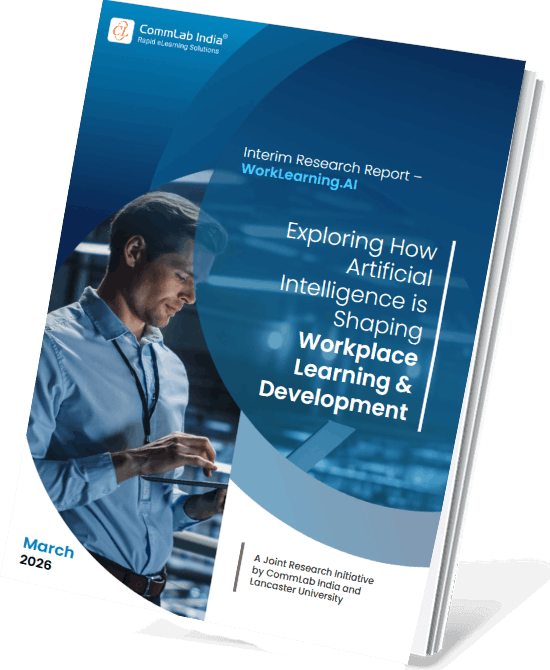
WorkLearning.AI Interim Research Report
A Joint Research Initiative by Lancaster University, UK and CommLab India