Leading Learning through Change, the New Role of L&D: A Conversation with Susan Evans
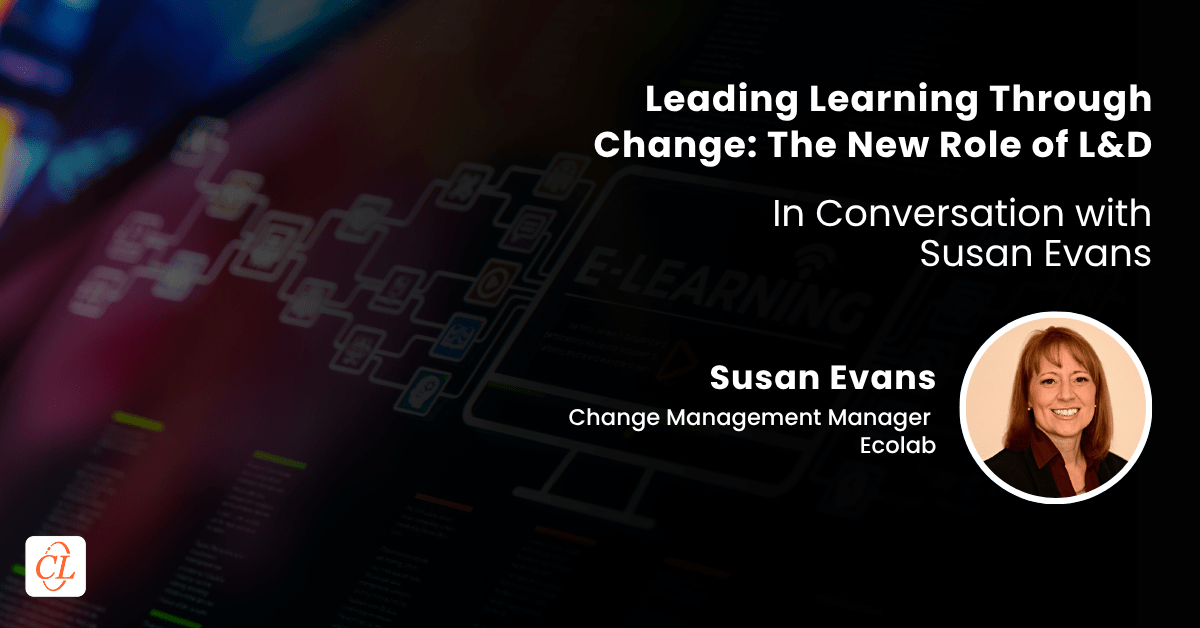
Welcome to CommLab India’s eLearning Champion video podcast featuring Susan Evans, Change Management Manager at Ecolab. Susan has worked on initiatives aimed at improving efficiencies, supporting adaptation to change, and facilitating skill development for sales teams and employees. She is trained in Six Sigma methodology and currently serves as a black belt in Ecolab Enterprise PMO. She also has a bachelor's degree in Organizational Communications with a minor in Business Management. She received her Brodsky certification in 2017 and Change Management Professional certification from the Association of Change Management Professional in 2023. Through her experiences in sales force processes, she has developed expertise in analysing stakeholder impact, communicating key benefits to various audiences, and enhancing learner and user experiences.
Click Here To Read Transcript
CommLab Podcast with Susan Evans
Alekha 0:10
Hey, Learning Champions, welcome back to the eLearning Champion podcast, where we deep dive into strategies and trends that are shaping the world of digital learning. In today's episode, we are going to look at Leading Learning through Change, the New Role of L&D. And for this topic, we have Susan Evans online with us. Hi there Susan.
Evans, Susan 0:53
Hi, Alekha, nice to talk to you today.
Alekha 0:56
Before we move forward, I would like to introduce Susan Evans, Change Management Manager at Ecolab. She has been in the company for around 38 years, and has a comprehensive background in business and digital transformations.
She has worked on initiatives aimed at improving efficiencies, supporting adaptation to change, and facilitating skill development for sales teams and employees. Currently, she serves as a black belt in Ecolab Enterprise PMO and she is trained in Six Sigma methodology. She also has a bachelor's degree in Organizational Communications with a minor in Business Management. In 2023, she received her Change Management Professional certification from the Association of Change Management Professional and obtained her Brodsky certification in 2017. Through her experiences in sales force processes, she has developed expertise in stakeholder impact analysis, communicating key benefits to various audiences, and enhancing learner and user experiences. I'm quite excited to learn the insights of change management from a proven and certified expert here.
So, getting started with our topic today, Leading Learning through Change, the New Role of L&D, how has the role of L&D changed from being primarily about training delivery to becoming a key enabler of organizational transformation?
Evans, Susan 3:05
I'm so glad you're asking these questions because we encounter them every day, but we need to step back and see how we can grow. Learning is a big enabler of the changes we're experiencing. When we make changes, we learn new processes and new approaches and new ways of interacting with our co-workers and our customers. So L&D content needs to not only address the ‘’what’’ by covering steps and tasks, but how the behaviors around those tasks enable new ways of working. Our training delivery needs to be richer in context. Examples of behavior changes could be having a new type of conversation with a customer or applying past knowledge to bring context to something new we learned.
Alekha 4:01
Yes, absolutely, Susan. To implement any practical, new way of process or learning, people should be emotionally set rather than take step wise action items.
Coming to our next question, in your view, what does it mean for L&D to act as a change catalyst rather than just a training function? Can you share any examples from your experience where L&D truly led the change?
Evans, Susan 4:39
Yeah, we're all change catalysts when leading transformations, but each function has an important and unique role. The L&D team provides key information by helping our employees build the skills and proficiency needed to adopt the change. But as change catalysts, we can facilitate learning through practicing the new skill and help learners develop confidence. This can be done in the sandbox environment or on the job learning, and will help build new habits and allow us to change faster. Some examples would be where L&D can participate in hyper care a team and in the troubleshooting. They can learn a lot by listening to the users and understand people's struggles and adjust the training and support their learning that way.
Alekha 5:55
Yeah, perfectly. It's more on the job training where the application is given and it has to be executed. That will be the only motivation to immediately learn. I absolutely agree with your point. Thank you for sharing that example, Susan.
Now with constant disruptions and AI being the trend, probably next year is going to be the year of automation, so with constant disruptions, AI automation, hybrid work, how can L&D leaders help organizations stay agile and resilient through learning?
Evans, Susan 6:40
Change is happening faster and faster. And learning mediums need to adapt as quickly as these disruptions happen. There's a constant demand for people's attention and training content needs to be more personalized and adjusted, for not just learning styles, but also environment factors such as years of experience, role requirements, working environment, such as our deskless workers, they need to be addressed. So L&D should seek to understand not only those learning styles, but the different learning paces and recognize that adaptability is different for each individual.
Alekha 7:15
Absolutely. Nowadays when we hear our customer requirements, they just talk about the adaptability. That itself defines that there's change in the mindset of the L&D community within the organization. Change management is not just about new skills, right? It's all about mindset shifts. What learning strategies works best for helping employees embrace change rather than resist it?
Evans, Susan 8:10
I believe that our stakeholders need to have a larger part in building their training. If we have subject matter experts build their training and operating procedures in real time, they will take greater ownership on the results and the outcomes intended.
One learning strategy would be to recommend peer-to-peer learning. L&D can partner with business leadership to provide guides for those peers to help drive the learning culture.
Alekha 8:45
That's a great idea, to peer up business leaders with the L&D team so they come up with a real time application rather than the theoretical part. And obviously in this digital age, people would like to go through their training at their own pace. So coordinating and collaborating with business leaders and getting the actual practical content for them to learn is great advice. Thank you for coming up with that.
Now coming to our next question, how can L&D teams partner with business leaders and HR to ensure learning initiatives directly support transformation goals and not operate in isolation?
Evans, Susan 10:25
I think our HR department can help by reinforcing the culture of continuous learning and establishing an expectation of the roles and responsibilities through having the employee set performance goals around their learning. L&D can also help support those goals by incorporating feedback from employees into the training and sharing that feedback with the change team to continuously refine the experience for the employee. Our change leaders can help keep the communication loop flowing between learners and training and communication and leadership. And this can be done through sharing best practices and success stories.
Alekha 10:56
Yes, absolutely. Success story is one particular element, a learning strategy where people are very fascinated to know if I learn this, what is going to happen or what results have been achieved in other companies or within the organization, so that personally and professionally everybody grows in their careers along with the organization.
So now we are talking about measuring and growing in terms of training and learning. What metrics or indicators should L&D leaders focus on to demonstrate the real impact of learning during organizational transitions?
Evans, Susan 12:19
One of the things I would love to get the most impact would be to capture practice metrics. People learn by practicing and our training modes need to capture those errors in practicing, gather behavior information, such as accurate data entry or process execution or coaching sessions received. This really gives us some insight into how a person adapts to the new skill and understand the learner's comprehension. Also, our change leaders and training team need to think about linking training completion to adoption and I'm hoping there are some cool advances in AI that could help here because it is tricky to do this, but it gives us so much information.
Alekha 13:04
Right. Along with the emotional shift, they'll carry that motivation point of why the transformation is happening. What can be my contribution here? All those questions come first for them to perform and then the learning behavior can be comprehended. I wish AI could help us understand the behaviors.
Now coming to our next question, change fatigue is a real challenge. How can L&D use learning design, communication, or coaching to sustain energy and engagement throughout the long-term transformations?
Evans, Susan 14:11
One way to reduce change fatigue is for our change leaders to bring visibility to change saturation down to the group and employee level. This can help pinpoint the best time and the best pace to expect new learning to be consumed. Change leaders also can share with L&D training-related barriers from the change impact analysis so adjustments can be made to the learning design and coaching. Both the pacing and the design go a long way to sustaining a learner's energy to help them keep up with the pace of change.
Alekha 14:58
Coming to our last question, looking ahead, what capabilities or mindsets will tomorrow's L&D professionals need to lead learning through change successfully?
Evans, Susan 15:18
I would say continue communicating the value, investing time and learning. The more people see the benefits and the positive impacts on their performance, the quicker they gain confidence and adapt to new changes. Also, help the business build a culture of open communication when it comes to individual learning needs. In the future, our training will become more and more personalized, so we need to listen to our learners and adapt our training to their needs.
Alekha 15:46
Yes, absolutely. I think adaptability is one of the things that has already started. When organizations are planning for their L&D training requirements, they are thinking about that adaptation factor. Still, there's much more time that has to be taken to build a culture of transparent communication.
For example, if something has been built in, assigned to an employee and if that person is not performing even after assigning that training, then they have to have that culture of open communication to share the real time difficulty that person is facing. Otherwise it will be like the training team creates the training and assigns and the employees should take it as part of the mandatory training. That's not open, transparent communication. Probably with L&D teams or L&D leaders will be able to find the actual reasons based on this transparent communication culture and probably adapt the training needs based on their learners so that it benefits both the learner as well as the organization.
So thank you Susan for your amazing insights on the change in role of L&D. Based on our discussion today, I personally got an insight that now, in today's generation or future generation, L&D is not just about creating and dumping training. It is almost about considering the behaviors to get the ROI of the person as well as the organization. So thank you for sharing all these great insights, Susan.
Evans, Susan 18:15
Absolutely. Thank you and well said. I really support and appreciate your partnership. So thanks.
Alekha 18:24
Thank you so much, Susan. And our E-learning Champion podcast ends with this amazing episode today. We have learned a lot about how the change transformation should happen. Instead of just being theoretical, it should have an impact on emotional mindsets and behavior before an L&D training initiative begins. So thank you for sharing such great insights on this change transformation, Susan.
Here are some takeaways from the interview.
How has the role of L&D changed from training delivery to enabling organizational transformation?
Learning is a big enabler of changes. When we make changes, we learn new processes, new approaches, and new ways of interacting with our co-workers and our customers. So L&D content needs to not only address the ‘’what’’ by covering steps and tasks, but also how the behaviors around those tasks enable new ways of working. Our training delivery needs to be richer in context. Examples of behavior changes could be having a new type of conversation with a customer or applying past knowledge to bring context to something new we learned.
What does it mean for L&D to act as a change catalyst?
We're all change catalysts when leading transformations, but each function has an important and unique role. The L&D team provides key information by helping employees build the skills and proficiency needed to adapt to the change. As change catalysts, we can facilitate learning by enabling learners to practice the new skills. This can be done in the sandbox environment or on the job learning, and will help build new habits, allowing us to change faster. An example would be L&D participating in troubleshooting. They can understand people's struggles by listening to them and adjust the training and support their learning.
With constant disruptions, AI automation, and hybrid work, how can L&D leaders help organizations stay agile and resilient through learning?
With change happening faster and faster, learning mediums need to adapt quickly. Training content needs to be more personalized and adjusted, for not just learning styles, but environmental factors such as experience, role requirements, and working environment. L&D should seek to understand not only those learning styles, but also the different learning paces and recognize that adaptability is different for everyone.
What learning strategies work best for helping employees embrace change?
Stakeholders must take a larger role in building training. If subject matter experts build training and operating procedures in real time, they will take greater ownership on the results and the outcomes intended. One learning strategy would be peer-to-peer learning, where L&D partners with business leadership to provide guidance for them to help drive the learning culture.
How can L&D teams partner with business leaders and HR to ensure learning initiatives directly support transformation goals?
The HR department can help by reinforcing the culture of continuous learning and establishing an expectation of the roles and responsibilities through having the employee set performance goals around their learning. L&D can also help support those goals by incorporating feedback from employees into the training and sharing that feedback with the change team to continuously refine the experience for the employee. Change leaders can help keep the communication loop flowing between learners and training and communication and leadership by sharing best practices and success stories.
What metrics should L&D leaders focus on to demonstrate the real impact of learning during organizational transitions?
L&D needs to capture practice metrics. Training modes need to capture errors in practicing and gather behavior information to get insights into the learner's comprehension and how they adapt to the new skill. Also, our change leaders and training team need to think about linking training completion to adoption.
How can L&D sustain engagement throughout long-term transformations?
One way to reduce change fatigue is for change leaders to bring visibility to change saturation down to the group and employee level. This can help pinpoint the best time and the best pace to expect new learning to be consumed. Change leaders can also share training-related barriers from the change impact analysis so adjustments can be made to the learning design and coaching. Both the pacing and the design go a long way to sustaining a learner's energy to help them keep up with the pace of change.
What capabilities or mindsets will tomorrow's L&D professionals need to lead learning through change successfully?
It’s important to communicate the value of investing time in learning. The more people see the benefits and positive impacts on their performance, the quicker they’ll gain confidence and adapt to change. Also, help the business build a culture of open communication when it comes to individual learning needs. We need to listen to learners and adapt training to their needs. For example, if something has been assigned to an employee and if that person is not performing even after that training, they must have a culture of open communication to share the difficulty that person is facing, find the reasons, and adapt the training needs based on their learners so that it benefits both the learner as well as the organization.
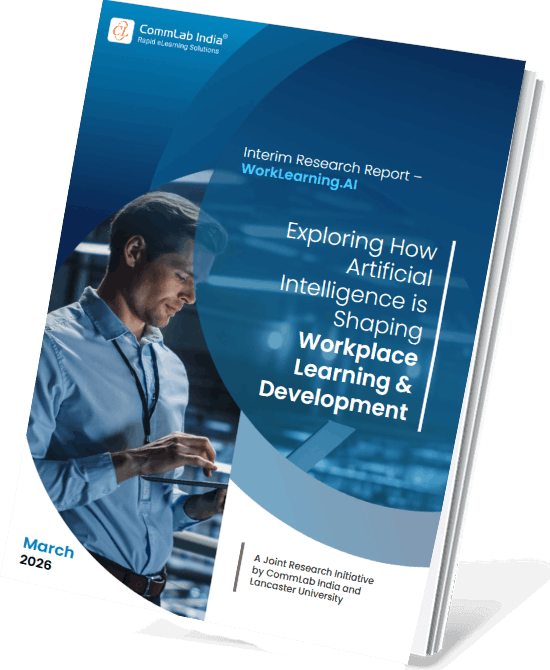
WorkLearning.AI Interim Research Report
A Joint Research Initiative by Lancaster University, UK and CommLab India