How to Get Buy-in from the C-Suite: A Conversation with Ashley Amiri
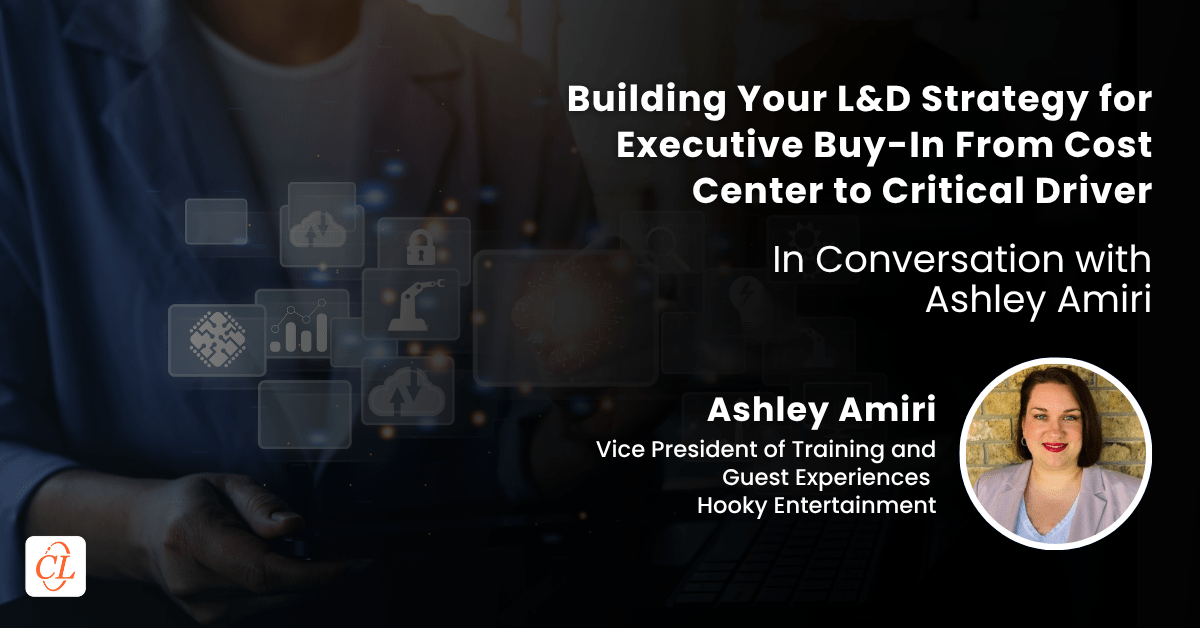
Welcome to CommLab India’s eLearning Champion video podcast featuring Ashley Amiri. Ashley is a recognized leader in strategic learning and development, and currently serves as the Vice President of Training and Guest Experiences at Hooky Entertainment. With a career dedicated to transforming L&D from a support function into a true business driver, Ashley specializes in building scalable training infrastructure, aligning learning outcomes directly with P&L goals and championing the value of L&D to the C-suite. Her deep experience in translating business strategy into learning strategy makes her an indispensable resource for L&D professionals looking to elevate their function and influence and secure executive buy in.
Click Here To Read Transcript
CommLab Podcast with Ashley Amiri
Sherna Varayath 3:39
Hello and welcome back to the eLearning Champion podcast where we deep dive into strategies, trends, and triumphs shaping the world of digital learning. Today we are talking about a topic very close to all of us in the L&D community, building your L&D strategy for executive buy in from cost center to critical driver. Joining us today for this session is Ashley Amiri. Ashley Amiri is a recognized leader in strategic learning and development, and currently serves as the Vice President of Training and Guest Experiences at Hooky Entertainment. With a career dedicated to transforming L&D from a support function into a true business driver, Ashley specializes in building scalable training infrastructure, aligning learning outcomes directly with
P&L goals and championing the value of L&D to the C-suite. Her deep experience in translating business strategy into learning strategy makes her an indispensable resource for L&D professionals looking to elevate their function and influence and secure executive buy in. Hi there, Ashley. We're glad to have you here today.
Ashley Amiri 5:10
Hello, thank you for having me.
Sherna Varayath 5:14
Before we dive in, make sure you're a true eLearning champion by hitting that Follow button wherever you're listening to us from. All right, let's get started. Now coming to building the strategic L&D function as a VP of training, Ashley, how do you define a truly strategic L&D function and what would be the very first change an L&D manager needs to make to stop being seen as just a reactive service provider?
Ashley Amiri 5:44
That's such a great question and I think there is some importance to maintaining some reactivity because it helps you earn buy-in. But truly to be strategic, we need to begin looking at L&D as part of organization development and how we're really building the enterprise talent. That really helps us look at things from a more macro level so we can be more strategic. If we zoom out from the reactive problems that come forward, we need to train new hires, we need to train on the safety thing because we had a lawsuit, being reactive in those moments and zoom out to say how are we training people from entry to preparing them for the next escalated role, whether that's a lateral role or a promoted role? That's when we can really start to begin building a full curriculum that is a talent development strategy. And then we start to align that with the business and say how can that, having a developed base of talent, a pipeline of talent, help us execute on the business needs?
Sherna Varayath 6:48
Wow, interesting. Now, when scaling an L&D team within a large company, what is an optimal structure that we should look at? Should L&D embed itself within a specific business unit or remain centralized? And how does this decision impact the ability to execute the strategy?
Ashley Amiri 7:11
There isn't just one right answer here. There's pros and cons to both. And I've worked within both centralized and decentralized. The bigger organizations like a Whole Foods and Amazon that I worked with can benefit from a decentralized program because you're able to embed in the business because it's so massive you're able to serve more team members, you're able to build more relationships, network and work cross-functionally so you can secure more buy-in and you can be more agile. When I was embedded in the merchandising org rather than being embedded in HR, let's say, I was able to build those relationships with the operations team and be more agile in delivering what they needed and being able to scale at a quicker pace. However, at my current organization, we're a smaller business and being centralized is more beneficial to us because we'll be able to work collaboratively and collectively to meet the needs of the business and scale. So there really isn't one answer. What's most important is that you have an effective strategy that's aligned to the business goals and you're securing buy-in, whether you're centralized or decentralized. And one of the hardest parts of being decentralized is staying connected with all the other L&D teams, so you're not doing too much duplicative work and you are aligned as a strategy. If you can't do that at the organization, I would advocate for a more centralized approach.
Sherna Varayath 9:19
Wow, interesting. Now you are a master at getting executive buy in. What are two or three non L&D metrics like turnover or time to market or cost per hire that L&D must tie itself to in order to win over the CEO and CFO?
Ashley Amiri 9:41
Well, my favorite is to try to find a way to tie to profit because that's what really speaks to the C-suite. If you can impact sales, cost of goods, if you can impact labor budgets, if there's anything you can do to impact the bottom line dollar, that's definitely the one you want to go after. It's important whenever we're talking about this to ensure that we're framing the data correctly. L&D is typically not going to be the full driver for these things. We're one of the various inputs that impacts it. So identifying correlations is very important and being able to say we had some impact on this metric and so that lets us just tap into things like profit. I also really like tapping into risk management. So how did training improve the way people are safe in the workplace? This has reduced the number of workers comp claims. This has reduced the number or the dollar amount and paying out workers comp claims or looking at things like saying we've trained leadership how to do performance management, how to have difficult conversations, how to document team members more effectively. So we've actually mitigated risk, and we can say we're impacting the rate of winning unemployment hearings, or we have less turnover because we're actually developing and coaching people rather than just terminating people. So finding metrics that can really impact the business outside of L&D where we look at things like do they actually learn what they're supposed to learn? What's the sentiment for the learning? Really looking at the behavior change part and how we impacted metrics that matter to the C-suite. Because the reality is it's very unlikely you have someone in an executive position that actually understands L&D the way that we do as professionals. So they're not going to understand all the correlations and have the same passion about it that we do. So we have to bring it to them, and we do that by picking metrics that are meaningful to them.
Sherna Varayath 11:35
Wow, interesting. Now when pitching a major training initiative like a new leadership program, what type of data and visuals or storytelling do you find the most effective in securing a budget and sign off from a sceptical executive?
Ashley Amiri 11:56
What's most important first is to get to know your audience, what is important to them, so that you can frame a story around what matters most to them. So if you know this executive is really passionate about culture or if they're really passionate about brand recognition for the business or really passionate about reducing cost of goods or anything like that, knowing what's important to them is going to help you frame the story more effectively. But it really starts with listening and communicating and all the interactions you have with them and all the team and executives leading up to that, because my favorite thing to do is to leverage their words. So if you can say, we're doing this leadership development program and Bob, I remember when we had that conversation about how great it would be if we had all our leaders who were fully trained in X, or the impact it would have on the business if our leaders were more proficient at this. Then right there, you're already creating the buy in because you're using the interaction you had with them where they were passionate and bought into something. So that's my favorite thing to do in these types of pitches to really bring your audience along. And it's important also to let them think to some degree, it's their idea. I love to present multiple options. I love to say I've heard your words, I've seen your strategy. This is because of you all's idea and to be able to convey that in a way that still maintains the credibility of the work that you do, but lets them come along, is really important to getting buy-in. And being able to have options presented and an adaptable mindset, because it's rare you're going to get everything you ask for. So come in already knowing where you can make concessions, where you can compromise. What does a low lift or low resource program look like? What does a full scale program look like? What benefits do each have so that you can have an effective conversation and walk out with a yes to some degree?
Sherna Varayath 13:51
Wow, that's really some cool advice there. So now coming to handling rejections, what is your advice for L&D leaders when a great proposal gets rejected or shelved? How do you maintain the influence and leverage feedback to return with a better and aligned solution?
Ashley Amiri 14:12
Unfortunately, rejection is part of it, but I try to make it a part that's really hard for them to tell me no. So I bring in a lot of options. I bring in a lot of alternatives. I come fully prepared to give them every reason to say yes and make it really hard to say no. That's the starting point. When they do say no, I take that as an opportunity to show what we're capable of because again, going back to a lot of C-suite executives do not have the proficiency or experience in L&D that we do as professionals. I often find that I'm trying to sell them on a vision of what's possible, but hasn't happened yet and that can be hard for people to imagine or understand. For example, at Whole Foods, I had this initiative to do a Negotiations training, and I was selling this huge vision of this workshop, and it was going to change how we do L&D at Whole Foods, and it was going to be the first of its kind program and they had a really hard time visualizing it. So there were a lot of no’s within those conversations. And so it's taking those no’s and saying, how can I create something incremental to show what we're capable of so that they can start to get excited about it? And that's what we did. We started with a smaller scale training, with a smaller pilot audience, with almost no resources, and then we started to show what we could do with that and get people excited. And it became our biggest program. We got an executive version of it because there was so much demand for it, and it gave me almost carte blanche to do any of the other programs we wanted to do because we had shown how effective we could be. So I took a lot of those no's and said how can we show what we're capable of within that no and adapt. So if the no is because we can't afford it, what free resources can I leverage? How can we work smarter, not harder to reduce the cost? If the no is ‘not right now’, how can I focus on an initiative that sets the groundwork for doing a negotiations training down the road? So it's thinking about turning that no into a foundation for a future yes.
Sherna Varayath 16:14
Wow. Like you said, you can't get a buy-in from everyone. How do you identify, cultivate, and empower an executive champion who will advocate for L&D initiatives across the C-suite?
Ashley Amiri 16:29
It's very, very important to have a champion in a high-powered role. And so when I first join a team, I always start by getting to know everyone. I have short one-on-ones, coffees, meet and greets, whatever it is to get to know everyone and find out what's important to them. I don't ask questions like what's the biggest training gap on the team?
I ask questions like, what's most important to you? What's the hardest part of your job? What can make your job easier? What programs are you excited about? And by understanding these things, you can really start to identify who is passionate about similar things.
I also come in not just as an L&D professional. I do org dev, I do change management. I'm coming in to completely transform the culture. And so I'm looking for someone who's passionate about innovation, someone who likes to take measured risks, somebody who's really passionate about culture or the business development, because that may not be L&D explicitly, but they're going to buy into us taking L&D risks. They're going to buy into us taking different approaches, buy into us transforming the culture through learning. So it's not just looking for somebody who cares about L&D explicitly. It's looking for someone who can be a good partner and steward to what you're trying to achieve. And you cannot underestimate the power of the team member base and their voices. To go back to that negotiations training, I had strongly advocated that we had a leadership version and was continuously told No, we don't have the bandwidth, all the reasons L&D gets told no. And we started with the team member version, and the team members became our biggest voice for how great this training was. And I got the buy-in to do an executive version and it became something that was their idea then, right? Even though it had originally been my idea. So immediately I had the buy-in through those team member voices. So while you want to have an executive champion, it is also equally important to have the team members trust you, to see you as credible, to want to engage in your training, to think that learning can be enjoyable because they're going to also advocate for you.
Sherna Varayath 18:20
Absolutely. Now looking at the future and AI, of course, when you talk to your CEO about investing in AI for training, what is the strategic pitch? How do you frame AI as a business imperative for L&D rather than just a shiny new tool?
Ashley Amiri 18:59
Yes, this can be hard because digital transformation is happening almost all the time across orgs at this point. And so you become inundated with different tools and platforms, and it can become overwhelming and costly. So the first thing I like to look at is how can we impact labor, because ultimately labor is always going to be one of your biggest costs as an organization. Because it doesn't just come with payroll, it comes with the cost of benefits, it comes with all the other things that come with having people headcount. So I look at can having an AI tool reduce our headcount or mitigate some of the need for headcount so that we can get the work done more quickly? This often is an easy buy-in for executives because the cost is just something you can't deny. Also, looking at the skill set and capability, instructional designers are highly, highly talented and are becoming more and more expensive to hire for good reason. They do incredible things. And you cannot offset the talent that comes with being an instructional designer who has real world experience teaching and training. AI just can't do that. So to be able to say, hey, we can afford one really amazing instructional designer and giving them this tool can make them more efficient in their work. So really grounding it in things that are going to matter to the executive and also think about how the rest of the org can benefit. So this AI tool isn’t just important to me, it’s important because Bob in finance is always asking me for trained resources, and now I can actually produce them for him because I have that capacity, and that is going to enhance his initiative. So thinking about how you’re acting cross-functionally is also really important.
Sherna Varayath 20:35
Absolutely. Now given the rise of AI and the need for data, what are the two essential non L&D skills you look for when hiring a modern strategic L&D team today? It could be around data literacy, business acumen or consulting skills.
Ashley Amiri 21:00
There are really two that I'm looking for. The 1st is consulting skills, because more and more, we're expanding the scope of our work to a point I made earlier. I also specialize in change management, organization development, succession planning, I develop comm strategies, I have been onboarding digital tools. There's a lot of other things that I do besides just learning and development. So being able to have a consultant mindset is key. It affects how you listen, it affects how you ask questions, and it affects how you present options and gain buy-in and influence. So to have those skills is really important because L&D is always going to be viewed as a support and a ‘nice to have’ until you make it a ‘need to have’ and to make it a need to have, you have to be able to communicate and influence at an executive level and that requires those consulting skills. So that's always going to be one that I look for, especially in higher level learning and development roles. And the 2nd is two-fold.
It is being able to evaluate learning effectively and data literacy. So you have to be able to show the fruits of your labor. You have to be able to say this program is effective. You have to be able to say this is the behavior change we created. So you have to understand how to use Kirkpatrick's levels, how to do formative and summative assessments. You have to understand how to do surveys, how to read surveys, how to story-tell with data. And this is a really hard skill that a lot of people struggle with and have to put effort into learning. Being able to have that is really key because you cannot get executive buy-in without strong data.
Sherna Varayath 22:39
Right. OK. Now to wrap it up, if you could give our audience one piece of actionable advice to implement this week to start building executive buy in, what would it be?
Ashley Amiri 22:53
It would be to focus on two things which go hand in hand, building your executive presence and building your credibility. You can have the best idea, you can have the best pitch, you can have the most beautiful presentation, you can have all the metrics and data. But if they don't buy into you and believe in you, you're never going to get the support that you need. So you have to build your executive presence. When you walk in a room, you deserve to be there. And as a woman, that has been difficult for me in my career to learn how to do and how to do it effectively. There are little things that you can do, like when you go into a meeting, sometimes L&D, we feel like we're just here as a support, so I don’t want to be intrusive, right? We're all very nice people in L&D. We're very kind and OK, I don't want to take up too much time or oh, you can just squeeze me in here. No, I'm here to prove something. I'm here to do something and I need this time and I'm going to command your attention in this time. I'm not going to talk fast and just whip through this. Little things like that that I've noticed a lot of people do, especially as a woman, I've noticed other women do, can really affect the executive presence you have. And then that affects the credibility you build. When you have credibility, it's a lot easier to get buy-in. It's a lot easier to be in the rooms you're supposed to be in, to be able to have the influence you need, and it helps you achieve the goals for the benefit of the team members you're trying to teach, which is the ultimate goal, right? We're all in L&D because we are passionate about being able to make other people's lives better through learning. And if I can do that more effectively by focusing on how I show up in meetings and how I tell my story and how I tell the story of my team, then that's what I'm going to do. So those are absolutely the two things you can do regardless of what position you're in today and take some time, but really pay off as you begin to see the changes of you adopting the things that you need to do to improve your executive presence and credibility.
Sherna Varayath 24:51
Wow. And this brings us to the end of another insightful episode of the eLearning Champion podcast. We've covered a lot today and especially the last take away of building your executive presence and showing up with credibility. Thank you so much, Ashley, for your time and perspective.
Ashley Amiri 25:09
Thank you so much for having me. I appreciate it. It's been a joy.
Sherna Varayath 25:12
Thank you. We always love to hear from you and our amazing listeners. So if you have any feedback on today's episode, what are your thoughts on today's topics, the challenges you're facing? What are you championing in the world of eLearning? Do follow CommLab India on LinkedIn and let us know your feedback and suggestions.
Thank you so much for tuning in to the eLearning Champion podcast. Happy learning.
Here are some takeaways from the interview.
Should L&D embed itself within a specific business unit or remain centralized?
I've worked within both centralized and decentralized programs, and there are pros and cons to both. Bigger organizations can benefit from a decentralized program because you could serve more team members, build more relationships, network, work cross-functionally, and secure more buy-in. But being decentralized makes it hard to stay connected with other L&D teams, and you might end up duplicating their work. In smaller business, being centralized is more beneficial because you'll be able to work collaboratively to meet the needs of the business. But whether you're centralized or decentralized, you need to have an effective strategy that's aligned to the business goals and helps you secure buy-in.
What are a few non-L&D metrics that L&D must tie itself to win over the C-suite?
Find a way to tie to profit because that really speaks to the C-suite. You need to impact sales, cost of goods, labor budgets, and the bottom line dollar. And when you talk about this, frame the data correctly. L&D is not going to be the only driver for these things, it is only one of the various inputs that impact. So, identifying correlations is very important. Tap into things like profit or risk management. How did training improve safety in the workplace? If it has reduced the number of workers’ comp claims, you've mitigated the risk. So find metrics that can impact the business outside of L&D and how you impacted the metrics that matter to the C-suite.
When pitching a major training initiative, what type of data is most effective in securing sign off from a sceptical executive?
It's important to get to know your audience and what is important to them, so you can frame a story around what matters most to them. It starts with your interactions with them and with the team and executives leading up to that, so you can leverage their words. That way, you're already creating the buy in by using the interaction you had with them, where they bought into something. It's also important to let them think to some degree that it's their idea. You can say, I've heard your words, I've seen your strategy, all this is because of your idea. Conveying that in a way that still maintains the credibility of your work is important for getting buy-in. Also, have an adaptable mindset, because rarely will you get everything you ask for. So know where you can make concessions, where you can compromise. What does a low resource program look like? What does a full scale program look like? What benefits do each have? This helps you have an effective conversation and walk out with a yes.
What is your advice for L&D leaders when a great proposal gets rejected?
Unfortunately, rejection is part of our work. You should make it hard for them to say no by providing a lot of options. Go prepared to give them every reason to say ‘’Yes’’ and make it hard to say ‘’No’’. When they do say ‘’No’’, use that as an opportunity to show what you're capable of. It's taking those No’s and thinking how you can create something incremental to show what you're capable of so they can get excited about it. And that's what we did. We started with a smaller scale training, with a smaller pilot audience, with almost no resources, and we started to show what we could do with that. And it became our biggest program. We were asked to do an executive version of it because there was so much demand for it. It gave me almost carte blanche to do any of the other programs we wanted to do because we had shown how effective we could be. I took a lot of those No's and thought, ‘’How can we show what we're capable of within that no and adapt?” If the No is because we can't afford it, think of any free resources you can leverage. How can we work smarter, not harder to reduce the cost? If the No is ‘not right now’, focus on an initiative that lays the groundwork for doing a training down the road. Think about turning that ‘’No’’ into a foundation for a future ‘’Yes’’.
How do you identify, cultivate, and empower an executive champion who will advocate for L&D initiatives across the C-suite?
It's important to have a champion in a high-powered role. When I first join a team, I always start by getting to know everyone, have short one-on-ones, coffees, meet and greets, and find out what's important to them.
I don't ask questions like, what's the biggest training gap on the team?
I ask questions like:
- What's most important to you?
- What's the hardest part of your job?
- What can make your job easier?
- What programs are you excited about?
I also come in not just as an L&D professional, I let them know that I do org dev, I do change management. I'm coming in to completely transform the culture. So I'm looking for someone who's passionate about innovation, someone who likes to take measured risks, somebody who's passionate about culture or business development, because that may not be L&D explicitly, but they're going to buy into us. They're going to buy into us taking different approaches and transforming the culture through learning. So don’t just look for somebody who cares about L&D. Look for someone who can be a good partner and steward to what you're trying to achieve. And never underestimate the power of the team member base and their voices. To go back to that training, I had strongly advocated for a leadership version and was continuously told No, we don't have the bandwidth. When we launched the team member version, the team members became our biggest voice for how great this training was. And I got the buy-in to do an executive version. And it became something that was their idea, even though it had originally been my idea. I had the buy-in through those team member voices. So while it’s important to have an executive champion, it is equally important to have the team members trust you, to see you as credible, to want to engage in your training.
How do you frame AI as a business imperative for L&D instead of a shiny new tool?
Digital transformation is happening all the time across organizations, and we are getting inundated with different tools and platforms. The first thing I look at is how we can impact labor, because labor will always be one of your biggest costs to an organization. Can an AI tool reduce our headcount or mitigate some of the need for headcount so we can get the work done more quickly? That often is an easy buy-in for executives because the cost is just something you can't deny.
Also, looking at the skill sets and capability, instructional designers are highly talented and are becoming increasingly expensive to hire, for good reason. You cannot offset the talent that comes with an instructional designer with real world experience teaching and training. AI just can't do that. So you can say, Hey, we can afford one amazing instructional designer and giving them this tool can make them more efficient in their work. So ground it in things that matter to the executive and think about how the rest of the organization can benefit.
What are the two essential non-L&D skills you look for when hiring a modern strategic L&D team today?
There are two that I look for.
The first is consulting skills, because we're expanding the scope of our work. Besides learning and development, I also work in change management, organizational development, succession planning, comm strategies, onboarding digital tools. Having a consultant mindset is key. It affects how you listen, how you ask questions, and how you present options and gain buy-in. Having those skills is important because L&D will always be viewed as a ‘nice to have’ support function until you make it a ‘need to have’. And to make it a need to have, you must be able to communicate and influence at an executive level and that requires those consulting skills. So that's going to be one I look for, especially in higher learning and development roles.
The 2nd thing I look for data literacy and the ability to evaluate learning effectively. You must be able to show the fruits of your labor, and say this program is effective, or this behavior change is because of the training we created. You must know how to use Kirkpatrick's levels, how to do formative and summative assessments, how to conduct and read surveys, how to story-tell with data. That is something a lot of people struggle with, but having that is key because you cannot get executive buy-in without strong data.
What would be one piece advice for getting executive buy in?
Focus on building your executive presence and building your credibility. You can have the best idea, the best pitch, the most beautiful presentation, you can have all the metrics and data. But if they don't believe in you, you'll never get the support you need. So you must build your executive presence. There are little things you can do. When we go into a meeting, we in L&D usually don’t want to be intrusive. We're very nice people in L&D, not wanting to take up too much time. That’s not how you must think. You’re there to do something and need the time. You must command their attention. If you talk fast and whip through something, it can diminish your executive presence. And that affects your credibility. When you have credibility, it's a lot easier to get buy-in. It's a lot easier to be in the rooms you're supposed to be in, to be able to have the influence you need, and achieve the goals for the team. We're all in L&D because we are passionate about making people's lives better through learning. And if I can do that more effectively by focusing on how I show up in meetings, how I tell my story, and how I tell the story of my team, then that's what I'm going to do. So these are the two things you can do regardless of what position you're in today. It might take some time, but it pays off as you begin to see the changes as you improve your executive presence and credibility.

WorkLearning.AI Interim Research Report
A Joint Research Initiative by Lancaster University, UK and CommLab India