Strategy vs. Execution: Why Most L&D Teams Are Built for the Wrong Job
Know Who’s Talking
Sushmitha Kolagani
Sushmitha Kolagani is the Content Strategist at CommLab India. Sushmitha's journey started with a simple love: reading and writing. That love led her into instructional design, business writing, and along the way, she picked up the technical side of the craft too — SEO, AEO, and everything in between. Equal parts creative and imaginative, she's spent over 13 years finding new ways to make content that people actually want to engage with.
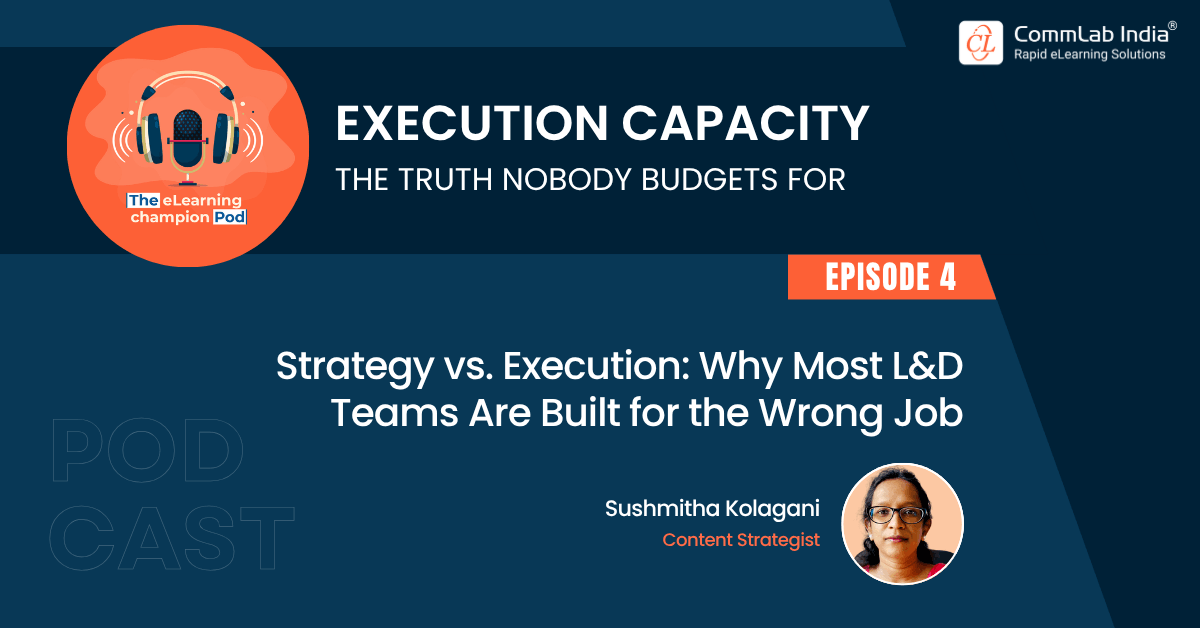
What is your L&D function truly meant to accomplish? The answer shapes how you hire, how you organize and how you track success. It also determines whether the team can deliver what the business actually requires. In Episode 4, Sushmitha examines the organizational design issue hidden inside the execution capacity challenge: strategy work and execution work are distinct disciplines.
Most L&D groups operate as though both are identical. That’s why so many find it hard to excel at either one when scale matters. This episode explores the structural flaw driving the problem, the strategic separation that top-performing organizations have adopted, and the build-versus-partner choice at the heart of a well-crafted execution model.
Click Here To Read Transcript
00:00:00 Sushmitha
What is your L&D team actually for?
00:00:03 Sushmitha
Before you answer and they know the instinct is to save, they build training or they develop a people's capabilities, I want to offer a more precise framing because how you answer this question determines how you staff the function, how you structure it, how you measure it and ultimately whether it can do what the business needs it to do.
00:00:24 Sushmitha
Here's the distinction I would draw.
00:00:26 Sushmitha
There are 2 fundamentally different types of work in a learning function.
00:00:30 Sushmitha
Work that requires deep business judgment, such as understanding what capabilities your organization actually needs, how learning connects to your specific business model, how to align stakeholders around a shared development agenda.
00:00:45 Sushmitha
And work that requires dependable execution capacity, such as the ability to build, localise, deploy, and maintain high quality learning content at the volume and speed the business requires.
00:00:56 Sushmitha
Different work types they require different skills, they have different scalability profiles, and most L&A teams are organised as if they are the same thing, which is exactly why so many struggle to do either one well at scale.
00:01:10 Sushmitha
I am Sushmitha.
00:01:11 Sushmitha
Welcome to episode 4 of 5 foundational episodes on learning execution capacity.
00:01:17 Sushmitha
We have named the problem, quantify the cost, map the velocity, and today we are addressing the organizational design question that sits underneath all of it.
00:01:27 Sushmitha
This episode is particularly relevant for all 3 audiences: HR and people leaders who design organization structure and have the authority to change how the training function is resourced.
00:01:38 Sushmitha
Functional leaders such as sales VPs, compliance heads, CHROs who have influence over how the training function supporting their teams is structured and staffed and finally CLOs and heads of L&D for actively trying to make their function more effective and sustainable.
00:01:57 Sushmitha
3 things today: The design mistake most organizations make and why it limits both quality and volume.
00:02:03 Sushmitha
The strategic split that high performing organizations have moved to.
00:02:07 Sushmitha
What stays internal and what becomes elastic and the bill versus partner portfolio decision that sits at the center of a well designed execution model.
00:02:18 Sushmitha
So let's start with section one, the design mistake, the most common organizational design mistake I see in enterprise L&D functions.
00:02:26 Sushmitha
Is treating every type of L&D work as equivalent and staffing accordingly.
00:02:31 Sushmitha
Specifically, most organizations hire instructional designers and assign them a portfolio of work that spans the full spectrum of the L&D function: needs analysis, program design, content development, project management, vendor management, stakeholder communication, measurement, and ongoing content maintenance.
00:02:50 Sushmitha
One person, all of those things and simultaneously.
00:02:54 Sushmitha
On paper, this looks like a flexible, generalist team that can respond to any need.
00:02:59 Sushmitha
In practice, it's a team where everyone is stretched across too many work types simultaneously.
00:03:04 Sushmitha
Nobody has the focus to develop deep expertise in any single area, and the throughput ceiling is low because the same people are doing strategy and execution work without any structural separation between them.
00:03:17 Sushmitha
This model worked when training demand was lower and the pace of change was slower.
00:03:22 Sushmitha
It doesn't work when demand is continuous, high volume and requires fast cycle times because strategic work and execution work have completely different rhythms.
00:03:33 Sushmitha
Strategic work that is needs analysis, learning architecture, stakeholder alignment, measurement design.
00:03:39 Sushmitha
These benefit from depth reflection and dialogue.
00:03:42 Sushmitha
It takes time to get them right.
00:03:44 Sushmitha
The cost of doing it wrong is high.
00:03:46 Sushmitha
It should not be rushed.
00:03:48 Sushmitha
You want this work done carefully by people with deep organizational knowledge and strong business judgment.
00:03:55 Sushmitha
Now execution work that is content development, localization, quality assurance, LMS deployment.
00:04:01 Sushmitha
Please benefit from volume, consistency and speed.
00:04:05 Sushmitha
This is production work.
00:04:06 Sushmitha
It has quality standards that can be defined in advance.
00:04:09 Sushmitha
It has process steps that can be systemised.
00:04:12 Sushmitha
It has output metrics that can be measured objectively.
00:04:16 Sushmitha
So the faster you can do it without compromising quality, the more training reaches your workforce.
00:04:22 Sushmitha
When you mix these 2 work types in the same team without separation, you get a team that does neither as well as it could.
00:04:29 Sushmitha
The strategic work gets crowded out by urgent execution demands.
00:04:33 Sushmitha
The next module that needs to be built.
00:04:35 Sushmitha
There's no time for careful needs analysis.
00:04:38 Sushmitha
The execution work gets delayed by the need for strategic judgment on every decision.
00:04:44 Sushmitha
The designer can't start building until they've had the stakeholder alignment conversation that should have happened in scoping itself.
00:04:50 Sushmitha
There's also a scaling problem.
00:04:53 Sushmitha
Strategic work doesn't scale by adding more people doing the same work.
00:04:57 Sushmitha
You scale strategy by getting better at it through deeper organizational knowledge, stronger stakeholder relationships and better analytical frameworks.
00:05:07 Sushmitha
Execution work does scale by adding more capacity, more developers, more localization bandwidth, more QA resources.
00:05:15 Sushmitha
But you can only scale execution if it's separated from strategy and resource differently.
00:05:21 Sushmitha
The manifestation of this design mistake looks different depending on organizational maturity.
00:05:26 Sushmitha
In small L&D teams, that looks like a team that produces high quality work when they have time but is perpetually behind on volume.
00:05:34 Sushmitha
There is never enough development capacity because the same people doing development are also doing needs analysis, stakeholder management and measurement.
00:05:45 Sushmitha
In large L&D teams, it often looks the opposite.
00:05:48 Sushmitha
A team that produces a lot of training but has lost connection to the business outcomes it was designed to serve because execution volume crowdsolve the strategic thinking.
00:05:58 Sushmitha
Now both manifestations stem from the same design choice that is treating different work types as equivalent.
00:06:05 Sushmitha
The organizations I have seen handle learning execution capacity most effectively have made a clear structural decision.
00:06:13 Sushmitha
Internal L&D owns learning strategy.
00:06:15 Sushmitha
And execution capacity is built and managed as a production system, which may be partly or largely external.
00:06:23 Sushmitha
Let me be specific about what internal L&D owns learning strategy means in practice, because this distinction is often misunderstood.
00:06:32 Sushmitha
Internal L&D owns needs analysis, the deep organizational work of understanding what capabilities the business actually needs and why.
00:06:40 Sushmitha
This requires people who know the business, who have relationships with functional leaders, who understand the organizational culture and context.
00:06:48 Sushmitha
It can't be outsourced because the relevant knowledge is organizational and contextual, not generic.
00:06:54 Sushmitha
Internal L&D also owns Learning Architecture, the strategic decision of how learning programs are structured, sequenced, and connected to business outcomes.
00:07:03 Sushmitha
What should be a formal course versus a performance support deal versus a coaching conversation versus an embedded job aid?
00:07:10 Sushmitha
How does the sales enablement program connect to the specific sales methodology your organization uses?
00:07:16 Sushmitha
These are design decisions that require business judgment and contextual knowledge.
00:07:21 Sushmitha
Internal L&D also owns stakeholder management, that is, the ongoing work of aligning business leaders around learning priorities, managing expectations about delivery timelines and resource requirements, and ensuring training investments are connected to measurable business outcomes.
00:07:38 Sushmitha
This is relationship work it lifts inside the organization.
00:07:42 Sushmitha
Internal L&D owns measurement and evaluation.
00:07:46 Sushmitha
That is the capability to assess whether training is producing the performance outcomes it was designed to produce and to feed those insights back into the design and prioritization process.
00:07:57 Sushmitha
What internal L&D does not necessarily own is the production of training content at volume.
00:08:03 Sushmitha
The actual development work that is writing scripts, building E learning modules, creating assessments, recording and editing audio and video, managing translation vendors, conducting quality assurance testing, deploying to the LMS.
00:08:16 Sushmitha
These are execution activities that can be performed to a defined quality standard by people who don't need to be embedded in the organization.
00:08:25 Sushmitha
In fact, keeping all of this work inside the organization often has a specific disadvantage.
00:08:31 Sushmitha
A fixed internal team has a fixed.
00:08:33 Sushmitha
Good ceiling when demand spikes such as a product launch, a compliance deadline or a merger integration, the internal team hits a ceiling and something has to give quality, timeline or scope.
00:08:46 Sushmitha
Always external execution capacity, whether through a managed service partner, a staff documentation model or a structured project based vendor relationship is elastic in a way that internal headcount isn't.
00:09:00 Sushmitha
It can scale up when demand spikes and scale back when it subsides without the fixed overhead of a larger permanent team.
00:09:08 Sushmitha
Now I want to be clear about what this model is not.
00:09:12 Sushmitha
It's not an argument for outsourcing everything.
00:09:15 Sushmitha
Strategic work described that is needs analysis, learning architecture, stakeholder management and measurement.
00:09:21 Sushmitha
These are genuinely necessarily internal work.
00:09:25 Sushmitha
They require organizational knowledge and judgment that an external partner cannot replicate.
00:09:30 Sushmitha
And there's a meaningful ongoing management role for internal L&D in overseeing external production capacity to ensure quality standards are maintained and the work connects to business objectives.
00:09:42 Sushmitha
So the internal team doesn't necessarily get smaller in this model, instead it gets refocused on the work that only it can do.
00:09:50 Sushmitha
The practical question that follows from the strategic split is how do you decide what to build internally versus what to partner on and what kind of partner relationship serves each type of need?
00:10:02 Sushmitha
I use a framework built around 3 demand types, each of which calls for a different capacity model.
00:10:08 Sushmitha
Demand type one recurring and continuous.
00:10:11 Sushmitha
This is the baseline production work of a mature training function, keeping existing content current across a changing regulatory and business landscape, supporting ongoing onboarding for a growing organization, maintaining compliance program currency across multiple jurisdictions, and refreshing performance support content as products evolve.
00:10:33 Sushmitha
This demand type doesn't peak dramatically.
00:10:36 Sushmitha
It just exists persistently at a volume that most fixed internal teams can't fully absorb alongside new program development for recurring and continuous demand.
00:10:46 Sushmitha
The right capacity model is a managed execution partnership, a structured ongoing relationship with an external partner who operates to your quality standards as an extension of your production capability, not a vendor you call when you have a project.
00:11:01 Sushmitha
A partner with a different standing engagement, shared standards and production capacity that's already on boarded to your organization requirements.
00:11:11 Sushmitha
Demand type 2 deadline bound spikes.
00:11:14 Sushmitha
A major product launch requiring training across your entire sales force before launch day.
00:11:19 Sushmitha
A regulatory change requiring compliance training deployment for 10,000 employees before the effective date.
00:11:25 Sushmitha
A merger integration requiring onboarding for a newly acquired workforce.
00:11:30 Sushmitha
These arrive with a hard.
00:11:31 Sushmitha
Deadline a large scope and often inadequate advance notice for deadline bound spikes.
00:11:37 Sushmitha
The right model is a controlled search bringing in focused external production capacity specifically for the spike duration with a clear brief, defined quality standards and a project management structure that ensures the output meets your standards.
00:11:52 Sushmitha
The keyword is control.
00:11:54 Sushmitha
This is not throwing a project over the world to a vendor and hoping for the best.
00:11:58 Sushmitha
It's an intensive, closely managed engagement with clear acceptance criteria.
00:12:04 Sushmitha
Demand type 3 defined role gap situations where you need a specific capability your current team doesn't have, such as expertise in a new learning technology specialization in a new content format.
00:12:18 Sushmitha
A deep knowledge of a new geographic market or regulatory context for defined role gaps.
00:12:24 Sushmitha
The right model is an embedded specialist and external expert who works inside your teams tools, processes and quality standards for a defined period.
00:12:33 Sushmitha
The goal is either to build a lasting internal competency through knowledge transfer or to maintain a defined ongoing specialist contribution in an area that doesn't warrant a permanent internal hire.
00:12:45 Sushmitha
The most expensive mistake I see in L&D capacity planning is using the wrong model for a demand time.
00:12:52 Sushmitha
Using a managed execution partner for a one time spike adds governance overhead that engagement does justify.
00:12:59 Sushmitha
Using project by project vendors for continuous baseline demand needs your constant.
00:13:03 Sushmitha
re-onboarding, never building shared quality understanding, and paying a coordination premium for inconsistency.
00:13:10 Sushmitha
Using a generalist vendor for a defined role gap means you get generic output rather than specialised expertise.
00:13:17 Sushmitha
The discipline is classification before sourcing.
00:13:20 Sushmitha
What is the shape of this demand?
00:13:22 Sushmitha
Is it continuous, episodic, or one-time gap?
00:13:25 Sushmitha
The answer determines the model.
00:13:27 Sushmitha
The model determines the partner type, and the partner type determines the outcome.
00:13:32 Sushmitha
Let me illustrate the strategic split with the real case from a large professional services firm, a consulting organization with roughly 15,000 employees operating globally with a continuous training obligation across professional development, client engagement skills and front lines.
00:13:48 Sushmitha
When I first worked with this organization, their L&D function had 18 people organised as a generalist team.
00:13:55 Sushmitha
Everyone did a bit of everything.
00:13:58 Sushmitha
They were producing good quality work, genuinely good instructional design.
00:14:02 Sushmitha
But significantly behind on volume.
00:14:05 Sushmitha
Average time from training request to deployment was 4 months.
00:14:09 Sushmitha
They had a backlog of over 60 projects at various stages of development.
00:14:14 Sushmitha
The team knew they had a capacity problem.
00:14:16 Sushmitha
The CLO had requested additional headcount twice and been declined 4 times on the basis that the existing team was already well resourced related to industry benchmarks.
00:14:27 Sushmitha
The conversation we had was about reframing the constraint.
00:14:30 Sushmitha
The team wasn't under resourced for strategy work, they were under resourced for execution work.
00:14:36 Sushmitha
The 18 people were spending the large majority of their time on development, building content.
00:14:42 Sushmitha
They were spending a small minority of their time on needs analysis, stakeholder management and measurement.
00:14:48 Sushmitha
That's the strategic work that should be driving everything else.
00:14:51 Sushmitha
The redesign separated the function into 2 explicit streams.
00:14:56 Sushmitha
A strategic team of 8 people, the most experienced, most organizationally connected members of the team, focused entirely on needs analysis, learning architecture, stakeholder alignment, and measurement.
00:15:08 Sushmitha
An execution stream initially built through a managed external partnership rather than internal headcount, handled all content development, localization, and deployment.
00:15:19 Sushmitha
In the first year, 3 specific outcomes changed.
00:15:22 Sushmitha
The backlog cleared, the average time from request to deployment fell from 4 months to 6 weeks for standard content.
00:15:28 Sushmitha
And for the first time, the CLO had systemic data on whether training was producing business outcomes because the strategic stream now had the bandwidth to build measurement into every significant programme.
00:15:41 Sushmitha
The total cost of the redesign module internal strategic team plus managed external execution partner was approximately equivalent to what it would have cost to hire the additional headcount.
00:15:54 Sushmitha
That had been requested and declined, but unlike fixed headcount, the external execution capacity was elastic when a major practice expansion in Q3 generated an unusual development spike.
00:16:06 Sushmitha
The execution capacity scaled up without disrupting anything else.
00:16:10 Sushmitha
When Q4 was lighter, it scaled back.
00:16:12 Sushmitha
So 3 things from today.
00:16:14 Sushmitha
First, map your L&D teams time allocation in a typical month.
00:16:19 Sushmitha
What percentage of the time is spent on strategic work meets analysis architecture?
00:16:24 Sushmitha
Stakeholder management measurement versus execution work, that is development, localization, QA and deployment.
00:16:31 Sushmitha
If execution work is consuming more than 60 to 70% of the team's time, you have a structural imbalance that's limiting both the quality of your strategy and the volume of your execution.
00:16:42 Sushmitha
Second, classify your current training demand by time.
00:16:45 Sushmitha
What's recurring and continuous?
00:16:47 Sushmitha
What are the deadline bounce spikes in the next 12 months?
00:16:50 Sushmitha
Where are the defined role gaps in your current team?
00:16:53 Sushmitha
Classification tells you which capacity model you need for each type and where a different sourcing approach could produce materially different outcomes.
00:17:02 Sushmitha
3rd, challenge the internal headcount assumption in your next capacity conversation.
00:17:06 Sushmitha
Before supporting a request for more internal L&E staff, ask whether the work that needs doing is judgment work or execution work.
00:17:14 Sushmitha
If it is execution work, external capacity might be faster.
00:17:18 Sushmitha
More flexible and no more expensive than internal head count and significantly more elastic to demand variability.
00:17:25 Sushmitha
Episode 4 Done the organizational design question underneath the learning execution capacity prompt.
00:17:32 Sushmitha
Episode 5 finale brings everything together into the learning operations model.
00:17:38 Sushmitha
All the 5 components, 3 maturity levels for each and where to start for your specific situation.
00:17:44 Sushmitha
Stay tuned, visit CommLabindia.com slash podcast.
00:17:47 Sushmitha
Subscribe whenever you are listening.
00:17:49 Sushmitha
I am Sushmitha, thank you for listening to the eLearning Champions podcast.
Here are some takeaways.
What's the Design Mistake Most L&D Teams Make?
They treat every type of L&D work as the same and staff for it that way. Instructional designers end up with needs analysis, program design, content development, project management, vendor management, stakeholder communication, measurement and content maintenance, all at once. On paper, that's a flexible generalist team. In practice, everyone is stretched and nobody builds deep expertise. The throughput ceiling stays low because nothing separates strategy from execution.
These Two Categories Operate on Entirely Different Tempos
Planning Work includes discovery, learning architecture, stakeholder alignment and impact design. It demands focus, thought, conversation, and errors here carry heavy consequences.
Production Work covers asset scripting, module assembly, assessments, localization, quality checks and LMS rollout. It demands scale, repeatability and pace. Its quality bars can be predefined and its workflows standardized.
When blended, urgent builds push aside careful discovery, and production halts awaiting strategic calls. Compact teams deliver quality but lag on volume. Bigger teams deliver volume but drift from business impact. Both stem from the same structural choice.
Why Don’t Planning and Production Scale Alike?
Adding heads doing identical tasks doesn’t grow planning capacity. Planning grows via deeper institutional insight, stronger stakeholder ties and sharper analytical models. Production does grow with added capacity: more builders, more translation bandwidth, more QA hands. But that only works if production is decoupled from planning and resourced separately.
What Does a Clean Split Resemble?
Internal L&D retains learning strategy. Production capacity is constructed and run as a manufacturing system, potentially partly or mostly external.
What Remains In-House
Discovery, learning architecture, stakeholder stewardship, and measurement plus evaluation. This work relies on organizational context an outside partner cannot mirror.
What Can Turn Elastic
Scripting, eLearning assembly, assessments, audio-video production, translation coordination, QA cycles and LMS deployment. Anyone adhering to set quality specs can handle this without being embedded inside the company.
A fixed internal crew has a fixed ceiling. When a product launch, compliance deadline or merger hits, something breaks: quality, schedule or scope. External production capacity can ramp up for a surge and ramp down after, without the fixed cost of a bigger permanent squad. This isn’t a pitch to outsource everything. The internal team doesn’t necessarily shrink. It refocuses on work only it can perform, including governing external output quality.
How Do You Choose What to Build Versus Partner On?
Categorize demand before selecting a source. There are three demand types, each calling for a distinct capacity approach:
Recurring and Steady
Content refreshes, ongoing onboarding, compliance currency across regions, and performance support updates. The fit is a managed production partnership—a standing arrangement with shared specs, not a per-project vendor.
Deadline-Driven Spikes
A sales-wide product launch, compliance training for 10,000 staff before a go-live, or merger onboarding. The fit is a controlled surge: targeted external capacity for the spike’s duration, with a crisp brief and acceptance criteria.
Defined Capability Gaps
A skill your team lacks, such as a new learning tech, a fresh content format or a new regulatory market. The fit is an embedded specialist who operates inside your tools and workflows for a set term.
The priciest error is mismatching model to demand type. A managed partner for a one-off spike adds governance overhead the work doesn’t warrant. Project-by-project vendors for baseline demand mean constant re-onboarding and uneven output. A generalist vendor for a capability gap delivers cookie-cutter work.
One Company, 18 Staff, 60-Project Queue
A global professional services organization with roughly 15,000 employees ran an 18-person generalist L&D unit. Output quality was solid, yet the team trailed badly on volume. Requests averaged four months to launch, and over 60 projects sat queued. Appeals for additional headcount were rejected.
The team wasn’t short on planning capacity. It was short on production capacity. The redesign divided the function: a strategic unit of eight focused on discovery, architecture, stakeholder alignment and measurement, plus a production stream delivered via a managed external partner.
Inside the First Year
- The queue vanished.
- Launch time for standard content fell from four months to six weeks.
- The CLO gained systematic outcome data for the first time.
Total cost matched roughly what the denied headcount would have cost. Capacity also flexed: it scaled up for a Q3 practice expansion and scaled back in a lighter Q4.
What Should You Do This Week?
- Track your team’s time split: if production work consumes more than 60–70% of a typical month, you face a structural mismatch.
- Sort your training demand: group it into steady work, deadline-bound spikes in the next 12 months, and defined capability gaps.
- Question the headcount reflex: before approving more internal hires, ask whether the work needs judgment or production. For production work, external capacity can be quicker, more adaptable, more elastic and no costlier.
Next Step!
Planning and production are distinct jobs, and your L&D structure should mirror that. The Episode 5 finale ties everything into the learning operations model: five components, three maturity tiers for each, and where to begin in your context.
Subscribe so you don’t miss it.

WorkLearning.AI Interim Research Report
A Joint Research Initiative by Lancaster University, UK and CommLab India