
What makes eLearning so exciting is that it allows learners to interact with the content through which they are acquiring knowledge. Long gone are the days when learners had to be subjected to an endless parade of slideshows, forcing them to digest content that wasn’t presented properly in the first place. Now, there are different and enriching mediums, such as videos, animations, audio, etc., through which you can offer the learning content.
Video-based learning is an amazing example of a creative and interactive instructional strategy. Videos are one of the foundational tools of eLearning. They improve learner performance by providing visual examples, allowing them to interact, explore, and understand the content at their own pace.
Wait! There’s more. Let’s explore why use video in eLearning by looking at seven key benefits of incorporating videos into interactive learning experiences.
Download eBook: Power of AI in Video-based Learning
Table Of Content
- What Is Video-Based eLearning?
- What are the Benefits of Using Videos in eLearning?
- How Can Video-Based Training Be Applied Across eLearning Programs?
What Is Video-Based eLearning?
Video-based eLearning is a digital learning approach that uses videos as a primary or supporting format to deliver training content online. Instead of relying only on text-heavy slides or static screens, it leverages visuals, audio, and storytelling to explain concepts, demonstrate processes, and model real-world behaviors.
By using videos in eLearning programs, learning becomes more intuitive, engaging, and performance-focused, especially for modern, time-pressed learners.
Video-based eLearning can take the form of:
- Context-setting videos that frame why a topic matters before instruction begins
- Process walkthroughs that visually guide learners through complex tasks or systems
- Behavior-modeling videos that demonstrate how skills should be applied on the job
- Decision-based scenarios where learners observe consequences through video outcomes
- Expert insight clips that add credibility and real-world perspective to courses
- Reinforcement videos used post-training to refresh key concepts and behaviors
Watch How to Measure the Impact of Video Based Learning?
What are the Benefits of Using Videos in eLearning?
Videos make eLearning more engaging, easier to understand, and faster to consume. They improve knowledge retention by showing concepts in action rather than explaining them with text alone.
Reflecting this shift, PwC’s Future of Learning 2025 insights emphasize that L&D strategies must embrace digitalisation and AI-enabled learning technologies, reinforcing the growing importance of immersive, video-based learning formats.
Here’s how videos elevate eLearning from static content to impactful learning experiences:
1. Facilitate Thinking and Problem Solving
Using videos to communicate ideas and concepts makes learning engaging and insightful. Through thoughtful video creation, a typical video combines moving images, sound, and text. When a learner watches an interactive video, they engage in multi-sensory learning—learning through two or more senses—which helps deepen understanding and insight.
When learners use multiple senses to grasp the depth of a concept, it allows for more cognitive connections. This not only facilitates deep thinking and understanding of the concept from different perspectives, but they also acquire problem solving skills which are crucial for better work performance.
2. Demonstrate Procedures to Assist Mastery in Topic
Videos can be used to demonstrate procedures that can assist in mastery learning. If your eLearning courses are procedural in nature, such as product training, then using videos would be the ideal. They will help you present a string of procedures in a comprehensive way that can be referenced again and again. For example, videos are a great way to demonstrate case studies, clinical procedures, or mechanical processes. They can also be used to reinforce information that has been previously explained in text.
3. Ideal for Visual Learners
We can all agree that everybody has a different learning style.
There are auditory learners who learn better through listening; kinesthetic learners who prefer doing an activity to learn; and then there are visual learners who better understand and retain information when ideas, words, and concepts are associated with images and videos. These learners learn best through what they see, and videos – as you rightly guessed – are an ideal recipe for visual learning. You can experiment with how you want to present videos to your learners, but here are some tips to make the most of them.

Next-Gen Training: Unlocking the Power of AI in Video-based Learning
Elevate your Training Videos with AI
- Relevance of Video-based Learning
- Various Video Formats
- Potential of AI in Videos
- And More!
4. Animations to Communicate Concepts
Videos need not be composed of real images. You can use animations, such as white-board drawings, animated avatars, animated explainer videos – which are very modern and visually engaging for online learners – to make it work. Having animated videos of any kind can add style and beauty to your eLearning courses.
5. Accessible on Multiple Devices
Videos could be made accessible on all devices with varying internet speeds if they are kept short and light. Multi-device delivery of videos enable learners to access the videos on a desktop or a laptop, at home or at the office, and through smartphones and other handhelds when they’re traveling.
On a side note, if you have a blended learning strategy in place, you can reiterate the classroom training by offering them summaries through short, digestible videos via a Learning Management System.
6. Demonstrate ‘How-to’ and ‘How-not-to’ Effectively
Another small, yet significant, benefit of using videos is that they can be employed to illustrate how not to do something and then getting the learners to spot the mistakes. If time allows for it, you can follow up by showing them the correct way of completing the task.
This is extremely useful for salespeople when it comes to teaching them how to handle customer objections. You can show them a video playing out two scenarios:
- A sales rep who doesn’t apply the knowledge he’s gained from training and consequently fails in his job
- A sales rep who does apply what he has learnt on how to tackle a customer objection
7. Reduce Training Costs and Time
Today, you can have an interactive video-based learning course up and running in no time, without burning a hole in your pocket. I don’t mean recording a live presentation and posting the fuzzy tape online for others to view. No. You can employ videos with engaging content created by industry professionals, according to your own business objectives.
Also, delivering videos is easier than ever. Everybody, in today’s tech-dominated world, owns a smartphone or a tablet. Videos can be distributed in short bursts to learners’ devices without too much effort. This rapid delivery of videos allows your learners not only an “anytime anywhere” access, but also lets them learn at their own pace.
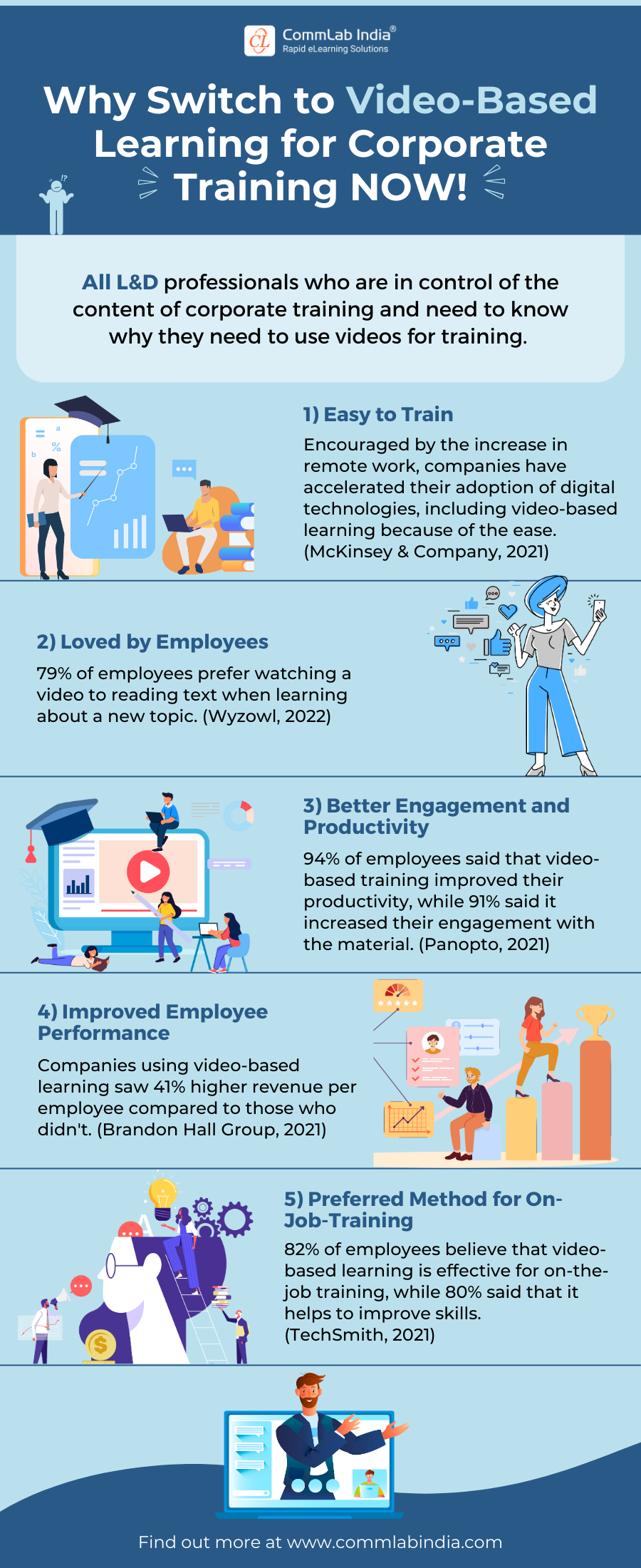
Need some more convincing? Well, here’s something highly effective and interactive just for you! Check out the infographic below to find out why you should switch to video-based learning for corporate training right now!
How Can Video-Based Training Be Applied Across eLearning Programs?
Where Can Video-Based Training Be Integrated in eLearning Programs?
You can include video-based training across multiple stages and formats of eLearning, such as:
- Onboarding and induction – to introduce roles, culture, and processes quickly
- Compliance training – to explain policies and expected behaviors clearly
- Product and systems training – to demonstrate features and workflows visually
- Sales and soft skills training – to model conversations and real-life scenarios
- Performance support – to enable just-in-time, on-the-job learning
Video-based training is most effective when it is embedded strategically across different eLearning programs and supported by the right tools, platforms, and content processes. Rather than existing as standalone assets, videos deliver the highest value when integrated into structured learning journeys that support performance, scalability, and measurable business outcomes.
Video-based training is applied across eLearning programs such as:
- Technical training programs to visually demonstrate tools, workflows, and troubleshooting steps
- Product enablement programs to support launches, updates, and faster feature adoption
- Process and SOP training programs to standardize execution and reduce operational errors
- Leadership and management development programs to reinforce decision-making and people skills
- Change management and transformation programs to drive alignment and adoption of new ways of working
- Customer, partner, and extended enterprise training programs to enable external audiences at scale
- Continuous learning and upskilling programs to support evolving skills and long-term capability building
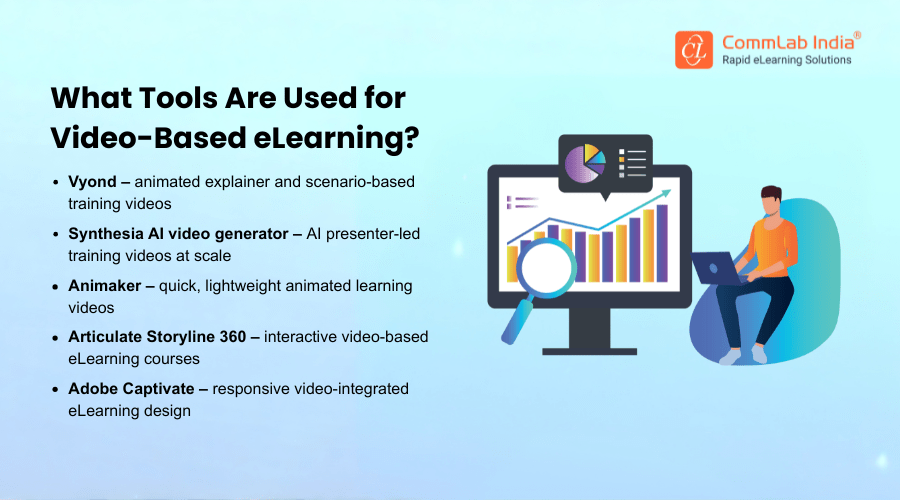
Effective application also depends on the right integration and execution strategies, including:
- Authoring tool integration to seamlessly combine video with interactions, assessments, and scenarios within eLearning courses

- LMS and LXP alignment to enable tracking, analytics, personalization, and data-driven optimization
- Content modularization so video assets can be reused, repurposed, and updated without rebuilding entire courses
- Localization and accessibility workflows that support subtitles, voiceovers, and multilingual delivery at scale
- Performance data feedback loops that use learner analytics to refine video length, format, and placement
When supported by the right tools and processes, video-based training reduces delivery costs, improves agility, and extends content lifespan—making it a high-ROI component of modern, performance-driven eLearning ecosystems.
Conclusion
By now, you’ve likely got a clear answer to the question of why use video in eLearning. When designed thoughtfully, video goes beyond visual appeal; it makes corporate training more engaging, scalable, and impactful. From addressing diverse learner needs to improving knowledge retention and training ROI, video has become a cornerstone of effective modern eLearning.
To take this a step further, explore our free eBook, as it dives into how video-based learning addresses diverse learner needs, explores high-impact video formats, and reveals how AI can elevate video experiences while optimizing learning outcomes and training ROI. You’ll also gain insights into emerging trends shaping the future of video-based learning.
Download now and start building smarter, AI-powered video-based learning experiences that deliver real impact.