
Walk into almost any enterprise L&D function today and you'll find AI already in use. An instructional designer drafting a scenario with a chatbot. A localization lead running translations through an AI-assisted workflow. Someone generating a first-pass storyboard in a fraction of the time it used to take.
And yet, ask the same L&D leaders whether AI has changed what their team can deliver at scale, and the answer is usually a hesitant "sort of." Individual output has gotten faster. Organizational capability hasn't moved nearly as much. That gap — between people using AI well on their own and a team executing with AI as a genuine capability — is the starting point for this entire series.
This is the first article in an eleven-part series on RAPID-AI, a framework built by CommLab India for closing that gap. Before getting into any of its seven principles, it's worth being precise about the problem the framework actually solves — because the problem, more than the framework itself, is what determines whether any of this is worth adopting.
Table Of Content
- The Problem Isn't a Shortage of AI Tools
- Why This Gap Is Expensive, Not Just Inefficient
- What a Framework Actually Needs to Do
- Introducing RAPID-AI
- The One Idea Everything Else in This Series Builds On
- Who This Series Is For
- What to Expect From the Rest of This Series
- Frequently Asked Questions
The Problem Isn't a Shortage of AI Tools
It's tempting to describe slow AI adoption in L&D as a tooling problem — the wrong platform, insufficient licenses, not enough training on prompting. In most organizations that's not what's actually happening. The tools are there, and individual practitioners are often using them skillfully.
What's usually missing is structural, not technical: AI has been adopted as a set of disconnected productivity habits rather than as part of a governed way of working. One instructional designer experiments with a chatbot for storyboarding. Another uses an image generator for visuals. A third has built a personal habit of running drafts through a self-critique pass before submitting them for review. Each of these is a genuine improvement for that person's own output.
None of it adds up to organizational capability, because the review cycles, instructional standards, and quality checks around all of that individual activity stay exactly as they were. The team can produce faster first drafts. It cannot yet reliably absorb more volume, more languages, or more urgent requests without the same bottlenecks it had before AI showed up.
Why This Gap Is Expensive, Not Just Inefficient
The cost of this gap isn't merely wasted potential — it's a specific, recurring failure mode: quality problems that used to surface during drafting now surface later, further downstream, because AI-generated drafts often look more finished than they actually are.
A rough AI-generated first draft in a text editor invites scrutiny. A polished, well-formatted AI-generated module invites acceptance. Without a structural counterweight — a defined point where a human has to actively evaluate rather than passively approve — teams start moving faster in a way that quietly increases risk rather than reducing it. The errors don't disappear; they just get caught later, in SME review, in a pilot cohort, or worse, after a course has already launched.
This is the specific pattern CommLab India kept observing across enterprise learning teams while building RAPID-AI: AI sped up drafting, but without a defined structure, quality problems just moved further downstream, where they cost more time and credibility to fix than they would have cost to catch earlier.
What a Framework Actually Needs to Do
Most conversations about "AI frameworks" for L&D stop at the concept — a slide with a few principles on it, agreed to in a meeting, that doesn't change how anyone actually works the next day. A framework that's worth adopting has to do something more specific than express good intentions. It has to answer three concrete questions.
- Where, specifically, is AI allowed to move fast? Not a vague endorsement of "using AI where it helps," but a named list of tasks and workflow stages where AI-generated drafts are the expected starting point.
- Where, specifically, does a human have to close the loop? A short, explicit list of decisions and sign-offs that stay human regardless of how good AI's draft looks or how tight the deadline is.
- How does this hold up under real pressure? Not just under calm, well-resourced conditions, but during the exact moments — a compliance deadline, a surge request, a product launch — when the temptation to skip a step is highest.
Introducing RAPID-AI
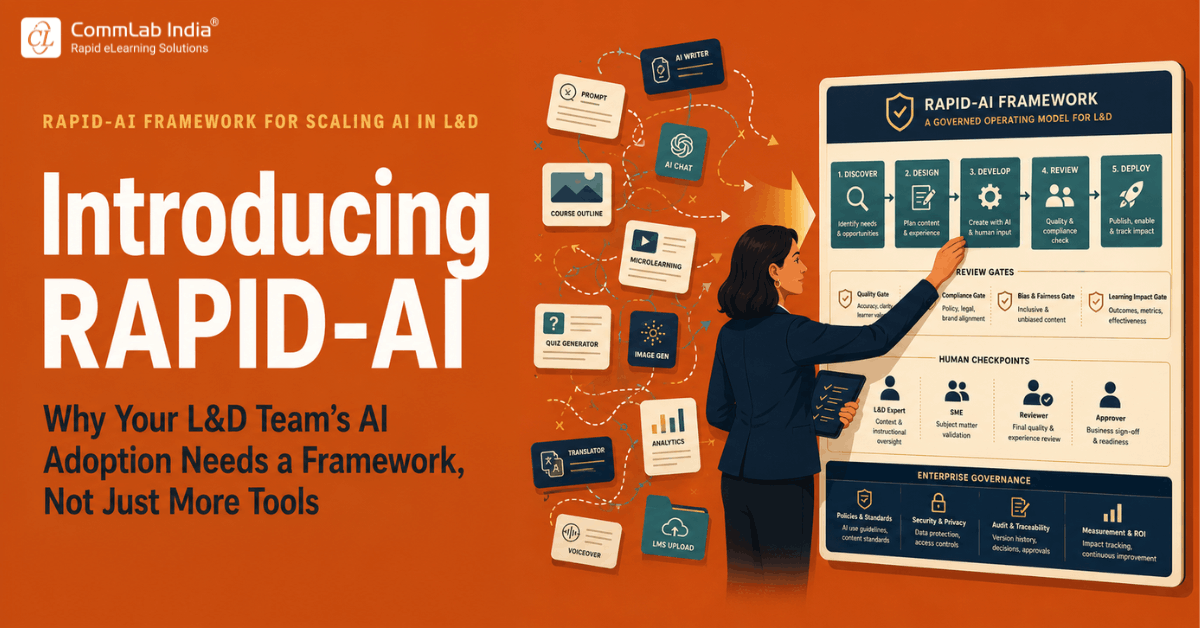
RAPID-AI is CommLab India's answer to those three questions. It stands for Responsible AI-Powered Instructional Design, and it is not a tool, a plugin, or a piece of software. It's an operating discipline — seven principles that define where AI adds speed and where human instructional judgment has to hold the line, operationalized through a five-stage development workflow and calibrated across three levels of organizational maturity.
The name is also the map for the rest of this series. Each letter — R, A, P, I, D, A, I — names a discipline an L&D team has to build, not a feature to switch on: Reframe the role of AI, Anchor in human judgment, Prompt with purpose, Introduce challenge, Design through stages, Adapt to maturity, and Institutionalize governance. The articles that follow this one take each of those seven principles in turn, then cover the operating model underneath all of them, the three maturity levels the framework scales through, and a practical roadmap for getting started.
The One Idea Everything Else in This Series Builds On
If there's a single sentence to take from this introduction before moving into the rest of the series, it's this: AI accelerates drafting, options, and speed. Humans own intent, judgment, and quality. Every principle, every workflow stage, and every governance checkpoint covered in the next ten articles exists to protect that division of labor — especially at the exact moments, under the exact deadlines, when it's most tempting to blur it.
That's a simple idea to state and a genuinely difficult one to hold onto in practice, which is exactly why it needs a framework around it rather than a slogan. The rest of this series is that framework, broken down into its actual components so you can see what building one really involves.
Who This Series Is For
This series is written for the people who actually have to make AI adoption work inside an L&D function, not for an executive audience looking for a one-slide summary. That means instructional designers deciding how to prompt and review AI-generated drafts day to day, team leads deciding what checkpoints to build into a workflow, and L&D leaders deciding how much structure to put in place before scaling AI use across a whole function.
It's also written for a specific moment many of these teams are in right now: past the initial experimentation phase, where a few people have found AI genuinely useful, but before any of that has turned into a documented, team-wide way of working. If individual AI use in your organization already outpaces your team's shared process for reviewing and governing it, this series is describing your situation specifically, not a hypothetical one.
One thing this series deliberately avoids is treating AI adoption as primarily a technology decision. Every article that follows treats it as an instructional design problem — a question of workflow, judgment, and governance — because that's a more accurate description of where the actual difficulty lives, and because it's the framing that produces a framework teams can actually use rather than a tools comparison that goes stale the next time a new model ships.
What to Expect From the Rest of This Series
The next seven articles each take one letter of RAPID-AI and unpack it as a practical discipline: how to actually reframe AI's role day to day, what it looks like to anchor a project in human judgment before opening any AI tool, how task-specific prompting works in practice, and so on through Institutionalize governance. Each one is written to stand alone, so you can start wherever your team's biggest gap currently is rather than reading in strict order.
After the seven principles, three closing articles pull the pieces back together: the single operating model underneath all seven components, the three levels of maturity a team moves through as it scales the framework, and a practical roadmap for the first thirty, sixty, and ninety days of putting any of this into practice. Read end to end, the series is the complete, concrete version of what a lot of organizations are currently trying to build from a single slide and good intentions.
Frequently Asked Questions
Why isn't better AI tooling enough to scale L&D output?
Because the bottleneck usually isn't the tools — it's the lack of a governed structure around how AI-generated drafts move through review. Individual practitioners can get faster without the team as a whole gaining reliable capacity, because review cycles and quality checks stay unchanged.
What's the risk of adopting AI in L&D without a framework?
Quality problems that used to surface during drafting start surfacing later, further downstream, because a polished AI-generated draft often gets less scrutiny than a rough one — even though it hasn't necessarily been evaluated for fit, accuracy, or audience any more than a rough draft has.
What is RAPID-AI?
RAPID-AI stands for Responsible AI-Powered Instructional Design — a seven-principle operating framework built by CommLab India that defines where AI is allowed to accelerate instructional design work and where human judgment has to close the loop, operationalized through a five-stage workflow and three maturity levels.
Is RAPID-AI a specific AI tool or platform?
No. RAPID-AI is not a tool — it's an operating discipline that L&D teams apply using whatever AI tools they already have. The framework focuses on governance, workflow structure, and decision ownership rather than any specific software.
Who is the RAPID-AI series written for?
Instructional designers, team leads, and L&D leaders whose teams have moved past isolated AI experimentation but haven't yet built a documented, shared way of governing AI use — particularly teams where individual AI adoption already outpaces the team's collective process for reviewing it.