AI is available to virtually every Learning & Development team on the planet right now. Anyone with a laptop and a login to a tool like Claude can generate a course outline, a set of learning objectives, or a full storyboard in minutes. Access is no longer the bottleneck it was even eighteen months ago.
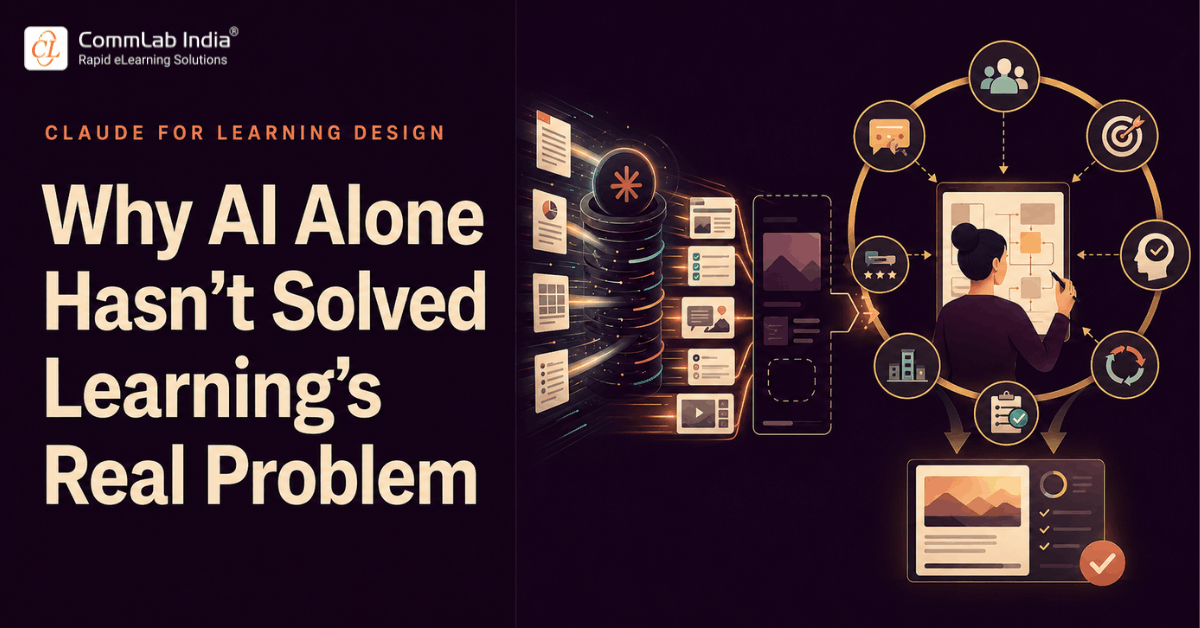
So, here's the question almost nobody in L&D is asking out loud: if AI is available to everyone, why isn't effective learning?
Two instructional designers can start with the exact same learning brief, use the exact same AI tool, and even draw from the exact same source material, and still produce learning experiences that are worlds apart.
One might result in a course that changes what employees actually do on the job. The other might result in a well-formatted, technically complete course that nobody remembers a week later, let alone applies.
If the AI is identical and the inputs are identical, what explains the gap? That question is worth sitting with, because the answer challenges two assumptions that have quietly become conventional wisdom in L&D circles over the past two years.
Table of Content
- Two Beliefs Reshaping, and Misleading, L&D
- The Reality L&D Teams Are Actually Navigating
- The Cost of Getting This Distinction Wrong
- Why the Tool Matters Less Than the Question Behind It
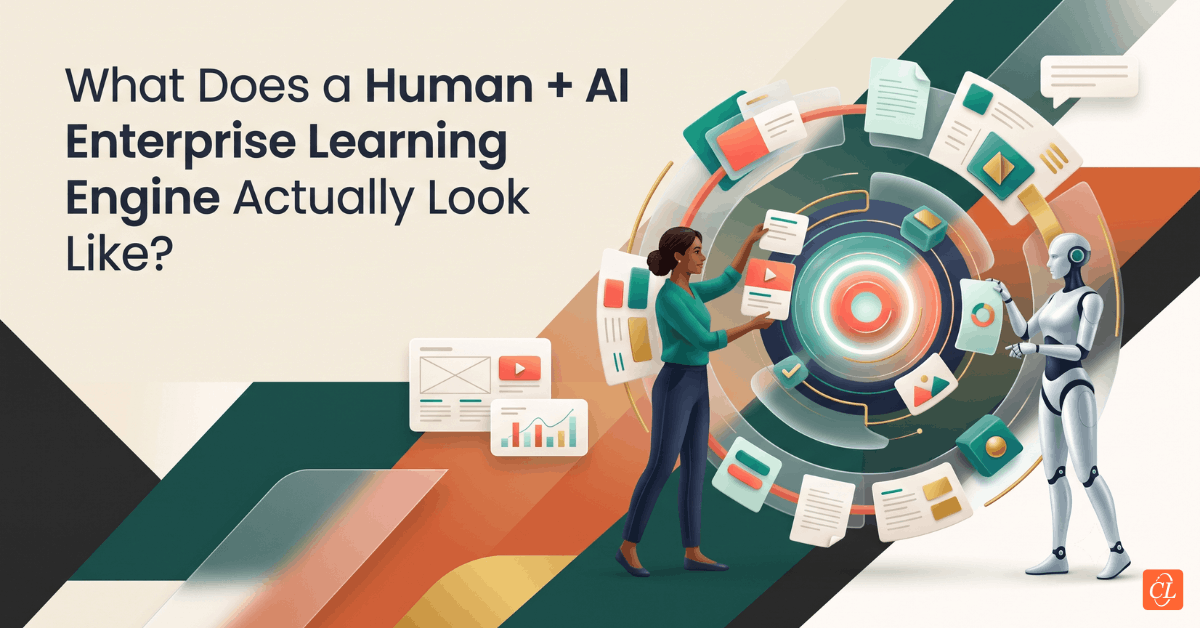
- The Real Divide Isn't Human vs. AI
- What This Means for Your L&D Strategy
- FAQ
Two Beliefs Reshaping, and Misleading, L&D
As AI adoption in learning design has accelerated, two narratives have taken hold across conference stages, LinkedIn threads, and internal town halls. Both contain a kernel of truth. Neither is complete, and treating them as complete is where a lot of L&D teams are quietly going wrong.
Belief #1: AI Will Replace Instructional Designers
This is the anxiety sitting underneath a lot of L&D conversations right now, even when nobody says it out loud in a team meeting. The logic seems sound on the surface: AI can already draft objectives, write scenarios, structure modules, and generate assessments faster than any human. If it can do the tasks, doesn't it eventually do the job?
The flaw in this reasoning isn't that AI can't do those tasks. It clearly can, and does them well.
The flaw is the assumption that instructional design was those tasks.
Drafting a module outline is a task. Deciding why that module exists, what behavior it needs to change on the job, and whether training is even the right intervention in the first place is judgment, and it sits a level above the task itself.
Consider a common scenario:
A compliance manager requests "a course on the new data privacy policy." A task-executor, human or AI, will produce exactly that: a course covering the policy.
An instructional designer with real judgment will ask a different set of questions first.
- Is the actual performance gap a knowledge gap, or is it a process problem that no course will fix?
- What decisions do employees need to make differently in the moment, and where do those moments occur?
- Is a full course even the right format, or would a two-minute job aid at the point of need solve this faster and cheaper?
AI has gotten remarkably good at answering "how do we build the course."
It has no mechanism for answering "should we build a course at all," because that answer depends on business context, stakeholder politics, learner psychology, and organizational history that live nowhere in a prompt or a source document.
That context has to be supplied by a human who understands the business, not summoned from an AI model, however capable.
Belief #2: The Better the Prompt, the Better the Learning Experience
This belief has quietly pulled a lot of L&D energy toward prompt engineering, as if the gap between mediocre AI output and excellent AI output is fundamentally a wording problem. Craft the perfect prompt, the thinking goes, and you unlock the perfect learning experience. Entire internal wikis of "prompt libraries" have sprung up around this idea.
It's an appealing belief because it's actionable, teachable, and gives teams something concrete to train on. Unfortunately, it also misdiagnoses where quality actually comes from.
A brilliantly worded prompt built on a shallow understanding of the learner will produce a brilliantly worded, shallow learning experience, just delivered faster and with better formatting.
Prompting is a multiplier, not a source. It amplifies whatever instructional thinking is already behind it, for better or worse.
Put two instructional designers in front of the same AI tool with the same learning brief. Give one of them a polished, well-engineered prompt template and a shallow understanding of the audience. Give the other a rough, unpolished prompt but a sharp understanding of what the learner struggles with on the job, where the real performance gap sits, and what "success" needs to look like six weeks after training.
The second designer's output will almost always be more effective, even with objectively worse prompt craft, because the instructional thinking behind the prompt is doing the real work, not the prompt's wording.
Neither belief is wrong so much as incomplete. And the gap in both of them points to the same missing piece: instructional judgment, which no AI tool currently possesses and no prompt can manufacture from scratch.
The Reality L&D Teams Are Actually Navigating
Set the myths aside for a moment and look at what modern L&D teams are actually being asked to deliver. Five pressures show up again and again, regardless of industry, geography, or company size:
- Faster delivery. Timelines keep shrinking while the demand for new learning content keeps growing. "We need this live in three weeks" has become the norm rather than the exception, and stakeholders increasingly expect AI to have collapsed timelines that used to take months.
- Scaling learning. More audiences, more formats, more languages, more delivery channels, often for the same headcount that supported a fraction of that scope two years ago. A single learning need now frequently has to become an ILT session, a self-paced module, a job aid, and a facilitator guide, all in parallel.
- Complex knowledge. Someone has to translate dense SME expertise, SOPs, technical manuals, compliance documents, engineering specs, into something a frontline learner can actually absorb and apply under real working conditions.
- High-stakes learning. In compliance and technical training, accuracy isn't optional. Getting it slightly wrong isn't a minor quality issue; it's a regulatory, safety, or legal risk that can follow the organization for years.
- Demonstrating impact. Course completions and satisfaction scores no longer satisfy stakeholders on their own. L&D is increasingly expected to draw a credible line from a learning intervention back to a business metric: reduced errors, faster ramp time, fewer support tickets.
It's not surprising that AI looks like the answer to all five. It genuinely can help with volume, speed, and the sheer cognitive load of processing large amounts of source content in a short window.
But "AI can help with the workload" and "AI can replace the judgment" are two very different claims, and the industry has been quietly conflating them, often without realizing it's happening.
The Cost of Getting This Distinction Wrong
The risk here isn't abstract.
Teams that lean on the "better prompt, better learning" belief tend to invest heavily in prompt libraries and AI training, then quietly wonder six months later why learner feedback scores and behavior-change metrics haven't moved, even though production speed clearly has.
Teams that lean on the "AI replaces instructional designers" belief tend to under-resource the design function itself, routing SME content straight to AI with minimal instructional review, and end up with content that's technically accurate, fast to produce, and largely ineffective at changing behavior on the job.
Both outcomes look like progress on a dashboard. Neither one is progress against the actual goal, which was never "produce more content." It was always "change what people do."
Why the Tool Matters Less Than the Question Behind It
With dozens of AI tools now available to L&D teams, the natural next question stopped being should we use AI a while ago; nearly every team has already answered that one. The more useful question, and the one far fewer teams are asking with any rigor, is: which AI tool actually supports the way instructional designers think and work, rather than just the way they produce content?
That distinction matters more than it sounds.
A tool that's excellent at generating polished slides doesn't necessarily help an instructional designer wrestle with a messy forty-page SME document, spot a gap in a learning sequence, or explore three different instructional strategies before settling on one.
Output speed and instructional support are not the same capability, and teams that select tools purely on the former often end up producing the wrong thing faster than they used to produce it.
This is the exact question that led us to evaluate Claude in depth, not as a content generator to be measured on slide count or word count, but as a potential thinking partner for the parts of instructional design that actually determine learning quality: understanding complex source material, organizing large volumes of information, and structuring a learning journey around it.
What we found in that evaluation, and where the real capability boundary sits, is the subject of the next piece in this series.
Quick Reference: Myth vs. Reality
| The Belief | The Incomplete Part | The Fuller Picture |
| AI will replace instructional designers | Confuses executing tasks with exercising judgment | AI accelerates production; humans still decide strategy, relevance, and success criteria |
| A better prompt produces better learning | Treats wording as the source of quality | Prompting amplifies existing instructional thinking, good or bad; it doesn't create it |
| Faster AI output equals better learning outcomes | Conflates production speed with behavior change | Speed and effectiveness are different metrics; one doesn't guarantee the other |
The Real Divide Isn't Human vs. AI
The uncomfortable truth both popular beliefs dance around is this: the meaningful divide in AI-augmented learning design was never human versus AI.
It's instructional expertise versus its absence, with AI simply making the consequences of that absence visible faster and at greater scale than ever before.
A skilled instructional designer using Claude well can now do in days what used to take weeks. A team without that expertise, using the exact same tool, can now produce mediocre learning at a speed and scale that was previously impossible, which is arguably a worse outcome than producing it slowly, because it consumes the same budget and stakeholder goodwill while delivering less value.
AI didn't remove the need for instructional judgment. If anything, it raised the stakes on having it, because the tools have made it trivially easy to skip straight to content production without ever doing the strategic thinking that should precede it.
What This Means for Your L&D Strategy
If your team is evaluating AI tools, running pilots, or trying to figure out why AI adoption hasn't moved the needle on learning quality the way it moved the needle on speed, the diagnostic question isn't "which tool should we buy" or "how do we write better prompts." It's: where in our current process is instructional judgment thin, and is AI being asked to compensate for that gap instead of amplify good thinking that's already there?
That question is a better starting point than any prompt library, and it's the thread we'll pull on throughout this series, starting with why we chose to build our AI-augmented workflow specifically around Claude, and what we were actually solving for when we did.
Frequently Asked Questions
1. Will AI eventually replace instructional designers entirely?
A. Current AI tools, including Claude, are highly capable at executing instructional tasks: drafting content, structuring modules, generating assessments, but they don't independently determine business alignment, learner relevance, or what success should look like. Those remain human judgment calls that shape whether a task-executor's output actually becomes effective learning.
2. Is prompt engineering worth investing in for L&D teams?
A. Prompt quality matters, but it's a multiplier on existing instructional thinking, not a substitute for it. Teams get more value from strengthening instructional judgment first and treating prompt craft as a secondary skill layered on top, rather than the primary lever for learning quality.
3. How do I know if my team is over-relying on AI output speed?
A. A useful signal is whether your quality conversations focus on production metrics (turnaround time, number of assets, completion rates) or on behavior-change metrics (performance shifts, error reduction, on-the-job application). If the former dominates, speed may be masking a judgment gap rather than closing one.