How long does it really take for a learning team to move from an initial brief to something a stakeholder can meaningfully review, react to, and experience?
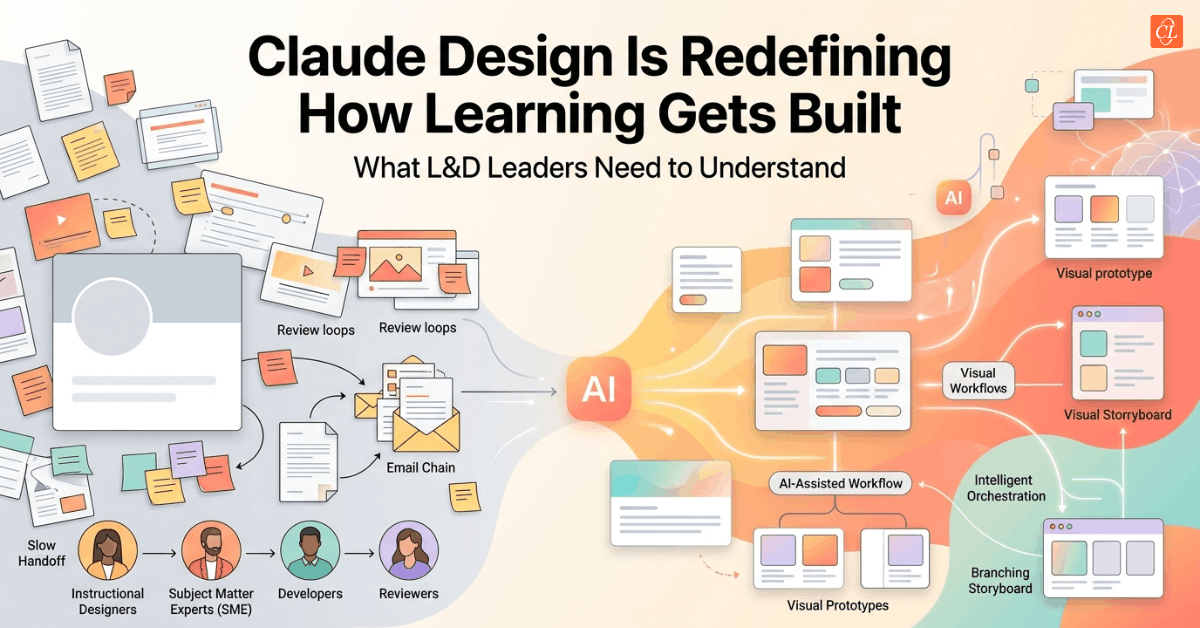
For most L&D teams, the answer is still measured in weeks rather than days. A request arrives, source content gets assembled, instructional designers begin shaping the structure, visual teams translate concepts into layouts, feedback loops stretch across multiple tools and stakeholders, and somewhere in the middle of that process the original intent often becomes diluted by operational complexity. By the time the first interactive prototype is ready, the team has already spent considerable energy managing transitions between systems, formats, reviewers, and workflows rather than refining the learning experience itself.
This is the environment into which Anthropic’s Claude Design has entered.
Recently launched inside Claude.ai, Claude Design is a visual creation workspace that allows users to describe what they want in plain language and rapidly generate prototypes, slide decks, interactive mockups, visual concepts, and structured learning artifacts that are immediately shareable and reviewable. What makes this significant is not simply the quality of the output, but the degree to which it compresses the distance between idea, visualization, iteration, and stakeholder validation.
At first glance, it is easy to interpret Claude Design as just another AI-assisted productivity feature entering the increasingly crowded learning technology landscape. But that interpretation understates what is actually changing. Claude Design signals a broader shift in how learning experiences may increasingly be conceptualized, structured, visualized, and refined inside unified AI-supported environments where content generation, interaction design, prototyping, and iteration begin to merge into a more continuous workflow.
At the same time, it is important to approach this shift with clarity rather than hype.
Claude Design dramatically accelerates the creation and visualization of learning assets, but accelerating production is not the same thing as solving instructional design itself. The deeper work of identifying performance gaps, sequencing learning appropriately, defining meaningful practice, validating assessment logic, reducing cognitive overload, and ensuring alignment with real-world business outcomes still depends heavily on human judgment. That distinction matters because one of the biggest misconceptions surrounding AI in learning today is the assumption that faster content generation automatically translates into better learning experiences.
The real significance of Claude Design lies elsewhere. It lies in the fact that many of the operational barriers that historically separated content creation, visual design, prototyping, and review are beginning to collapse into a far more fluid and iterative workflow. For L&D teams, this creates an opportunity to spend less time navigating fragmented production processes and more time focusing on the higher-order instructional thinking that actually determines learning effectiveness.
Table of Contents
- What Claude Design Actually Does
- From Content Generation to Experience Visualization
- AI as a Workflow Collaborator, Not a Replacement for Instructional Judgment
- The Most Important Shift: Reducing Operational Friction Without Removing Intellectual Rigor
- What This Means for Instructional Designers
- The Governance Challenge Behind Faster Creation
- The Next Evolution: AI as Critic, Reviewer, and Auditor
- Conclusion
What Claude Design Actually Does
Claude Design lives inside the Design workspace within Claude.ai and functions as a conversational visual creation environment. Users can describe what they want using natural language prompts, and Claude generates an initial visual output that can then be refined through a combination of conversational instructions, inline comments, direct canvas editing, and contextual adjustments to layout, typography, spacing, color, and visual hierarchy.
What makes the platform particularly notable is not just its ability to generate visuals, but the way it attempts to embed organizational consistency directly into the creation process itself. Claude can analyze existing websites, design systems, Figma files, codebases, slide decks, and brand assets to infer reusable patterns such as typography systems, interface components, layout structures, and color standards. Future outputs inherit those patterns automatically, helping organizations avoid the fragmented visual inconsistency that often emerges when learning assets are created across distributed teams, regions, or vendors.
Projects can begin from multiple starting points:
- Text prompts
- Uploaded DOCX, PPTX, or XLSX files
- Sketches or reference images
- Live website URLs
The export flexibility also deserves attention. Outputs can be shared as:
- PDFs
- PPTX presentations
- Standalone HTML experiences
- Canva-editable assets
- Shareable links
- Production-ready handoffs into Claude Code workflows
For learning teams, this significantly reduces the amount of translation work typically required when moving between ideation, review, and development environments.
From Content Generation to Experience Visualization
Until recently, most AI tools in learning and development functioned primarily as assistants for content generation. They could help summarize documents, generate quiz questions, suggest learning objectives, or draft outlines, but the actual transformation of those outputs into coherent learning experiences still required movement across separate authoring, design, and development systems.
Claude Design changes the nature of that workflow by introducing a visual co-creation layer directly into the generation process itself.
Instead of progressing through a rigid sequence where content is created first and visualized later, teams can increasingly move through overlapping cycles of ideation, prototyping, review, and refinement in near real time. A learning concept can evolve into a visual storyboard within minutes. A rough storyboard can become an interactive prototype before the authoring environment has even been opened. Feedback can occur against tangible experiences rather than static documents.
This dramatically shortens the path between concept and validation.
However, it is equally important to recognize what Claude Design is not doing. While the platform accelerates the visualization and structuring of learning experiences, it does not inherently understand instructional effectiveness. A polished prototype is not automatically a well-designed learning solution. AI can help organize information, suggest layouts, and accelerate production, but it does not independently determine which concepts deserve emphasis, which interactions improve retention, which activities support transfer, or whether the learning experience actually addresses the underlying performance problem.
That distinction remains fundamentally human.
AI as a Workflow Collaborator, Not a Replacement for Instructional Judgment
One of the most meaningful shifts introduced by Claude Design is the repositioning of AI within the learning workflow itself.
Rather than functioning solely as a passive content generator, AI now participates more actively in structuring, visualizing, refining, and iterating on learning experiences as they evolve. The interaction becomes less transactional and more collaborative, allowing designers to shape outputs conversationally while receiving increasingly sophisticated visual and structural responses from the system.
But this shift should be framed carefully.
Claude Design moves AI beyond basic assistance and into workflow collaboration, but that does not mean AI has suddenly acquired the full instructional reasoning capabilities required for high-quality learning design.
Effective instructional design involves far more than assembling visually polished screens or generating structured content quickly. It requires the ability to:
- Identify what learners actually need to do differently
- Distinguish essential knowledge from supporting detail
- Determine the appropriate learning treatment
- Sequence complexity thoughtfully
- Design meaningful practice opportunities
- Validate whether assessments genuinely measure intended outcomes
These are judgment-heavy activities rooted in context, experience, tradeoff analysis, and human interpretation.
As a result, the role of instructional designers does not disappear in AI-supported environments. Instead, the role evolves upward. The value of the instructional designer increasingly shifts away from manual production mechanics and toward:
- Orchestration
- Evaluation
- Learning architecture
- Governance
- Performance alignment
Advanced Instructional Design Meets AI
- Modern instructional strategies
- Top Gen AI tools in action
- Case studies, tips, and tricks
- And More!
The Most Important Shift: Reducing Operational Friction Without Removing Intellectual Rigor
Much of the current excitement surrounding AI in L&D revolves around speed. Faster drafting. Faster prototyping. Faster asset creation. Faster iteration.
Those gains are real.
But there is an important nuance that learning teams cannot afford to ignore.
Not all friction in instructional design is wasteful. Some forms of friction are intellectually necessary because they force deeper thinking, sharper prioritization, and stronger design decisions.
High-quality learning experiences are rarely created through pure acceleration alone. They emerge through critique, ambiguity, revision, debate, simplification, and the deliberate process of deciding what truly matters.
This is where many conversations about AI-enabled learning workflows become overly simplistic. If teams begin treating speed itself as the primary indicator of quality, they risk removing the very moments where instructional rigor is formed.
The challenge is not to eliminate thoughtful deliberation from the process.
The challenge is to eliminate unnecessary operational overhead so that learning professionals can devote more time and energy to the strategic and cognitive aspects of design that AI still struggles to replicate meaningfully.
What This Means for Instructional Designers
For instructional designers, Claude Design introduces both a significant opportunity and an equally significant recalibration of responsibilities.
One of the most immediate benefits lies in the acceleration of early-stage content transformation. Instructional designers frequently begin projects with:
- Dense SME documentation
- Overloaded presentations
- Lengthy recordings
- Spreadsheets
- Fragmented notes
Claude Design dramatically reduces the time required to convert those raw materials into:
- Structured visual drafts
- Learner flows
- Storyboard concepts
- Job aids
- Prototype experiences
This removes much of the blank-page problem that historically consumed large portions of the design process.
At the same time, the reduction in production friction increases the importance of higher-order instructional judgment. Designers must now spend more time evaluating:
- What deserves emphasis
- What should be simplified
- What belongs in performance support
- Which interactions genuinely reinforce learning
- How experiences should adapt to business context
The work becomes less about manually assembling assets and more about shaping learning systems.
The Governance Challenge Behind Faster Creation
As AI accelerates learning production, governance becomes more important rather than less important.
Faster creation introduces enormous opportunities for responsiveness and experimentation, but it also introduces new risks around:
- Inconsistency
- Quality control
- Instructional coherence
- Uncontrolled proliferation of AI-generated content
Organizations that focus only on tool adoption without designing governance structures around review discipline and instructional standards may ultimately create fragmented learning ecosystems at scale.
Tool access alone is not governance.
Real governance involves defining:
- Where AI supports generation
- Where human review is mandatory
- Where critique is required
- How outputs are evaluated
- How instructional standards are enforced
- How quality is maintained
The organizations that succeed in this transition will not simply be the ones that adopt AI tools fastest. They will be the ones that build the most disciplined and thoughtful human-AI collaboration models around them.
The Next Evolution: AI as Critic, Reviewer, and Auditor
Today’s AI systems are strongest at generation.
The next major evolution may emerge not from creating faster drafts, but from building systems capable of more meaningful critique and evaluation.
Future AI-assisted workflows will likely require AI systems that can:
- Challenge weak objectives
- Identify overloaded interfaces
- Question decorative interactions
- Detect assessment misalignment
- Surface hidden assumptions
- Evaluate learning-flow coherence
In other words, the future of AI in learning may depend less on AI as a content machine and more on AI as a structured thinking partner.
That is where the deeper long-term opportunity may ultimately lie.
Conclusion
Claude Design represents a meaningful turning point in how learning experiences are created, visualized, and iterated.
By collapsing many of the operational barriers that historically separated content generation, visual prototyping, review, and refinement, it allows learning teams to move from concept to reviewable experience with a level of speed and flexibility that would have been difficult to imagine only a few years ago.
But the deeper significance of this shift is not simply about acceleration.
The long-term value of AI-enabled learning workflows will ultimately depend on how effectively organizations combine AI-driven speed with human instructional judgment, governance discipline, thoughtful critique, and performance-centered design thinking.
The future of workplace learning will not be defined solely by how quickly content can be generated. It will be defined by how well organizations preserve Rigor, Coherence, Judgment and Instructional quality inside increasingly AI-assisted systems of learning creation.
For instructional designers, eLearning developers, and L&D leaders, the opportunity is substantial. The teams that succeed will not simply produce learning faster. They will build stronger systems for thinking, designing, evaluating, and continuously improving learning in collaboration with AI.