As organizations scale learning, content is no longer the constraint. The real challenge lies in how that content is selected, structured, and transformed into meaningful learning experiences.
Most organizations already have an abundance of knowledge in the form of documents, presentations, systems, and expert insights. Yet, much of this content remains underutilized or ineffective because it is not designed for learning. It is created for reference, not for understanding or application.
This is where instructional design plays a critical role at the content layer.
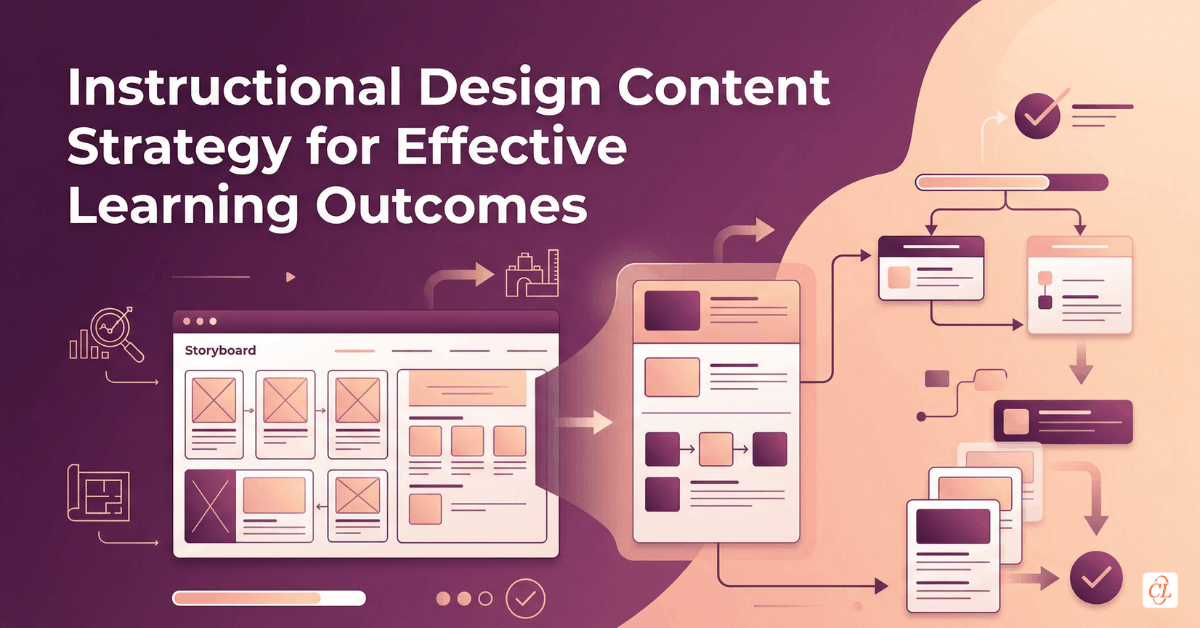
Instructional design content strategy ensures that learning is not built from scratch every time, but is intelligently curated, structured, and aligned with outcomes. It determines what content should be included, how it should be presented, and how learners will engage with and apply it.
In this article, you will explore how to approach content as a strategic asset in instructional design. You will understand how to curate effectively, design for comprehension, and balance teaching with testing to create learning experiences that are both efficient and impactful.
Download eBook: Advanced Instructional Design Meets AI
Table of Contents
- Content Strategy as the Foundation of Instructional Design
- From Content Creation to Content Curation
- What Makes Content “Learnable”
- Structuring Content for Comprehension and Retention
- Teaching vs Testing: Designing for Real Learning
- Balancing Depth, Brevity, and Relevance
- Building a Scalable Content Design System
- FAQs
Content Strategy as the Foundation of Instructional Design
Instructional design is often associated with interactions, visuals, and engagement techniques. However, the effectiveness of any learning experience ultimately depends on how well its content is designed.
Content strategy provides the foundation for this process. It ensures that learning is built with intention rather than assembled from disconnected pieces of information.
When content strategy is absent, learning experiences tend to become overloaded, inconsistent, and misaligned with objectives. When it is applied effectively, content becomes focused, structured, and aligned with outcomes.
What a Strong Content Strategy Enables
- Clarity of purpose
Every piece of content included in the learning experience serves a clearly defined objective, reducing noise and improving focus - Logical progression
Information flows in a way that supports understanding, allowing learners to build knowledge step by step - Consistency across learning experiences
Standardized approaches ensure that learners encounter familiar structures and expectations
Content Creation vs Content Strategy
| Dimension | Content Creation | Content Strategy |
| Focus | Producing new material | Selecting and shaping knowledge |
| Approach | Volume-driven | Outcome-driven |
| Risk | Information overload | Information clarity |
| Value | Adds content | Improves learning effectiveness |
Effective instructional design is not about creating more content. It is about making better decisions about the content that already exists.
From Content Creation to Content Curation
As organizations accumulate knowledge, the ability to curate content becomes more valuable than the ability to create it. Instructional designers must act as filters and translators, transforming raw information into meaningful learning experiences.
Content curation is not simply collecting resources. It is a deliberate process that includes:
- Identifying relevant material
Selecting content that directly supports the learning objective rather than including everything available - Eliminating redundancy
Removing duplicate or unnecessary information to improve clarity - Structuring for usability
Organizing content in a way that supports learning flow and comprehension
Why Curation Matters at Scale
- Reduces development time by leveraging existing resources
- Ensures consistency across learning programs
- Improves learner focus by removing unnecessary information
A Practical Curation Filter
Before including any content, instructional designers should ask:
- Does this help the learner perform better in their role?
- Is this essential for achieving the learning objective?
- Can this be simplified without losing meaning?
If the answer is unclear, the content likely needs to be refined or removed.
What Makes Content Learnable
Not all content is inherently suitable for learning. Information becomes effective only when it is transformed into a form that supports understanding and application.
Characteristics of Learnable Content
| Attribute | What It Means in Practice |
| Clarity | Information is easy to understand and free from unnecessary complexity |
| Relevance | Content is directly connected to learner needs and context |
| Structure | Ideas are organized in a logical sequence |
| Applicability | Learners can use the information in real-world situations |
Transforming Raw Content into Learning Content
- Convert dense material into structured explanations that guide understanding
- Use examples and analogies to clarify abstract concepts
- Highlight key ideas to help learners focus on what matters most
Content becomes learnable when it is designed for the learner’s experience rather than the expert’s perspective.
Structuring Content for Comprehension and Retention
The way content is structured determines how effectively it is understood and remembered. Poorly structured content increases cognitive load, while well-structured content enables clarity and retention.
Designing for Cognitive Efficiency
- Progressive sequencing
Introduce concepts gradually, allowing learners to build understanding without being overwhelmed - Chunking information
Break content into smaller, digestible units that are easier to process - Reinforcement mechanisms
Revisit key ideas through summaries, examples, and practice
Strengthening Retention Through Design
- Provide opportunities for learners to apply concepts
- Reinforce learning over time rather than in a single session
- Use summaries to consolidate key takeaways
When content is structured effectively, learners are able to process information more efficiently and retain it for longer periods. This directly improves the effectiveness of learning.

Advanced Instructional Design Meets AI
- Modern instructional strategies
- Top Gen AI tools in action
- Case studies, tips, and tricks
- And More!
Teaching vs Testing: Designing for Real Learning
One of the most critical yet often overlooked aspects of instructional design is the balance between teaching and testing. Many learning experiences either focus too heavily on delivering content or rely excessively on assessments.
Effective learning requires these elements to be integrated.
- Teaching introduces concepts, explains ideas, and builds foundational understanding
- Testing validates comprehension and enables learners to apply what they have learned
Teaching vs Testing in Design
| Element | Teaching Focus | Testing Focus |
| Objective | Build understanding | Validate application |
| Method | Explanation, examples | Scenarios, problem-solving |
| Outcome | Knowledge acquisition | Performance demonstration |
Designing for Integration
- Introduce concepts with clarity and context before assessment
- Use assessments as learning tools, not just evaluation mechanisms
- Provide feedback that reinforces understanding and corrects mistakes
Testing should not signal the end of learning. It should extend and deepen it.
Balancing Depth, Brevity, and Relevance
Content design often requires navigating a delicate balance. Too much detail can overwhelm learners, while too little can leave them unprepared.
Achieving the Right Balance
- Depth ensures that learners have enough information to understand concepts fully
- Brevity improves usability by reducing unnecessary complexity
- Relevance ensures that every element contributes to the learning objective
Practical Design Approach
- Focus on essential information that supports performance
- Provide optional resources for deeper exploration
- Avoid including content that does not directly contribute to outcomes
When content is balanced effectively, learners can engage with it more easily and apply it more confidently.
Building a Scalable Content Design System
As organizations scale their learning initiatives, content design must move from an ad hoc process to a structured system.
Elements of a Scalable Content System
- Standardized templates
Ensure consistency across learning experiences - Content design guidelines
Provide clear direction for structuring and presenting information - Reusable assets
Enable efficiency by allowing content to be repurposed
Benefits of a Systematic Approach
| Element | Benefit |
| Templates | Improve consistency and speed |
| Guidelines | Maintain quality standards |
| Reusable assets | Reduce development effort |
A scalable content system enables organizations to maintain quality while increasing efficiency.
FAQ
1. What is content curation in instructional design?
A. Content curation involves selecting, organizing, and structuring existing content to create effective and relevant learning experiences.
2. Why is content strategy important in eLearning?
A. It ensures that learning is focused, aligned with objectives, and designed for clarity and application, improving overall effectiveness.
3. What makes content learnable?
A. Content becomes learnable when it is clear, structured, relevant, and applicable to real-world tasks.
4. How should teaching and testing be balanced?
A. They should be integrated, with teaching building understanding and testing reinforcing and validating learning.
5. How can organizations scale content design?
A. By implementing standardized frameworks, reusable assets, and clear design guidelines.
6. What is the difference between content creation and curation?
A. Content creation produces new material, while curation focuses on selecting and structuring existing knowledge.
Conclusion
Instructional design at the content layer is where learning begins to take shape. It determines not just what learners see, but how they understand and apply it.
Organizations that approach content strategically move beyond accumulation and toward transformation. They focus on clarity, relevance, and structure, ensuring that learning experiences are both efficient and effective.
Ultimately, the value of learning is not defined by how much content is available, but by how well that content enables action.