You’ve read the “AI in L&D” article before. AI writes faster. AI translates faster. AI makes video faster than any human team ever could. All true, and honestly, kind of beside the point at this stage.
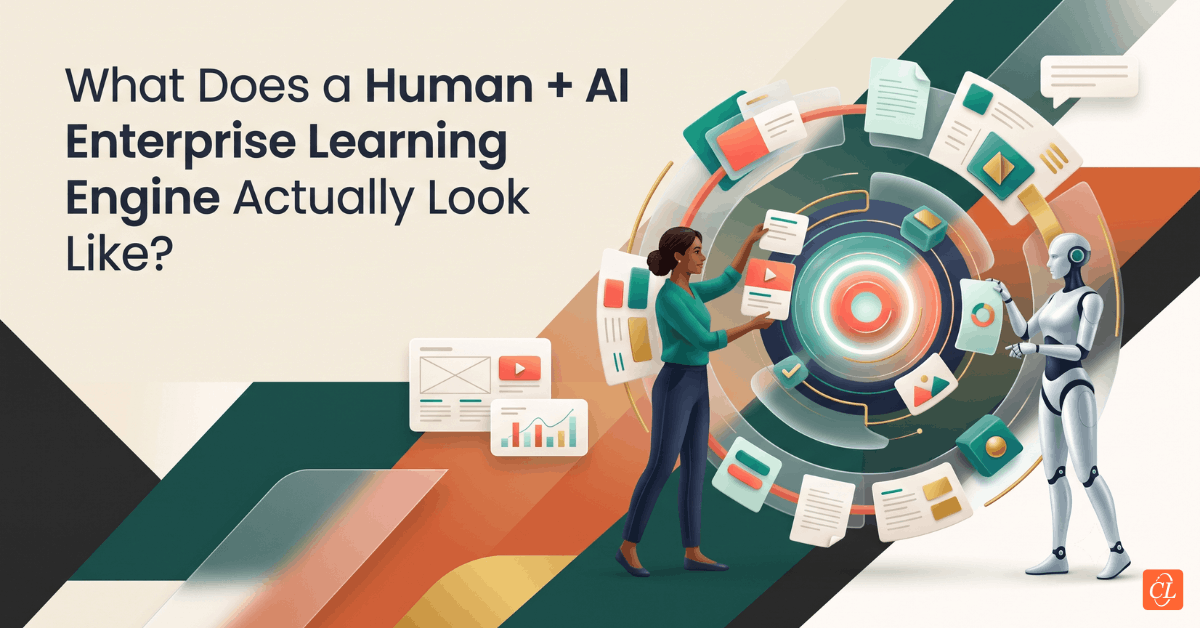
Here’s the question that actually keeps enterprise learning leaders up at night in 2026: it’s not whether AI belongs in your production pipeline anymore. It’s what operating model turns AI’s raw speed into learning that’s accurate, business-aligned, and shipped at the pace your organization actually needs. That operating model, not the tool stack, is the “engine.”
And the numbers say we badly need one. The Josh Bersin Company puts total annual corporate L&D spend at roughly $400 billion. AI adoption inside that spend is already everywhere: Synthesia’s AI in Learning & Development Report 2026, a survey of 421 L&D professionals worldwide, found more than 87% of teams already use AI, with only 2% having no plans to. And yet, in research published this February, Josh Bersin didn’t mince words: “This week we launch our fifth major study of corporate L&D and the results are staggering: 74% of companies tell us they are not keeping up with their company’s demand for new skills. This is a shocking statistic.” Only about 27% of companies feel they’re actually building the skills they need to grow, per Bersin’s 2025 research.
Read that again: near-universal AI adoption, and three-quarters of companies still falling behind. If tools alone fixed this, that gap would be shrinking. It isn’t. So what actually separates the teams pulling ahead? Not better prompts. A repeatable engine built from six pieces that work together: AI acceleration, human judgment, workflow orchestration, governance, scalable execution capacity, and business measurement. Let’s walk through each one.
Table of Content
- AI Acceleration: Where AI Genuinely Compresses the Cycle
- Human Judgment: Where Context and Quality Ownership Stay Human
- Workflow Orchestration: How Work Moves Between Humans and AI
- Governance: Who Reviews, Approves, Validates, and Owns
- Scalable Execution Capacity: What Happens When Demand Exceeds the Team
- Business Measurement: Connecting the Engine to Outcomes
- The Engine, Not the Tool
- Continue the Conversation at LearnFlux
AI Acceleration: Where AI Genuinely Compresses the Cycle
Let’s start with the part everyone already believes: AI is fast. Synthesia’s 2026 report shows the top current use cases are voice generation (63% of teams), content and quiz drafting (60%), video creation (52%), and translation (38%). The single most-cited benefit? Faster production, reported by 84% of teams, with 88% saving real time on content creation.
But “faster” undersells it. Here’s what the actual numbers look like:
- Course builds that used to take months now take weeks. IDC’s 2025 Business Value Study of nine organizations using CYPHER Learning found average course-build time drop from 33.1 weeks to 13.4 weeks. That’s a 60% cut. Docebo says its AI Authoring feature alone can save up to 130 hours per course.
- Localization is where the numbers get almost silly. Novelis cut localization costs by roughly 85% (nearly $1 million, compared to its old outsourced model) by bringing video translation in-house and expanding to ten languages. International SOS took its localization turnaround for three languages (French, Spanish, Arabic) from 3-4 months down to just weeks, saving six figures in the process. Modern Canada cut video creation time by 90%, saving about $6,000 per video. One client in Synthesia’s case library turned 100 hours of localization work into 10 minutes.
- The old math was brutal. A professionally produced training video traditionally ran $3,000 to $15,000, plus $1,000-$2,000 per extra language for reshoots or dubbing. AI tools quietly erase a big chunk of that.
- And speed doesn’t automatically wreck quality, as long as you know where the edges are. A preregistered Harvard Business School/BCG field experiment had 758 BCG consultants tackle 18 realistic tasks. With GPT-4, they completed 12.2% more tasks, finished 25.1% faster, and produced work rated over 40% higher in quality. But here’s the catch: on tasks outside AI’s actual capability, those same consultants performed 19% worse than people working without AI at all. Confidence and competence aren’t the same thing, and AI is good at faking both.
- Map AI to the stages where it’s actually good. AI does its best work in Design and Develop, drafting outlines, storyboards, media, first-pass assessments, localization, while humans own Analyze (the needs analysis, the business alignment) and Evaluate (does this actually work?), with quality gates running through the whole thing.
- Treat AI as a co-designer, not a replacement. As one 2025 industry analysis put it, the best teams “increasingly treated AI as a co-designer and co-analyst, accelerating curation, personalization, and assessment while keeping humans accountable for pedagogy and ethics.”
- Expect your tool stack to look different. Synthesia’s 2026 report describes teams blending general copilots, L&D-specific tools, and internal layers, “AI built-in, not bolted on.” Only 47% of teams now think the LMS will stay the backbone of their ecosystem. That’s a real shift.
- Put friction back in on purpose. Because fluent AI output is easy to rubber-stamp, the best pipelines deliberately reintroduce checkpoints, review gates at the prompt stage, mandatory sign-off before publishing, instead of trusting individual habit to catch problems.
- Completion rates are on their way out as the go-to metric. As one measurement guide puts it, “A 95% completion rate tells you who showed up. It tells you nothing about whether anyone can do their job differently afterward.” The shift is toward Kirkpatrick Levels 3 (behavior) and 4 (results), and newer frameworks like D2L’s IMPACT model.
- Translate your metrics into language executives actually fund. Skip “improved outcomes at Kirkpatrick Level 3.” Say “cross-regional project delays dropped 25% in one quarter.” Executives fund results, not frameworks.
- AI can actually improve the measurement itself, not just the content. AI-powered analytics can flag at-risk learners before they fail instead of after. One analysis found AI-powered adaptive platforms cutting training time by 40-50%, with teams using advanced learning analytics seeing a 22% productivity lift and a 41% improvement in performance versus basic measurement. Deloitte’s own research describes AI shifting workforce planning “from forecasting headcount” to “predicting the skills and work that will be needed.”
- Skills data is the missing link. It’s the thing that actually ties a specific course to a specific capability gap tied to a specific business goal, the connective tissue that finally links a training record to a KPI.
So the honest read: AI reliably compresses the mechanical work: drafting, media, translation, versioning. That’s where the ROI case is airtight today. And per Synthesia’s own data, the conversation is already moving past “we saved time” (88%) toward the harder question: did it actually move the business (55%)?
Human Judgment: Where Context and Quality Ownership Stay Human
Here’s the thing nobody wants to say out loud: going faster with the wrong thing is just failing faster.
Amy Farner, EVP of Product at the Josh Bersin Company, put it bluntly: “The old ways of working will not survive the AI revolution. If organisations are not willing to radically transform the ways they create content and the modalities of learning available, they risk becoming irrelevant.” But in the same breath, the research is clear that human skills aren’t going anywhere. Here’s why.
AI still makes things up, and legal-grade evidence backs that up. A Stanford RegLab/HAI study found that even specialized, retrieval-augmented legal research tools from LexisNexis and Thomson Reuters hallucinated 17-33% of the time. An earlier Stanford study found general-purpose LLMs hallucinated on 58-88% of legal queries. Translate that into compliance or safety training, and one confidently wrong sentence isn’t a typo, it’s a liability.
Relying on AI can quietly dull your team’s thinking. A Microsoft Research/Carnegie Mellon University study presented at CHI 2025 surveyed 319 knowledge workers across 936 real use cases and found that “higher confidence in GenAI is associated with less critical thinking.” A polished-sounding AI answer removes exactly the friction that makes instructional design good in the first place.
And AI simply doesn’t know your business. It doesn’t know which of your five competing sales methodologies is actually the current one. It doesn’t know which regional regulation applies to which audience. Training needs analysis, business alignment, deciding what not to teach, that’s all still human work.
Synthesia’s own L&D Evangelist, Amy Vidor, PhD, has a name for what happens when nobody’s minding this: “AI slop” and “readiness debt”, a deluge of content factories churning out training nobody has time to actually evaluate. The human role in this engine exists precisely to stop that from happening. Precision over volume.
Workflow Orchestration: How Work Moves Between Humans and AI
Here’s a stat that might surprise you less than it should: a 2025 study by McNeill and colleagues, surveying 144 instructional designers, found 83% already use ChatGPT, with 67% reporting real time savings. In other words, “using AI” is already the baseline. It’s not the differentiator anymore.
The differentiator is whether you’ve actually designed a pipeline instead of letting everyone freelance their own workflow. What that looks like in practice:
If you’re building this: write the pipeline down. Decide exactly which stages AI drafts, which stages need a human set of eyes, and where the non-negotiable approval gates sit. Then bake that into your toolchain instead of leaving it to whoever’s doing the work that week.
Governance: Who Reviews, Approves, Validates, and Owns
Governance sounds like the boring chapter. It’s actually the one holding everything else up.
In Synthesia’s 2026 report, the top blockers to AI adoption in L&D are security (58%) and accuracy concerns (52%), followed by integration (46%) and legal restrictions (41%). Their own framing: “budgets are beginning to catch up with adoption even as governance lags behind.” That gap is exactly where things go wrong.
A workable governance framework for AI-assisted learning content really comes down to five things:
- Ownership. Every AI-assisted piece of content needs one accountable human, full stop, regardless of how it was produced.
- Use-case clarity. Know where AI is fine (drafting outlines, first-pass summaries) and where it’s not (compliance guidance, legally weighted assessments, anything requiring leadership judgment).
- Review and validation. Mandatory human review before anything ships. Not just fact-checking, tone and context matter too.
- Transparency. Keep a record of how AI was used, what was prompted, what was assumed. You want an audit trail before you need one.
- Ongoing oversight. Governance doesn’t stop at launch. Content needs to be revisited as regulations and priorities shift.
More enterprises are anchoring this to the NIST AI Risk Management Framework and ISO/IEC 42001, inventorying their AI systems, assigning an executive sponsor, and running everything through a cross-functional ethics board. For regulated content, that usually means RAG grounding, confidence thresholds, and a human who has to sign their name to it. The best summary of why this matters: AI governance in learning “is not primarily a technical challenge. It is a leadership one.”
Scalable Execution Capacity: What Happens When Demand Exceeds the Team
Even a fast, well-governed internal team hits a wall eventually. A product launch, an acquisition, a new regulation, a reorg, any of these can spike demand well past what your headcount was ever built to absorb. This is where elastic capacity, managed learning services, staff augmentation, hybrid AI-plus-human production, stops being a nice-to-have and becomes part of the engine itself.
And the market’s responding. Per Expert Market Research, the global managed learning services market hit roughly $3.63 billion in 2025, projected to grow at 11.4% annually through 2035 to reach $10.68 billion. Persistence Market Research puts North America at about 40% of that revenue, with large enterprises driving roughly 60% of demand.
What’s actually differentiating providers in this space is the “AI + human delivery” model, pairing expert instructional designers with AI-enabled workflows so you can scale output without proportionally scaling headcount. CommLab India is a good example: custom eLearning, staff augmentation, and translation into 35+ languages, all built around exactly this combination, giving enterprise L&D teams the operational capacity to keep pace with business demand without a hiring spree every time demand spikes.
Treat capacity like elastic infrastructure, not a fixed headcount decision. Flex up when you need to, flex back down when you don’t, and hold your external partners to the same governance bar as your internal team.
Business Measurement: Connecting the Engine to Outcomes
Here’s the uncomfortable part. None of the above matters if you can’t prove it worked. And L&D has a real credibility problem here: per Deloitte, 95% of L&D organizations “do not excel at using data to align learning with business objectives, run the learning and development organization, or increase the effectiveness of learning methods.” Separately, D2L reports that 69% of teams “lack the skills to ask the right questions that link learning to business results.”
That’s changing, slowly:
Measurement isn’t a report you generate after the fact. It’s something you design in from day one, with baselines set before launch, not bolted on to justify what already shipped.
The Engine, Not the Tool
None of these six pieces work in isolation. AI acceleration without governance is exactly how you get “AI slop.” Human judgment without AI acceleration can’t keep up with demand. Great orchestration without measurement optimizes for the wrong thing entirely. Scalable capacity without governance just imports risk faster than you can catch it.
The organizations actually closing the skills gap are the ones running all six at once, a real Human + AI enterprise learning engine, not a productivity hack bolted onto an unchanged process. Moderna’s Head of Learning, Molly Nagler, put it well in Bersin’s research: “AI is our force multiplier. It helps us scale learning with precision and connect people to impact faster.”
Continue the Conversation at LearnFlux
This is exactly the conversation CommLab India built its 2026 flagship event around. LearnFlux 2026, CommLab India’s invitation-only virtual summit, is themed “Human + AI at Scale: Building the Next Enterprise Learning Engine,” running October 7-8, 2026, built specifically for leaders in large, complex organizations where “learning demand is continuous, timelines matter, and delays can affect readiness, compliance, performance, or business growth.”
LearnFlux started back in October 2020 as a customer-only virtual event and has grown into a proper summit. The 2025 edition, marking CommLab India’s 25th anniversary, brought together 150 global learning leaders with speakers from DHL Group, Intuit, Moody’s Analytics, and Amcor, alongside researchers from Lancaster University. The 2026 edition promises a Human + AI blueprint for one real learning priority, three proven enterprise scaling practices, and a peer network of leaders wrestling with the exact same challenges.
If the engine described here sounds like where your organization needs to go, LearnFlux 2026 is where this conversation is actually happening, live, with the people building it.