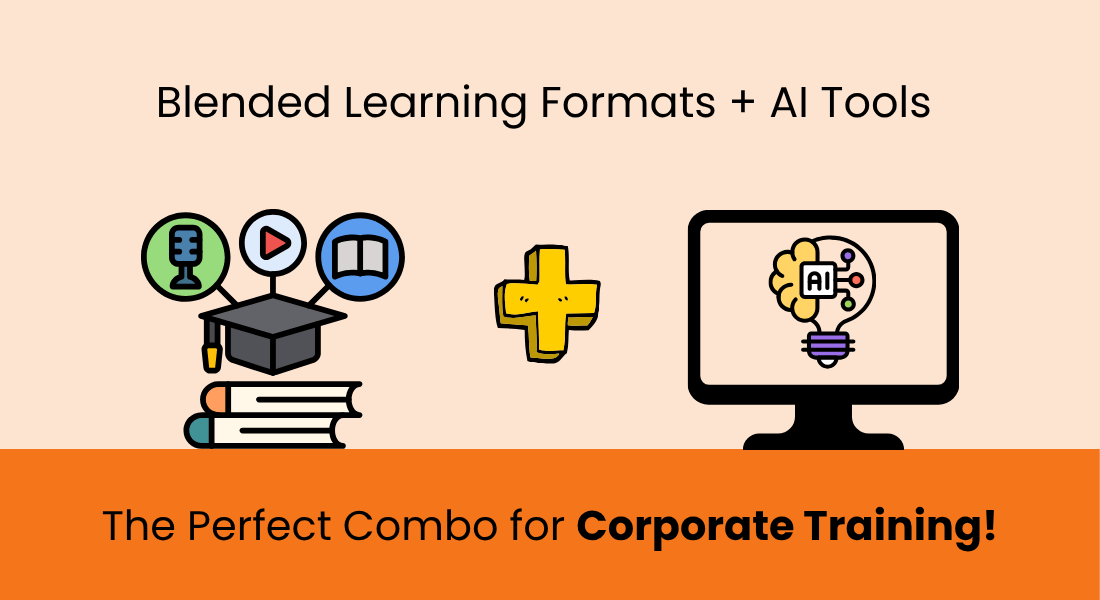

As organizations continue to evolve, their learning and development (L&D) strategies must adapt to keep pace. One of the most powerful forces driving this change is Artificial Intelligence (AI). Once considered a futuristic concept, AI has become a practical tool that is reshaping how we deliver, measure, and personalize corporate learning programs. Despite its growing influence, many L&D professionals still seek clarity on how AI can be effectively integrated into their training strategies.
In this blog, we’ll discuss the 11 most common questions L&D professionals have about AI, offering practical answers and insights into how this technology is changing corporate learning. From personalized learning paths to AI-powered content creation and data-driven decision-making, we’ll explore the benefits, applications, and considerations associated with Artificial Intelligence in L&D. Understanding these applications can help learning leaders make informed choices about how to use AI to improve training programs and learner outcomes.
Recommended resource: AI in Corporate Training: A Partner, Not a Replacement — a free eBook exploring AI tools, applications, and implementation challenges.
1. What Is AI in the Context of L&D?
Artificial Intelligence, or AI, refers to computer systems capable of performing tasks that typically require human intelligence, such as recognizing patterns, understanding language, generating content, and making predictions.
In the context of L&D, AI can automate tasks, personalize learning experiences, support instructional design, and help improve training effectiveness. Its value depends on how well these capabilities are applied to actual learning and performance needs.
Core AI technologies
- Machine learning: Algorithms that identify patterns in data and improve predictions or recommendations through training.
- Natural language processing (NLP): Technology that enables systems to process, interpret, and generate human language.
- Data analytics: Techniques for examining learner behaviors, assessment results, and training performance to identify patterns and opportunities for improvement.
- Generative AI: Models that create text, images, audio, and other content based on instructions and available context.
These technologies support different activities. For example, machine learning can power learning recommendations, while generative AI can help instructional designers draft learning objectives, assessment questions, and scenario-based activities.
AI applications in L&D
- Personalized learning: Tailors content recommendations and learning paths based on learner needs, performance, and progress.
- Automation: Speeds up tasks such as grading, scheduling, reporting, and content recommendations.
- Chatbots: Provide on-demand assistance, explanations, and feedback to learners.
- Content development: Supports drafting, summarizing, assessment creation, and course prototyping.
Organizations exploring broader applications can refer to CommLab India’s guide to AI in learning and development.
2. How Can AI Improve Personalized Learning in L&D?
One of the most significant advantages AI brings to Learning and Development is its ability to support personalized learning experiences. Employees enter training with different levels of knowledge, job responsibilities, experience, and proficiency. AI can help L&D teams account for these differences by recommending learning paths that respond to individual strengths, gaps, and progress.
Rather than assigning every employee the same sequence of content, an AI-enabled learning platform can use available performance data to recommend relevant activities and resources.
Tailoring learning paths
AI can assess learners’ behaviors and progress, adjusting recommendations based on their needs. For example:
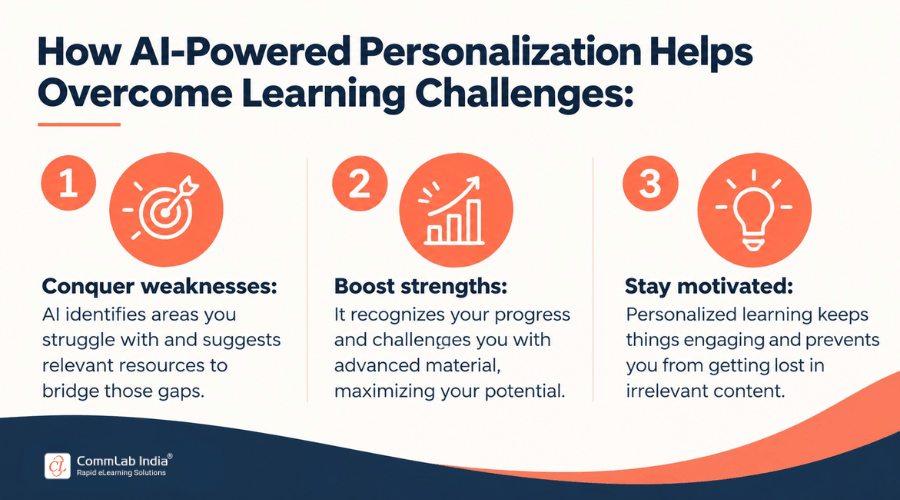
- If a learner struggles with a particular concept, AI can suggest supplementary resources, such as videos or interactive learning exercises, to reinforce understanding.
- Conversely, for learners who demonstrate a firm grasp of the material, AI can recommend more challenging tasks or advanced modules, helping them progress without unnecessary repetition.
These recommendations depend on the platform’s capabilities and the quality of the learner data available.
Real-time adjustments
Adaptive learning systems can modify learning experiences based on learner performance:
- Learners receive feedback after completing quizzes, helping them understand mistakes and identify areas for improvement.
- As learners move through the material, adaptive systems can adjust task difficulty or recommend additional practice.
For example, an employee who repeatedly struggles with a product troubleshooting procedure could receive a targeted practice scenario before progressing to more complex situations.
Enhancing learner engagement
AI can personalize the learning journey as well as the content:
- AI-enabled systems may recommend quizzes, challenges, or interactive elements based on previous learner performance.
- Learning platforms can suggest relevant content, reminders, or practice activities based on engagement patterns.
The objective is to make training relevant to what employees need to know and do, rather than relying solely on content preferences. Through these strategies, AI can support a more learner-centered approach to corporate training. L&D teams should still evaluate whether personalization improves knowledge, skills, and workplace application.
How AI-driven adaptive learning enhances personalization and inclusivity in L&D
AI-driven adaptive learning paths can tailor content based on individual performance, learning needs, and progress. With appropriate assessment data, courses can respond to learner difficulties and provide additional practice or advanced challenges.
AI tools can also support accessibility through features such as automated captions, transcripts, translation assistance, and flexible content formats. However, accessibility requires deliberate design and testing; AI-generated features should be checked against applicable accessibility requirements.
For enterprise L&D teams, personalization is most useful when it supports measurable learning objectives and accommodates the diverse needs of the workforce.
3. What AI Tools Are Commonly Used in L&D Today?
AI tools are increasingly integrated into L&D systems, from Learning Management Systems (LMSs) to content development platforms. These tools can automate administrative tasks, support personalized learning, and provide analytics that help teams improve training programs.
The capabilities vary considerably across products, so organizations should evaluate specific features rather than assume that every AI-enabled platform offers the same functionality.
AI-powered LMS platforms
Many modern learning platforms include AI-enhanced features to support learning recommendations, content discovery, and analytics.
- Docebo: An LMS offering AI-related capabilities for learning recommendations, content discovery, and learning administration, depending on the product configuration.
- Lingio: A training platform using AI-supported capabilities to develop and deliver workplace learning, including multilingual training applications.
When evaluating AI-enabled learning platforms, L&D leaders should consider how well they integrate with existing systems, handle learner data, and support the organization’s training requirements. For additional context, explore learning management system solutions.
Content development tools
AI is also changing how training content is created and curated.
- AI-driven content creation: Platforms such as Articulate 360 and Rise 360 include AI-assisted capabilities that can help course developers generate drafts, refine content, and accelerate parts of the development process. The features available depend on the product and subscription.
- Generative AI assistants: Tools such as ChatGPT and Claude can help instructional designers brainstorm scenarios, summarize source materials, develop assessment drafts, and review content.
- Automated content curation: AI-enabled platforms can analyze content metadata, learner needs, and activity data to recommend relevant articles, videos, or learning modules.
These tools can reduce manual effort, but instructional designers remain responsible for validating technical accuracy, learning alignment, and the quality of the learner experience. CommLab India’s AI tools expertise provides additional context on incorporating AI into learning design and development.

AI in Corporate Training
Partner, Not Replacement
- AI in Corporate Training
- AI Toolkit for Super-charged Learning
- Challenges to Consider with AI Implementation
- And More!
4. How Does AI Impact Content Development and Curation for L&D?
Creating high-quality, engaging content is one of the most time-consuming tasks in Learning and Development. AI offers opportunities to streamline this process, helping instructional designers and content developers produce customized, relevant content more efficiently. The important consideration is whether the resulting materials remain accurate, instructionally sound, and appropriate for the learners.
AI-assisted content development
AI can assist in generating new content and improving existing materials. By examining course structures, source materials, learning objectives, and available learner data, AI tools can suggest improvements and help optimize the learning experience.
For example:
- AI tools can recommend changes to course structure or layout, such as reorganizing content to improve progression and clarity.
- AI can generate draft quizzes, assessments, and interactive activities based on course content, reducing initial development effort.
However, AI-generated assessment questions need to be checked for accuracy, appropriate difficulty, plausible distractors, and alignment with learning objectives. Instructional designers can also use AI to prepare scenario variations, draft feedback, summarize SME inputs, and prototype learning activities.
AI for content curation
AI’s ability to assist with content curation is another valuable contribution to L&D. By searching, classifying, and analyzing available content, suitable AI tools can help identify resources relevant to a learner’s role, development needs, or learning objectives.
- AI can recommend articles, videos, podcasts, and interactive modules based on available content and learner information.
- As new material becomes available, AI-enabled systems can identify potentially relevant resources for inclusion in learning paths.
This can be especially useful for enterprises managing large content libraries across departments and regions. However, automatically recommended material should be reviewed for currency, accuracy, source credibility, and organizational relevance. AI should not be assumed to identify the most authoritative content without verification.
These capabilities can improve content development and curation efficiency while allowing instructional designers to spend more time on learning strategy, meaningful practice, and quality assurance.
5. Can AI Enhance Learner Engagement and Motivation in L&D Programs?
Learner engagement remains a significant challenge for L&D professionals. AI can help by supporting more interactive, personalized, and responsive learning experiences. Through adaptive strategies, feedback, and relevant practice opportunities, AI-enabled systems can help learners remain engaged throughout a training program.
Gamification powered by AI
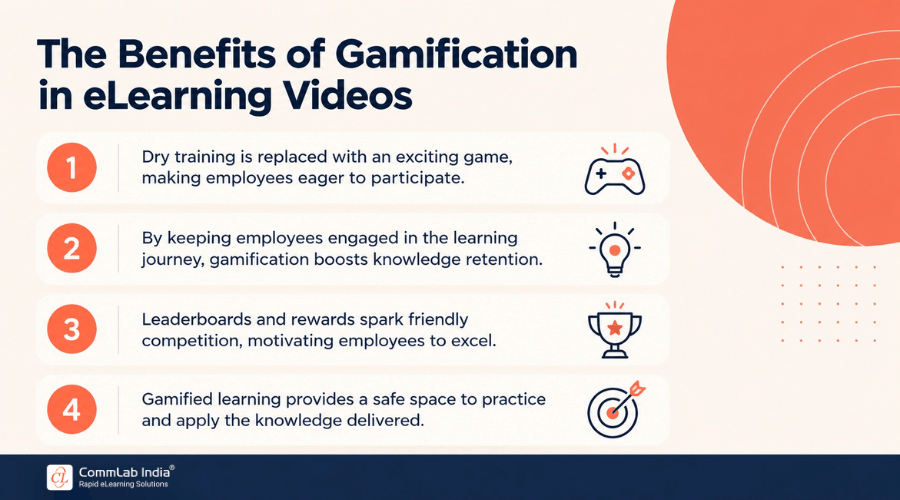
AI can support gamification by helping learning platforms adapt challenges, recommendations, or feedback based on learner progress.
- Learners can earn badges, points, or rewards for completing tasks or reaching milestones.
- AI-enabled systems can recommend additional challenges or recognition opportunities based on progress.
Badges and points are gamification features rather than inherently AI-driven capabilities. AI becomes relevant when these experiences are adapted or recommended using learner data.
Interactive learning
AI can enhance interactivity by supporting dynamic learning environments:
- AI-driven tools can provide immediate feedback during quizzes or simulations, helping learners understand mistakes.
- Interactive scenarios can adjust based on learner choices, allowing employees to explore different decisions and consequences.
For example, a sales representative practicing a customer conversation could receive different customer responses depending on the questions asked or objections addressed. Such scenarios can make practice more relevant, provided the feedback reflects sound instructional and subject-matter principles.
AI-driven feedback
AI can help learners receive more specific feedback than a simple correct-or-incorrect response.
- It can analyze quiz results and recommend areas for improvement.
- By identifying patterns in performance, AI-enabled systems can suggest revisiting topics or completing additional practice activities.
The quality of this feedback matters. Incorrect or overly encouraging feedback can reinforce misconceptions, so high-stakes applications require particular care. AI-supported feedback and interactivity can contribute to learner engagement, but organizations should also measure whether employees are developing the intended skills.
6. How Does AI Support Data-Driven Decision-Making in L&D?
AI can process large amounts of learner and training data, making it useful for supporting evidence-informed decisions in L&D. AI-powered analytics can help professionals identify patterns in learner behavior, content effectiveness, and assessment performance. These insights can inform improvements to training design and delivery.
Data collection and analysis
AI-enabled tools can analyze learner data throughout the training process:
- Monitor quiz results, time spent on tasks, and engagement indicators.
- Identify content areas where learners struggle or repeatedly seek assistance.
- Highlight patterns across learner groups, courses, or departments.
These insights can help L&D teams determine where additional support or instructional improvements may be needed.
Predictive analytics
Predictive analytics uses historical and current data to estimate possible future outcomes. In L&D, suitable models may:
- Identify learners who could be at risk of falling behind, allowing teams to offer timely support.
- Estimate potential training completion or assessment outcomes based on available patterns.
Predictions are estimates, not guarantees. Their usefulness depends on data quality, appropriate validation, and responsible interpretation. L&D teams should avoid treating predictive scores as definitive judgments about employee ability or potential.
Continuous improvement
AI-supported analytics can also contribute to ongoing improvements in learning programs.
- Learning platforms can recommend adjustments based on performance patterns.
- L&D teams can use analytics to identify confusing content, assessment gaps, or opportunities for additional practice.
For enterprise training programs, the most valuable insights connect learning activity with workplace needs. This may require combining LMS data with observations, operational measures, or other business performance indicators.
7. What Ethical Considerations Should L&D Professionals Have When Using AI?
AI offers significant opportunities, but its implementation requires careful attention to ethics, privacy, fairness, and accountability. These considerations are particularly important in enterprise learning environments, where AI systems may process employee information or influence learning recommendations.
Data privacy concerns
AI systems often rely on substantial amounts of data, raising questions about privacy and security. L&D teams should:
- Evaluate applicable data protection obligations, including GDPR where relevant.
- Be transparent about the learner information being collected and how it is used.
- Limit personal information shared with AI tools to what is necessary and authorized.
- Review vendor data-processing terms, retention policies, access controls, and security measures.
For example, uploading confidential employee performance records to an unapproved public AI tool could create unnecessary privacy and security risks.
Avoiding bias in AI algorithms
AI systems can reproduce or amplify biases present in training data, model behavior, or organizational processes. To reduce these risks:
- Regularly evaluate AI-generated recommendations and assessments for unfair or inconsistent outcomes.
- Review whether learning opportunities are being recommended equitably across relevant employee groups.
- Use representative evaluation data where appropriate and permitted.
Bias cannot be eliminated simply by using a larger dataset. Human review, appropriate testing, and ongoing monitoring remain important.
Transparency and control
L&D professionals should maintain transparency when using AI:
- Explain how AI influences learning recommendations, assessments, or feedback.
- Provide appropriate mechanisms for reviewing or challenging consequential AI-supported decisions.
- Establish clear responsibility for approving AI-generated learning content.
Where relevant, organizations should also assess applicable AI-specific regulations, internal policies, and contractual obligations. For a structured approach to implementing AI while maintaining instructional oversight, explore the RAPID-AI Framework for Learning and Development.
AI in Corporate Training
Partner, Not Replacement
- AI in Corporate Training
- AI Toolkit for Super-charged Learning
- Challenges to Consider with AI Implementation
- And More!
8. Can AI Replace Human Instructors in L&D?
AI can automate or assist with some activities traditionally performed by instructors, but it does not eliminate the need for human expertise in learning and development. Instructors contribute contextual judgment, facilitation, mentorship, and an understanding of organizational and learner needs. AI can complement these capabilities by handling selected administrative, analytical, and content-support tasks.
The human-AI partnership
AI can automate certain tasks, allowing instructors to focus on activities that benefit from direct human involvement.
- AI can assist with grading, scheduling, and routine learner questions, depending on the learning platform.
- Human instructors can provide mentorship, facilitate discussion, interpret complex situations, and support learners facing challenges.
In leadership development, for example, an AI role-play tool may help employees practice difficult conversations. A human facilitator can then help participants examine the organizational context, interpersonal consequences, and alternative approaches.
AI as an enabler, not a replacement
AI can help instructors deliver more responsive learning experiences:
- AI-supported analytics can provide information about learner progress and potential difficulties.
- Automation can reduce repetitive work, allowing instructors to devote more time to learner interaction and instructional improvement.
The balance between AI and human involvement will vary according to the subject matter, learner needs, and consequences of error. For compliance, safety, leadership, and other sensitive training areas, human oversight is particularly important.
9. How Can AI Be Used to Measure Learning Effectiveness in L&D?
Measuring the effectiveness of a training program is one of the most challenging responsibilities for L&D professionals. AI can help analyze assessment results, learner behavior, and training activity to identify patterns that might otherwise be difficult to detect. However, measuring learning effectiveness requires more than tracking participation or course completion.
Tracking learner progress
AI-enabled platforms can track individual progress and provide insights into:
- Completion rates, quiz scores, and time spent on tasks.
- Engagement indicators and content interaction patterns.
- Changes in assessment performance over time.
These measures help teams understand how learners interact with training and where additional support may be needed.
AI-driven assessment tools
AI tools can support assessment development and evaluation:
- Generate draft assessment questions and feedback.
- Analyze quiz results to identify common misconceptions.
- Identify patterns that suggest learners need further practice.
For example, if employees consistently answer a particular safety procedure question incorrectly, the L&D team can investigate whether the issue lies in the training content, assessment design, or underlying understanding.
Improving course effectiveness
AI analytics can help identify which training elements require attention.
- Highlight content associated with repeated errors or low assessment performance.
- Support comparisons of learner progress across modules or groups.
- Provide information that helps instructional designers refine learning programs.
However, strong quiz results do not automatically demonstrate successful workplace application. To evaluate training effectiveness more comprehensively, organizations should consider measures such as observed job performance, skill demonstrations, error reduction, or other relevant business outcomes.
AI can assist with analysis, but L&D leaders must determine whether the evidence supports meaningful conclusions about learning impact.
10. How Do AI and Automation Benefit L&D Professionals?
AI and automation can benefit L&D professionals by streamlining workflows, reducing repetitive effort, and supporting productivity. By automating selected tasks, AI can give learning teams more time for instructional design, learner support, strategic planning, and continuous improvement.
Automating administrative tasks
AI-enabled systems and workflow automation can support tasks such as:
- Grading assessments, tracking attendance, and managing schedules.
- Sending notifications and reminders to learners.
- Generating routine reports and organizing learning records.
Not every automation requires AI. Rules-based workflows may be sufficient for predictable tasks, while AI is more useful when work involves interpreting information, generating content, or identifying complex patterns.
Boosting productivity
With suitable AI assistance, L&D professionals can:
- Spend less time preparing first drafts of content and assessments.
- Focus more on improving learning activities and instructional quality.
- Support strategic planning and continuous improvement.
For example, AI can help an instructional designer organize SME notes into a preliminary course outline. The designer can then evaluate the structure, identify missing information, and build activities aligned with performance objectives. This can accelerate early development work without transferring instructional responsibility to the AI system.
Supporting decision-making
AI-driven analytics can provide insights that support L&D decisions:
- Learner data can highlight areas for improvement.
- AI tools can suggest adjustments to content, delivery methods, or learning paths.
The recommendations should be reviewed in the context of the organization’s goals and the limitations of the underlying data. For enterprises seeking to incorporate AI into training development, AI-assisted learning design and development services offer another avenue for exploring practical applications.
AI in Corporate Training
Partner, Not Replacement
- AI in Corporate Training
- AI Toolkit for Super-charged Learning
- Challenges to Consider with AI Implementation
- And More!
11. What Are the Future Trends of AI in L&D?
As AI continues to evolve, its applications in learning and development are likely to expand. From predictive analytics to immersive simulations, emerging capabilities may allow L&D teams to offer more responsive learning experiences and support employees closer to the point of need. Some applications are already available in particular platforms, while others remain experimental or require further validation.
Emotional AI
Researchers and technology developers have explored AI systems designed to infer emotional states from signals such as language, voice, or facial expressions. Potential applications include:
- Adjusting feedback or support based on signals that a learner may be experiencing difficulty.
- Investigating whether contextual information can help learning systems respond more appropriately.
However, inferring emotions reliably from behavioral or biometric signals is difficult. These technologies raise important questions about accuracy, consent, privacy, and fairness. Enterprise L&D teams should be cautious about using emotion-recognition technology, particularly in workplace settings where legal restrictions may apply.
AI in immersive learning
AI can support virtual reality (VR) and augmented reality (AR) learning experiences by making selected interactions more adaptive.
- AI-driven simulations can respond to learner decisions and offer different scenarios.
- Learners can receive feedback during immersive practice activities.
- AI can help generate variations in simulated conversations or workplace situations.
For example, an immersive safety-training simulation could present different consequences based on the actions a learner takes. The value of such applications depends on the realism of the simulation, the quality of the feedback, and alignment with training objectives.
Continuous learning and improvement
AI-enabled learning systems can support ongoing development through feedback, recommendations, and targeted learning opportunities.
- Predictive analytics may help identify emerging skill gaps.
- Adaptive learning platforms can recommend relevant learning experiences based on demonstrated progress.
- AI assistants may provide explanations, practice opportunities, or performance support when employees need assistance.
As these capabilities develop, L&D teams will need to evaluate their effectiveness, accessibility, and suitability for enterprise use. The most promising applications will be those that help employees develop relevant capabilities and apply them effectively at work.
Frequently Asked Questions
1. How should an enterprise L&D team start implementing AI?
Start with a clearly defined learning or performance problem rather than selecting a tool first. Identify a suitable use case, such as assessment drafting, content curation, or learner support. Establish success measures, review data security requirements, and conduct a limited pilot. Evaluate the quality of AI outputs, the time required for human review, and learner outcomes before expanding adoption.
2. What is the difference between generative AI and traditional AI in L&D?
Traditional AI applications in L&D often focus on prediction, classification, analytics, and personalized recommendations. Generative AI creates new content, such as course outlines, scenarios, assessment questions, images, and feedback. The technologies can work together within a learning platform. Both require evaluation, although generative AI introduces additional concerns about factual accuracy, consistency, intellectual property, and the quality of generated materials.
3. What should instructional designers verify when using AI-generated training content?
Instructional designers should verify factual accuracy, learning objective alignment, instructional relevance, assessment quality, accessibility, and the suitability of examples. Subject-matter experts should review technical or regulated content. Teams should also check for fabricated references, biased assumptions, and confidential information. AI-generated materials should be treated as drafts requiring appropriate review rather than automatically approved training assets.
4. How can L&D leaders measure the ROI of AI implementation?
Measure AI implementation against a defined baseline and business objective. Useful indicators include development time, review effort, rework, operating costs, content quality, learner performance, and relevant workplace outcomes. For example, faster course production has limited value if substantial rework is required or training quality declines. ROI calculations should account for software, integration, governance, and ongoing human oversight costs.
5. What are the biggest challenges of scaling AI across enterprise L&D?
Common challenges include inconsistent output quality, data privacy, integration with existing learning systems, insufficient AI skills, and unclear review responsibilities. Scaling also requires standardized workflows, approved tools, quality criteria, and governance. Organizations should identify which activities can be supported by AI, where human approval is mandatory, and how performance will be monitored across teams and projects.
6. Can AI-generated learning content be published without human review?
Publishing AI-generated learning content without human review creates avoidable risks, particularly for technical, safety, compliance, or customer-facing training. AI can produce inaccurate explanations, misleading assessments, or inappropriate examples even when the output appears polished. Review requirements should reflect the risk of the content, with subject-matter validation and instructional quality checks applied before publication.
Final Thoughts on AI in L&D
Artificial Intelligence is transforming learning and development. From personalized learning paths to AI-assisted content development and data-driven decision-making, AI offers significant opportunities for L&D professionals.
However, these opportunities require a balanced approach. AI can support learning teams in developing content, analyzing data, and delivering more responsive experiences, but human expertise remains essential for instructional decisions, quality assurance, and understanding what employees need to perform effectively.
As AI technology continues to evolve, so will its applications in L&D. By staying informed about emerging capabilities and evaluating them against real learning needs, L&D professionals can make better decisions about where AI adds value.
Organizations planning broader adoption can explore the RAPID-AI Framework for scaling AI in L&D for a structured approach to implementation and instructional oversight.